After trading for over 6 years, I’ve found the BEST scalping strategy…
I’ve tested ICT, support/resistance, and moving averages,
But this one beats all of them…
Here’s the scalping strategy that’ll make you rich:
This is Josh Waitzkin
He figured out the science of becoming a top performer in any field.
CEOs, billionaires & elite athletes pay him millions to learn his techniques.
Here's his superhuman performance protocol:
I'm 38.
When I was young I worshipped politics, went woke (broke) & believed in the myth of equality.
Then I discovered Thomas Sowell, and he changed my life forever.
12 lessons from America's most controversial & unknown philosopher:
Trading is about mastering ONE setup
And I'm giving you the one that turned me into a profitable trader FREE...
Take 2 mins out of your day to learn my EXACT setup:🧵
A NEW MENTAL MODEL MEGATHREAD HAS ARRIVED!
In 20 tweets I’ll summarize 20 of the most useful principles I know.
Estimated reading time: 4 minutes.
Value: A lifetime.
Thread:
The most powerful thinking framework:
First Principles Thinking.
Used by Elon Musk, Jeff Bezos, Steve Jobs, and Richard Feynman...
Here's what it is, how to use it, and become better at it:
This is Morgan Housel.
He's the author of "Psychology of Money."
His message? Getting money is one thing. Keeping it is another.
Here are 8 of his insights on how to get (and stay) rich:
YOU WILL NEVER BE PRO TRADER UNLESS YOU LEARN FROM MARKET LEGENDS.
HIGHLY RECOMEND THIS VIDEO WARTCH IT ON YOUR WEEKEND.#IBDpartner
THESE VIDEO SERIES IS FOUND ON @marketsurge 'RESOURCES ' SECTION.
THEY FOUND HERE;https://t.co/7vs0tGpzDw
18 of my favorite frameworks:
1) Location, vocation, relation: Where you live, what you do, who you're dating or married to. Try not to change more than one at a time.
2) Do something fast, do it for cheap, do it at a high quality. Pick two.
3) Head, heart, wallet: Three questions to ask yourself if you don't know what to write about — what does your head want you to write about? what does your heart want you to write about? what does your wallet want you to write about?
4) Frank Slootman's mantra for running companies: increase the tempo, raise the standards, narrow the focus.
5) High/Low self-monitors: High self-monitors adjust to the people around them. They're highly flexible and good at getting along with people, but they can be social chameleons. Low self-monitors don't adjust to their audience or change their behavior based on the situation. (Source:@GrahamDuncanNYC)
6) Voice, exit, and loyalty: If you're frustrated with a situation, there are three ways to respond: (1) voice means making a complaint or offering a suggestion, (2) exit means to leave the situation, and (3) loyalty means to put your head down and stay.
7) The shape of stories: A character who wants something encounters a problem before they can get it. At the peak of their despair, a guide steps into their lives, gives them a plan, and calls them to action. That action helps them avoid failure and ends in a success. (Source: Donald Miller)
8) At any point in a movie, you should be able to pause and ask: (1) what does the hero want? (2) who or what is stopping the hero from getting what they want? (3) What will the hero's life look like if they get what they want?
9) Focus on the 5-second moment of change to tell better stories: Every story revolves around a single, transformative moment In that moment. The clearer and more dramatic the flip or realization, the better the story.
10) One-way door vs. Two-way door decisions: One-way door decisions like selling your company or quitting your job are almost impossible to reverse, and you should make them slowly. Two-way door decisions like starting a hobby or changing your prices are easy to reverse, and you should make them faster. Most decisions are two-way doors.
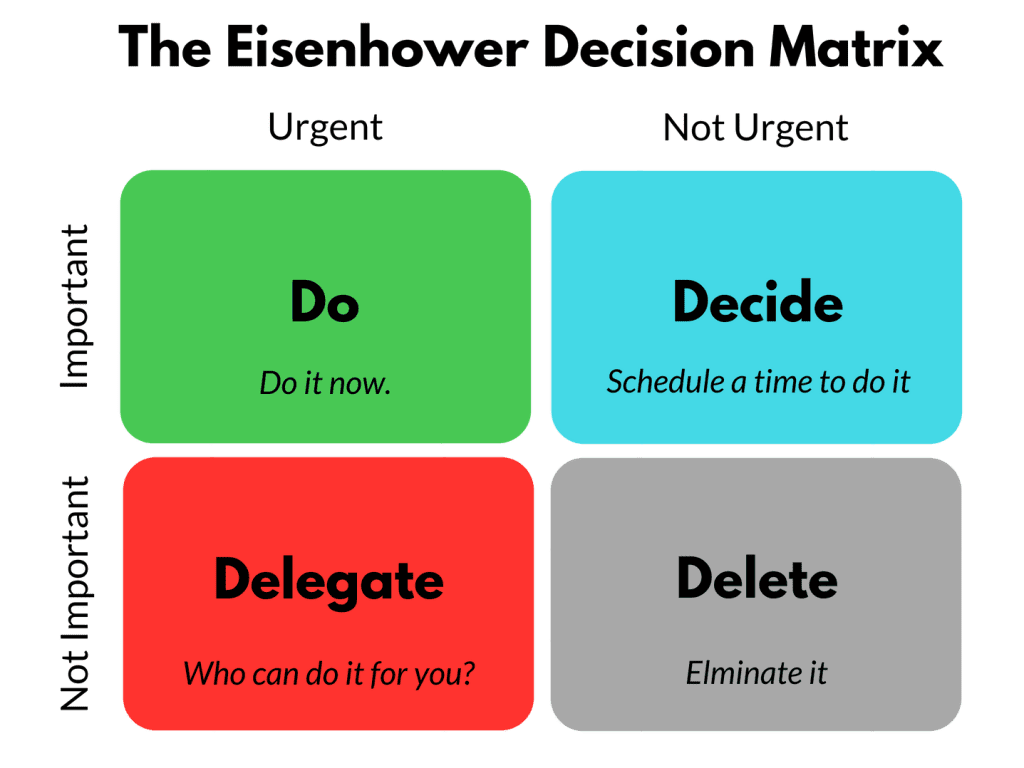
11) The four types of work tasks: (1) need to do, love to do, (2) need to do, but don't love to do, (3) don't need to do, love to do, and (4) don't need to do, don't love to do.
12) The Eisenhower Matrix says there are four kinds of tasks: (1) Urgent and important, (2) urgent and not important, (3) not urgent and not important, and (4) important but not urgent. (See the photo below)
13) General and Specific: If you’re stuck on something general, zoom into the specifics. If you’re stuck on something specific, zoom out to the general. (From @ShaanVP)
14) Three rules for copywriting: Write things that are concrete, visual, and falsifiable. (From @harrydry)
15) Fast-twitch and slow-twitch thinkers: People exist on a spectrum. Fast-twitch people speak fast, work fast, and crave novelty. Throw a problem their way and they'll come up with 3–5 solutions in a matter of minutes. They're the people you want in the room when you're brainstorming an idea. Slow-twitch people are much more deliberate. Throw a problem at them and they'll ask for time to think about it, only to come back with something deeper, more polished, and more organized than a fast-twitch person could ever generate. You need both kinds of people for a group to be successful.
16) The TOP framework for finding what somebody should work on: Talent, organization, and passion. What are you talented at? What serves the organization? What are you passionate about? The perfect gig has all three.
17) The Keith Rabois formula for billion-dollar startups: "Find large highly fragmented industry w/ low NPS; vertically integrate a solution to simplify the value of the product."
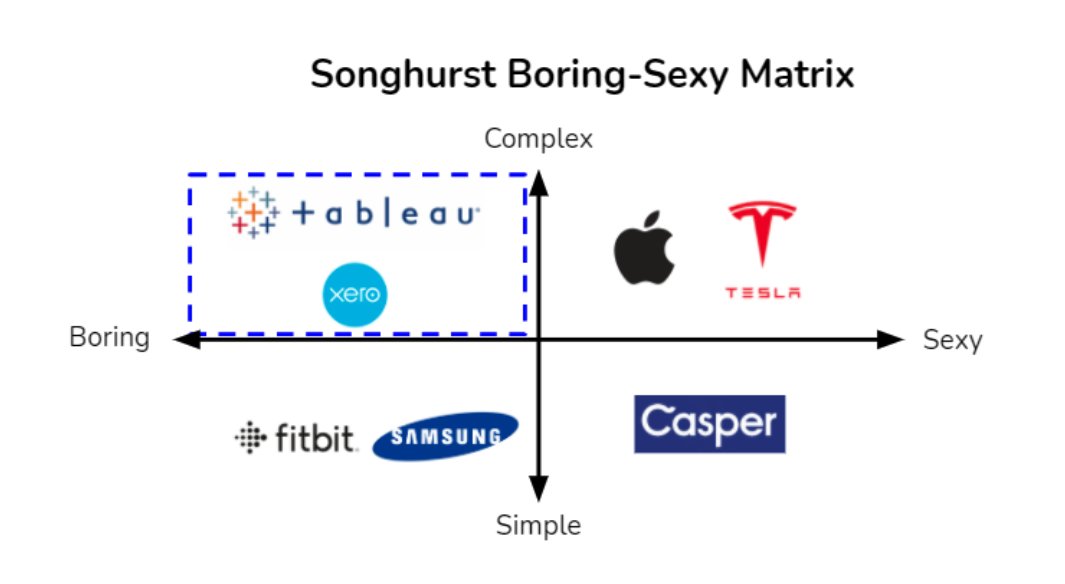
18) The Sexy-Boring Matrix: When investing, look for companies in the unsexy + boring categories. Why? Because everything in the universe is a supply & demand curve. People want to work on things that are sexy and simple. Doing the opposite tends to lead to less competition, and therefore, higher returns. Without complexity, it's hard to be differentiated. And the sexy and complex categories attracts brilliant entrepreneurs who are hard to compete with (From Charles Songhurst, image below).
I can't stop thinking about this…
Some say the Rock is overrated and has no talent.
Then why does he make $20,000,000 per film while most actors barely survive on food stamps?
Here's everything I’ve found and how he did it:
This is Ander Ericsson.
Some called him the crazy psychologist obsessed with prodigies.
After 30+ years, he has created a formula to master anything faster.
I’ve devoured his wisdom to find the secret.
5 powerful habits to reach world class & peak performance:
This is Kristjan Qullamaggie.
He's a swing trader, who turned $9,100 into over $80,000,000 from 2013 to 2021.
In 2021, he was featured as the 15th highest income earner in Sweden.
Here’s Kristjan's story: