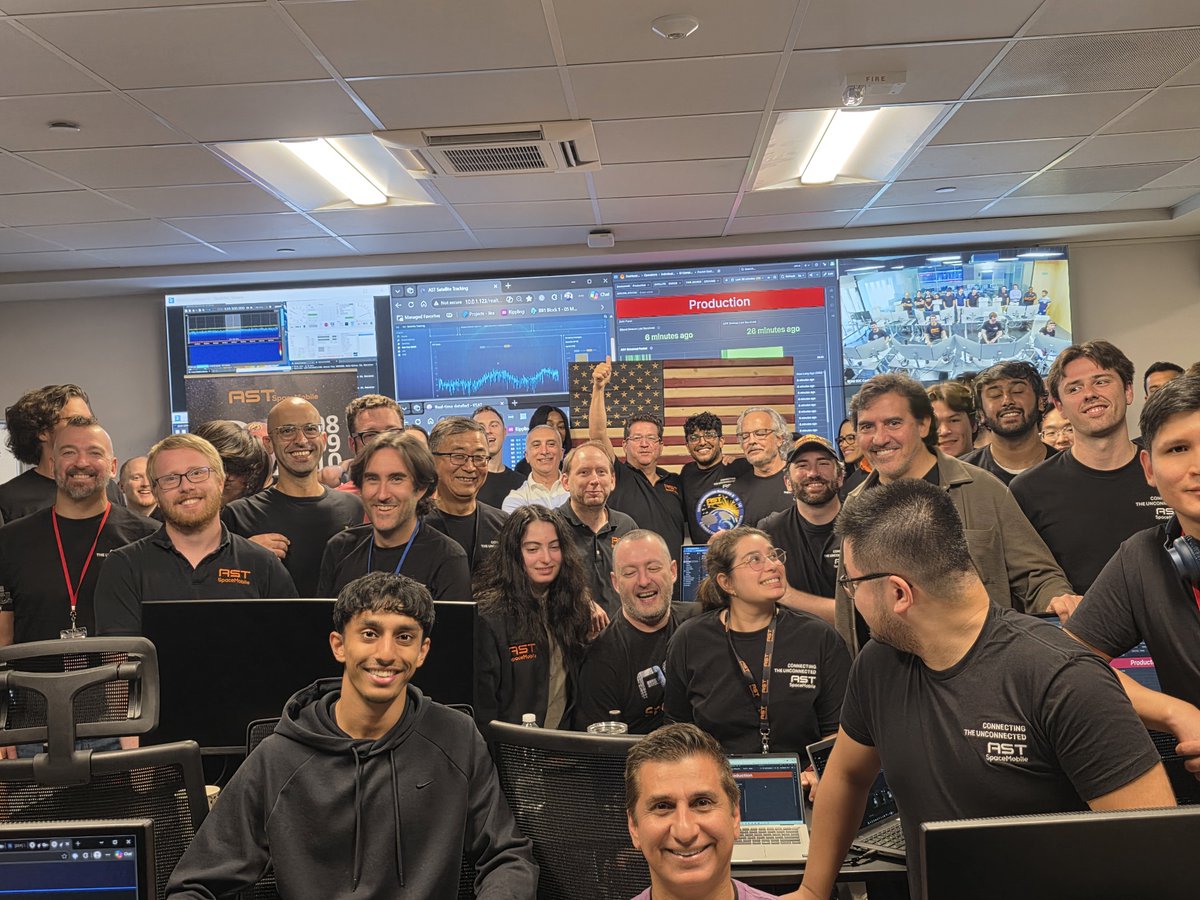
Successful launch!🚀🚀🚀🚀🚀🚀🚀🚀🚀🚀
All satellites were captured within minutes and already orbiting Earth with all systems nominal.
Congratulations to the incredible AST SpaceMobile team! 250Y U.S.A. 🌎📶 🤠
Incredibly good work here. Well worth the time it takes to read - very very rare that you can get free access to work of this caliber.
The $ABVX “cancer scare” days are numbered, IMO.
@spacanpanman One thing you gotta hand to Elon & Co - the public communication playbook is always the same, superinvolved and outward and waaay overly ambitious. But it works, MCAP wise :)
Some things to consider regarding the non-SpaceX space stocks selloff yesterday.
Many ETFs, funds, and money managers had bought them leading up to the IPO, especially $SATS, with the idea to rotate into $SPCX when they could.
This created an exaggerated move down on Friday. Definitely buying opportunities on some.
To show you how ridiculous these moves are, consider the NAV of EchoStar for its SpaceX stock was $122/share at the IPO price of $135.
$SATS closed Friday at $114.
Yes, holdco's should trade at discount but based on $SPCX closing price Friday, each EchoStar share = $145.50 value of SpaceX stock.
That's a 21% discount!
Will post about $RKLB and $ASTS later. Just wait 'til Barron's etc. start telling boomers about SpaceX alternatives.
FYI if $SPCX is your first IPO
The 9:30am ET opening bell does not mean SpaceX starts trading. Nasdaq runs a price-discovery auction first, and for a deal this size it can take hours before the first share ever prints.
What's actually happening when the bell rings:
- Orders pour in but NOTHING matches yet, it's "display only," basically an order book filling with bids & asks and zero fills.
- Nasdaq broadcasts the imbalance and a moving indicative price (think live order-book depth before a launch).
- The lead underwriter (Goldman) gives the green light while Nasdaq's automated cross keeps re-pricing until buys and sells balance out
Only THEN does the "opening cross" fire. A single batch auction that clears everyone at one price, and then continuous trading begins.
The bell and the first trade are NOT the same.
Google (2004) → first trade 11:56am (~2.5 hrs after the bell)
Meta (2012) → 11:30am (~2 hrs after)
Twitter (2013) → 10:49am (~1hr 20m after)
So if there's no chart at 9:31, nothing's broken. Price discovery just isn't finished.
@pennycheck Great call. And this was a slow moving train, this bottom has been steady for quite a while. Liked the chart from the first time it was flagged, and last explanations from you of why this is nearly one-of-one helped conviction. Thanks!
Some existential ramblings on crypto..
The parabolic rise of crypto over the last ten years centered on two main aspects. Innovative blockchain technology and decentralization of finance. The idea that a trustless financial system could exist outside the control of governments and institutions was very compelling. Plus the narrative around financial inclusion and a new internet of value made it sound even better.
The thesis continued to evolve as more money poured in. Bitcoin became digital gold due to its scarcity aspect (which correlation has never been consistent as it trades like a risk asset in panic, not a safe haven). Other coins were positioned as the infra layer for a new decentralized economy with smart contracts, DeFi, Web3, etc.
What is the actual value of any of them? Put aside the big 5-10 coins, what are you really owning when you buy into one of these exciting crypto “projects”? Strip away the marketing/hype and the answer is almost always nothing beyond speculation on future demand.
After ~15 years (the last ten in mainstream consciousness), crypto has largely failed to evolve beyond a vehicle for speculation. Laser eyes. WAGMI. Going to the moon. Pump my bags. But for what? What is the use case? What value are you seeing in a random coin you’re holding that makes you bullish or bearish? Why should your coin be at $5 or $2,000? Nobody knows, other than people buying it and hoping to sell it to someone else at a higher price.
Don't get me wrong, there are still some interesting use cases such as perp exchanges, stablecoins, and tokenization. But stablecoins are just dollars on a blockchain. You still need the dollar. The entire value prop is borrowed from the fiat system crypto was supposed to replace. Tokenization of real world assets doesn't require a speculative coin to function. The tech can be useful without the tokens having value. So the most legitimate use cases in crypto (thus far) either depend entirely on traditional finance to work and have nothing to do with why anyone is actually buying coins. Nobody is buying Solana because they believe in the tokenization of real estate. They're buying it because they want it to go up.
What about decentralization? Over the last couple years, governments across the world have regulated virtually every corner of the space. Institutional money also jumped in and basically control many aspects of it with all the stakes and ETFs that were launched. The thing that was supposed to exist outside the system is now deeply embedded in it. Whatever decentralization meant in 2009 isn't the case in 2026.
And then there’s quantum risk. As quantum computing continues to advance, the cryptographic foundations that secure blockchain networks face an existential long-term threat. QC could derive private keys from public keys, meaning wallets could be drained without the owner's knowledge.
As for memecoins, the space has become so hilarious with outright scams that Trump launched a memecoin for himself and his wife, used it to host an event for top holders, and it proceeded to collapse in value. He essentially rugpulled his own supporters on the way into the White House.
The NFT and blockchain metaverse boom during COVID such as Decentraland, The Sandbox, Axie Infinity etc.. were direct byproducts of the speculative crypto cycle and both were hard flops that burned billions.
Regardless, crypto can still go higher or make all time highs. But none of that negates any of the above either. Price going up is not the same as “value” existing. The majority of people owning crypto have zero care about whatever the “project” is as much as they just want that token to go 50x so they can make a bag. The thing is the people telling you to buy are the ones with the pre-mine allocations, early positions, or VC bags. When you buy a random coin, you’re almost always exit liquidity for someone who got in earlier and cheaper.
So my final questions is, why would anyone put their hard-earned money into a random coin when there are innovative private or public companies out there building in AI, space, quantum, energy, autonomy, robotics, nuclear, etc? Real technology with real use use cases that will benefit society as a whole.
The 'majority' of the crypto industry has been built on degeneracy, gambling, and get rich quick schemes. And it knows exactly who it’s marketing to, people who have nothing to lose and are willing to risk it all for a shot at escaping the matrix. Thats why you’ve seen crypto exchanges offering leverage of 100x, 200x, even 500x on crypto trades (insanity).
At this point, you’re literally better off going to the real casino and putting it on red.