I can't stand Donald Trump. He is braggy, he insults people for no reason, and he is just a brutal personality. But my mind is made up. I'm voting for him and here's why:
* He puts Americans and their well-being first. Kamala will not.
* He will bring @elonmusk into his cabinet to be the efficiency czar and get rid of waste. This alone may be the best single reason to vote for him.
* He will bring @RobertKennedyJr into his cabinet to Make American Healthy Again. He will finally get to the bottom of why our food companies are destroying the health of our children.
* I'm sick of the way the media lies continuously about @realDonaldTrump, starting with the incessant racism claims. They are just nonsense. The latest thing I learned? He sent his plane to fly Nelson Mandela home after he was in jail with the U.S. wouldn't do it. Racist? No.
* I'm sick of the U.S. being embroiled in foreign wars. Trump will keep us out of them again. He's just crazy enough that foreign nations will stand down. They have no fear of Kamala. They will fear him.
* Trump sees this country as fundamentally good. Kamala sees it as inherently evil.
* Trump will end the nonsense of the open border which makes our country less secure, less financially stable, and brings in millions of people illegally who compete for Americans' jobs.
* This government has to print billions to care for the illegals. That makes all of our dollars less valuable and makes prices zoom upward.
* He will stockpile Bitcoin.
* He will keep men out of women's bathrooms and women's sports.
* He is a heavyweight personality and negotiator. Kamala is a phony personality and a lightweight negotiator.
* The people who want Kamala Harris to win are the most annoying people in the country. They have pushed for pronouns, masks, endless vaccines, cancel culture, riots, blatant racism towards whites, gender confusion, undermining the U.S. constitution.
* He will upset the current political system. He was nearly the victim of assassination 3x. And he keeps going. He's not the best in interviews, but he at least puts himself out there. Over and over and over. Kamala hasn't done a single press conference.
* Harris and the media trying to prop her up hid Biden's cognitive decline. They accuse @realDonaldTrump of being a threat to democracy. Yet she was installed as the nominee with no votes. She wants to pack the Supreme Court. She wants to eliminate the filibuster. She sued @RobertKennedyJr to keep him off the ballot. And the threat to democracy is Trump? Nonsense.
* Those who support Harris look at Trump supports as vile, stupid, ignorant, and fascists. They disown family members or disinvite them from Thanksgiving dinner of they support Trump. This is disgraceful.
* Every time she talks, I try to give her a chance. But she is the most phony and condescending politician I have ever seen. Ever. I can't do it. I won't do it.
* She and those who support her are resistant to Voter ID and believe requiring an ID is racist. Her Department of Justice is suing the state of Virginia for trying to purge the voter rolls of illegals. Why would we not want 1 vote per 1 U.S. citizen? Is it more racist to believe people from the inner city are perfectly capable of securing a government issued ID? Or to believe they are incapable?
That's it. I'm done. Thanks for hearing me out.
Thirty-three years ago today, Clarence Thomas delivered one of the most remarkable statements ever made in Congress.
(If you have developed a soft spot for Joe Biden in recent weeks, the first few seconds of this clip will quickly dispel that sentiment.)
@FromKulak Whatever happens, it will not be an "ethnic" conflict. And, the cities are razing themselves!
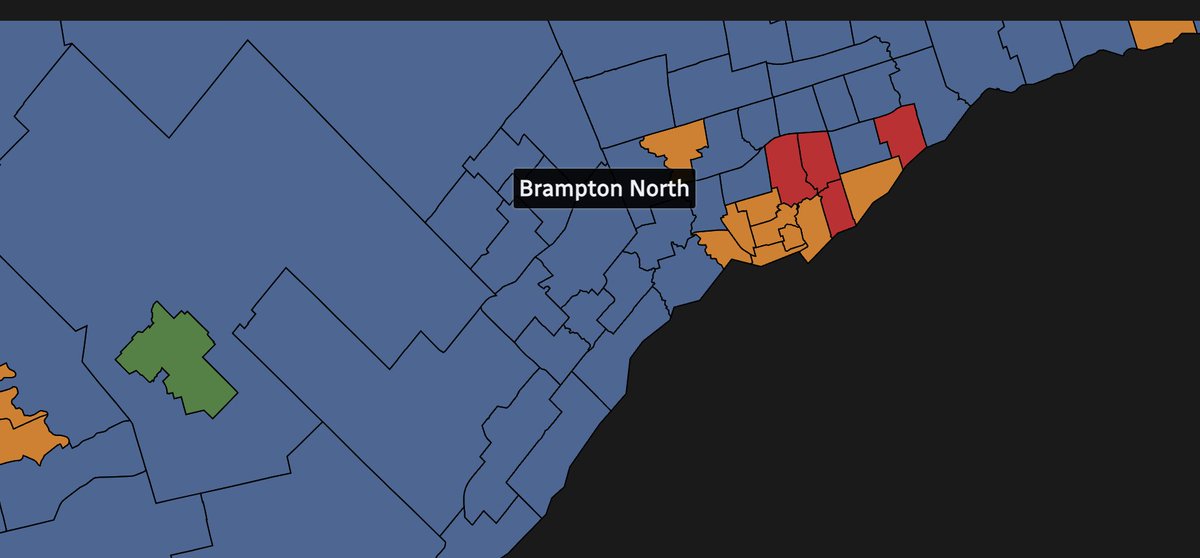
Brampton looks pretty blue to me...
( Ontario 2022 provincial election results)
https://t.co/TG8FY7pc37
Never forget that Natasha "Fusion GPS" Bertrand funneled the Russia Collusion lie into print and also was the author of the disinformation op claiming America's intel experts said Hunter Biden's laptop was Russian. CNN now rewarding her for her propaganda with a promotion.
Due to AI, “We are about to enter the era of mass spying,” says Bruce Schneier
Schneier: AI will enable a shift from observing actions to interpreting intentions, en masse.
In an editorial for Slate published Monday, renowned security researcher Bruce Schneier warned that AI models may enable a new era of mass spying, allowing companies and governments to automate the process of analyzing and summarizing large volumes of conversation data, fundamentally lowering barriers to spying activities that currently require human labor.
In the piece, Schneier notes that the existing landscape of electronic surveillance has already transformed the modern era, becoming the business model of the Internet, where our digital footprints are constantly tracked and analyzed for commercial reasons. Spying, by contrast, can take that kind of economically inspired monitoring to a completely new level:
"Spying and surveillance are different but related things," Schneier writes. "If I hired a private detective to spy on you, that detective could hide a bug in your home or car, tap your phone, and listen to what you said. At the end, I would get a report of all the conversations you had and the contents of those conversations. If I hired that same private detective to put you under surveillance, I would get a different report: where you went, whom you talked to, what you purchased, what you did."
Schneier says that current spying methods, like phone tapping or physical surveillance, are labor-intensive, but the advent of AI significantly reduces this constraint. Generative AI systems are increasingly adept at summarizing lengthy conversations and sifting through massive datasets to organize and extract relevant information. This capability, he argues, will not only make spying more accessible but also more comprehensive.
"This spying is not limited to conversations on our phones or computers," Schneier writes. "Just as cameras everywhere fueled mass surveillance, microphones everywhere will fuel mass spying. Siri and Alexa and 'Hey, Google' are already always listening; the conversations just aren’t being saved yet."
From action to intent
We've recently seen a movement from companies like Google and Microsoft to feed what users create through AI models for the purposes of assistance and analysis. Microsoft is also building AI copilots into Windows, which require remote cloud processing to work. That means private user data goes to a remote server where it is analyzed outside of user control. Even if run locally, sufficiently advanced AI models will likely "understand" the contents of your device, including image content.
Microsoft recently said, "Soon there will be a Copilot for everyone and for everything you do."
Despite assurances of privacy from these companies, it's not hard to imagine a future where AI agents probing our sensitive files in the name of assistance start phoning home to help customize the advertising experience. Eventually, government and law enforcement pressure in some regions could compromise user privacy on a massive scale. Journalists and human rights workers could become initial targets of this new form of automated surveillance.
"Governments around the world already use mass surveillance; they will engage in mass spying as well," writes Schneier. Along the way, AI tools can be replicated on a large scale and are continuously improving, so deficiencies in the technology now may soon be overcome.
What's especially pernicious about AI-powered spying is that deep-learning systems introduce the ability to analyze the intent and context of interactions through techniques like sentiment analysis. It signifies a shift from observing actions with traditional digital surveillance to interpreting thoughts and discussions, potentially impacting everything from personal privacy to corporate and governmental strategies in information gathering and social control.
In his editorial, Schneier raises concerns about the chilling effect that mass spying could have on society, cautioning that the knowledge of being under constant surveillance may lead individuals to alter their behavior, engage in self-censorship, and conform to perceived norms, ultimately stifling free expression and personal privacy.
So what can people do about it? Anyone seeking protection from this type of mass spying will likely need to look toward government regulation to keep it in check since commercial pressures often trump technological safety and ethics. President Biden's Blueprint for an AI Bill of Rights mentions AI-powered surveillance as a concern. The European Union's draft AI Act also may obliquely address this issue to some extent, although apparently not directly, to our understanding. Neither is currently in legal effect.
Schneier isn't optimistic on that front, however, closing with the line, "We could prohibit mass spying. We could pass strong data-privacy rules. But we haven’t done anything to limit mass surveillance. Why would spying be any different?" It's a thought-provoking piece, and you can read the entire thing on Slate.
@ScottAdamsSays
https://t.co/TpR5YQHq7D