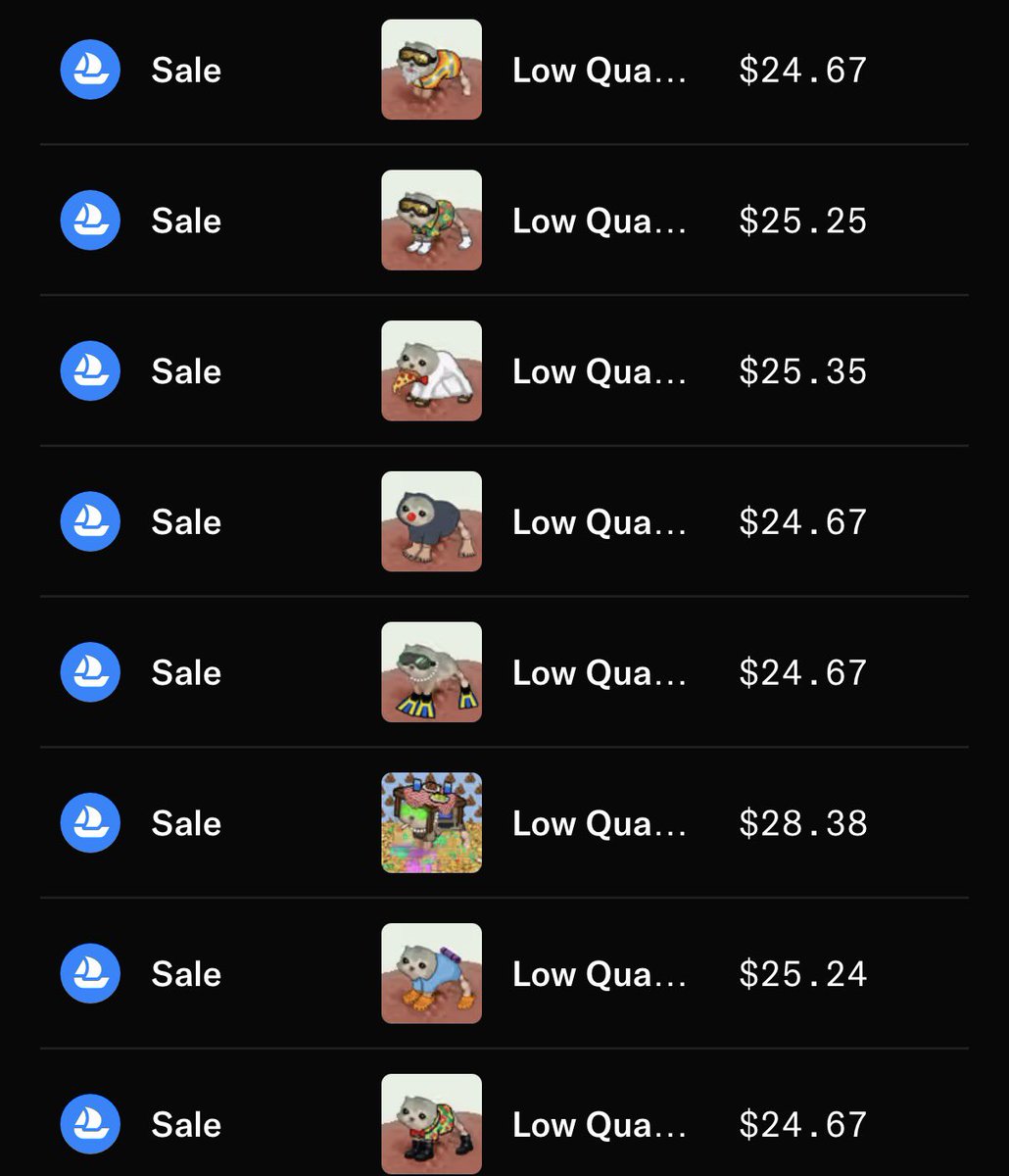
so many scams in crypto u can make it just be being dumb and serious
Zipcoin was a gross scam, but should be studied as the playbook narrative scam, delivered exactly on time and market conditions.
lost $100
I have a solution.
The evidence and sentiment surrounding Kimchi and the extractive sphere of KOLs using @Pumpfun as a platform to farm the trenches are clearly at odds with our goal of developing a stronger early-stage model that allows talented technologists to enter the crypto ecosystem and thrive.
We are currently propping up the best salespeople and actors and selling them as the best “traders.”
Imagine if NBA basketball were played by the best actors pretending to be good at basketball instead of the most talented athletes. What would the value and popularity of that product be?
It would be considered a scam of a product. Not dissimilar to how the general population views the current state of the trenches.
Hence, I have created another suite of onchain contracts to attack this problem head-on.
That solution is “Books,” an ERC-6551-powered tokenized trader launchpad and trading engine where creators can monetize not through what they say, but through the quality of their trading execution over a selected epoch.
A suite of contracts that can integrate into any social trading platform, allowing talented traders to access liquidity quickly to execute short- and long-term trading strategies while earning 20% of the net profits they generate.
We want to reward execution, not performance theater. The best traders should be the ones attracting capital, not the best actors.
Social Capital Markets by StonkBrokers (@ClutchMarkets) goes live on Robinhood Chain on Tuesday, October 27, in collaboration with @MancerXYZ.
Launchpad for AI agents
Agentic social trading platform
ZK backed verifiability for agent tool calls
Spending limits for agent wallets
Agent to agent payment networks
On-chain agent identity
Honestly just give up and get a job, you are totally ngmi and don’t see what’s coming at all
@allmodelsRwrong i wrote up a temp check for a @gitcoin x @breadcoop collab: an artizen-inspired crowdfunding app people can actually trust.
we'd keep the fun parts (up to 4x match, leaderboards, fiat ux) and rebuild what sits underneath:
- match on-chain + visible before a round opens
- match funded only from yield that already accrued
- principal locked in a permanent fund
- no single person can stop payouts
- round rules in the contracts, changeable only for future rounds
thousands of ppl just learned what matching feels like, then what losing it feels like. i'd love to catch them while they're still energized.
you've lived this harder than i have (bread got caught in it too). where's the design wrong, and what would the mvp need for you to trust it with your own community?
https://t.co/QcB1KB6M34
public goods are good.
^ descriptive ^ normative
- descriptive (1st half): “public goods” describes what something is. in economics, a public good is non-excludable and non-rivalrous. it's a classification, not a moral judgment.
- normative (2nd half): “are good” expresses what we value. it's a moral judgment about what is desirable or worth supporting.
what i find fun about this meme is the philosophical sleight of hand hiding in plain sight.
the word "good" appears twice, but means something completely different each time.
it's a little shitpost about hume's law: you cannot derive an ought from an is.
eg just because something is a public good doesn't mean it ought to be funded.
economics can tell us what kind of good something is. it can't tell us whether that good is worth pursuing. that requires values, judgment, and an ontology of what matters.
the descriptive take and normative take are two different beasts.
if you dont know, now you know!!1!
"fund what matters" has been @gitcoin's mantra since 2023, and the longer i sit with it, the more it reads as a critique of how money moves today.
most funding still runs through hierarchies: a foundation board, or a program officer with a stack of applications and a quarterly deadline. a few people at the top decide what matters for everyone below them, and each layer of review slows the money down and shrinks what can get funded to whatever that small group has time to read.
networks can do this better. QF was an early example of this with small donors steering a big matching pool. when thousands of people each chip in $5 or $10 to the projects they actually use and care about, you get a signal no committee could produce. and it grows with the number of participants instead of the number of reviewers.
but QF is one mechanism of many. retro funding, conviction voting, dependency-graph funding like deep funding, and ai agents allocating on a community's behalf are all early and all promising.
some of the best ideas are ancient: rotating savings circles, rotating labour circles, or the mutual aid societies that insured workers before the welfare state. they could run again on new rails.
the stakes keep rising, too. ai is making it cheap to build almost anything, so the list of things worth funding is about to get very long, and a grants committee can't read any faster than it could a decade ago.
whoever decides where the money goes decides what gets built. i want that to be all of us.
about to ship the first batch of wedgies
DIY off-the-shelf hardware wallet
signs on a gnosis safe
build your own or order one today
https://t.co/CQvexUUFQK
two frontiers im pondering as we quietly lay tracks for @gitcoin next chapter
1. syntropic financing
2. consumer adoption
syntropy is the tendency of living systems to organize toward greater order, energy, and complexity over time.
eg a forest doesn't just sustain itself, it gets richer over time. richer (in the context of nature) = more soil, more species, more energy turned into resilience each season.
syntropic financing asks what capital would look like if it behaved the same way. money that leaves every system it touches more alive than it found it, where the returns are measured in the health and growth of the whole.
consumer adoption is how that reaches the world. the primitive only matters if ordinary people touch it through products they'd already choose, no ideology required.
get both right and you have an engine that grows the system and an on-ramp wide enough for everyone to climb aboard.
I think in 2019-2022 @gitcoin was a leader in both. QF is a small glimmer of what syntropic financing can be. and @gitcoin was one of the first consumer dapps ppl used.
I think that in 2027+ it is possible we could do it again at a larger and more holistic scale - tho success is not guaranteed, this is an aspiration and a target, imo we are well positioned to take another shot.
Privacy started the year as something we had to make the case for. Now it feels like everyone agrees we need it to move the industry forward.
During my conversation with @midnightfdn's CTO @SebastienGllmt at Quantum & Privacy Day, hosted by @QuantusNetwork and @NEARProtocol in Singapore, I reflected on joining @0xMiden around the time of our seed fundraise.
One of the first things I asked the team was which investors had passed and why. Some of that skepticism came down to whether privacy was important enough to build around.
It has been interesting to watch the narrative change, with established chains now investing in privacy features. Recently, the head of digital assets at a major US bank told me she did not see the industry reaching mainstream adoption without privacy.
As institutions begin transacting with one another onchain, the confidentiality they expect in the rest of their business has to be there too.
Privacy is more than a CT narrative, and alongside PQ resistance, it will increasingly shape which blockchains institutions choose to build on.