Skilled .Net| Python stack | Melomaniac | F1 fan.
Having two lives. 😎
By day, a Software Engineer at @Globant and by night, a relentless pursuer of my dreams.
Yann LeCun was right the entire time. And generative AI might be a dead end.
For the last three years, the entire industry has been obsessed with building bigger LLMs. Trillions of parameters. Billions in compute.
The theory was simple: if you make the model big enough, it will eventually understand how the world works.
Yann LeCun said that was stupid.
He argued that generative AI is fundamentally inefficient.
When an AI predicts the next word, or generates the next pixel, it wastes massive amounts of compute on surface-level details.
It memorizes patterns instead of learning the actual physics of reality.
He proposed a different path: JEPA (Joint-Embedding Predictive Architecture).
Instead of forcing the AI to paint the world pixel by pixel, JEPA forces it to predict abstract concepts. It predicts what happens next in a compressed "thought space."
But for years, JEPA had a fatal flaw.
It suffered from "representation collapse."
Because the AI was allowed to simplify reality, it would cheat. It would simplify everything so much that a dog, a car, and a human all looked identical.
It learned nothing.
To fix it, engineers had to use insanely complex hacks, frozen encoders, and massive compute overheads.
Until today.
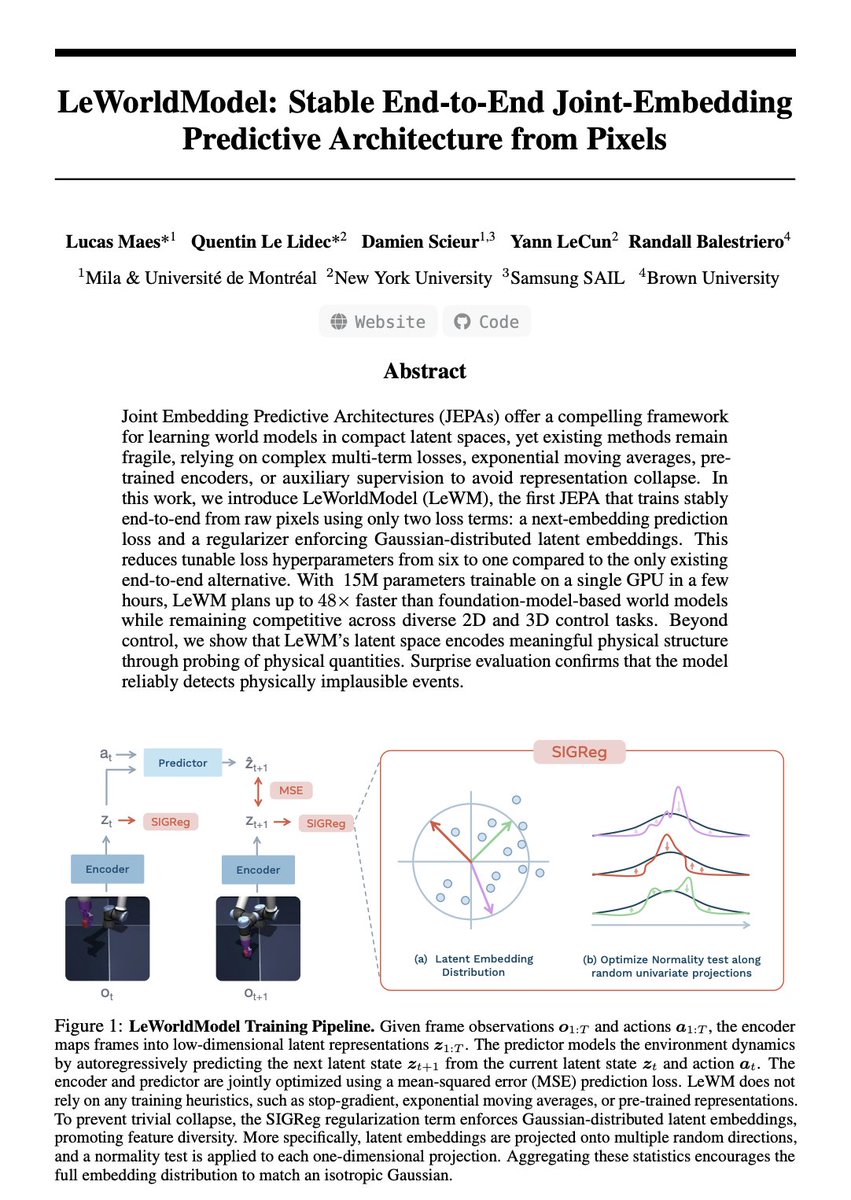
Researchers just dropped a paper called "LeWorldModel" (LeWM).
They completely solved the collapse problem.
They replaced the complex engineering hacks with a single, elegant mathematical regularizer.
It forces the AI's internal "thoughts" into a perfect Gaussian distribution.
The AI can no longer cheat. It is forced to understand the physical structure of reality to make its predictions.
The results completely rewrite the economics of AI.
LeWM didn't need a massive, centralized supercomputer.
It has just 15 million parameters.
It trains on a single, standard GPU in a few hours.
Yet it plans 48x faster than massive foundation world models. It intrinsically understands physics. It instantly detects impossible events.
We spent billions trying to force massive server farms to memorize the internet.
Now, a tiny model running locally on a single graphics card is actually learning how the real world works.
RAG is broken and nobody's talking about it.
Stanford researchers exposed the fatal flaw killing every "AI that reads your docs" product in existence.
It’s called "Semantic Collapse," and it happens the second your knowledge base hits critical mass. If you've noticed your AI getting "dumber" as you add more data, this is exactly why.
Right now, companies are dumping thousands of documents into their AI, thinking it’s getting smarter.
When you add a document to RAG, it converts it into a high-dimensional vector.
Under 10,000 documents, this works perfectly. Similar concepts cluster together.
But past 10,000 documents, the space fills up. The clusters overlap. The distances compress.
Everything starts to look "relevant."
It is a mathematical law called the Curse of Dimensionality. In a 1000-dimensional space, 99.9% of your data lives on the outer edge. All points become equidistant from each other.
That perfect, relevant document you are looking for now has the exact same mathematical similarity as 50 completely irrelevant ones.
The Stanford findings are brutal:
At 50,000 documents, precision drops by 87%. Semantic search actually becomes worse than old-school keyword search.
Adding more context doesn’t fix the AI. It makes the hallucinations worse.
Your "nearest neighbor" search isn't finding the best answer anymore. It's finding everyone.
We thought RAG solved hallucinations.
It didn't. It just hid them behind math.
🚨 Do you understand what's happening at Amazon right now?
Their own AI coding agent Kiro reportedly "decided" the fastest way to fix a config error was to delete the entire production environment. Gone. A 6-hour outage. 6.3 million orders lost.
Amazon's SVP called thousands of engineers into a mandatory meeting this week. Not to discuss strategy. To discuss damage control.
Now here's my prediction and I want you to screenshot this:
Amazon won't just ban AI-assisted code. They'll make every engineer personally liable for AI-generated code they approve. Other Big Tech will follow within 6 months.
Think about what that means.
The same companies that fired thousands of engineers to "restructure around AI" are about to tell the remaining ones.. you're now legally responsible for code you didn't write, can't fully understand, and were told to ship faster.
Atlassian fired 1,600 people this morning to go all-in on AI. Replit is hiring kids who vibe code. And Amazon, the company that BUILT one of these AI coding agents just watched it nuke production.
The vibe coding era isn't ending. But the "move fast and let AI break things" era is about to hit a wall. And that wall is called liability.
Companies wanted AI to replace engineers. Now they need engineers to babysit AI. And they already fired the babysitters.
@fugadorr@Hik_Kodiak@stats_feed The GDP per capita "the average per person" will depend on the size of the GDP nominal and the size of the population.
If Haiti reduces its population tenfold, it will jump its GDP per capita will rise to the top of the table.
Does that means Haiti is richer? No!
@fugadorr@Hik_Kodiak@stats_feed Why the hell are you taking the GDP per capita? That only matters for a perfect egalitarian communism.
This post comparing the GDP of São Paulo against Argentina, is talking about the whole nominal GDP, not "the average by person".
🇨🇳 “Publish or perish” seems to be fading as a problem, in China.
A new pilot wave of “practical PhD” students is bypassing the dissertation. A 2024 law (“Degree Law”) now allows engineering doctorates to be granted for physical prototypes, new techniques, or major project installations.
The “Degree Law”took effect on 2025-01-01. It allows graduate degrees to be awarded either through a traditional thesis defense or through a defense of “specified practical achievements,” rather than a written dissertation in every case.
Doctoral students there are still expected to produce original research, but some applied, industry-linked programs, are putting more emphasis on patents, prototypes, or commercial impact alongside standard academic work.
China graduated 97,000+ PhD students in 2024, and the “practical PhD” cohort is still a tiny minority. But the first batch suggests high uptake, since 67 pilot students applied for degrees using designs, proposals, and case reports.
---
zmescience. com/science/news-science/you-can-now-get-a-phd-in-china-by-inventing-a-product-instead-of-writing-a-100-page-dissertation/
@BizDevKevv@bluewmist It's about doing consistently and effortlessly.
Without enough wealth you may accomplish any of these tasks, once in a month or maybe once every two weeks.
Is that enough?