We are now most active on LinkedIn. 🌍
To dive deeper into climate change and the energy transition, we’ve shifted our primary focus to LinkedIn. Join our growing community there for clear insights and collaborative discussions.
Follow us below 🔗
https://t.co/gNmZlKuSHf
En el mundo se han quemado ya en lo que va de año 160 millones de hectáreas de bosque, preámbulo de incendios impulsados por el fenómeno El Niño, en una versión catalogada como súper y que postula a 2026 como un año de calor extremo, advierte @ZerocarbonA https://t.co/EruTO5ngRa
Oceans drive economic growth, climate mitigation and adaptation. But the ocean economy remains underfunded💰🌊
As the #BlueEconomy Finance Forum #BEFF closes, we looked into the status of #OceanFinance, what's needed, and what investors stand to gain.
➡️ https://t.co/rnh19noy5V
.
Plug-in solar: France, Germany, Italy, Poland, Spain, and UK case
Plug-in solar refers to small, easy-to-install solar panels used for home electricity. They can be plugged directly into a standard outlet to reduce household power consumption.
There is an interesting chart here.
Each line in the chart shows how Google search interest for (plug-in solar) has changed over time in each country.
Germany clearly stands out in plug-in solar adoption, and the reason is simple: policy clarity and incentives. Measures like feed-in tariffs, VAT exemptions, and early regulatory support have created a predictable environment for households. When people know how quickly they can recover their investment, adoption follows, and the data reflects that.
In contrast, countries like France, Italy, and Poland face more complex permitting processes and weaker financial incentives. Without clear pricing for surplus electricity or easy installation rules, consumer interest remains limited. The gap in Google search trends shows this difference in policy support.
Source: @ZerocarbonA
by Bridget Woodman and Jessica Nicel
⚡ Since the US-Israel invasion of Iran, clean energy ETFs have outperformed oil & gas. $3B flowed into renewable funds in April alone.
Our latest briefing examines what the energy crisis means for the transition: https://t.co/SxcyqEtZgl
New research: if the #Philippines hits its 2030 #solar target, it could avoid PHP 1.7B (USD 28M) in coal & gas import costs - enough to fully fund the Cancer Assistance Fund for vulnerable citizens.
Read it here 👉 https://t.co/KgxQAqubAL
Some ASEAN countries are using more coal as the Middle East crisis has made natural gas imports more expensive. According to Amy Kong, research analyst of Zero Carbon Analytics, while coal might serve as a temporary buffer, it will not solve the region’s dependence on imported energy sources. @ZerocarbonA
#energytransition #MiddleEastcrisis #coal
@NOAA puts a 61% chance of #ElNiño forming by May-July 2026. Some models flag it as the strongest in 140 years.
On a warming planet, that's not routine. Crop failures, droughts, floods, disease, across multiple continents at once.
More here 👉 https://t.co/7pWK3MEnvs
Do massive LNG investments in Malaysia, Philippines, Thaiand, Singapore and Vietnam increase exposure to supply shocks and price volatility?
Indonesia’s LNG investment remains limited
But, Vietnam, Philippines, and Malaysia have the highest LNG investments in absolute terms, while Thailand and Singapore stand out in relative terms.
Vietnam: ~$9.6 billion total, with ~$9 billion still in development
Philippines: ~$5.9 billion, majority under development
Malaysia: ~$4.9 billion, heavily tilted toward future capacity
Some sources suggest that increasing dependence on LNG imports is putting Southeast Asian countries at risk of supply shocks and price volatility. Investing in domestic renewables and the ASEAN power grid can better support energy independence and security
What do you think?
Source: @ZerocarbonA
2 countries. 1 crisis. Very different electricity bills.
In the weeks after the #StraitOfHormuz blockade, wholesale power prices in #Italy averaged EUR 142/MWh. In #Spain, EUR 59.
The difference comes down to how much gas each still relies on.
👉 https://t.co/uGIDdCvkX3
@NOAA puts a 61% chance of #ElNiño forming by May-July 2026. Some models flag it as the strongest in 140 years.
On a warming planet, that's not routine. Crop failures, droughts, floods, disease, across multiple continents at once.
More here 👉 https://t.co/7pWK3MEnvs
While India and Southeast Asia continue to show economic growth, will their rising demand be enough to offset the massive deficit left by China’s lack of demand? Understanding this regional tug-of-war is critical for anyone managing raw material supply chains or energy investments in Asia.
Analyze the net result of Asia's shifting demand. Register here: https://t.co/vC0QTmNcsE
Speakers:
📌 Colette van der Ven – Founder & Executive Director, Tulip Consulting (@Tulip_Tweets_)
📌 Nick Hedley (@nickhedley) – Energy Transition Research Analyst, Zero Carbon Analytics (@ZerocarbonA)
📌 Sakshi Balani – Director, India & Director, Policy, Climate Catalyst (@climacatalyst)
📌 Tim Buckley (@TimBuckleyCEF) - Founder & Director, Climate Energy Finance
📌 Wenbo ZHAO – Advisor, China Industry, Agora Energiewende (@AgoraEW)
Host:
📌 Chris Wright – Principal Analyst, CarbonBridge Consultancy
#China #SteelIndustry #MetallurgicalCoal #CokingCoal #EnergyTransition #IndustrialTransition
As #Thailand updates its #PowerDevelopmentPlan, our new calculator visualizes how lifting the 90 MW net billing cap impacts the economy. Data shows solar households could be 77% better off.
📊 Access the calculator and full briefing here: https://t.co/qL8Dnvn259
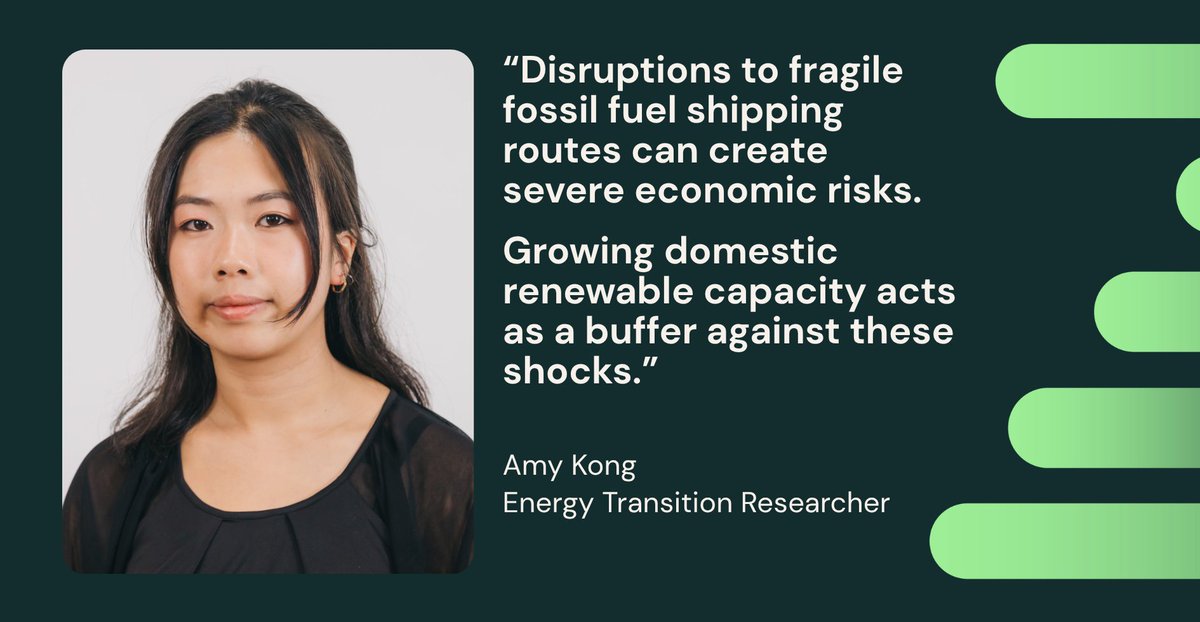
In our latest Zeroing In, Amy Kong shares the thinking behind her recent briefings: fossil fuel routes are fragile, but domestic #renewables act as a vital economic buffer.
Subscribe ⚡: https://t.co/mT4AQQcOUa
While oil giants pivot back to fossil fuels, countries like South Korea and Vietnam are fast-tracking #renewables for energy security.
Insights from Nick Hedley: https://t.co/CTED4Bm5y3
Get the next update in your inbox 👉 https://t.co/sFFHRVnSz7
Lifting #Thailand’s 90MW net billing cap could save solar households 77% more on energy bills.
Despite #solar reaching grid parity, policy constraints are stalling progress. Raising the cap is vital to protect consumers from rising tariffs.
Read more 👉 https://t.co/qL8Dnvn259
#EnergySecurity is economic security. 🌏
For #Fiji, #Vanuatu & #Tonga, rising oil prices from the Middle East conflict could spike Fiji’s fuel bill by $670M. Transitioning to local solar & wind can protect economies.
Know what’s at stake 🔗 https://t.co/6d70jyQjeb
Our popular monthly newsletter, The Energy Transition in Oil and Gas, December roundup ran straight into the breaking news of early 2026, earning the title: Fossils fuel instability.
Catch up here: https://t.co/ofYW9AAczS
Higher temperatures and more unpredictable and extreme #weather are posing increasing challenges for #wine production, which relies on stable and specific conditions.
Full briefing 👉 https://t.co/yNzvqViR6h
As we celebrated the new year, our briefing on the impact of climate change on sparkling wine was featured in coverage by Danish public broadcaster https://t.co/r17qoSlp2V 🍷 https://t.co/ZiMvv8jokv