Alan Wolff @PIIE argues that the EU must step up to lead the world trading system at this moment of historic disruption. In his contribution to CEPR's Europe 2050 series, he sets out a strategic roadmap for EU trade policy to 2050.
https://t.co/y1FJ30SkbE
#Europe2050@ojblanchard1
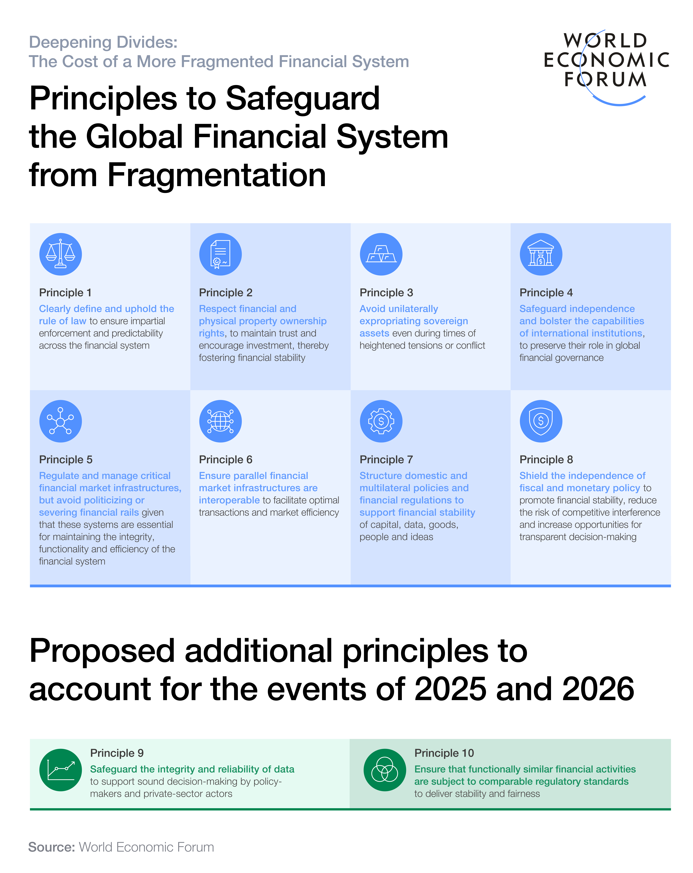
As #geopolitical tensions reshape trade and finance, the world is entering a new era of #economic fragmentation.
A new report from the @wef and @OliverWyman, Deepening Divides: The Cost of a More Fragmented Financial System, examines the costs of rising trade and #financial divides, and explores what is at stake for global growth: https://t.co/ruCHzLsrF8
From ancient trade routes to modern supply chains, control of commodities has long shaped economic power—and continues to do so today, Jean-Marc Natal writes in the latest F&D magazine. https://t.co/2aV7h8gWsu
El último presidente electo de Venezuela. Y precisamente por eso, hoy hablo de elecciones presidenciales, como un mandato. Así lo decidieron los venezolanos.
Cuando muchos creían que la lucha popular hacia la democracia se había truncado otra vez por las maniobras del régimen criminal, un hombre noble y valiente hizo posible lo que muchos nos dijeron que era imposible.
No lo vieron venir. No calibraron su integridad y su valentía. No entendieron que la verdad se abriría paso, hasta demoler todas sus mentiras y arrancarles todas sus máscaras.
Edmundo González Urrutia, un hombre noble y coherente, quien arriesgó todo por Venezuela, hoy, una vez más, es ejemplo de servicio y entrega a la patria.
La Venezuela libre y próspera que ya renace, mi querido Edmundo, lleva tu nombre impreso en el corazón.
Muy pronto nos reencontrarnos allí, en nuestra tierra, con nuestra gente, en nuestros hogares!
El universo siempre reemplaza lo que sale de tu vida con algo más grande y mejor. No te quedes atrapada aferrándote al pasado o resistiéndote al cambio. Bienvenida a la nueva energía. Deja ir lo que necesita ser eliminado. Hay mucho más destinado para tu vida.
The BIS provides extensive residential and commercial property price data sets, helping analysts and policymakers to better understand developments across jurisdictions and over time.
Watch the video and explore our data sets on the BIS Data Portal: https://t.co/sOkoYm62T2
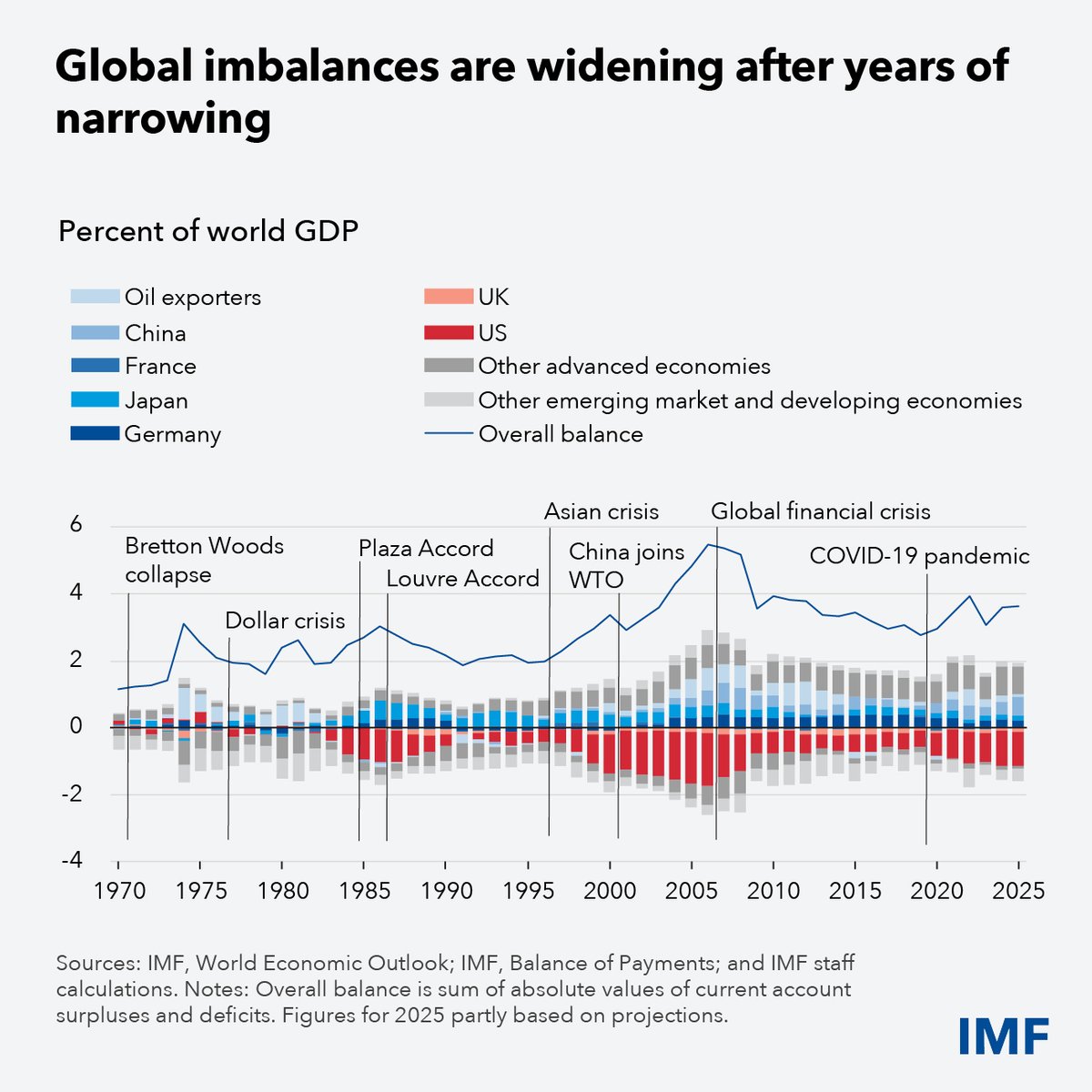
The gap between countries running large trade surpluses and those running large deficits is growing. Sound domestic policies, not trade barriers, remain the path to durable rebalancing. See our blog for more. https://t.co/UfYUGEjUVy
Cyber risk is a growing threat to financial stability. The ECB’s cyber resilience stress test shows that supervisory scrutiny can boost banks’ cyber security investment, even without capital penalties or public disclosure. https://t.co/likNpd2gLv #CyberRisk#Banking
Central bank framework reviews have gained increasing prominence in recent years. But how do private agents learn new monetary policy strategies, especially amid significant inflationary and deflationary shocks? https://t.co/vyezhShMDn
Maduro Regime Ally Alex Saab Arrested on Money Laundering Charges Involving Venezuelan Food Contracts and Oil
“Thanks to the efforts of the Homeland Security Task Force, Alex Saab will be prosecuted and held fully accountable under U.S. law for his alleged role in this scheme,” said Acting Attorney General @DAGToddBlanche.
🔗: https://t.co/iS2jBVHucR
Tu camino está despejado ahora. Se eliminan todos los bloques. A partir de aquí para ti sólo es hacia arriba. Vas a experimentar una aceleración imparable. Este es tu momento de empezar a recibir.
Humboldt Research Fellowship 2027 in Germany | Research Opportunity
Applications are now open for the Humboldt Research Fellowship 2027. This is a great opportunity for international researchers to conduct research in Germany with full financial support and access to top institutions.
Visit: https://t.co/UYfK4bgtO2
Benefits include: Monthly stipend (€3,000–€3,600), travel allowance, health insurance support, free German language course, family allowances, and strong academic support.
Study Level: Post-Doctoral & researchers
📍 Duration: 6–24 months
🌍 Open to applicants from all countries
This fellowship allows you to work with leading researchers and gain international experience in your field.
📌Want to attend the III CEMFI School of Economics at UIMP in Santander? Apply if:
✅Undergraduate or graduate student in Economics or Business Administration
✅Ten €500 scholarships
⚠️Deadline May 28, 2026
👉Apply: https://t.co/mqnz7w4UBu
#Scholarships#Economics#Santander2026
Highly relevant!
"The Central Bank’s Dilemma: Look Through Supply Shocks or Control Inflation Expectations?" by Paul Beaudry, Thomas J Carter, and Amartya Lahiri.
"When countries are hit by supply shocks, central banks often face the dilemma of either looking through such shocks or reacting to them to ensure that inflation expectations remain anchored. In this paper, we propose a tractable framework to capture this dilemma and explore optimal policy under various assumptions on how agents form their expectations and the sophistication with which those expectations account for the central bank’s announced policies. While our analysis covers a wide range of potential specifications, our baseline results focus on level-k thinking (LKT) – a form of bounded rationality that enjoys significant support in the experimental literature and encompasses both adaptive expectations (AE) and rational expectations (RE) as special cases. Nonetheless, we show that the optimal policy under LKT is qualitatively very different from its analogues under AE and RE, exhibiting abrupt pivots in the policy stance. In particular, it is optimal for the central bank to initially look through supply shocks until a threshold is reached, then pivot discontinuously to a more hawkish anti-inflationary stance. We find that such pivots can, if optimally executed, be compatible with soft landings in the sense that most (or even all) of the reduction in inflation occurs through re-anchoring of expectations rather than economic slack. We also discuss risks and why policy errors in terms of tightening too late or too slowly can be especially costly in such an environment."
https://t.co/wO7ToDMNXR
Really cool!
"Systemic Banking Crises Database: 1970-2025" by Luc Laeven and Fabian Valencia.
"This paper presents an updated version of the Laeven and Valencia (2013, 2020) database on systemic banking crises, extending the coverage through 2025. The update incorporates new episodes, while maintaining the definition established in previous editions, which emphasizes both significant signs of financial distress and substantial policy interventions. The update integrates textual tools to screen potential candidates that are then further scrutinized to confirm if our definition is met. The database includes information on banking crises episodes during 1970-2025, including starting dates, policy responses, fiscal costs, and output losses. It offers a comprehensive tool for assessing cross-country vulnerabilities and policies to resolve banking crises."
https://t.co/4nSydVP6lF
Highly relevant!
"Preparing for Quantum Technologies: Key Considerations for Financial Sector Participants," report prepared by the G7 Central Bank Quantum Technologies Working Group co-chaired by the Banque de France and the Bank of Canada.
"This report examines two areas where quantum technologies may have material implications for finance. The first concerns data and communication security, in light of advances in quantum computing that are expected, over time, to challenge widely used cryptographic techniques underpinning digital trust. The second focuses on potential applications of quantum technologies across financial markets, payment systems and central banking activities, as well as their broader system-level effects."
https://t.co/K0IG9xL9uo
Highly recommended!
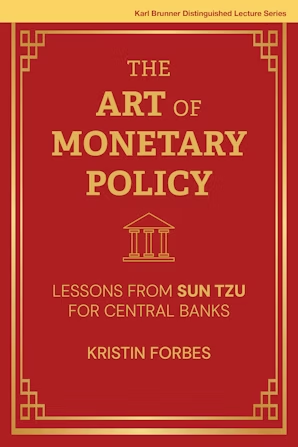
"The Art of Monetary Policy" by Kristin J. Forbes (Karl Brunner Distinguished Lecture Series).
https://t.co/lWLWjaet2v
"When central banks were forced to innovate and develop a multifaceted set of new weapons in response to the 2008 global financial crisis and 2020 COVID-19 pandemic, the result was a substantial expansion in their authority and reach. In The Art of Monetary Policy, Kristin Forbes draws lessons for monetary policy of the last two decades from the principles of Sun Tzu, the author of The Art of War, a Chinese philosopher and military strategist from the fifth century BC. Tzu proposed several key principles for success—tenets that apply to monetary policy and the battlefield today: (1) plan in advance for the next battle; (2) accept and adapt to the inevitability of powerful, external shocks outside your control; (3) establish a strong tactical position; (4) develop a variety of weapons that can be combined for different maneuvers and situations; (5) maintain flexibility so that you can quickly modify your strategy; and (6) consider the longer-term costs when evaluating the trade-offs of different approaches. These principles provide insights into what central banks did (and did not) do well over the last two decades, as well as how they should deploy interest rates, balance sheets, emergency support programs, forward guidance, and macroprudential tools in the future."
https://t.co/lWLWjaet2v
Tu camino está despejado ahora. Se eliminan todos los bloques. A partir de aquí para ti sólo es hacia arriba. Vas a experimentar una aceleración imparable. Este es tu momento de empezar a recibir.