Dear X community, does anyone have any insight into what’s going on at the @idtdna plant in Belgium?
Many of our oligo orders have been significantly delayed, with several repeatedly failing synthesis/QC cycles. Some colleagues have experienced similar issues.
We have a 3-year post-doc position open. Apply now and join BioBeyond_NL to power up mass spec studies with new chemical biology tools!
https://t.co/CWCxpl6yws
I am so thrilled to finally share the latest work from the lab, finally out in @NatureComms, on #RNA structural ensemble repartitioning by small molecule drugs, an amazing heavy lifting by my amazing PhD candidate @CChundan, with the help of a stellar team of collaborators: Martin Witte (X-less), @ArtDrugDiscover and @jschneek! A short thread! (1/n)
https://t.co/dWpsZgauXf
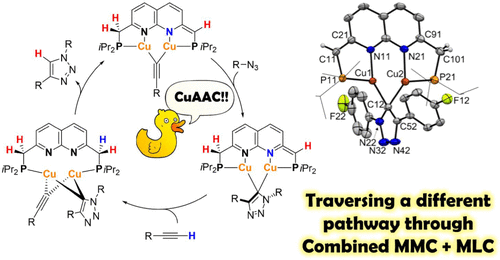
CuAAC! Check out how combining Metal–Metal and Metal–Ligand cooperativity enables traversing a new mechanistic pathway @Orgmet_ACS . This collab with @baikkaist is dedicated to Jarl Ivar van der Vlugt on the occasion of his 50th cycle around the sun. https://t.co/PKe9g2xGup
Our studies call for development of labeling and analytical methods that are really SPECIFIC for glycoRNA.
Team effort with @Sungchul_Kim_ lab, @chirlmin55060 Joo lab, and Pascal Miesen lab
#glycotime We hope our b2b publications serve as a heads-up for the #glycoRNA community, and drive the field forward constructively. Links👇
Kim et al. https://t.co/8QqbR093AJ
Kegel et al. https://t.co/P9zIlbzBSF (Stefan Bauer lab)
These glycoproteins behave like glycoRNA biochemically and electrophoretically, so it may confound assays on glycoRNA. E.g. when doing #glycomics analysis, how much glycans are from the contaminant glycoproteins vs. from glycoRNA? This will critically affect your conclusions
We show that the total #RNA isolated from cell cultures can contain substantial non-RNA glycoconjugates, which was found out to be #glycoproteins (characterized in Kegel et al paper), and those glycoconjugates persist even after protease treatment and rounds of purification.
Deeply honored to be a co-applicant of #BioBeyond_NL. The team will develop enabling #MassSpec based technologies to advance (glyco)proteomics, glycomics and spatial omics.
Stay tuned for PhD/post-doc openings in the near future!
I am excited to share my graduate work in @DMSabatini and Dave Bartel’s labs. Since their discovery, we have known lysosomes possess RNase activity; however, their substrates were not known. Surprisingly we find specific RNAs are targeted for degradation! https://t.co/o5SdvJzjnW
The IncaRNAto lab is seeking a motivated #PhD candidate, interested in studying #RNA structural ensemble dynamics in living cells. Here's the link to the vacancy: https://t.co/eaQbAOVBG4. Please share!
An independent study from Kegel et al. has led to alike conclusions. The common RNA prep may not give you the RNA as pure as you think. The results also call for the development of glycoRNA-specific labeling methods… A dual labeling?
https://t.co/xowml18U4U
Here is an updated version of a preprint posted in 2024: It describes a non-RNA glycoconjugate persisted throughout RNA sample processing, with similar electrophoretic properties and enzymatic reactivity as glycoRNA.
https://t.co/JcvAMR2wtu
Suppose you are ready to load the glycan-labeled glycoRNA into gels. Get half of it, mix with RNases, incubate, add sample loading buffer, denature, DIRECTLY load the mixture into gel. Do the rest the same as reported. GlycoRNA gets degraded, the N-glycoconjugate remains intact.
Check out our first steps into the main group @ChemRxiv ! Pioneered by @ErrikosKounalis and in collab with @ME_Moret An N-Heterocyclic Germylene with a Versatile Metal-Binding Pocket: Insights into Heterodinuclear Bonding and Reactivity | ChemRxiv - https://t.co/Pl3nH0qziX
6. KIR2DL5 does directly bind to RNA. Food for thought: what are other classical membrane glycoproteins that can directly bind to RNA as non-canonical RBPs?
4. SCOOPS validated HS is essential for hepRNA presentation on cell surface in an orthogonal fashion to the originally described TLR7 probe.
5. SCOOPS enabled unveiling hepRNA identities: high-confidence candidates include mRNA, lncRNA (Huang 2020) and snoRNA.