Yesterday, OpenAI killed GEO/AEO startups, including mine.
Today, Moatlight rises again🌅 and I'm launching something FREE to help businesses get verified and listed in ChatGPT.
OpenAI's new Business Hub comes with a 17-step setup process. YES, 17 steps!
So I built a SKILL.md for AI agents that does the heavy lifting:
- Finds your domain and DNS provider.
- Guides you through DNS TXT verification.
- Selects your business category.
- Writes your 293–300 character business description.
- Prepares contact, delivery, return and ID requirements.
- Helps set up your Business Agent and Brand Insights.
FREE. NO ACCOUNT REQUIRED.
Visit https://t.co/eLi0n24swk
Install. Run. Get your audit and step-by-step instructions.
Get your business ready for ChatGPT Business Hub 🚀
My GEO/AEO startup died before launch.
OpenAI just shipped brand analytics inside ChatGPT. Free. Businesses can see how often they show up and how many clicks they get.
Why always me? 😭
...
Okay, now the honest part. It killed something that was already dying: the "dashboard that tells you AI mentioned you 14 times this week" product. That was a commodity way before today.
This was predictable. Whenever a platform has data that third-party tools scrape and resell, it eventually ships that data itself. Google did it with Search Console. Meta and Amazon did it too. Third-party tracking becoming first-party was always going to happen with ChatGPT, and it's fine.
Because I've been talking to the people who actually do this work, and here's what I keep hearing: the dashboard was never their problem. Nobody described their biggest headache as "I can't see my mentions." Nobody said a better chart would make them happy.
What makes them happy is getting the right thing done and knowing it was the right thing. Execution. That's where the pain is.
So this update actually made me more confident, not less. I can clearly see where the market is going, and I can really help brands get recommended in AI search with Moatlight: spend less money on guesswork, and most importantly, trust the work they're paying for.
I'm building in public. If you're building a startup and want to be recommended in AI search, let's connect.
I actually thought about adding a product screenshot earlier! If you scroll below “How It Works”, you’ll find a fully interactive product interface, not just a static screenshot.
I was considering bringing it into the hero section but wasn't sure if it was the right UX decision. I was missing exactly this kind of expert UI/UX perspective 😄
And I completely agree about the numbers. I overlooked that, even though competitors use metrics as a strong trust signal.
Really appreciate your feedback🙌
🚨 AI SLOP CHECK
Rate my landing page from 0 to 10:
[ 0 ] = Definitely AI slop. Generic, soulless, and forgettable.
[ 10 ] = Great design. Polished, distinctive, and genuinely impressive.
I want brutally honest feedback. No sugarcoating, no fake compliments. Evaluate it based on design, branding, clarity, UX, originality, copywriting, visual consistency, trust, and conversion potential.
It was made by me and Claude Code. The model is Claude Sonnet 5.5 (medium effort).
Drop your score (0–10) and tell me what sucks, what works, and what you'd improve first. Be honest. 🔥
@KalshiFC@Cristiano is the best. A lot of long-range goals, powerful rocket shots, free kicks, and unique moments, such as the incredible 40-yard strike against Arsenal.
Do you use Lighthouse(DevTools) to optimize your website in 2026?
Today, I decided to do a quick check of my landing. All scores look good. I made(Claude made 😄) a few fixes to achieve a 100 accessibility score. Performance is at 99/100 , while mobile performance consistently stays at 96.
I'm happy with these results for now. I'm not particularly focused on achieving a perfect 100 on mobile performance. Sometimes, good enough is good enough.
What scores are you getting?
@kaisenmisin@bekenovernar I was born and raised in Almaty, and I still live here. Kazakh is my native language and the one I use in everyday life, followed by English at work and Russian for certain services. That’s why your comment comes across as a bit overly sensitive and unnecessarily offended.
In the AI era, being good isn’t enough. You need to be known for something specific.
❌ Don’t just compete to be the “best dentist in San Francisco.”
✅ Be the dentist known for helping patients save natural teeth and avoid unnecessary extractions.
The more clearly you define who you help, what problem you solve, and how you’re different, the easier it is for both people and AI systems to understand when you’re the right choice.
Don’t just be the best. Be the right choice for a specific problem.
#GEO #AEO
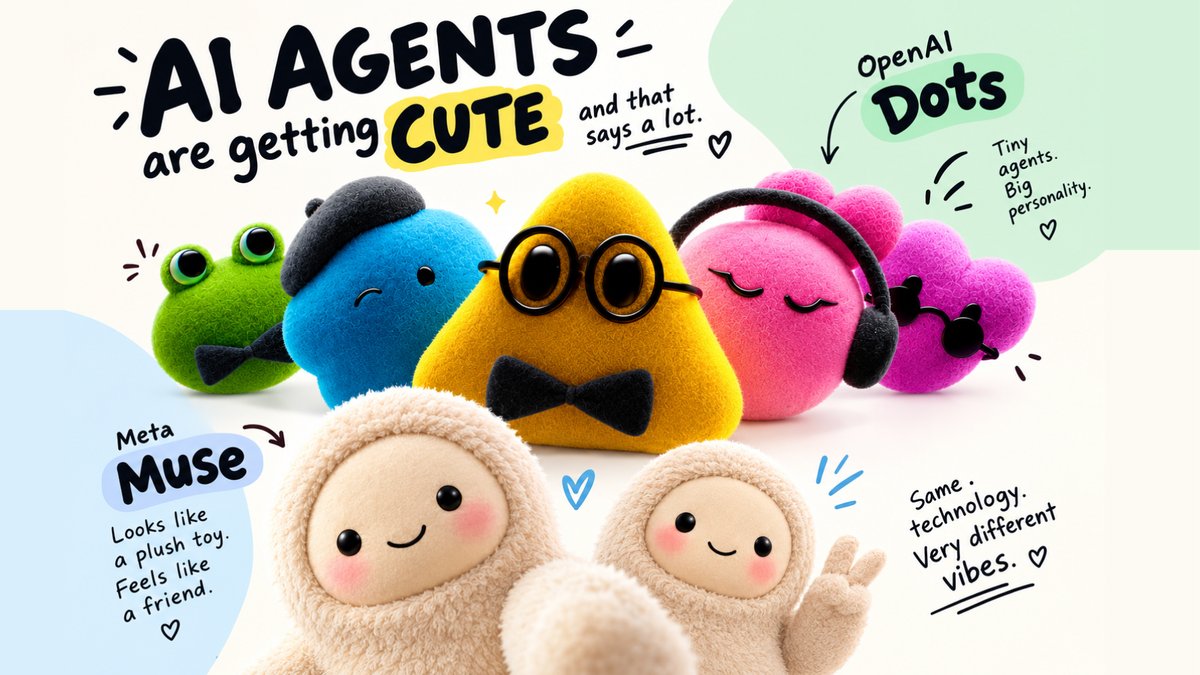
“It’s so cute” or how the most powerful AI agents are being wrapped in plush toys 🧸
Yesterday OpenAI dropped Dots, their take on a personal agent. Earlier this month Meta launched Muse with its fluffy mascot, Jolly. Put them side by side and the pattern is hard to miss: both are soft, plush, toy-like characters.
Dots come in pink, blue, green, yellow and purple. One wears glasses, one has headphones, one rocks a bow tie. Iggy, Felipe, Todd, Alfred, Jojo are the demo names, but you name your own.
Mascots have always been a cheat code for brand memory. Think of Duolingo's owl (okay, not always cute 😅). Now the little guys are leveling up: more realistic, more lovable, and built to make heavy AI work feel like a friend helping you out.
Notice the shift in language too: it's not "AI assistant" or "agent" anymore, it's your personal agent.
Building a mobile app and thinking about a mascot? Consider going plush. With this trend, a fluffy 3D-feeling character may land better than a flat 2D one. Details matter too. Accessories and modern tech touches in the design pull virtual companions and personal agents closer to our real world.
The next big AI battle might be fought on personality, not just on models. Who has the cutest Dot? 👀