The materials science problems here are wildly under discussed. A Dyson swarm or even a large satellite fleet at L1 only work if the components don’t quietly degrade under radiation & thermal stress. That’s a pure materials + measurement sci challenge before it becomes an AI one.
Bridging the gap between the wet lab and data analysis! 🧪📊 Just launched an open-source repository showcasing my latest analytical chemistry work on food dye quantification and kinetic modeling. 🧵👇 (1/1)
Everything—from my raw .csv datasets and vector plots to the live .sciprj workspace file—is completely open and reproducible on my GitHub. Check out the full write-up here: https://t.co/aEMmhkuGvA (4/4)
Bridging the gap between the wet lab and data analysis! 🧪📊 Just launched an open-source repository showcasing my latest analytical chemistry work on food dye quantification and kinetic modeling. 🧵👇 (1/1)
From there, I tracked oxidative bleaching over 180s. By applying automated column formulas to linearize the decay curve (ln(Absorbance) vs. Time), I confirmed pseudo-first-order kinetics and a rate constant (k) of (0.0165 s^-1). (3/3)
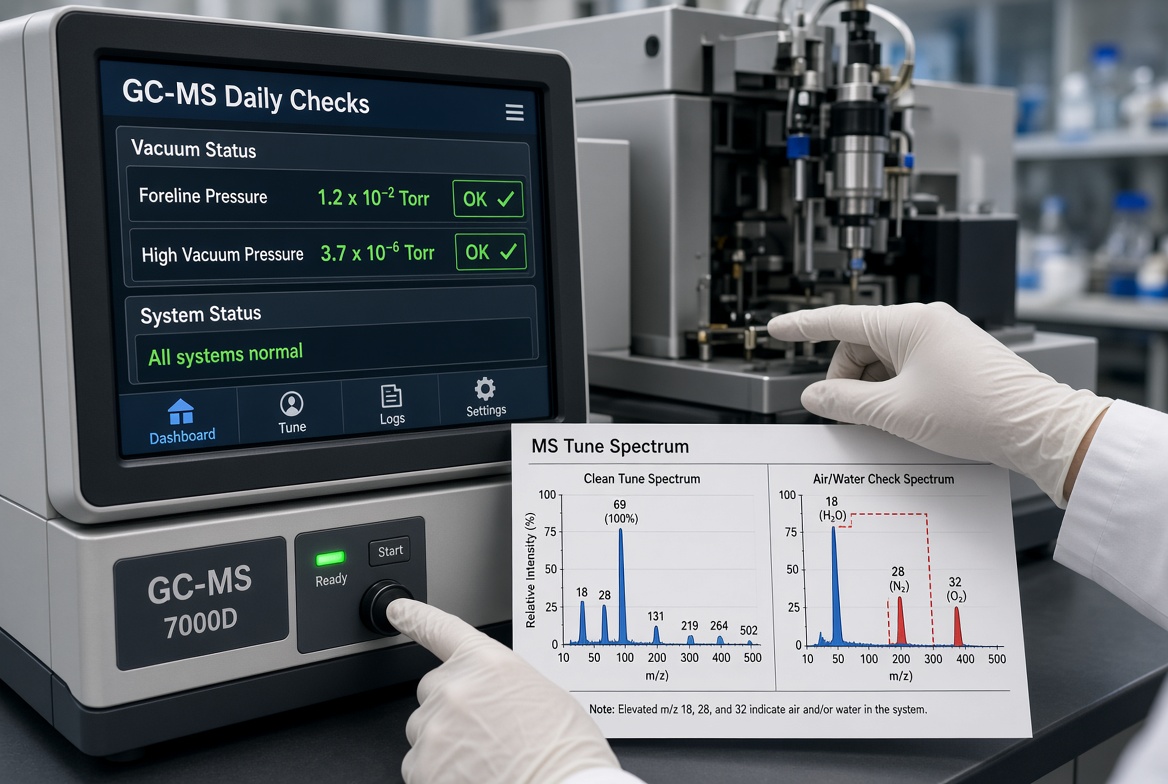
Track electron multiplier voltage and PFTBA tune responses over time. Rising EM voltage often signals a dirty source before you “feel” the sensitivity loss.
@michaeljmcnair Without that exper filter elegant outputs risk becoming sophisticated confabulation.Recent math results look genuine &exciting. Extending that momentum uncritically into data constrained physics is where the critical thinking gap appears. Happy to see the discussion stay rigorous
@michaeljmcnair In exp fields like chem & materials science, critical thinking still starts & ends with ground truth: NMR, HPLC MS, reproducible kinetics, & actual measurements. AI is already extremely useful for modelling & hypothesis generation, but it cannot invent the data.
GC-MS Tips: Check foreline + high-vacuum pressures under the same column conditions. Any jump = leak, pump issue, or flow problem.
Air/water peaks (m/z 18, 28, 32) in the tune spectrum are your early warning. Catch them before sensitivity tanks.
Frequent gentle solvent cleaning (hot water → LCMS water → IPA/MeOH) over rare harsh soaks.
Many skip Alconox entirely or rinse extremely thoroughly — residual base etches newer capillaries. Syringe-flush or protected sonication works well.
@leecronin Same here Prof. Massive fan of AI tools in chemistry (especially for kinetic modelling & chemometrics), but verifiability is non-negotiable. If it can’t be checked by NMR, HPLC-MS or proper kinetic data, it’s just noise.
Change septa and liners on a schedule (or at the first sign of tailing/reproducibility drift), not when everything falls apart.
~70% of GC performance issues are inlet-related. Keep a log. Your future self (and the MS) will notice the difference.
Use the smallest injection volume and lowest concentration that still meets your LOQ. Prefer dilute samples + low split over high split ratios — non-volatiles love to stick in the inlet and slowly poison your source.
Dry solvents only. Water is the silent peak-shape killer.
Capillary GC is clean GC. Practice, practice, practice and stay a student of the technique.
Most GC-MS problems start upstream (inlet, gases, sample). Fix the front end first and your MS will thank you.