The Yin Yang is my favorite symbol. It describes a type of symmetry the modern West has failed to focus on. Among other things, it illustrates the healthy gender dynamics that we have lost at every scale. Complementarity rather than identity. Spin it and it does not disappoint!
The Individuation Principle: “The idea of #individuation is by no means new. Interest in the principium individuationis has recurred throughout the history of Western philosophy since the time of Aristotle. It is to be found in the work of Aquinas, Leibniz, Spinoza, Locke and Schopenhauer, but these great thinkers focused on the conscious aspects of the process, so their work is of limited usefulness in the development of a dynamic psychology. A small number of developmental theorists in the present century, such as Charlotte Buhler, Erik Erikson, Kurt Goldstein and Abraham Maslow, have observed the operation of the individuation process in their subjects and have used such terms as ‘self-realization’ and ‘self-actualization’ to describe it. But these concepts fall short of Jung’s ‘individuation’ because they view the self-actualizing process as peculiar to humans. #Jung, on the other hand, considered self-actualization to be a property of all living things. ‘Individuation, he wrote, ‘is an expression of that biological process – simple or complicated as the case may be – by which every living thing becomes what it was destined to become from the beginning’ (CW 11, para. 144). He eventually concluded that a similar principle was at work in inorganic matter as well – as when a crystal forms out of a hidden configuration within its pre-existent liquor. But it is in humans that individuation finds its highest expression.
As part of the order of nature, and because it is a natural homeostatic system, the psyche possesses the power to heal itself, and this is why #dreams are so important – particularly series of dreams. In them one can perceive natural processes of healing and individuation taking place. For this reason, individuation is undoubtedly assisted if one attends to one’s dreams, but it is not essential to have them analysed. The mere act of writing them down or illustrating them greatly enhances their effect on ego-consciousness. After all, the vast majority of dreams that have ever been dreamed have not been analysed. Yet they clearly perform a vital function because we all have them – as, indeed, do all mammals – and when human subjects are deprived of dream sleep for any length of time they become disorientated, hallucinated and deluded. The probability is that their function, in all species that dream, is to integrate the programme for life laid down in the genome (ie., the entire genetic constitution of the species) with the daily experience of the individual.
Individuation, then, involves the progressive integration of the #unconscious timeless self in the personality of the time-bound individual. And since the human psyche is itself a product of nature, it follows that individuation is a biological phenomenon proceeding in a cosmic context.
However, in the course of growing up, the degree to which the Self can be integrated is inevitably limited by circumstance – especially by the personality, culture and relationship of the parents. Just as no parent can ever hope to embody the totality of the parental #archetype, so no individual #ego can ever hope to incorporate the wholeness of the Self. In every case, certain aspects of the Self will prove unacceptable to the family milieu and will consequently be relegated to the personal unconscious to fill out the #shadow personality, while others will remain un-actualized and will persist as latent archetypal potential, which may or may not be activated at a later date. In the history of every one of us there will have been some distortion of primary archetypal intent, and none of us by middle age can hope to be any more than a ‘good enough’ version of the Self. The extent of the earlier distortion, however, will make all the difference between neurosis and mental health and will affect the degree to which one may be said to have started on the path of individuation.
At the organic level individuation proceeds with or without the participation of #consciousness, and it has to be understood as a relative, not an absolute, phenomenon. There are differing degrees and various forms that individuation can assume. Natural, relatively unconscious individuation, for example, just happens and is virtually indistinguishable from normal maturation: the individual merely acts as a carrier of the process. This ‘natural’ individuation proceeds inexorably from the cradle to the grave. It is the imperative to develop that is imminent in every aspect of life from the very beginning.
However, the kind of individuation that was the focus of Jung’s attention was the process consciously lived and actively participated in by the committed ego. This is the individuation that Jung saw to be the responsibility of the second half of life; and ego-consciousness is crucial to its fulfilment – not as director, stage-manager or metteur-en-scéne but as collaborator, co-author and grateful recipient of all that the unconscious may offer. This is the initiation which is ushered in by the mid-life crisis – the time at which many people ‘wake up.’
Involvement in life during the first thirty-five or forty years is usually so wholehearted that it is possible to live out the life cycle quite unreflectingly and still experience the joys of achievement, but if one goes on living biologically and economically into the second half without becoming conscious of oneself existentially, then one is missing the point; life, in all essentials, is finished. To choose individuation is to wake up to the prospect of ageing, to grow accustomed to the sound of time’s wingéd chariot hurring near, to accept one’s achievements and failures, weaknesses and strengths and to make ready to abandon the youthful ego-centred state for the mature state of ego-transcendence. Then the original promise of one’s conception may be achieved – to become as complete a human being as it is in one to be.
Like individuation itself, the idea that each of us is but a pale replica of our potential Self is extremely ancient. When Pindar advised, ‘Become what thou art,’ he meant, ‘Abandon your superficial #persona, your social clichés, your worldly habits, and discover the ideal human being latent in your #soul and befriend the personal #daimon which lives there.’ At Delphi the temple of Apollo bore the words ‘Know thyself’ – which is what Socrates meant when he said that the unexamined life is not worth living. Both Plato and Aristotle taught that to become your true self is to make explicit what implicitly you already are. Jung was indebted to these sources, as indeed he was to the great European discoverers of the unconscious, Carl Gustav Carus, Eduard von Hartmann, Arthur Schopenhauer, G. H. von Schubert and Ignaz Paul Vital Troxler. Particularly influential was von Schubert’s belief that in each individual there coexisted a personal soul (the ego) and an aspect of the World Soul (the Self). For his part, Troxler saw the centre of the personality not as the ego but as what he called the Ich selbst: the Ich selbst, he said, was the goal of this life and the starting point for life after death: it was indispensable for communion with God. Troxler also attributed major importance to dreams, insisting that in them we find the revelation of our own human essence and that dreams are the means through which we progress to a higher form of existence.
The Self, then, is both the origin and the goal of ego-consciousness. Everything unexperienced by the ego is unconscious and unknown. Individuation is about experiencing the unexperienced and knowing the unknown. Coming to Selfhood, therefore, in the second half of life, is more than a cultural commitment to being a good citizen; it is an ethical choice to fulfil one’s individual humanity, to transcend one’s fear of death and to recognize oneself as a unique expression of all creation. That realization made, one enters the religious dimension; one attains ‘wisdom’. For the more conscious one becomes, the more conscious the universe becomes of itself.”
~Anthony Stevens, M.D., Jungian analyst, On Jung, pp. 187-190
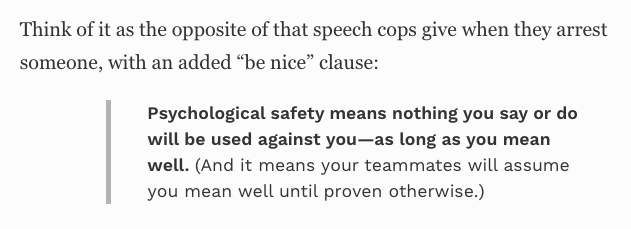
Psychological safety is an important concept for organizations. But how do you get it, without going too far, into safetyism? Here's a really helpful answer, from @shanesnow
https://t.co/m2zY0MDRzS
We’ve looked at the Influencer Marketing performance of over 20,000 brands. The key to success isn’t money, it’s a shift in strategy.
https://t.co/Zqv9VYsY6S
We took a look at sports influencer marketing by Apparel & Accessories brands. @adidas goes home early, @nike performs well, but which unlikely brand takes home the Influencer Marketing World Cup? https://t.co/6z5zdxhbbW
We’re publishing our first beauty influencer marketing leaderboard, comparing performance by company. Well done to @JeffreeStar !
https://t.co/fpyqDWX28Y
Really interesting case study from our research on "Grip" in influencer marketing. @Pampers and @MagnumGlobal both invested heavily in Fashion influencers this month – with very different results.
https://t.co/lbN4tL0WGK