Large-scale RL has a problem: weight updates from trainers to samplers are slow and expensive
We’re sharing weight teleportation: faster weight updates than existing intra-cluster techniques with internet speeds, enabling samplers anywhere (maybe even space!)
Weight teleportation is so efficient (<0.23s sampler pause time, ~3s non-blocking compression + prepare), the bottleneck ends up being the GPU hardware’s decompression ASIC
We unlock these gains by using GPUs for massively parallel compression of model weight changes, engineering a heterogeneous decompression and patching pipeline, along with other optimizations and overlaps. These techniques are co-designed with hardware-native features in NVIDIA’s Blackwell generation of chips
We’ve open-sourced weight teleportation, so everyone can use it today
While keeping model weights in 4-bit, increasing activation precision from 4 to 16 bits lets us make the kernel up to 25% faster for decode vs FlashInfer’s optimized NVFP4 MegaMoE
This gives up to 10% more generation throughput and 7% faster latency overall for real workloads
https://t.co/NoQE12qlwc
While keeping model weights in 4-bit, increasing activation precision from 4 to 16 bits lets us make the kernel up to 25% faster for decode vs FlashInfer’s optimized NVFP4 MegaMoE
This gives up to 10% more generation throughput and 7% faster latency overall for real workloads
https://t.co/NoQE12qlwc
Introducing Boba - the social intelligence that understands your goals and your community. Text Boba today or message it online at https://t.co/ZrF5yBrp2g
No one changes the world alone
Introducing Ampersand - the first model built for us. Ampersand is a collaborator trained to help people achieve their individual and collective goals. In multi-month simulations, users collaborating with Ampersand accomplished more than with Fable and other frontier models
Available to everyone through our API
Super excited to release our model that understands humans - the first large-scale user model that realistically simulates how humans talk and interact!
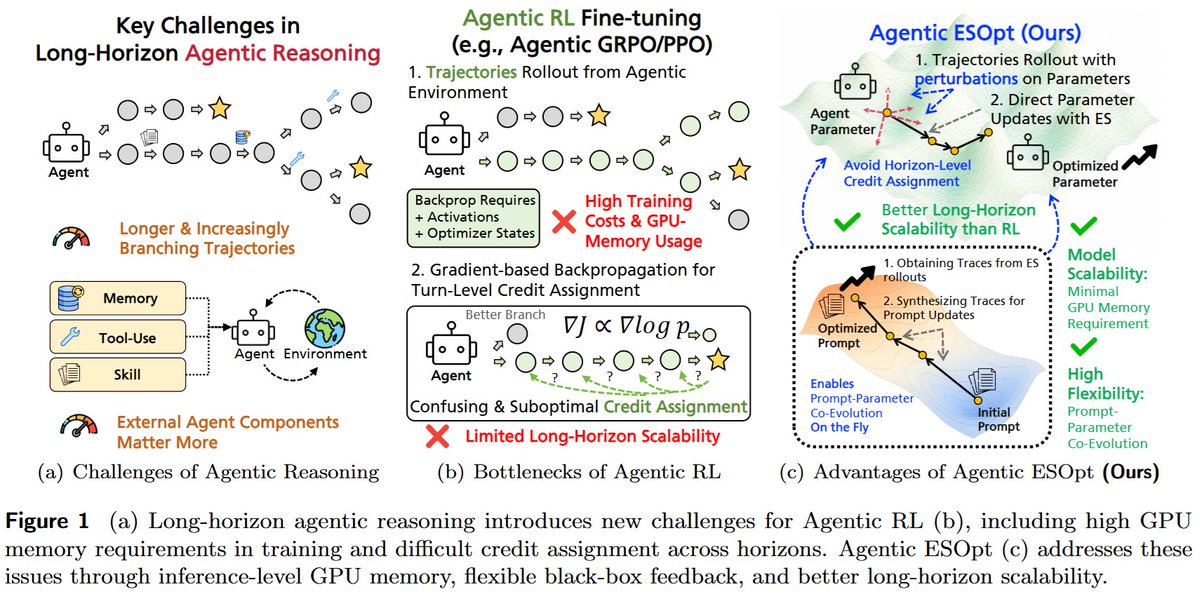
🚀 Will Agentic ESOpt Be the Future of Long-Horizon Agentic Fine-Tuning?
Excited to share our new work on Arxiv.
Agentic ESOpt: Fine-Tuning Long-Horizon LLM Agents with Minimal GPU Memory Requirements
As LLM agents become longer-horizon and more branching, conventional Agentic RL faces three growing bottlenecks: high training/memory cost and increasingly challenging long-horizon credit assignment.
Our Agentic ESOpt approaches agent fine-tuning from the parameter space instead, targeting three advantages:
⚡ Model Scalability — only minimal inference-level GPU memory requirement
🔧 Flexibility — prompt/skill–parameter co-evolution
⏳ Long-Horizon Scalability — trajectory-level parameter attribution without horizon-wise decomposition
There are impressive empirical results, and we believe ES may be a better-matched parameter fine-tuning paradigm as agents become larger and longer-horizon.
📄 Paper: https://t.co/E9JcGSRpA6
🌐 Project: https://t.co/RttR9ot7n5
💻 GitHub: https://t.co/QT3FW8vXwc
🤗 Models & Checkpoints: https://t.co/nTarfX3rCg
Code, training logs, and checkpoints have been fully open-sourced.
Main takeaways ↓
@humansand uses Miles as core infrastructure for production-scale, long-horizon, multi-agent asynchronous RL research, adapting it to its own orchestration and extending it with MXFP8 and NVFP4 low-precision RL recipes.
“Miles combines a high-performance foundation for RL training at scale with an ambitious technical vision. Together, we’re turning advances in algorithms and engineering into practical capabilities for demanding RL workloads.”
Ziang Li (@zianglih), humans&
A stable, hardware-native NVFP4 RL recipe from @humansand is now open source, and Miles is the trainer behind it! The blog calls it the 4-bitter lesson, that the hard problems live in the interactions between pieces, not the pieces themselves, which we've internalized deeply building Miles and SGLang.
Miles & SGLang keep quantization bit-exact across both sides: dequantized backward, 4/6 adaptive scaling at zero extra rollout latency, and selective precision that holds from checkpoint to rollout. Reward curves come out identical to BF16, while unlocking up to 9x tensor core FLOPs on next-gen NVIDIA GPUs.
Congrats @humansand, @zianglih, and proud to build this together with @nvidia!
At humans&, we train models from the long-term impacts of their interactions with people. This requires prioritizing long-horizon multi-agent RL. We've developed and are excited to share an open-source, hardware-native 4-bit RL recipe, significantly accelerating training
Loved seeing how @LinkedIn is using SGLang to accelerate large-scale RecSys ranking, and contributing major features back to both SGLang and @NVIDIA’s FlashInfer open-source stack.
SGLang is now powering LinkedIn’s latency-critical ranking workflows with:
• Massive prefill speedups
• Efficient multi-item scoring
• Production-ready FA3 attention
• Accurate and fast FP8 kernels
• End-to-end latency hiding for real-time recommendations
From multi-item scoring to FA3 to per-token FP8, this work shows what’s possible when strong engineering meets an open ecosystem. See the full blog 👇
Huge thanks to the @LinkedInEng team, @NVIDIAAIDev , FlashInfer and HazyResearch for pushing LLM serving forward together.