That's how the psychology behind private capital works a lot of times. Lead investors set an arbitrary valuation and everyone else swims in like goldfish.
Even if it's one ex-Anthropic with just a pitchdeck, they can just set a $1B+ valuation and still get funding.
If someone undervalues themselves, people get skeptical for some reason, rather than independently thinking it's an opportunity.
Even if I had a self-driving Cybertruck, I’d still bike to work.
But I’d still want to own it.
The truck carries my luggage.
I carry myself.
Autonomy replaces driving.
It doesn’t replace ownership.
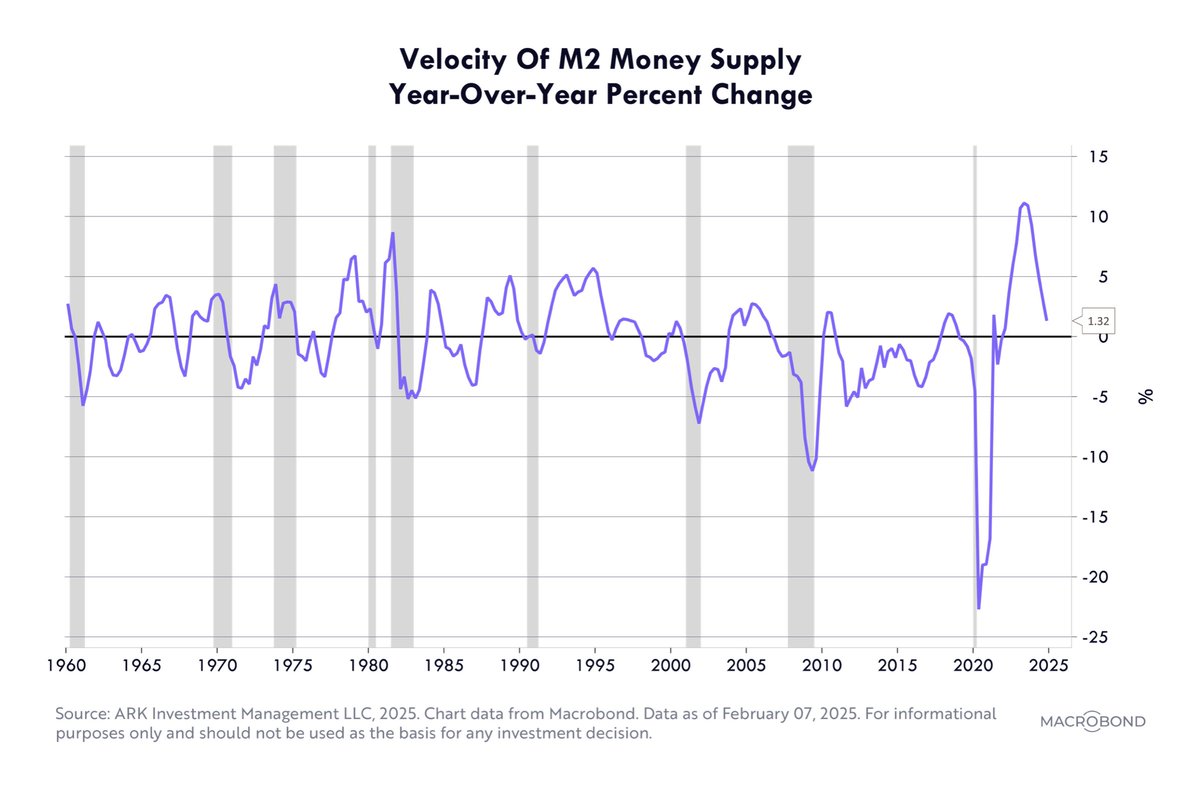
During the uncertainty associated with the transition from Biden to Trump, the velocity (V) of money is rolling over, suggesting that monetary policy is tighter than the Fed may understand. I discuss this hypothesis in our In the Know webinar (link below), including charts.
V can either turbocharge the impact of money on GDP, as it did during COVID, or detract from money growth, as it is starting to do now. On a year-over-year basis, V growth peaked at 11% in 2022 and has dropped to ~1%. During December, growth in M2 was 3.9% YOY, so V growth added another 1%, taking nominal GDP growth to ~5%.
More important at the moment, V declined ~1% sequentially from the third quarter to fourth quarter and probably is depressing GDP growth in the first quarter, which makes sense. Velocity can drop if individuals and companies become uncertain, fearful, or cautious.
Targeting waste, abuse, and fraud in government, @DOGE has put federal government employees on notice and on edge, but the impact could be much more pervasive. Federal government employment accounts for only 1.9% of total employment in the US, but state and local governments, education, health care, and social services account for another ~28%.
In other words, today nearly a third of the labor force, and perhaps their families, could be holding back on spending until they see the impact of rapid policy changes. While we believe the changes will be net positive for the economy - perhaps massively so - the short term uncertainty is palpable. After benefiting from preemptive buying in the fourth quarter to get ahead of tariff hikes, Walmart shocked the market last week by lowering guidance for same-store sales growth in 2025 to 3-4%, ~30% below its 5% gain in 2024.
I believe that the US has entered the last stage of the rolling recession that has been in place since the Fed hiked interest rates by a record-breaking ~24-fold in little more than a year starting in 2022. The consumer is the last sector to succumb. As this Administration succeeds in pushing funding from the federal sector to state and local governments, economic growth should begin to rebound during the second half of this year.
As a result, interest rates are likely to surprise on the low side of expectations in the short term while the Trump Administration puts in place policies that eventually will increase consumer and business confidence: they are likely to unleash the animal spirits and productivity that have been building thanks to breakthroughs in robotics, energy storage, AI, blockchain technology, and multiomics sequencing.
Turbocharged by AI, real growth should accelerate significantly from the 3% in place since 1900 during the next five years. We believe that, after recent downside volatility, equity markets soon will look beyond short-term uncertainty and reward strategies exposed to truly transformative innovation.
Full episode: https://t.co/YE8UswE61f