Welcome to the official account of Hou Lab
We focus on AI-assisted drug design, spanning small-molecule drug design, biomacromolecule design and multiscale molecular simulations. 🧬💊
We also develop and maintain platforms and tools such as DrugFlow, ODesign, ADMETlab, PROTAC-DB, and more. 🛠️
Website: https://t.co/ahIhLV2MjV
People: https://t.co/GESej28T8W
Publications: https://t.co/7YCwaTAsmU
Software: https://t.co/uARiVmU4sU
DrugFlow: https://t.co/kbbPJeuDvf
This account is collectively operated by members of the lab and is intended for sharing research updates, publications, tools, and lab news.
AI-powered virtual screening is becoming faster and more accurate — but choosing the right model and building a complete workflow can still be challenging. 💻💊
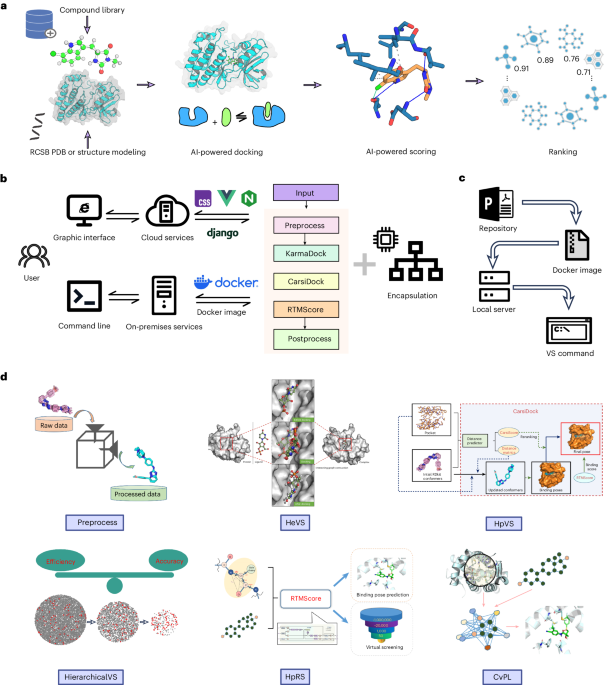
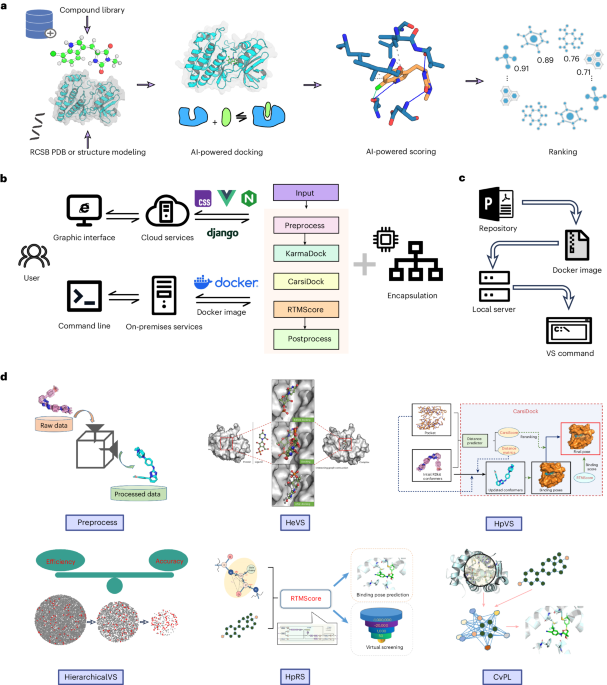
In our new protocol published in @NatureProtocols , “Facilitating structure-based drug discovery with an artificial intelligence-driven virtual screening platform,” co-first authors Shukai Gu, Xujun Zhang, and Mengwu Xiao present CVSP-AIE, a user-friendly platform for AI-driven structure-based virtual screening.
🚀 1. What is CVSP-AIE?
CVSP-AIE integrates three complementary AI models:
⚡ KarmaDock for ultra-fast molecular docking
🎯 CarsiDock for accurate and physically plausible binding-pose prediction
📊 RTMScore for protein–ligand affinity scoring and reranking
By applying these models hierarchically, the platform dynamically balances screening speed and accuracy.
🧩 2. What can users do?
The online platform supports the complete virtual screening workflow, including:
🧹 Protein and compound-library preprocessing
🔍 Efficient, precise, hierarchical, or rescoring-based virtual screening
🧬 Protein–ligand interaction analysis and visualization
🗺️ Interactive chemical-space and molecular-property analysis
Users can initiate a screening task by simply uploading a target protein, a reference ligand, and a compound library.
⏱️ 3. How efficient is it?
The hierarchical workflow can screen 100,000 compounds in approximately 30–45 min, combining fast initial screening with accurate docking and rescoring of top-ranked candidates.
For larger projects, CVSP-AIE also provides a locally deployable package, enabling command-line screening of compound libraries at arbitrary scale while preserving local data privacy. 🖥️
🌐 4. Ready to use
The web server is freely available at:
https://t.co/o2mVPK7JGB
The local hierarchical screening workflow is also available through Docker and PyPI, making the platform accessible to both computational researchers and users without extensive programming experience.
✨ Overall
CVSP-AIE brings preprocessing, AI-powered docking, scoring, molecular ranking, interaction analysis, and chemical-space visualization into one integrated workflow — helping make structure-based virtual screening more efficient, flexible, and accessible.
Read the full article here:
https://t.co/Lcl99I2i9u
#NatureProtocols #DrugDiscovery #VirtualScreening #AIforScience #AI4DrugDiscovery #MolecularDocking #ComputationalChemistry #ComputationalBiology #StructureBasedDrugDesign #MachineLearning #DeepLearning #Cheminformatics #MedicinalChemistry #CADD
Research, the first Science Partner Journal jointly launched by the China Association for Science and Technology (CAST) and the American Association for the Advancement of Science (AAAS), has received its latest metrics:
📈 Impact Factor (2025): 12.9
🌍 Ranked #13 among multidisciplinary natural science journals
📊 CiteScore 2025: 13.5
🏆 JCR Q1
The journal publishes high-impact research across materials science, AI, health sciences, energy, quantum information, micro/nanotechnology, space science, and other interdisciplinary frontiers.
Congratulations to the editorial team, authors, reviewers, and the entire community on this exciting milestone!
https://t.co/T5BbKxVols
Targeting the intrinsically disordered AR-NTD through a machine learning-based enhanced sampling workflow
In our new work published in @NatureComms , co-first authors Kai Zhu @KaiZhu560347 , Huating Wang, and Jintu Zhang report a computational-experimental strategy for targeting the intrinsically disordered N-terminal domain of the androgen receptor (AR-NTD).
🔬 1. Why AR-NTD?
Most approved androgen receptor antagonists target the ligand-binding domain. However, drug-resistant prostate cancer can bypass this route through AR mutations, amplification, and splice variants. Since these resistance mechanisms often retain the N-terminal domain, AR-NTD represents an attractive but challenging therapeutic target.
🧠 2. What is the key idea?
For intrinsically disordered proteins, the target is not one static structure, but a dynamic ensemble.
By combining enhanced sampling simulations with machine learning-based collective variables, we mapped the conformational landscape of the Tau-5 region of AR-NTD and identified transient druggable conformations.
⚙️ 3. What did we find?
The workflow integrates REST3, AutoEncoder-based collective variables, SWISH, OPES, and Deep-TICA. It identified nine metastable conformations and revealed key features of ligand recognition, including π–π stacking, aromatic residues, and structured water-mediated hydrogen-bond networks.
💡 4. What did this enable?
Guided by these druggable conformations, we performed structure-based virtual screening and discovered K53, a rationally designed AR-NTD antagonist.
K53 directly binds the AR-NTD-AF1 region, suppresses AR transcriptional activity, downregulates canonical AR target genes, and shows potent anti-proliferative activity in enzalutamide-resistant prostate cancer cells. 🎯
🚀 Overall
This work highlights how machine learning-enhanced molecular simulations can help transform dynamic IDP ensembles into actionable opportunities for rational drug discovery, providing a potential roadmap for targeting other challenging intrinsically disordered proteins.
Read the full article here: https://t.co/s07dYBnWND
#DrugDiscovery #AIforScience #MachineLearning #MolecularDynamics #EnhancedSampling #IDP #AndrogenReceptor #ComputationalBiology #ComputationalChemistry #MedicinalChemistry #MolecularSimulation #AI4DrugDiscovery
Excited to share LiTENexus from our lab!
An end-to-end virtual drug discovery system built on quantum chemical grounding, with code, preprint @ChemRxiv , and website now available.
Great work by Qun Su and collaborators — stay tuned for more updates!
⚛️ The First Quantum Chemistry-Driven End-to-End Virtual Drug Discovery System: LiTENexus Officially Released
🧪 Industry Pain Point: The Critical Gap Between "Active Molecule" and "Drug Candidate"
A molecule showing promising activity in silico still faces multiple validation hurdles before becoming a qualified drug candidate, including solubility, membrane permeability, in vivo exposure, toxicity, and target selectivity. Most current AI molecular models rely on data-driven statistical fitting, leading to unstable performance in out-of-distribution (OOD) chemical spaces such as natural products and cyclic peptides, as well as poor interpretability. This has become the fundamental bottleneck preventing AI drug discovery from evolving from an "auxiliary tool" to a "decision core".
⚛️ Core Paradigm Shift: Return to First Principles of Physics
LiTENexus introduces the Quantum Chemical Information Injection (QCII) mechanism, which for the first time directly encodes fundamental quantum chemical laws (potential energy surfaces, charge distributions, dipole moments, etc.) into neural operators, building an end-to-end quantum-inspired virtual drug discovery platform.
Vertical Integration: Unified cross-scale mapping from quantum chemical fundamentals → physical representations → macroscopic pharmacological properties
Horizontal Closed Loop: Complete workflow covering molecular generation → conformation optimization → virtual screening → ADMET prediction → multi-objective optimization
Core Foundation: The LiTEN-Base universal physical operator provides a unified physical representation backbone for the entire pipeline
🔑 Fundamental Technical Breakthrough: LiTEN-Base Cross-Scale Physical Representation Engine
Unlike traditional models that only learn data correlations, LiTEN-Base treats molecules as continuous physical distributions in local geometric fields, and accurately characterizes molecular interactions through its original dual-module design:
Many-Body Interaction (MBI) Operator: Captures local chemical environments within 5Å, precisely modeling fine structural features such as bond angles and torsional energy barriers
Dual-Body Interaction (DBI) Operator: Extends the receptive field to 10Å, explicitly simulating long-range non-covalent interactions including dipole-dipole effects and induced polarization
Through staged physical pre-training on tens of millions of quantum chemistry data points, LiTEN-Base internalizes the basic physical laws governing molecular behavior, and differentiates into two foundational modules: LiTEN-FF (conformational optimization) and LiTEN-Micro (microscopic property prediction), fundamentally solving the poor generalization and weak interpretability issues of traditional models.
🔬 Quantum-Level Microscopic Precision with Unprecedented Speedup
Delivers prediction accuracy matching the M06-2X DFT method, while running 2–3 orders of magnitude faster than standard DFT calculations
Achieves a conformational optimization MAE of 0.09 kcal/mol, well below the 1 kcal/mol chemical accuracy threshold
Outperforms mainstream functionals (PBE, B3LYP-D3BJ) in charge distribution and molecular dipole moment prediction
💊 State-of-the-Art Macroscopic Pharmacokinetic Prediction
Surpasses 20+ SOTA baselines (including KPGT and CHMR multimodal architectures) on the Biogen industrial dataset
Excels in 25/33 metrics on PharmaBench and 62/77 tasks on ADMETLAB 3.0
Exhibits robust out-of-distribution (OOD) generalization for natural products and cyclic peptides
🔍 Novel Cross-Modal Virtual Screening Paradigm
Introduces Quantum Manifold Dense Retrieval (QMDR) framework for pose-free target-ligand interaction modeling
Achieves EF₁% = 44.06 on DUD-E (38.2% improvement over DrugCLIP)
Delivers EF₁% = 6.77 on the challenging LIT-PCBA benchmark for true binder discrimination
✅ Modular End-to-End Drug Discovery Pipeline
Unified end-to-end workflow spanning molecular generation, conformation optimization, ADMET evaluation, and virtual screening
All modules are fully interoperable and can be used independently for targeted research tasks
🌐 Online platform: https://t.co/kkwS9aCZEC (Welcome to use)
📄 Preprint: https://t.co/tViKXLyGkg
💻 Open-source code: https://t.co/K9Mb2H6oVv
#AIDD #DrugDiscovery #VirtualDrugDiscovery #AIforScience #QuantumChemistry #PhysicsInformedAI #MachineLearning #ComputationalChemistry #FirstPrinciplesAI