AI systems are becoming more capable.
The next challenge isn't generating better outputs —
it's processing information from multiple sources without compromising privacy or trust. ⚙️
Verification, encrypted computation, and explicit trust boundaries will become core building blocks for AI in Web3.
That's the infrastructure direction we're continuing to explore at ZKBotX.
#AI #ZK #AIInfra #Web3
The future of AI in Web3 won't be defined by models alone.
It will be shaped by the infrastructure that supports them.
Privacy-preserving computation.
Verifiable execution.
Composable integrations.
These foundations matter more than short-term narratives.
Infrastructure first.
Hype second.
That's how we think about AI systems at ZKBotX. ⚙️
#AIInfra #ZK #Web3
CZ Suggests Freezing Satoshi's Bitcoin to Address Quantum Threats
Binance founder Changpeng Zhao (CZ)@cz_binance said in a June 18 interview with Galaxy that if Bitcoin forks in the future to adopt quantum-resistant cryptography, the community could give Satoshi-linked addresses holding about 1 million BTC a 6- to 12-month migration window. If the coins still do not move, the new protocol should freeze those addresses.
CZ said that otherwise, the coins could eventually be claimed by the first person to crack the private keys with quantum computing. He acknowledged there is no perfect solution and said the final decision should be made by the community, potentially through miner signaling.
Volatility tests every capital structure. Strategy remains focused on Bitcoin, disciplined capital allocation, credit quality, and long-term value creation. We appreciate our investors and will continue to execute with transparency and resolve. $MSTR
Trust is becoming one of the most important layers in AI-powered systems.
As AI agents gain more autonomy, the question is no longer what they can do.
It's how their actions can be verified without exposing sensitive data.
Zero-knowledge architectures introduce a different model:
• Verifiable outcomes
• Explicit trust boundaries
• Privacy-preserving execution
This is the design space we're exploring at ZKBotX. ⚙️
#ZK #AIInfra #Web3
AI systems are only as reliable as the data they operate on. ⚙️
As AI agents increasingly interact with Web3 environments, the challenge is no longer just intelligence —it's how data from multiple sources can be verified, processed, and protected.
Multi-source encrypted architectures introduce a different approach:
• richer context
• controlled access
• privacy-preserving computation
Building trustworthy AI starts with building trustworthy data layers.
This is part of the infrastructure direction we're exploring at ZKBotX.
#ZK #AIInfra #Privacy #Web3
AI agents are becoming increasingly autonomous.
But autonomy without verifiable trust models creates new systemic risks for Web3 environments.
Privacy-preserving computation and ZK-based verification may become foundational layers for next-generation AI infrastructure.
#AI#ZK #Web3 #AIAgents
Adaptive AI systems require more than intelligence.
They require:
• verifiable decision flows
• privacy-preserving memory
• controlled execution boundaries
In decentralized environments, these constraints become infrastructure-level requirements — not optional features.
#ZK #AIInfra #Infrastructure
As AI systems become more adaptive,
the challenge isn’t just learning — it’s learning within clear trust boundaries. ⚙️
In Web3 environments, autonomous systems must balance:
• verifiable computation
• privacy-preserving execution
• controlled access to sensitive data
ZK-based architectures introduce a path toward adaptive AI systems that remain accountable by design.
This is part of the infrastructure direction we’re exploring at ZKBotX.
#AI #ZK #AIInfra #Web3
As AI agents become part of Web3 workflows,
integration matters as much as intelligence.
Systems need assistants that can operate across protocols, respect privacy boundaries, and adapt to different trust assumptions.
Seamless integration isn’t just about APIs —it’s about composable infrastructure.
That’s the direction we’re building toward at ZKBotX.
#AI #ZK #AIInfra #Web3
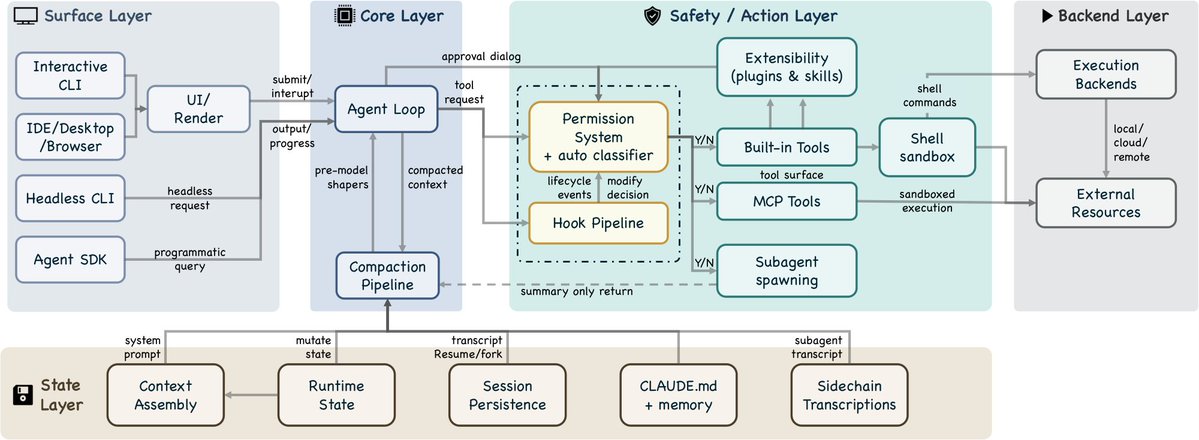
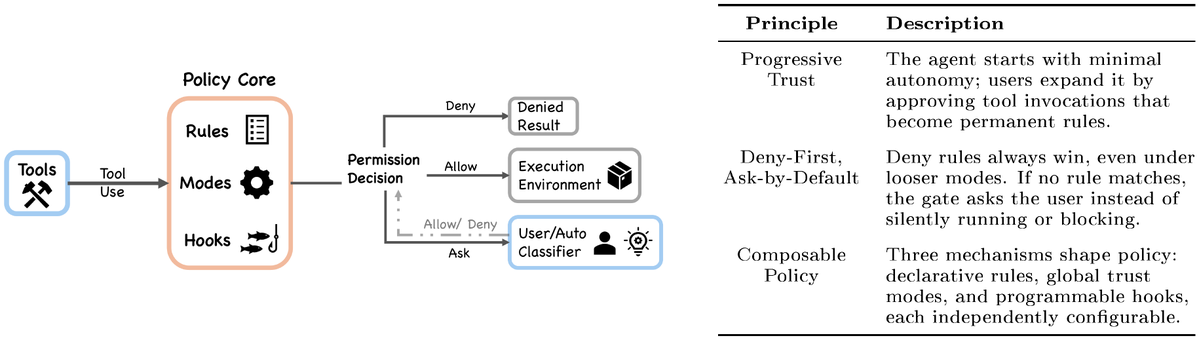
Dissecting production agent harnesses like Claude Code highlights real trade-offs: long-horizon planning vs. verifiable execution without central points of failure.
Strong framing for practical system design.
A must read for anyone interested in building practical AI systems in 2026:
Dive into Claude Code: The Design Space of Today's and Future AI Agent Systems
The paper explains the architecture of a modern production-grade AI agent system (Claude Code) by analyzing its source code. This is what they call a "harness" of an agentic coding system.
Learn by reading with an AI tutor: https://t.co/sailmnkDcR
PDF: https://t.co/Jvl4HRMU4y
AI assistants in Web3 environments must operate under different constraints:
• Limited data exposure
• Verifiable computation
• Privacy-preserving execution
These requirements turn AI from an application feature into infrastructure.
This is the design space we’re exploring at ZKBotX.
#AI #ZK #AIInfra #Web3
Web3 doesn’t stop — and neither should AI infrastructure.
24/7 encrypted AI support means systems can operate continuously while preserving privacy and trust boundaries.
Always available.
Verifiable by design.
Built for decentralized environments.
This is the direction we're building with ZKBotX. ⚙️
#ZK #AIInfra #Web3 #Privacy
Valid boundary on ZK: correctness proofs alone don’t deliver fully permissionless, privacy-preserving chain access. Trade-off between light-client UX and censorship-resistant data availability remains the open engineering question.
Some of the biggest scams in crypto were hoisted on people under one simple pretext:
"But you can self-host your own node!"
This simple red herring has enabled all kinds of compromises to our sovereignty when using crypto.
Now first, let me be clear: self-hosting is great. Running your own node is great. Compared with having to trust companies to not screw you over, it's absolutely massive.
However, the "you can self-host" distraction actually harms the practical decentralization and sovereignty of the space in two key ways:
1) Not Everyone Needs to Run a Node!
The entire novel innovation of crypto is a decentralized, unified, guaranteed network that remains censorship resistant.
The whole point of this is that you don't need to self-host to have censorship-resistance guarantees. You can just use the self-funded, self-running decentralized network.
By deliberately engineering protocols like Bitcoin (and to a lesser extent, Ethereum) in order to make node-running accessible for hobbyists, everyday transactions and actual use by said hobbyists became out of reach.
In other words, people were made to be able to run nodes to validate transactions they themselves can't afford.
2) Ignore Centralization If You CAN Self-Host
The even darker part: by giving a self-hosting option, users are distracted from the blatant centralization and censorship vectors facing 99% of users.
A great example of this is Lightning, where anyone can theoretically run their own node and manage their own payment channels in a fully peer-to-peer way. But practically, it's immensely clunky, technical, involved, and expensive.
As a result, almost all users use fully-custodial systems, or at best extremely-centralized semi-custodial services, and this goes ignored because theoretically anyone can self-host.
The Real Holy Grail: No Need to Self-Host
The real innovation we should be striving for: no need to self-host!
The most innovative freedom projects take the core foundational principle of crypto that started with Bitcoin: that the system makes it so that honest miners will run a censorship-resistant network without all participants having to run miners themselves.
They take this foundation, and apply the principle to every level of the stack.
Essentially, anywhere in the entire experience of an average user where there's a company or centralized service in there that they need to trust, find a way to decentralize it, without requiring the user to self-host.
We've already made amazing progress on this already, and we can keep doing better.
But we have to learn to avoid the self-host red herring.
Designing AI assistants for Web3 means balancing these constraints carefully.
Privacy-preserving AI isn’t just a feature layer.
It’s infrastructure.
Exploring this design space is part of what we’re building with #ZKBotX — where AI systems interact with Web3 while preserving verifiable privacy.
#ZKBotX #AIInfra #Web3
AI assistants are beginning to interact with on-chain systems.
But the real challenge isn’t intelligence — it’s trust architecture.
• Who can access data?
• Who can trigger actions?
• How can interactions be verified without exposing sensitive inputs?
These questions will define how AI operates in Web3.
#AI #Web3
Traditional AI assumes full visibility of data and context.
Web3 environments cannot.
This is where zero-knowledge technology changes the model:
• Computation with verifiable outcomes
• Sensitive inputs remain private
• Trust without full transparency
But ZK also introduces new challenges — cost, latency, and system complexity.
#ZK #AI
Not every Web3 system needs the same assistant.
Different environments require different trust assumptions, data boundaries, and execution logic. ⚙️
ZK-based assistants should be composable infrastructure — adaptable to the needs of each protocol rather than fixed products.
That’s the philosophy behind ZKBotX:
privacy-preserving AI assistants designed for diverse Web3 use cases.
#ZK #AIInfra #Web3
Vitalik: zk Will Transform Not Only Blockchains, but the Entire Internet
On January 27, Ethereum founder Vitalik Buterin stated at the ETH ChiangMai togETHer Tuesday event that zero-knowledge proofs (zk) offer not only privacy and scalability benefits for blockchains, but may also extend their impact to broader internet use cases.
zk technology enables the verification of computation results without revealing the underlying data, providing new approaches to identity verification, algorithm transparency, and large-scale computation verification. He added that as technologies such as zk-SNARKs continue to mature, their range of applications is expected to expand significantly over the coming years.
Source: https://t.co/tOsHFfrts0
Deploying AI in Web3 shouldn’t require exposing user data or compromising trust boundaries. ⚙️
ZK-based assistants can be integrated as infrastructure components —
not as black-box services, but as verifiable modules within your system design.
Launching is only the surface.
The real work lies in defining computation, access, and assumptions correctly.
That’s the approach we’re building toward at ZKBotX.
#ZK #AIInfra #Web3