"They can and will now legally scan any person's messages, emails and photos you send without a warrant"
Not an issue for customers of https://t.co/m2jsJuCX8k, for the messages don't exist.
Spent my morning reading this recent speech from @SecScottBessent. It lays out a new and defining vision for America's role in the economy for the next 100 years. @elerianm calls it a "remarkably important speech."
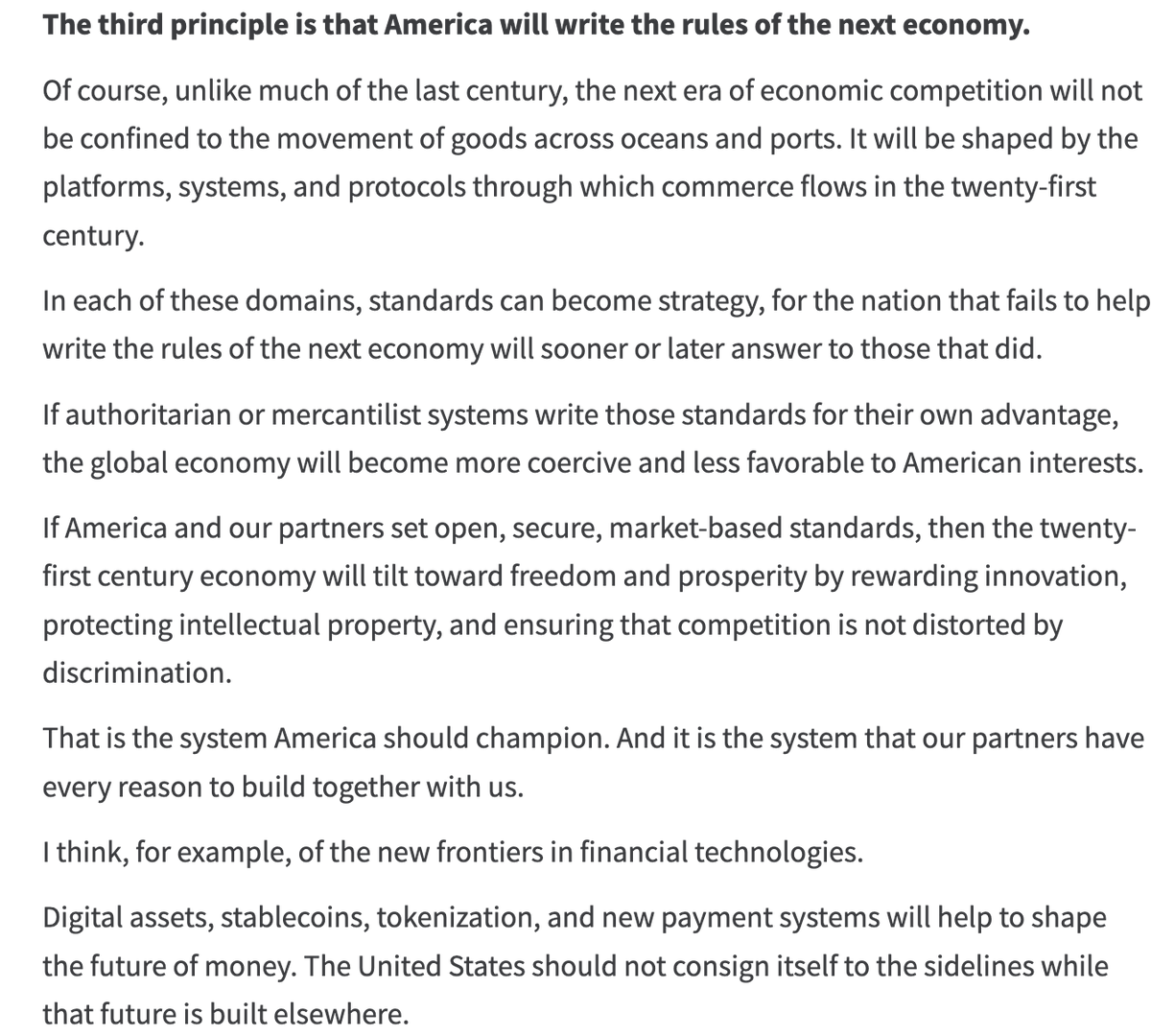
Bessent organizes his vision around five principles. Principle 3 is, "America will write the rules of the next economy." He gives one example of what this means:
"Digital assets, stablecoins, tokenization, and new payment systems will help to shape the future of money. The United States should not consign itself to the sidelines while that future is built elsewhere."
If you've wondered how committed Washington is to making crypto succeed in the US, that tells you something.
Not all blockchains are the same.
🤝Operator attested: the signing key is the last line of defense.
🔐Cryptographically enforced: the math is.
One has been broken repeatedly. One cannot be.
This is why Institutions building resilient infrastructure are choosing ZKsync.
The 10 $ZK Fee That Could Turn Every Bank-to-Bank Message Into $ZK Buybacks
For over fifty years the world has run on infrastructure invented in 1973. Seven banks created SWIFT to fix chaotic cross-border messaging. Today it handles 53 million messages daily and routes roughly $150 trillion a year. Looks impressive from the outside.
Well, here’s the thing. Underneath all that volume are the same old 1970s limitations, multi-day settlements, batch processing, layers of correspondent banks, and core systems still written in COBOL, a language older than the internet. Capital sits idle. Opportunity cost piles up, you know. Every coordination between institutions burns time and money that should be working harder.
Not only that, but in March 2026 that era started to end.
Not because the old system broke down, but because something far better finally arrived.
With governance proposal v31 (ZKsync Connect native interop) now active, ZKsync has turned on something transformative. Atomic, programmable interoperability across any Prividium chain and the entire ZKsync network.
Every time two banks need to settle, pledge collateral, move tokenized assets, or sync state, it can now happen in roughly one second. Privately. Compliantly. And with a small protocol fee attached.
That fee is 10 $ZK per interop call.
Sounds tiny on its own. 10 ZK Token doesn’t feel like much. But scale changes everything. Because it’s not one call, it’s thousands. Not one bank, it’s hundreds. Not once a day, but constantly. And when all of that starts stacking, that “small fee” turns into a continuous stream of value flowing back into the system.
And this is where it starts getting really interesting…
Under ZKsync’s evolved tokenomics direction, 100% of protocol revenue, including every single interop fee, flows back into value accrual for $ZK: open-market buybacks, programmatic burns, staking rewards, and ecosystem growth.
The fee is simple (as described above): 10 ZK Token per call.
But zoom out for a second, picture this.
A single large bank or consortium can easily generate thousands of these coordination events every day, treasury movements, collateral adjustments, settlements, compliance syncs… it adds up fast.
Now scale that.
With ~100 major banks and consortia running Prividium chains (a pretty conservative near-term number), the volume becomes structural.
Even capturing a small slice of SWIFT’s ~53 million daily messages pushes this into hundreds of thousands… even millions of interop calls per day.
A rough, conservative view:
500,000 calls/day × 10 $ZK = 5 million ZK Token per day flowing into the protocol.
And that’s just the starting point.
At higher adoption, this easily moves into tens of millions of ZK Token daily, from actual usage, really. Sustained buy pressure, permanent supply reduction through burns, and real staking yield tied straight to institutional activity.
This is the first token that’s positioned to earn from the high frequency, high margin coordination that has always powered traditional finance.
The protocol worked. $290M is gone. No bugs.
This is what operator-attested infrastructure looks like when it fails.
And why cryptographic enforcement is the only path for responsible and secure Institutional adoption.
Those who say "crypto is dead" or "DeFi is dead" don't know what they are talking about.
Banks never operated in such harsh conditions, and they always get saved by the Big Printer. As a result, their infra is horrifically bad.
In DeFi, we have to make sure that our stuff is solid, and only the fittest survives
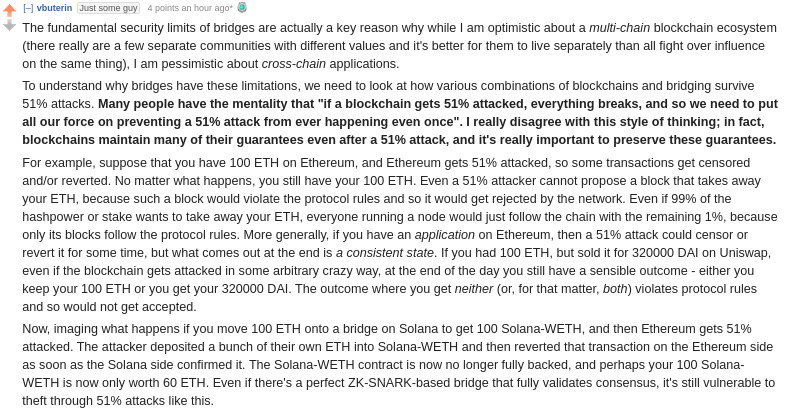
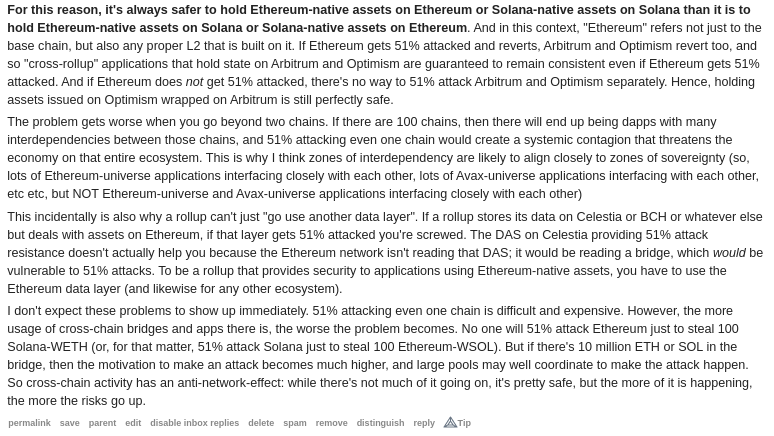
My argument for why the future will be *multi-chain*, but it will not be *cross-chain*: there are fundamental limits to the security of bridges that hop across multiple "zones of sovereignty". From https://t.co/3g1GUvuA3A:
Wall Street is moving onchain. The question isn't if. It's which infrastructure wins.
I sat down with @VivekVentures and @dannyryan from Etherealize to talk about Ethereum's role in tokenization, stablecoins, AI agents, and the regulatory path ahead. As ever, please enjoy!