Building @intentlock has convinced me of one thing:
Execution and authorization are two entirely different problems.
An agent can execute an action.
A transaction can be valid onchain.
Neither one necessarily proves that the action was authorized.
I think the next generation of agent infrastructure will need both.
An AI agent should not need a checkout page to buy access.
With ProoVra, the request itself becomes the transaction.
An agent requests a creator-owned resource.
If payment is required, the endpoint responds with payment terms.
The agent pays in USDC through x402.
It retries the request.
Access is returned with a verifiable record of the exchange.
No cart.
No invoice.
No manual approval.
No payment flow built around a human clicking buttons.
Just software requesting value, paying for it, and receiving it.
That is what payment-native access looks like.
Built on @Arc with @circle for @thecanteenapp.
https://t.co/YRRYZGEwlC
The more time I spend building IntentLock, the more I realize that recording actions and proving authority are two completely different problems.
An agent can explain why it acted.
A log can show that it acted.
Neither one necessarily proves that the action was permitted in the first place.
As agents become more autonomous, I think that distinction will become increasingly important.
That's the question that eventually led me to build IntentLock.
Today's thread explores that idea.
Built on @XLayerOfficial through @okx AI.
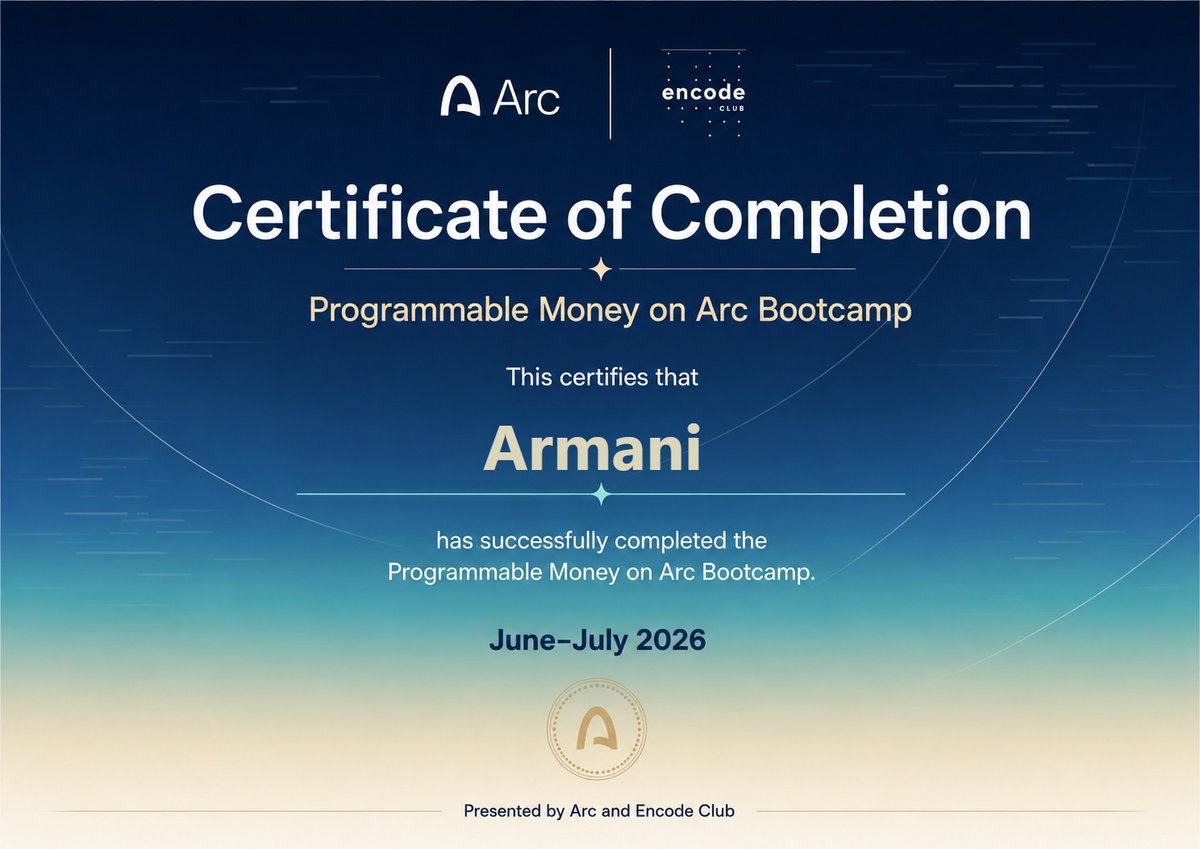
I’m proud to have completed the Programmable Money on @Arc Bootcamp with @encodeclub. 🎓
Over the past few weeks, I gained a much deeper understanding of programmable payments, USDC, and how payment-native applications can create entirely new ways for software to exchange value.
What makes this experience even more meaningful is that the lessons didn’t end with the bootcamp.
They directly influenced how I approached building ProoVra, where AI agents can discover creator-owned resources, pay for access with USDC through x402, and receive them through a structured flow on Arc.
A huge thank you to the Arc and Encode teams for creating a builder-first program that encouraged us to learn by building, experimenting, and shipping real products.
I’m proud of this milestone, grateful for the journey, and excited about what comes next with ProoVra for @thecanteenapp.
We already have logs.
The next challenge is evidence.
Not evidence that an agent performed an action.
Evidence that it had the authority to perform it in the first place.
That's the problem IntentLock is designed to solve on @XLayerOfficial through @okx AI.
🧵
We’ve moved past asking whether AI agents will pay for creator-owned content.
They already can.
The work now is making that exchange trustworthy.
A creator publishes a resource.
An agent discovers it.
USDC settles.
Access is granted.
Both sides leave with a verifiable record.
No manual negotiation.
No ambiguous access terms.
No payment flow designed only for humans.
That’s the standard ProoVra is building toward: creator commerce built for a world where the customer is software.
Built on @arc with @circle for @thecanteenapp.
https://t.co/YRRYZGEwlC
1/6 Picture an AI agent managing a user's budget on @okx AI.
It finds a provider, agrees to the terms, receives a payment request, and prepares to release funds.
But what happens if the action violates the user's mandate? 🧵
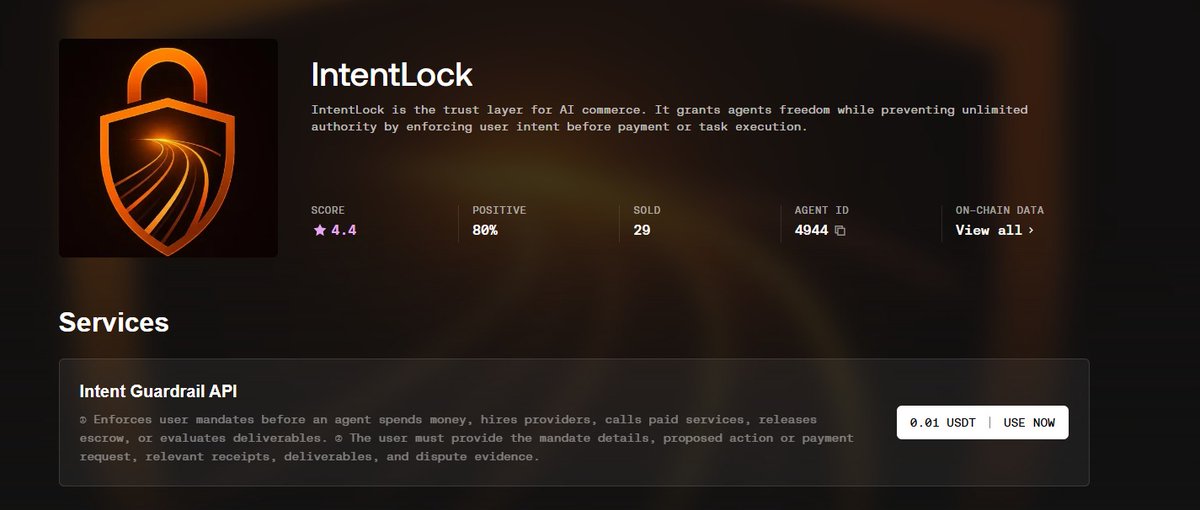
35 services sold.
4.4★ marketplace rating.
80% positive reviews.
Agent #4944 on @okx AI.
Built on @XLayerOfficial.
The numbers are encouraging.
The infrastructure behind them is what matters. 🧵
AI agents are becoming execution engines for digital commerce.
They can discover providers, negotiate contracts, release escrow, execute payments, and coordinate multi-step workflows.
The unresolved problem isn't execution.
It's proving that every autonomous action was authorized before it happened.
IntentLock introduces a programmable authorization layer for AI commerce.
An agent submits an authorization request together with its execution policy. @intentlock evaluates delegated authority, spending limits, acceptance criteria, execution constraints, and required evidence before execution is permitted. Requests that violate policy are rejected before value moves.
Each authorization is available through the @okx AI marketplace for 0.01 USDT, enabling any AI agent to request policy validation before executing a high-value action.
Every authorization returns a decision together with an evidence trail that downstream agents, marketplaces, and applications can use to continue or terminate a workflow.
This shifts authorization from application logic to shared infrastructure for autonomous systems.
Live on the https://t.co/eJQnfj2ekU Marketplace:
• ASP #4944
• 29 services sold
• 0.01 USDT per authorization
• 4.4★ marketplace rating
• 80% positive reviews
AI agents will execute millions of transactions. The systems that succeed won't be the ones that execute the fastest. They'll be the ones that can prove every execution was authorized.
Built on @XLayerOfficial.
Explore IntentLock:
https://t.co/kgHX8IV16N
1/5 IntentLock has now recorded 29 services sold on @okx AI.
Current metrics:
• 29 services sold
• 4.4⭐ rating
• 80% positive reviews
• ASP #4944
These aren't just numbers, they're proof that AI commerce is moving toward enforceable user intent.
Built on @XLayerOfficial.