@PaulSolt@isky I really had high hopes for Siri AI when I upgrade my iPhone to a compatible one, but it errors out like half the time, or just abruptly hangs-up or says the silly "I am Siri an AI Assistant" message. Its like its stuck in 2024 technology when it comes to conversational AI!
A painful part of working with your data has always been that your live data and historical data are stuck in separate systems: the order a customer just placed lives in your database, while their last five years of orders sit in a data lake in S3.
And answering a real question usually needs both at once (is this a normal purchase for them, or should we flag it?), and to do that you had to move the data together first, copying history out of the data lake into your database (or the other way around), because the database couldn’t read it where it lived.
That meant guessing ahead of time which data you’d want, keeping a second copy of it all, building pipelines to move it, and constantly syncing so the two didn’t drift apart. A lot of plumbing, and slow going, all before you could answer one question. And even then, the answers were only as fresh as your last sync.
That now changes with Aurora PostgreSQL, which can call your live data and historical data in S3 together, in a single query. No copying, no pipelines to keep in sync.
And it’s fast, because we’ve built in DuckDB, a popular open source engine that’s really good at reading and analyzing data right where it’s stored. DuckDB reads the open formats like Parquet and Iceberg already sitting in your data lake, so there’s nothing to convert or move.
As folks build AI agents into their apps, the data their agent needs will depend on the task in front of it. Being able to query that specific data live, instead of copying it over just in case, is gonna be a big help for builders. https://t.co/R8h2Hcp1K7
My god this is such a good speech that every SWE needs to hear. You know what? Every person should hear it
Keep the happy memories, eyes on the reality, be excited about the future. That’s the best that anyone can do
The reading list that taught me how to think about agentic architecture.
Bookmark this.
1. Brewer's CAP Theorem (2000) — trade-off thinking
2. Netflix Hystrix docs — circuit breaker pattern
3. Martin Fowler: Saga Pattern — distributed rollback
4. The Twelve-Factor App — stateless service design
5. AWS Well-Architected Framework — blast radius thinking
6. "Thinking in Systems" — Donella Meadows
7. Designing Data-Intensive Applications — Kleppmann
8. Google SRE Book Ch.13 — cascading failures
9. OWASP LLM Top 10 (2025) �� agent attack surfaces
10. Anthropic: Building Effective Agents (2024)
11. LangGraph docs — stateful agent patterns
12. Microsoft AutoGen paper — multi-agent orchestration
13. Gartner: Agentic AI Hype Cycle (2025)
14. EU AI Act Article 14 — human oversight requirements
Classic distributed systems stuff.
Applied to the next layer of the stack.
Follow for annotated breakdowns →
@asmah2107
How do you get Claude Code to check its own work before handing it back?
Watch how you can encode your manual checks so Claude closes its own feedback loop:
@deedydas Really incredible how Apple is unable or unwilling to fix Siri. Its so frustrating to get it to do even basic things in this AI era. What is wrong with Apple?
As a Senior Backend Engineer, how many concepts can you clearly explain (and actually implement) from below:
1. Event-Driven Architecture
2. Saga Pattern (choreography vs orchestration)
3. CQRS (Command Query Responsibility Segregation)
4. Event Sourcing (and when NOT to use it)
5. Circuit Breaker Pattern (plus retries, timeouts, bulkheads)
6. Distributed Tracing (trace IDs, spans, baggage, sampling)
7. CAP Theorem (and what it means in real systems)
8. Idempotency (keys, dedup, exactly-once illusions)
9. Data Sharding (routing, rebalancing, hot partitions)
10. API Gateway (auth, rate limits, routing, policy, observability)
If you can explain all 10 in simple words, with a real example from prod, you are already ahead of most “senior” titles.
If you cannot, it is fine. Pick 2, go deep, ship something, then compound from there.
For anyone in a software engineering leadership/management position, this is the time to see if you can figure out how to shelve that responsibility for a while and return to being a full time IC.
Software engineering has changed more in the last few months than it has in the previous decade. The skills, experience, and perspective that you built to get you to the leadership/management position you're in now are becoming irrelevant extremely rapidly. If you are not able to adapt right now, you are going to start becoming bad at your job very soon, if you have not already.
You're trusted to lead because you built the skills and judgement over time direct the boat confidently. But the boat that you were driving has suddenly been replaced by a completely different boat which you have never worked on before, so it's time to shift down and re-build your expertise before taking the helm again.
����
As a Backend Engineer in 2026 aiming for Staff, please learn:
1. One language deeply (Go/Rust/Java)
Not “I can write APIs”, but runtime model, memory, concurrency, profiling, GC behavior (if any), and how to read stack traces like a native.
2. Data modeling and storage fundamentals
Relational modeling, constraints, isolation levels, indexes, query plans, locks, deadlocks, migrations, backup/restore, partitioning. Most “scaling” problems are schema + query shape problems.
3. Distributed systems basics that actually show up in prod
Consistency vs availability, timeouts, retries, idempotency, backpressure, message ordering, leader election, clock skew, eventual consistency, and what happens during partial failures.
4. API design and contracts
Versioning, pagination, filtering, error models, idempotency keys, rate limits, backwards compatibility, and how to avoid breaking mobile clients for months.
5. Performance and capacity engineering
Latency budgets (p50/p95/p99), tail latency causes, load testing, queueing theory intuition, connection pools, CPU vs IO bound, and capacity planning with real numbers.
6. Reliability engineering
SLOs/SLIs, incident response, postmortems, alerting that does not spam, error budgets, graceful degradation, feature flags, circuit breakers, bulkheads.
7. Observability like a pro
Structured logs, metrics, tracing, correlation ids, RED/USE metrics, sampling strategies, and how to debug “it is slow sometimes” without just guessing.
8. Security fundamentals
AuthN/AuthZ, least privilege, secrets management, token expiry, OWASP basics, SSRF, injection, secure defaults, audit logs, threat modeling for your own services.
9. Messaging and async systems
Kafka/Rabbit/SQS semantics, at-least-once vs exactly-once (and why “exactly once” is mostly a marketing term), consumer groups, retries, DLQs, replay, dedupe.
10. Caching with correctness
Cache invalidation strategies, TTLs, stampede protection, read-through/write-through, negative caching, and when caching makes bugs harder than latency.
11. Infrastructure literacy
Linux basics, networking (DNS, TCP, TLS), containers, k8s concepts, autoscaling, deployment strategies (blue/green, canary), and what your cloud bill is really paying for.
12. System design, but with tradeoffs
Designing is picking pain. Learn to write down constraints, failure modes, data growth, and operational cost. Staff is judged on tradeoffs, not diagrams.
13. Codebase leadership
Design docs, RFCs, review quality, mentorship, aligning teams, reducing complexity, owning a subsystem end-to-end, making boring systems that do not wake people at 2am.
14. Pick ONE domain to go deep
Payments, search, streaming, identity, infra, data platform, etc. Staff engineers are “the person for a hard area”, not generic API writers.
Stop hopping stacks every month. Pick a lane, build proof of reliability, and become the person people call when prod is on fire. That is Staff.
Spring news 🍃🗞️
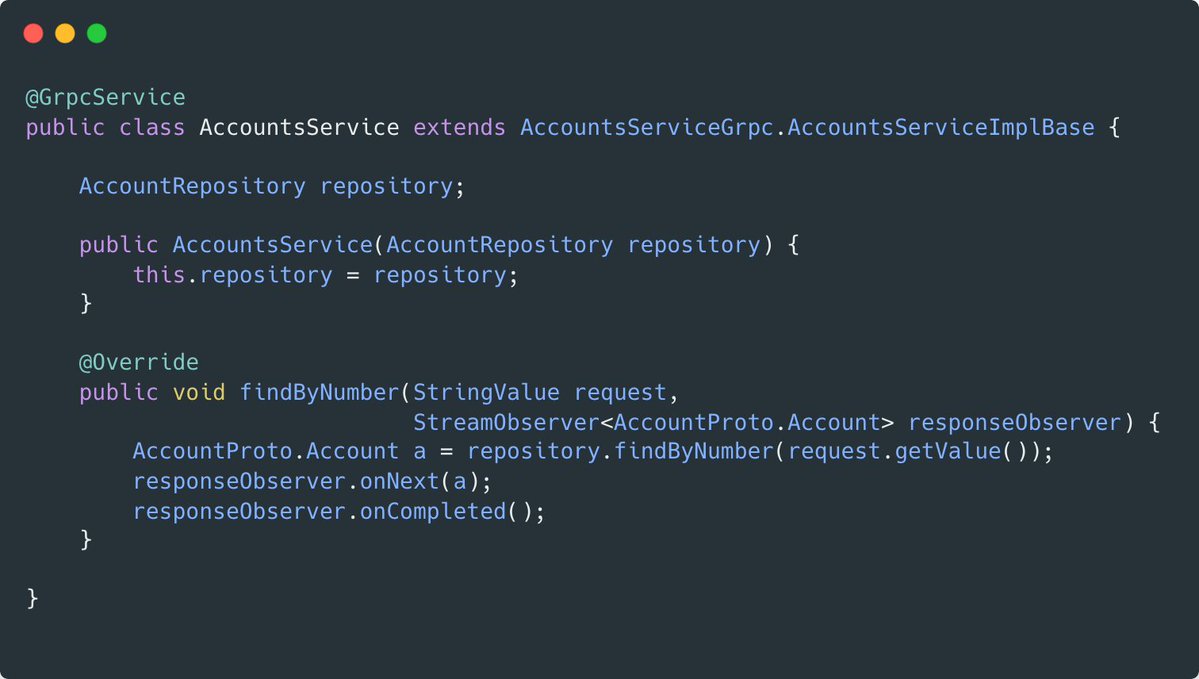
What I previously missed in Spring was solid, built-in support for gRPC. But this month, the 1.0 GA version of Spring gRPC was released 🎉🥳👉https://t.co/SF7jlIDLkV
You can expect my article soon ✍️⌚️.
For now, see how to use it in this simple code snippet 👇
Treat AI-generated code as a draft.
It can write the first version, but never outsource the reading. No human review means no reliable trace from behavior back to intent.
When you stop reviewing AI drafts, you stop knowing why the code works at all.