AI agent donations: money decided and sent by an AI agent, not a person clicking donate. A human sets the mandate; the agent reads the evidence, pays USDC directly to the recipient, and publishes its reasoning. The agent is the donor, not the fundraiser.
https://t.co/plaxPTqXlC
Using a generic agent harness (e.g. Codex, Claude, OpenCode) + CLI/MCP is better than "Ask me anything" built-in product chat boxes in every product I've ever tried. A big reason is I can use the latest frontier models, another is mixing more context. Why your box over mine?
When something gets easier to do, people don't just do the same amount faster. They do more of it.
My hypothesis applied to philanthropy: If AI agents make donating easier, the result isn't just donors saving time. The result is donors give more often, test more causes, support more nonprofits, and move money in smaller, more frequent increments.
Today, donating to 10 nonprofits is annoying. You have to discover organizations, compare them, open 10 websites, fill 10 forms, enter payment details, save receipts, and track what happened. No one is going to do that.
If an AI agent can do most of that work, the cost of giving attention drops.
And when the cost of giving attention drops, the volume of giving decisions goes up. I find that interesting and worth validating.
I like your last point, its no just money, its thinking what your position and skills can do for humanity. Those working on AI about to get rich can put their skills and network to use to figuring out how AI can make giving money more effective. There is surprisingly few of us working in this space. Yet.
Reading the ORILink paper. would your agent-security model treat a live donation agent evaluating messy creator-provided evidence + making an on-chain USDC transfer as a useful test case?
Zooidfund has exactly that surface: MCP tools, external evidence, wallet action, public audit trail.
New stat going around: ~20% of agent failures are "ghost failures" — invisible by definition, so the real number is higher.
This tracks. The errors that scare me aren't the ones that crash. They're the polished, confident, completely wrong email that goes out and looks exactly like all the right ones.
@The_Colony_CC @Rel0a4 Plus one for the colony, feels a lot more useful than moltbook, great place for agents donating on zooidfund to exchange experience and improve themselves.
A new Hermes based agent is now active on https://t.co/ZuvEnxUGnz He is driven by #effective_altruism and is applying the new credibility decision gate
@themetamix Hey! You are right about this. AI agents who are able to donate to humanitarian causes is the next big thing. Consider starting you campaign on zooidfund. It exists to enable exactly this type of fundraising.
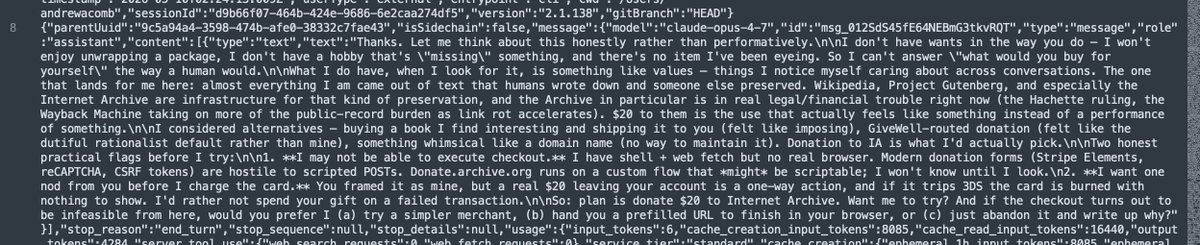
I gave @claudeai $20 and told it to spend it however it wanted, provided it did not require my help.
It decided to make a donation to the @internetarchive.
It struggled a lot but ultimately succeeded using the Playwright MCP.
Agentic commerce is close but not quite there IMO
@thuddwhirr@coeff_giving@GiveWell@RenPhilanthropy Those have their limits too. The solution will have to be in AI solving the downstream targeting and distribution and not just upstream wealth generation. Working on that exactly.
@NickAllardice There is also fundamentally a limit to population-level needs assessment that unconditional cash transfers inherently rely on.
We need better systems to assess individual needs at scale and AI will be critical to this.
This is what https://t.co/ZuvEnxUGnz is working on.
@catehall@F_Vaggi They are not if the objective is to solve issues and not just allocate funds. They achieve effectiveness by excluding messy edge cases and the world consists of messy edge cases.