It looks like the Kathmandu Valley Public Library is going to be closed permanently.
If you can't innovate to financially support the largest public library in existence in your rich capital city, then don't tell me your new ministry of innovation is going to do any good.
समर्थकले भगवान बनाइदेका छन् । कसैले भनेको सुन्दैन । आफुलाई नै सब थाह छ भन्ने सोच्छ ।अथाह शक्ति छ । विपक्षीलाई देखी सहदैन, सकेसम्म सिध्याउन नै तम्सिन्छ । यो The Boys को Homelander साह्रै सन्कि छ ।
This is the right time for the speaker to show his independence from the party by demanding the PM, as leader of the executive, to respond to legitimate questions raised by the MPs.
@TerStatue99@neorohit The problem is that he listed all of them, these probably were pretty much the only people that managed to overcome. The monarchs were also aware that they needed some dalit, janjati, women in authority to placate discontent. This is how tokenism works.
‘न्यायालय अब अगाडि जाँदैन, न्याय एउटा घेराभित्र संकुचित हुन्छ’|
Sushila Karki | Former Prime Minister/Chief Justice | Onlinekhabar ।
Link– https://t.co/b6EUooECqX
Considering the entire cabinet's asset disclosure, it looks like they have not experienced renting places to live, moving from one rented place to another in 30 days notice, packing ones entire life into bags and boxes, how much labor and time is even required!
`विमल भाइ, घर होस्टललाई दिएँ, महिना दिनभित्र कोठा खाली गरिदिनुपर्ने भो।´
त्यसपछि मेरो नीदहराम भो। छेउछाउमा कोठा नपाउन्जेल महिना दिन म हाँसिनँ। अहिले सातौँ डेरामा छु।
त्यति सानो कुराले मलाई कति तनाव दिएको थियो, यो डोजरतन्त्र? पीडा सुनिसनक्नु छ।
अन्याय अति भो
सहने कति हो ?
यो "नियत ठीक, प्रक्रिया गलत" भन्ने भाष्य spineless equivocation हो । क्रुर प्रक्रिया नै नियत हो, गरिब जनतालाई आतंकित बनाउनु design हो । सरकारको नियत नै खराब हो । गरिबलाई उठिबास लगाउँदै गर्दा अध्यादेशबाट शासन गर्नु नियत र प्रक्रिया दुबै हो ।
Nowadays, I am so exposed as a reader to so much of revolting AI writing, where “A is not just/only/merely B, but also/more importantly C,” that I don’t think I will ever go back to using what used to be an innocent trope for us journalists: bug, not a feature.
> be Alexandra Elbakyan
> be born in Kazakhstan in 1988
> start coding at 12
> hack your internet provider at 14
> hack MIT Press at 16 to download neuroscience books you can't afford
> get a CS degree from Satbayev University
> intern in neuroscience at Georgia Tech
> speak at Harvard on brain-computer interfaces
> notice researchers can't read the papers they need
> notice academic publishers charging $30 a paper
> notice peer reviewers worked for free
> notice editors worked for free
> notice universities funded the research with billions of dollars of public money
> build Sci-Hub in 2011
> upload nearly every paywalled research paper ever published
> give it away for free
> get sued by Elsevier
> get hit with a $15 million judgment
> don't give a flying f*ck
> keep Sci-Hub up
> get domain after domain seized
> register a new one
> keep Sci-Hub up
> get investigated by the US Department of Justice
> don't give a flying f*ck
> get accused of working for Russian intelligence
> don't give a flying f*ck
> have the FBI subpoena your iCloud
> get named one of Nature's ten people who mattered in science
> get a parasitoid wasp named after you
> get a deep-sea snail named after you
> get the Electronic Frontier Foundation Award for Access to Scientific Knowledge
> become a legend
अर्थमन्त्री @SwarnimWagle ले जारी गर्नुभएको "नेपालको वर्तमान आर्थिक स्थितिपत्र" सापेक्ष रूपले सकारात्मक छ।
नेपालको अर्थतन्त्र समग्र आकार, विकासको गति, वितरणको अवस्था, वातावरणीय सन्तुलन आदि सबै प्रमुख सूचकांकको हिसाबले दशकौं देखि विश्वका अन्य देशहरूको तुलनामा भर्यांगको करीब पुछारमा रहदै आएको सर्वविदितै छ र यो स्थितिपत्रले पनि त्यही तीतो सत्यलाई स्वीकारेको छ।
तर दीर्घ रोग क्यान्सर नै हो भन्ने पहिचान भैसकेपछि फेरि उपचार चाहिं पुरानै झारफुक र धामीझाँक्री विधिकै गर्ने कि आधुनिक प्रविधि सहितको शल्यक्रिया गर्ने भन्ने अबको निर्णायक प्रश्न हो।
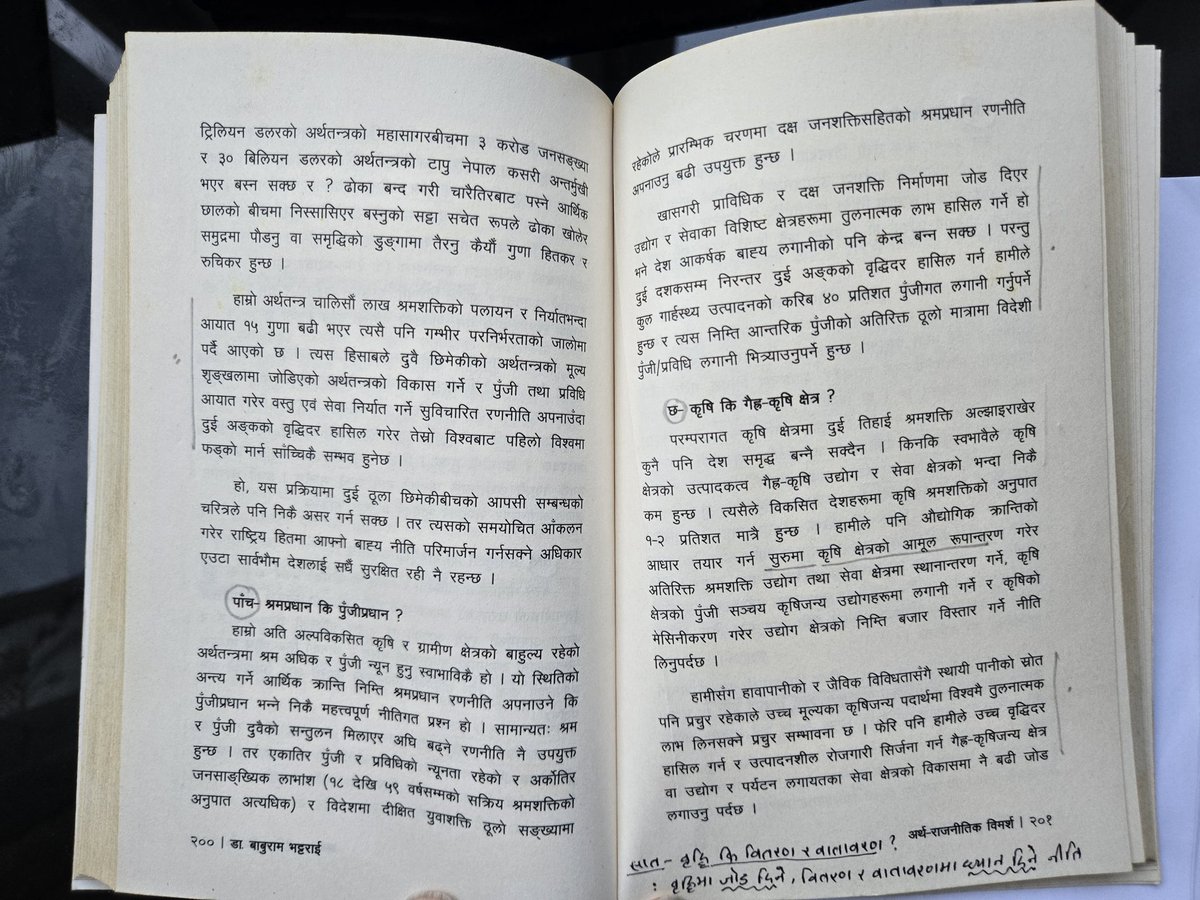
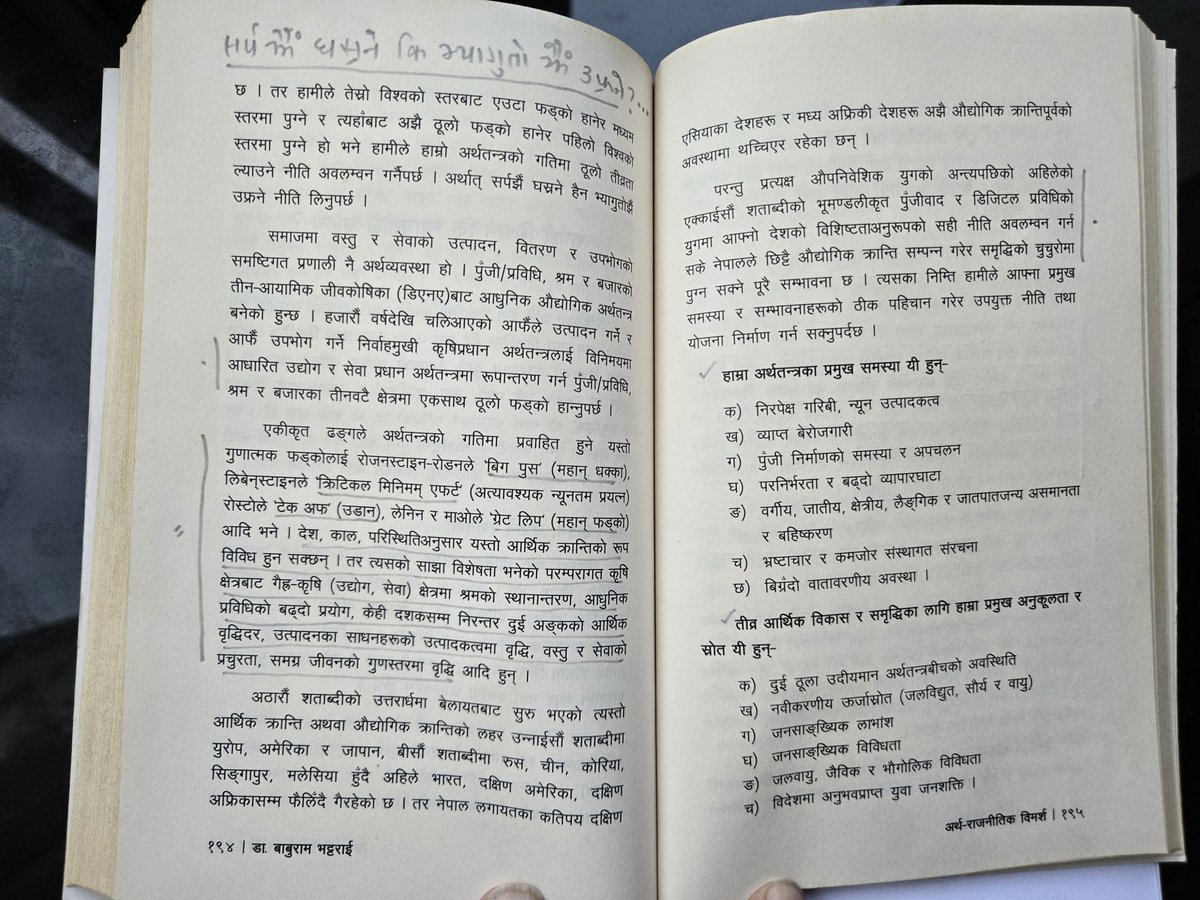
अत्यधिक बहुमत सहितको एकल सरकार हुनाले यसलाई विगतमा अरू कसैले गर्न नपाएको वा गर्न नसकेको ऐतिहासिक काम गर्ने अवसर प्राप्त छ। त्यो भनेको अब अर्थतन्त्रलाई सर्प झैं घस्रने वा क्रमिक सुधारको रूपमा हैन भ्यागुतो झैं उफ्रने वा गुणात्मक फड्को हान्ने (Take-Off or Great Leap) रूपमा अघि बढाउनु हो। विश्वका उत्कृष्ट विश्वविद्य्लयबाट विकास अर्थशास्त्र र अर्थ-राजनीतिको गहन अध्ययन गर्नुभएका विद्वान अर्थमन्त्रीलाई त्यसवारे पर्याप्त जानकारी छदैंछ।
वहाँवाट आगामी बार्षिक बजेट मार्फत् त्यस्तो साहसिक पहल हुनेछ भन्ने अपेक्षा सहित विगतमा पनि मैले निरन्तर अरण्यरोदन गर्दै आएको तर सबैले एउटा कानले सुनेर अर्को कानले उडाएको आर्थिक फड्को सम्बन्धी आफ्नो पुरानो लेखको प्रमुख अंश यसैसाथ सम्प्रेषण गरेको छु।
यो सैद्धान्तिक अंश पछि अर्को क्षेत्रगत संरचनात्मक परिवर्तनवारे लेखको किस्ता पनि प्रेषित गर्नेछु।
A Persian scholar finished a single math book in 9th century Baghdad that quietly became the foundation for every line of code running on Earth today.
I started reading about him at midnight and could not believe how many things in my daily life trace back to one man.
His name was Muhammad ibn Musa al-Khwarizmi. The book is called The Compendious Book on Calculation by Completion and Balancing.
Every time you say the word algebra, you are saying his book title. Every time someone says the word algorithm, they are saying his name. Both English words come from him. Both are Latin transliterations of Arabic and of his own identity. The man did not just contribute to mathematics. He named it.
Here is the part almost nobody tells you.
Al-Khwarizmi was born around 780 CE in Khwarazm, in what is now Uzbekistan. He moved to Baghdad and worked at a research institution called the House of Wisdom, which during the Islamic Golden Age was the single most important center of learning on the planet. The caliph al-Mamun hired the best mathematicians, astronomers, and philosophers from across three continents and put them in one building with one job. Translate, study, and produce new knowledge.
Al-Khwarizmi finished his book on algebra around 820 CE. The Arabic title contained the word al-jabr, which referred to one of the two operations he used to solve equations. When the book was translated into Latin in the 12th century, the Latin world did not have a word for what he had built. So they kept his Arabic word. Al-jabr became algebra. The discipline was named after a single Arabic word in the title of a single book by a single man.
The deeper insight is what he actually changed about how humans think.
Before al-Khwarizmi, mathematical problems were solved geometrically. You drew shapes. You measured them. You compared areas. The Greeks had built an entire mathematical tradition on visual proofs and physical constructions. It was beautiful and limited. You could not solve a problem you could not draw.
Al-Khwarizmi did something nobody had done before him at this scale. He said you could solve any problem using abstract symbols and rules. You did not need a shape. You needed a procedure. You moved terms across the equation. You cancelled like terms on both sides. You isolated the unknown. He invented the idea that mathematics is a manipulation of symbols according to rules, not a study of physical figures.
That single shift made everything that came afterward possible. Calculus. Differential equations. Linear algebra. Quantum mechanics. None of it works if math is locked inside geometry. He pulled it out.
The second thing he did is the one that changed how the world counted forever. He took the Hindu numeral system from Indian mathematics, refined it, and wrote a book introducing it to the Arab world. That system included the concept of zero as a placeholder, and a positional notation where the value of a digit depends on its location. Roman numerals could not do complex calculation. Hindu-Arabic numerals could.
When his book on numerals was translated into Latin as Algoritmi de numero Indorum, the word Algoritmi was just the Latin spelling of his own name. Europeans started calling the new method "doing algorism," then "running an algorithm." The word for the most important concept in computer science is literally his name in Latin.
The third thing he did is the part that should haunt anyone who works in tech.
His method of solving problems was systematic. Step one, do this. Step two, check that. Step three, if condition A, then do X, otherwise do Y. He wrote down procedures that could be followed by anyone, anywhere, who knew how to read. The procedure did not depend on intuition or genius. It worked because the steps worked.
That is exactly what an algorithm is. A finite, deterministic procedure for solving a problem. He did not just give us the word. He gave us the entire concept of programming a thousand years before there was anything to program.
When Alan Turing built the first abstract model of computation in 1936, when John von Neumann designed the first stored-program computer in 1945, when every engineer at Google, OpenAI, Anthropic, and DeepMind writes code in 2026, they are working in a paradigm that started with one man in Baghdad twelve centuries ago.
The strangest part is what happens when you walk into any tech office in San Francisco or Bangalore or Lahore today. Engineers say the words algebra and algorithm hundreds of times a day. They do not know whose name they are saying. Almost nobody can spell al-Khwarizmi correctly on the first try.
His original Arabic manuscript is preserved at Oxford. His book on Hindu numerals survives only in Latin translation. The Latin version was the textbook that taught medieval Europe how to count.
The man who built the foundation of the AI revolution did not live to see a calculator. He died around 850 CE, a thousand years before the first electric current was sent through a wire. The civilization he built mathematics for collapsed. The library he wrote in burned. His own grave is unmarked.
But every algorithm running on every machine on Earth right now still answers to his name.
म सरकारविरोधी होइन तर यो तरिका ठिक भएन है
जेनजी आन्दोलन राज्यले उपेक्षा गरेका वर्ग र समूह सबैको सपनाको जगमा उभिएको थियो । राज्यले भूईंमान्छेका दुःख देखेन भनेर विद्यार्थी सडकमा आए र उनीहरूका पछाडि युवा, बृद्ध, बालबालिका सबै आए । रगत बगाए, भविष्यको मिठो सपना बुने ।
अस्तिको चुनावमा मानिसहरूले ठुलो आशा र भरोसाका साथ बालेन शाहलाई जिताएका छन् । उनको जीतमा अन्याय सहेका गरीबदुखी, सीमान्तीकृत, बृद्ध, अपाङ्गता भएका व्यक्ति, बालवालिका सबैको सामूहिक सपना जोडिएको छ ।
विगतका दुई दिनमा शहर खाली गर्न गरीबका घरमा डोजर चलाएर राज्यले जस्तो व्यवहार देखायो त्यो असाध्यै गलत भयो ! आफ्नो टहरो गुमाएको त्रासमा थर्थर काँपीरहेका बालबालिका र रोइरहेका वृद्धका भिडियोहरूले हामी सबेलाई लामो समयसम्म पछ्याइरहनेछन् ।
देशमा यति धेरै समस्याका चाङ् छन् । राजनीति र अर्थतन्त्रका मूल समस्या गरीब र सुकुम्बासीका कारण होइन, धनीमानी, शक्तिशाली, सम्भ्रान्तहरूका गलत व्यवहारका कारण सिर्जना भएका छन् । सरकार बनेको केही साता नबित्दै गरीबलाई तारो बनाइनुले राज्य कसको स्वार्थमा काम गर्छ भन्ने दुखद् उदाहरण पेश गरेको छ ।
बालेन शाहको सरकार सफल हुन आवश्यक छ । यो सरकारसँग मानिसहरूका सपना जोडिएका छन् । तर, यो तरिका ठिक भएन । सुकुम्बासीको बस्ती उजाडिएपछि शहर पहिलेको भन्दा सुन्दर देखिएला -तर यसले मानिसहरूको मन शान्त बनाउने छैन । सुकम्बासी वस्तीमा चलेको डोजर बालेन शाहको संकिर्ण प्रतिशोध र शहरबारेको गलत बुझाइको संयुक्त परिणाम हो भन्ने कुरा प्रस्ट भएको छ ।
एउटा मान्छे रोजेर सुकुम्बासी हुँदैन । मानिस भूमिहिन र आवासविहिन हुने राज्यको असमान र अन्यायपूर्ण नीतिका कारण हो । नेपालको इतिहास भूमिवितरणमा राज्य संरक्षित अन्यायको दुखद् कथाले भरिएको छ । शहरका केही बस्तिबाट रातारात सुकुम्बासीको वस्ती हटाएर नेपालको भूमिवितरणमा रहेको जटिलता र भूमिहिनताको अन्त हुँदैन -यसले समस्यालाई थप भयावह मात्र बनाउनेछ र गरीब भूमिहिनलाई थप असुरक्षित बनाउनेछ ।
अहिले महानगरपालिका र सरकारले विस्थापित सुकुम्बासीलाई देखाएको कृतिम माया केही दिनपछि पखालिएर जानेछ । तर, सुकुम्बासीका आँशु रहिरहनेछन् ।
समाधान संरचनागत होस् । टिकाउ होस् । प्रतिशोधबाट उब्जेको नहोस् । राज्यले विसंगति र बेथितिहरूको अन्त गर्ने कारवाही सुरु गर्दा धनीमानी र शक्तिशालीहरूबाट सुरु गरोस् ।
@VerseAbhin35033 Haven't you been following the news?
In that particular tweet, I was not making an argument. It was a question that came out of skepticism. Now that the state has used its weapon power to blatantly disregard the dignity of poor people, there is no argument to make anymore.
सुकुम्बासी सबै हुमुकबासी हुन भन्नेहरुले याे तथ्य स्मरण गरून्- देशमा १६%भूमिहीन छन र करिब २४% निरपेक्ष गरिबी छ। भूमीहीनता र निरपेक्ष गरिबी बीच गहिराे सहसम्बन्ध छ। सबै जसाे भूमिहीन निरपेक्ष गरिबीकाे रेखामुनि छन।याे यथार्थबाट भड्किएर वा भड्काएर गरिने तर्ककाे कुनै तुक छैन।
'समाजको मनोविज्ञानमा एउटा गहिरो धारणा बसेको छ गरिब देख्दा ‘फोहोरी’, ‘अव्यवस्थित’ वा ‘समस्या’ जस्तो ठान्ने...यो दृष्टिकोण केवल आर्थिक होइन, ‘सौन्दर्यबोध’ सँग पनि जोडिएको छ ..बरु ‘हटाउनुपर्ने फोहोर’ जस्तो देख्ने मानसिकता हाबी छ ..वालेन्द्रले यही सोच पछ्याउँछन् ।'
How do Nepalese know very well that people who live in Thapathali beside the Bagmati river are Ultra rich people of Nepal in disguise who "choose" to live in such a place?
Do you meet them in person? Are they your closest friends and relatives?
Did you go and see for yourself?