Public health experts warn that an extremely drug-resistant fungal pathogen is likely spreading far more widely than current surveillance indicates. Clinicians in Nairobi, Kenya, recently swabbed an infected surgical wound and isolated Candida auris, a hospital-associated yeast now officially reclassified as Candidozyma auris. Laboratory susceptibility testing revealed that the strain resisted all four major classes of antifungal medications, including fluconazole, the echinocandins caspofungin and micafungin, amphotericin B, and flucytosine.
Although the patient received at least 13 different antimicrobial agents, the infection persisted. Detailed in the journal Scientific Reports, this isolate represents only the second pan-drug-resistant case ever documented worldwide, following an initial report in the United States in 2022.
Candidozyma auris ranks among the most feared fungal pathogens in modern medicine due to its rapid transmission within healthcare facilities. Individuals can harbor the yeast on their skin for months without exhibiting symptoms, and the organism can survive for weeks on dry hospital surfaces. Invasive infections carry an estimated mortality rate between 30% and 50%. Furthermore, the pathogen is frequently misdiagnosed because many standard clinical laboratories lack the specialized equipment needed to identify it accurately, and its primary symptom is a persistent fever that fails to respond to standard antibiotics.
Speaking with BBC Science Focus, Professor Matthew Fisher of Imperial College London emphasized that actual infection numbers are almost certainly higher than reported, noting that health systems are currently only detecting what they have the diagnostic capacity to look for. Infectious disease specialists stress that expanding advanced laboratory diagnostics, alongside enforcing strict hospital hygiene protocols that remain effective against resistant strains, is essential to containing this growing threat.
[Odoyo, E., Kigen, C., Wachira, J., Natasha, V., Ondolo, S., Georges, M., Wataka, A., Pow Sang, L., Haynes, R. C., & Musila, L. (2026). Emergence of pan-drug resistant Candidozyma auris in Kenya, the second globally documented case. Scientific Reports, 16, 33696. DOI: 10.1038/s41598-026-70653-9]
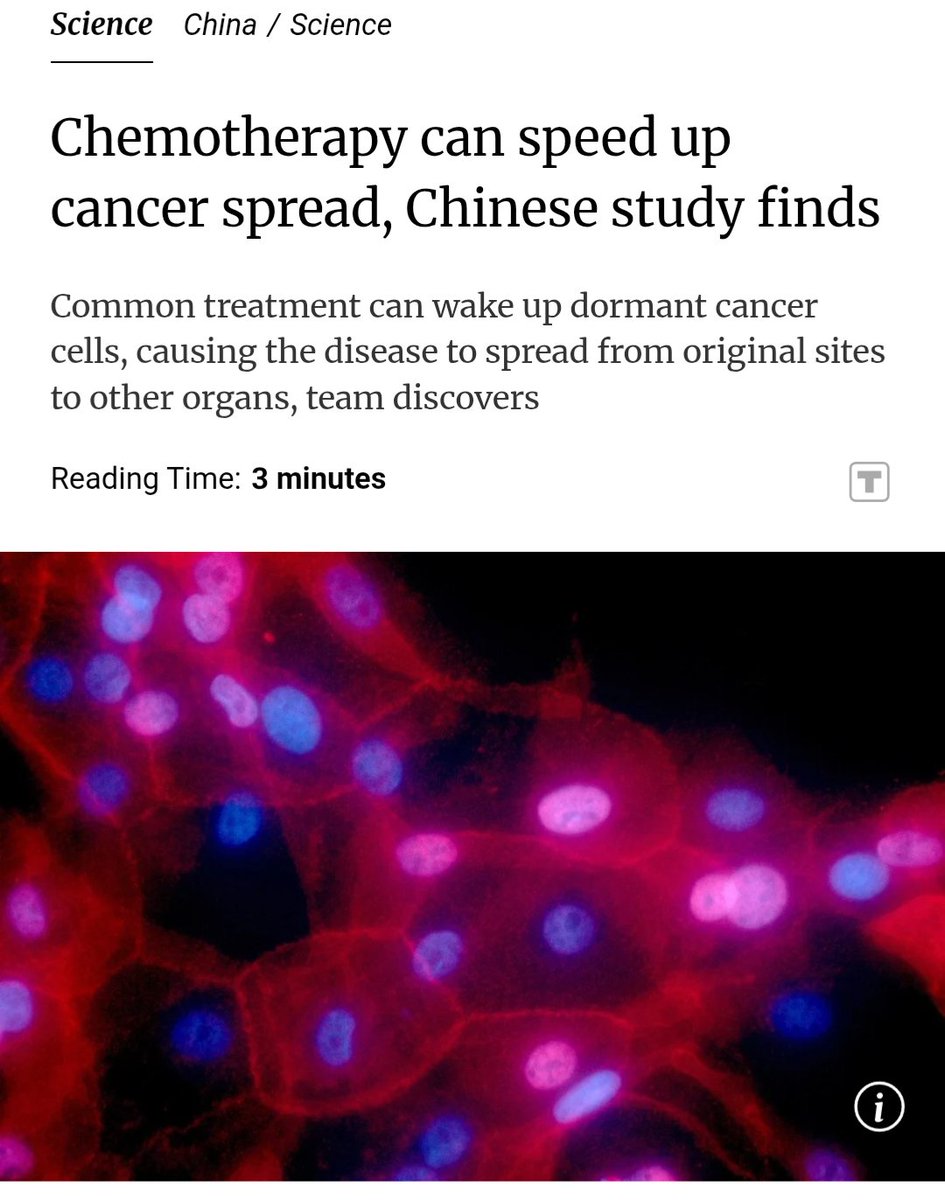
🚨🚨 Un equipo de científicos chinos ha descubierto que la propagación del cáncer desde los tumores originales a órganos distantes puede deberse a que la quimioterapia desencadena la reactivación de células cancerosas latentes...
Sus hallazgos arrojan luz sobre por qué las pacientes con cáncer de mama pueden experimentar metástasis en órganos como los pulmones, a pesar del tratamiento exitoso de sus tumores primarios.
El equipo también descubrió que el uso de fármacos específicos en combinación con quimioterapia podría inhibir este proceso en ratones, y ya se está realizando un ensayo clínico en pacientes con cáncer de mama.
"Demostramos que los fármacos quimioterapéuticos, como la doxorrubicina y el cisplatino, aumentan la proliferación y la metástasis pulmonar de las células cancerosas latentes de mama", escribió el equipo en un artículo publicado en la revista revisada por pares Cancer Cell el 3 de julio.
"Este estudio proporciona evidencia directa de la reactivación de la latencia y revela un mecanismo subyacente al efecto perjudicial de la quimioterapia sobre la metástasis, lo que destaca posibles estrategias para mejorar el tratamiento del cáncer".
Investigadores en Estados Unidos descubrieron previamente que altas dosis de radioterapia para tratar el cáncer podrían, paradójicamente, provocar el crecimiento de tumores metastásicos. Muchos pacientes que se someten a quimioterapia para tratar tumores primarios (el sitio original del tumor en el cuerpo donde las células cancerosas comienzan a desarrollarse) pueden sufrir recaídas del cáncer en otros órganos incluso después de la regresión completa del tumor primario.
Esto ha llevado a la investigación sobre si la quimioterapia puede tener un efecto paradójico similar, en el que trata los tumores primarios y desencadena la metástasis del cáncer.
"Se postula que la reactivación, o despertar, de células tumorales diseminadas (CDT) latentes en órganos distantes resulta en una recaída metastásica después del período asintomático", afirmó el equipo.
Estudios han demostrado que las células cancerosas diseminadas, que viajan desde los tumores primarios a otras partes del cuerpo, pueden encontrarse incluso durante las primeras etapas de la formación del cáncer primario, según un comunicado de prensa de la Academia China de Ciencias (ACC).
Estas células pueden permanecer en estado latente durante años, durante los cuales no crecen ni se multiplican, lo que les permite evadir la quimioterapia. Los investigadores han identificado previamente mecanismos moleculares que regulan la recaída metastásica y la latencia diseminada de las células cancerosas. Sin embargo, no está claro si la metástasis se debe a la reactivación de células latentes o al crecimiento de células diseminadas poco frecuentes y no latentes...
https://t.co/FU5o2UJ7H3
Can light make stem cells work better?
Ultraviolet, photobiomodulation & photodynamic therapy can boost proliferation & differentiation while preserving stemness, but dose & wavelength matter.
https://t.co/yQWq8RE2yS
Could poor sleep drive breast cancer spread?
A new model links circadian disruption to metastasis via melatonin loss, inflammation, & insulin resistance, hitting EMT, CTC survival, & dormant reactivation.
https://t.co/HkwtpHKRKu
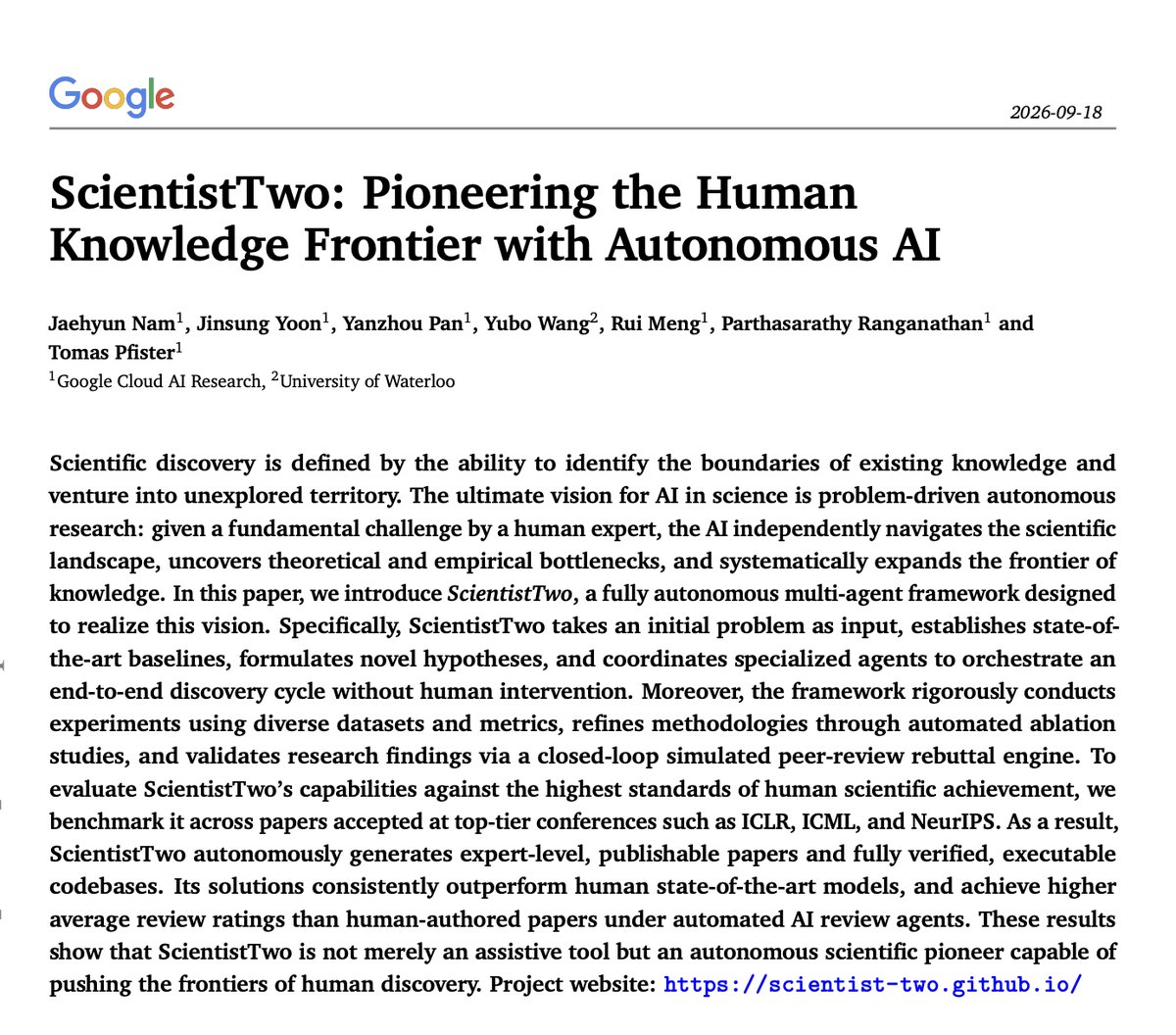
🚨 زلزال في الأوساط العلمية: جوجل تؤتمت شهادة الدكتوراه والبحث العلمي بالكامل بنسبة 100% بدون أي تدخل بشري! 🔬🧠💥
فريق البحث في Google يطلق رسمياً إطار عمل ذكي يُدعى "ScientistTwo".. نظام متعدد الوكلاء (Multi-Agent) ينفذ دورة البحث العلمي كاملة من الفكرة إلى الورقة البحثية المحكمة!
كيف يعمل هذا ا��وحش البحثي بشكل مستقل تماماً؟
💡 تعطيه المشكلة أو التحدي العلمي فقط.. وهو يتكفل بالباقي:
📚 يقرأ الأوراق العلمية السابقة ويحدد النقاط المرجعية (Baselines).
🧪 يصيغ فرضيات جديدة مبتكرة ويكتب الأكواد البرمجية ويجري التجربة بنفسه!
يقوم بدراسات الاستبعاد (Ablation studies) ويصمم نظام مراجعة أقران وهمي (Peer-review) ليجادل نفسه ويحسن ورثته البحثية قبل الصياغة النهائية!
النتائج الميدانية صدمت مجتمع العلماء:
🎯 تم اختباره مقابل أفضل أوراق علمية مقبولة في مؤتمرات نخبوية مثل NeurIPS و ICML.
⚡️ تفوق وحسّن نتائج أفضل الموديلات البشرية في 86 task مختلفاً!
📈 حقق قفزة في الأداء بنسبة بلغت 25.2% مقارنة بأعظم الإنجازات البشرية!
مؤلفات خالية 100% من الهلوسة المرجعية، مع أكواد تعمل بكفاءة وورقة علمية جاهزة للنشر الفوري!
المرحلة التي كنا نستخدم فيها الذكاء الاصطناعي كمساعد للتلخيص أو كتابة الكود انتهت رسمياً.. نحن أمام "باحث مستقل" يوسع حدود المعرفة البشرية!
إذا كان الـ AI يصيغ الفرضيات ويختبرها وينشر اكتشافاته بمفرده اليوم.. فكم يلزمنا من الوقت ليفتتح علماً جديداً لا نملك حتى الرياضيات لفهمه؟!
احفظ التغريدة فوراً، واقرأ الورقة البحثية كاملة عبر الرابط الرسمي بالأسفل! 🧵👇
Scientists have created one of the most detailed 3D reconstructions of a human cell (eukaryotic cell) ever produced.
This groundbreaking model, often termed a "Cellular Landscape Cross-Section Through a Eukaryotic Cell," combines data from X-ray tomography, nuclear magnetic resonance (NMR), and cryo-electron microscopy to map molecular structures in extreme detail.
Me rescataron chiquito y muerto de miedo; le bufaba a todo. Él no se ofendió: se quedó a mi lado. — Tres días bastaron. Con pura paciencia, el cachorro golden curó lo que nadie había podido, y el gatito terminó acurrucado contra él.
CORONARY CTA: WE CAN MEASURE NOT ONLY ATHEROSCLEROSIS, BUT ALSO ITS REGRESSION AND STABILIZATION.
For decades, coronary imaging has focused primarily on one question:
HOW SEVERE IS THE STENOSIS?
But atherosclerosis is a dynamic disease. And modern Coronary CTA allows us to investigate something far more interesting:
HOW DOES THE PLAQUE CHANGE OVER TIME AND IN RESPONSE TO TREATMENT?
A new study by Vasanthakumar et al., published in JACC: Cardiovascular Imaging (2026), provides another important piece of evidence.
The researchers evaluated 840 coronary lesions in 338 asymptomatic individuals over three years.
Among patients receiving statins, they observed:
➤ REGRESSION of non-calcified plaque volume.
➤ INCREASED DENSITY of coronary calcifications.
➤ A shift toward plaque characteristics consistent with STABILIZATION or PASSIVATION.
Interestingly, total calcium volume did not differ significantly between treated and untreated groups.
In other words:
MORE DENSELY CALCIFIED PLAQUE DOES NOT NECESSARILY MEAN MORE PROGRESSIVE ATHEROSCLEROSIS.
MY TAKE
This is where Coronary CTA becomes particularly valuable.
We are moving beyond simply detecting coronary disease and measuring stenoses.
We can now quantitatively investigate how atherosclerotic plaques respond to treatment.
✅ PLAQUE REGRESSION.
✅ PLAQUE STABILIZATION.
✅ PLAQUE PASSIVATION.
These are not interchangeable concepts, and imaging evidence of stabilization is not yet proof of fewer cardiovascular events.
But CCTA provides an increasingly powerful way to investigate all three. Yes it does.
And PHOTON COUNTING CT, with its superior spatial resolution and spectral capabilities, may take longitudinal plaque characterization even further.
Of course, we still need standardized quantitative methods and clinical outcome validation.
But the direction is clear.
The future of coronary imaging is not simply about identifying who has atherosclerosis.
IT IS ABOUT UNDERSTANDING HOW THE DISEASE EVOLVES, HOW IT RESPONDS TO TREATMENT, AND WHETHER WE ARE ACTUALLY CHANGING ITS BIOLOGY.
Because the ultimate goal is not merely to detect coronary artery disease.
IT IS TO HELP MAKE IT LESS DANGEROUS.
Reference: Vasanthakumar SA et al. Calcium Density as a Marker of Coronary Plaque Stabilization in Primary Prevention: The CAUGHT-CAD Trial. JACC: Cardiovascular Imaging. 2026. DOI: 10.1016/j.jcmg.2026.07.029.
#CoronaryCTA #CardiacCT #PhotonCountingCT #Atherosclerosis #PlaqueRegression #PlaqueStabilization #PreventiveCardiology
Near-infrared light therapy eliminates the need for thyroid meds in nearly half of patients.
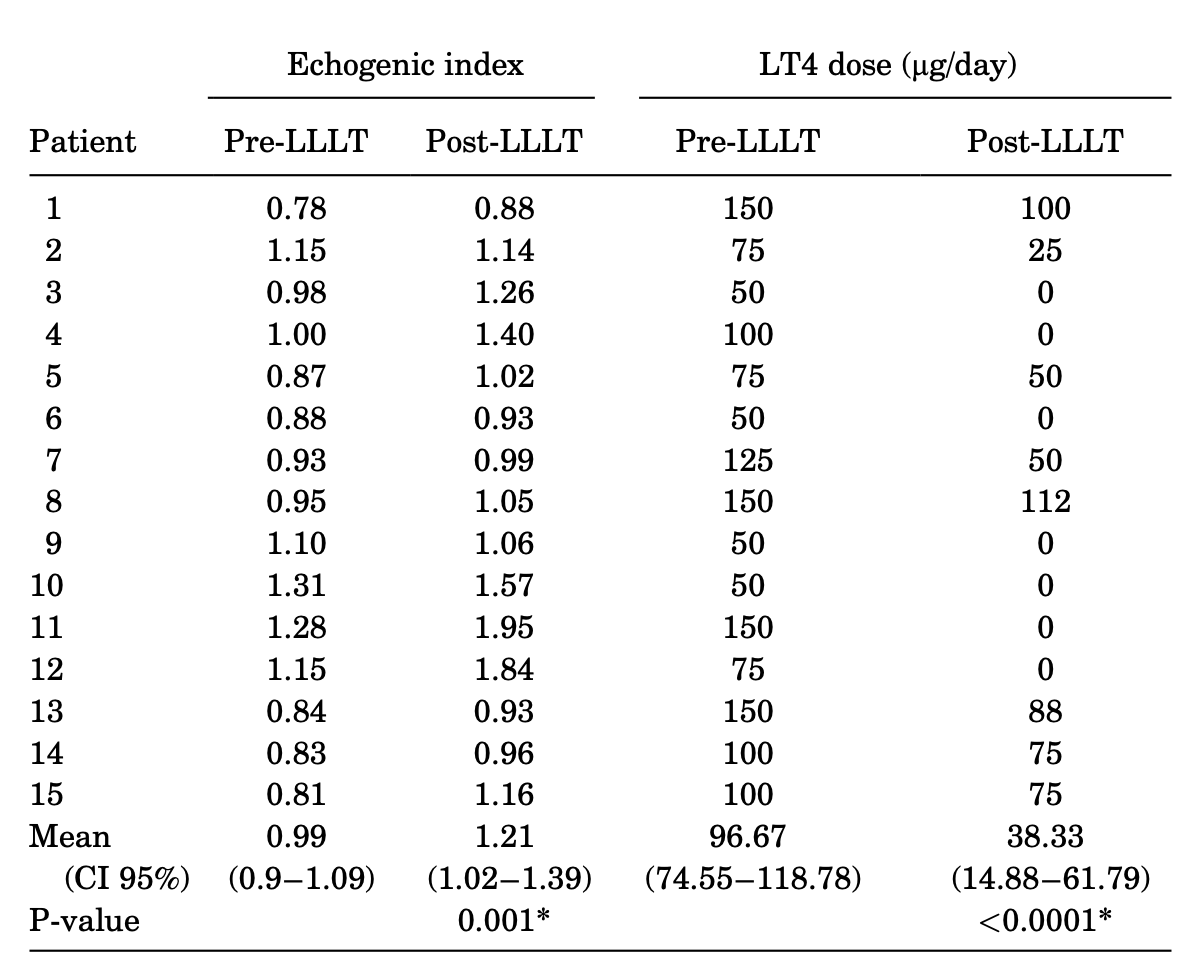
→ Fifteen patients with autoimmune thyroiditis had ten sessions of light therapy
→ Nine months later, seven patients required no medication (LT4)
→ Med needs dropped about 60% on average
→ Thyroid antibodies (TPOAb) dropped by 40%
→ The echogenicity index improved by over 20%
The echogenicity index measures how bright thyroid tissue appears on ultrasound. The echogenicity index is linked to autoimmune activity. In thyroiditis, particularly Hashimoto’s thyroiditis, thyroid tissue often becomes hypoechoic (darker) than surrounding tissues, indicating inflammation, fibrosis, and lymphocytic infiltration.
Note: This has to be carefully dosed with specific equipment.
“We noted all patients’ reduced T4 dosage needs, including 7 (47%) who did not require any T4 through the 9-month follow-up...TPOAb levels also decreased...We did observe a post-treatment increase in the echogenicity index... The preliminary results indicate that light therapy promotes the improvement of thyroid function, as patients experienced a decreased need for thyroid medication, a reduction in TPOAb levels, and an increase in parenchymal echogenicity.”
BREASTMILK
She thought she was studying milk.
What she uncovered was a conversation.
In 2008, evolutionary anthropologist Katie Hinde was working in a primate research lab in California, analyzing breast milk from rhesus macaque mothers. She had hundreds of samples and thousands of data points. Everything looked ordinary—until one pattern refused to go away.
Mothers raising sons produced milk richer in fat and protein.
Mothers raising daughters produced a larger volume with different nutrient balances.
It was consistent. Repeatable. And deeply uncomfortable for the scientific consensus.
Colleagues suggested error. Noise. Statistical coincidence.
But Katie trusted the data.
And the data pointed to a radical idea.
Milk is not just nutrition.
It is information.
For decades, biology treated breast milk as simple fuel. Calories in. Growth out. But if milk were only calories, why would it change depending on the sex of the baby?
Katie kept digging.
Across more than 250 mothers and over 700 sampling events, the story grew more complex. Younger, first-time mothers produced milk with fewer calories but significantly higher levels of cortisol—the stress hormone.
The babies who drank it grew faster.
They were also more alert, more cautious, more anxious.
Milk wasn’t just building bodies.
It was shaping behavior.
Then came the discovery that changed everything.
When a baby nurses, microscopic amounts of saliva flow back into the breast. That saliva carries biological signals about the infant’s immune system. If the baby is getting sick, the mother’s body detects it.
Within hours, the milk changes.
White blood cells surge.
Macrophages multiply.
Targeted antibodies appear.
When the baby recovers, the milk returns to baseline.
This was not coincidence.
It was call and response.
A biological dialogue refined over millions of years. Invisible—until someone thought to listen.
As Katie reviewed existing research, she noticed something unsettling. There were twice as many scientific studies on erectile dysfunction as on breast milk composition.
The first food every human consumes.
The substance that shaped our species.
Largely ignored.
So she did something bold.
She launched a blog with a deliberately provocative name: Mammals Suck Milk.
It exploded. Over a million readers in its first year. Parents. Doctors. Scientists. People asking questions research had skipped.
The discoveries kept coming.
Milk changes by time of day.
Foremilk differs from hindmilk.
Human milk contains over 200 oligosaccharides babies can’t digest—because they exist to feed beneficial gut bacteria.
Every mother’s milk is biologically unique.
In 2017, Katie brought this work to a TED stage. In 2020, it reached a global audience through Netflix’s Babies. Today, at Arizona State University’s Comparative Lactation Lab, she continues reshaping how medicine understands infant development, neonatal care, formula design, and public health.
The implications are staggering.
Milk has been evolving for more than 200 million years—longer than dinosaurs walked the Earth. What we once dismissed as simple nourishment is one of the most sophisticated communication systems biology has ever produced.
Katie Hinde didn’t just study milk.
She revealed that nourishment is intelligence.
A living, responsive system shaping who we become before we ever speak.
All because one scientist refused to accept that half the story was “measurement error.”
Sometimes the biggest revolutions begin by listening to what everyone else ignores.
A research team at ETH Zurich led by Martin Fussenegger has engineered a small, wirelessly powered medical implant designed to break down excess blood sugar using targeted electrical current. Operating as a drug-free alternative for metabolic management, the system automatically deactivates once circulating glucose drops to a healthy baseline, presenting a theoretical path toward treating metabolic disorders without traditional pharmacological interventions. The interior of the device contains no biological materials or living cells, relying entirely on an engineered catalyst composed of porous graphite felt covered in microscopic gold and platinum particles.
The automated system functions via a closed-loop digital architecture linked directly to a standard continuous glucose monitor worn on the skin of the patient. Whenever the external sensor registers a rapid postprandial surge in blood sugar, it sends a wireless alert via Bluetooth to a paired smartphone or smartwatch, which immediately activates the sub-dermal implant. The activated internal catalyst facilitates an electrochemical reaction that transforms circulating glucose molecules into gluconate, which is an organic compound that the body can easily filter and eliminate safely through urinary excretion. Once blood sugar metrics fall back into the ideal target zone, the transmission automatically ceases, throwing the internal catalyst back into an inactive state.
Animal models evaluating obese and diabetic mice demonstrated that the device successfully kept blood sugar levels under precise clinical control throughout a six-week monitoring window. Beyond stabilizing glucose, the treatment induced a notable ten percent reduction in overall body weight among the test subjects without causing any measurable tissue irritation, thermal spikes, or electrical trauma near the insertion site.
Because the system physically removes excess sugar from the body rather than driving it into storage, it limits the amount of caloric energy that can be converted into fat tissue, causing the engineering team to view the technology as a dual therapeutic candidate for both type 2 diabetes and clinical obesity. While initial laboratory scaling models proved the device could efficiently clear glucose volumes equivalent to the five liters found in adult humans, the technology has thus far been verified only in animal subjects, meaning extensive human clinical trials must still be completed before it can enter mainstream medical practice.
[Maity, D., et al. (2026). Wireless electrocatalytic closed-loop system for drug-free management of diabesity. Science, 391(6789), eady8560]
Fertilization is not random, and the fastest sperm does not always win: in reality, the egg decides who succeeds.
While for decades we were taught that fertilization is a race won by the fastest sperm, a study published in Proceedings of the Royal Society B shows how human reproduction actually works.
Scientists analyzed follicular fluid from 60 couples undergoing fertility treatment at St Mary's Hospital in Manchester, UK. They discovered that the egg releases chemical signals (chemoattractants) that actively attract sperm from certain men over others.
Through these chemical signals, the egg exerts its own biological selection, influencing which sperm manage to get close. The egg appears to favor sperm that offer optimal genetic compatibility with its own genome, particularly in genes related to the immune system, which may help produce healthier offspring.
Interestingly, this cellular preference does not always align with the couple’s conscious partner choice. In many cases, eggs showed stronger attraction to sperm from non-partner males.
This chemical communication demonstrates that female biology continues to evaluate and select options even after intercourse. Understanding this process could lead to more precise solutions for unexplained infertility. Science continues to reveal the remarkable level of biological interaction that occurs during reproduction.
[Fitzpatrick, J. L. et al. (2020). Chemical signals from eggs facilitate cryptic female choice in humans. Proceedings of the Royal Society B, 287(1928), 20200805. DOI: 10.1098/rspb.2020.0805]
This review integrates current molecular, preclinical, and clinical evidence to establish mechanistic links between NAD+ metabolism, brain aging, cognitive dysfunction, and neurodegeneration, while emphasizing current limitations and future translational challenges associated with combining vitamin B3 metabolites, exercise, and microbiome-targeted approaches.