We live in an era of cultural marxism, which is in itself a contradiction in term. This is a marxism that turns Marx on his head, as Marx did long before this to Hegel.
The war this new breed of marxism is waging is not a war of class, but war of identities; war of pronouns.
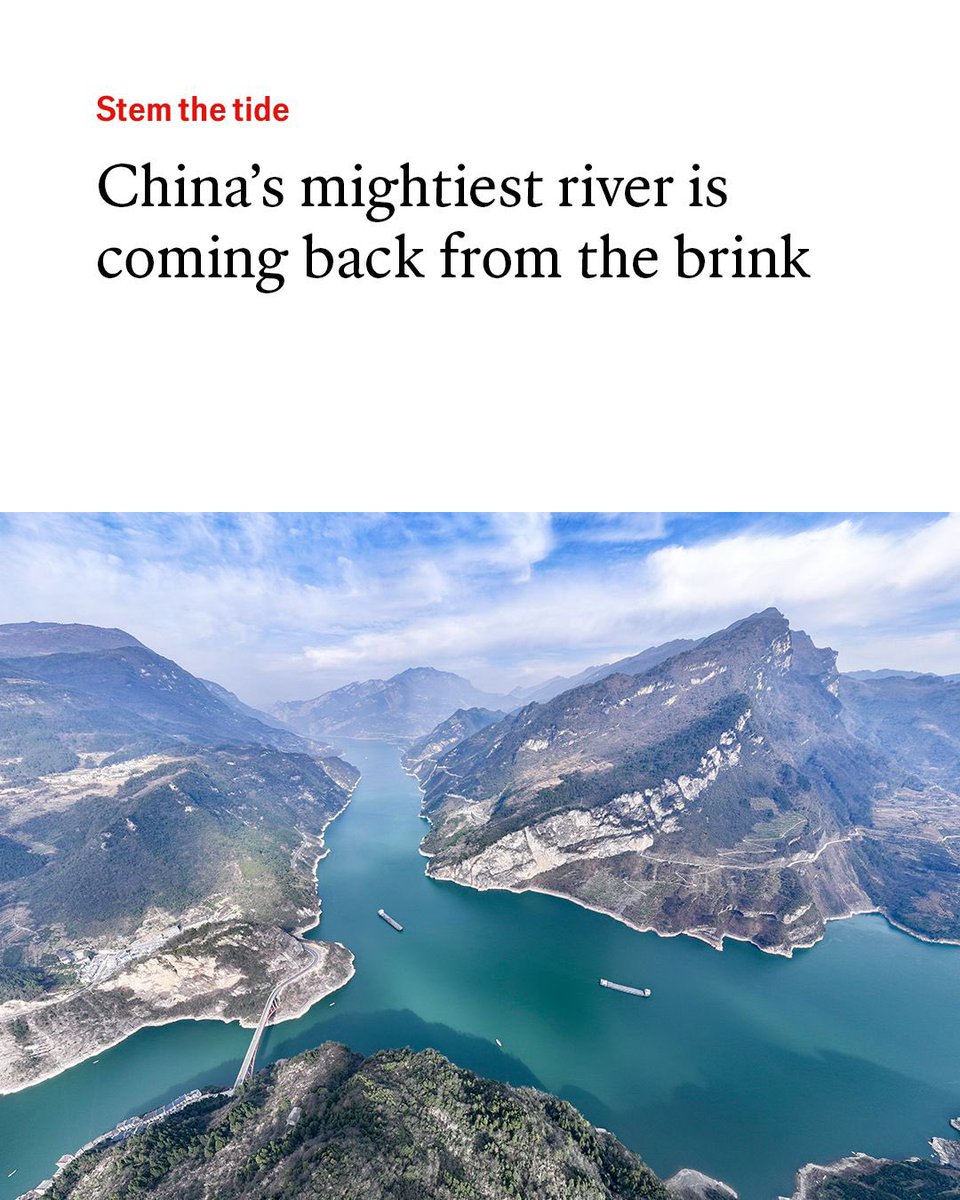
The Economist just dropped another classic:
“China’s mightiest river is coming back from the brink”
(The Economist, 2026)
But eco-authoritarianism is not all roses
Fish stocks up 200%+. Sturgeons breeding again. Porpoises recovering.
A 6,300 km river brought back from ecological death in a few years.
And still they manage to make it sound like a human-rights violation with a green filter.
The cope is relentless.
Every time China fixes something the West spent decades lecturing about, the headlines twist themselves into pretzels to find the dark side. Success is never allowed to stand on its own. It must be framed as accidental, authoritarian, temporary, or somehow still a failure.
The formula never changes. Deliver results → insert the “yes, but…” → remind everyone that competence without the correct ideology is suspicious.
Here are ten titles that are already jokes the moment you read them:
China builds the world’s largest high-speed rail network – tragically, people can now arrive on time
(The New York Times, 2024)
800 million lifted out of poverty – but did anyone ask if they miss the dirt floors?
(The Guardian, 2021)
China’s EV factories dominate the planet – a clear threat to Western parking lots
(Financial Times, 2025)
Yangtze fish stocks triple after fishing ban – eco-authoritarianism claims another victim (the fishermen’s freedom to go bankrupt)
(The Economist, 2026)
China plants billions of trees – nature recovers without a single democratic consultation
(BBC, 2023)
World’s biggest renewable energy capacity installed – still somehow China’s fault for the climate
(Bloomberg, 2025)
Poverty eliminated in record time – experts warn success may discourage future suffering
(Washington Post, 2020)
Chinese high-speed trains run at 350 km/h – democracy would have preferred a slower, more inclusive timetable
(The Atlantic, 2022)
Belt and Road builds ports and railways across continents – developing countries cruelly denied the right to remain underdeveloped
(Foreign Policy, 2023)
China’s space station completes missions without exploding – suspiciously competent for a non-Western power
(CNN, 2024)
Same script every single time.
China delivers results → Western media delivers the “yes, but…”
They can’t celebrate competence when it doesn’t come wrapped in their preferred ideology.
The cope is becoming performance art at this point.
This claim — that China is de-industrializing the rest of the Global South while the US has helped it industrialize — is one of the most inaccurate claims I've come across in my career as a development economist.
The US actively contributed to de-industrialization in Africa and Latin America in the 1980s and 1990s by dismantling most domestic industrial policy efforts, either directly or via international organisations over which it held outsized influence.
Subsequently, US involvement in the Global South has has not in any meaningful way focused on raising investment rates in manufacturing. If anything, it's been about corporate access to natural resources and setting up sweatshops to serve US consumers.
China, on the other hand, does focus on raising investment rates in manufacturing in the Global South and helps build and provide crucial infrastructure that enables this.
China, of course, is not a magic bullet for industrialization in the Global South. In addition to economic partnerships that have the potential for domestic industrialization, China is a competitive threat.
I recently spoke to an Indonesian government official long involved with Indonesia's industrial policy who essentially shared this view. He described the relationship with China as one with upsides and downsides for industrialization in Indonesia, and the relationship with the US as one with mostly downsides.
On the one hand, he said, China invests in manufacturing and energy infrastructure, provides crucial goods and inputs, and is even willing to engage in technology transfer deals. When I asked about the US, he essentially said they are hunting for natural resources and will threaten with various trade policies if they can't get them.
You can rightfully claim that China's impact on industrialization in the Global South is complicated. But it's a joke to claim the US is better than China for industrialization in the South.
China promotes Global South access to AI, but at what cost?
One of the most reliable rules in Western journalism is that, when China does something that materially helps the Global South, the story is reported as a cynical manoeuvre and given a name ending in “diplomacy”.
When China shipped billions of Covid vaccine doses to countries the West had left at the back of the queue – while Britain and the US hoarded supplies and blocked the TRIPS patent waiver that would have let poorer countries manufacture their own – this was not a matter of solidarity or public health, but “vaccine diplomacy”.
When China built ports, railways, power stations, fibre networks, hospitals, schools and stadiums across Asia, Africa and Latin America, this became “debt-trap diplomacy” (a narrative which has been comprehensively debunked).
Now, the Financial Times informs us, we face the terrible spectre of “AI diplomacy”.
What does this sinister campaign consist of? China is releasing open-source AI models that developing countries can actually use and adapt; opening application cooperation centres to train thousands of people from the Global South; and establishing the 29-member World AI Cooperation Organisation to give those countries a seat at the table where the rules for the most consequential technology of the century get written.
China’s offer, we are told, is one that developing countries will find “hard to refuse” – as though sharing technology were a protection racket. Apparently the aim is to “build foreign dependence” and to impose Chinese values over the “liberal world order” (incidentally, you have to wonder how “liberal” a world order is when it includes a genocide in Gaza, a criminal war on Iran, an energy blockade on Cuba, and the kidnapping of Venezuela’s elected president).
But consider the alternative on offer. As the article itself concedes, US closed models from OpenAI and Anthropic are simply too expensive for most people in the Global South, and Washington’s rival outfit, Pax Silica, exists mainly to lock down semiconductor supply chains and critical minerals.
So while the US and its allies organise to secure control of chips and the minerals in other people’s countries, China organises to distribute the technology and help countries make use of it. Only one of these is described as a bid for domination, and it isn’t the one hoarding the silicon.
The concern here is not actually that China exploits the Global South. It’s that China is breaking a monopoly. For five centuries the technological frontier has been the private property of a handful of Western powers, and that monopoly is a big part of what keeps the periphery peripheral. In the understanding of the imperialists, a technologically-advanced country that shares technology is not being generous; it’s being disruptive, and therefore must be framed as a threat.
You can tell Sophie Cunningham’s feminism is authentic but Megan Rapinoe’s is a Trojan horse for Marxism.
Just as classical Marxism sought to abolish class distinctions as mere constructs that obscure true human equality, she insists upon dissolving the material reality of sex itself, declaring that any recognition of the immutable physiological differences between males and females, differences that create profound advantages in strength, speed, and skeletal structure, constitutes “an attack on women in society.”
In her vision, categories of sex are not biological distinctions or protective boundaries hard-won by Title IX, but oppressive barriers to be torn down in the name of an abstract, undifferentiated “inclusion,” thereby erasing the very foundation upon which women’s sports and competitive fairness rest.
This stands in stark contrast to Sophie Cunningham’s unapologetic defense of sex-based categories which is completely aligned with biological reality.
That’s what feminism was supposed to be about - protecting women and womanhood - before it was completely derailed by the third wavers, who paved for the way for this nonsense by insisting that women can do anything a man can do and that everything is *just* a social construct.
This is Nancy Armour, the woman who said Caitlin Clark's basketball ability is akin to the lynching of Emmitt Till.
White, liberal women with this hair cut will be our country's demise.
Karl Marx hated the traditional family.
So how do you sell people on giving up on one of the most important institution in human history?
-Tell women it’s oppressive.
-Tell men to be passive.
-Tell them both children are a burden.
-Denigrate the family in entertainment.
-Replace husbands and fathers with the state.
🚨J’AI RAISON DEPUIS LE DÉBUT
👉Cette demi-finale contre l’Espagne n’est pas seulement une défaite. C’est l’échec d’une philosophie de jeu.
Depuis deux ans, je répète que le football moderne est entré dans une nouvelle ère : celle du pressing, du contre-pressing et de la récupération haute.
Beaucoup m’ont insulté en expliquant que seul le talent individuel comptait encore. Ce soir, l’Espagne a apporté la démonstration inverse.
👉Pendant tout le match, les Espagnols ont étouffé la France. Nos quatre attaquants ont été privés de ballons, non parce qu’ils auraient soudain perdu leur talent, mais parce que le système espagnol empêchait tout simplement la France de jouer. Le football moderne ne commence plus avec les attaquants ; il commence par la récupération du ballon. Celui qui récupère haut impose son jeu. Celui qui subit ne fait que courir après le ballon.
👉C’est exactement ce que Luis Enrique a construit au PSG. Beaucoup y voyaient un choix esthétique. En réalité, c’est une révolution tactique. L’Espagne applique les mêmes principes : onze joueurs qui attaquent, onze joueurs qui défendent, pressing coordonné, contre-pressing immédiat et récupération à trente mètres du but adverse.
👉À l’inverse, Didier Deschamps est resté fidèle à un football d’une autre époque : bloc plus bas, transitions, attente de l’exploit individuel. Tant que l’opposition est moyenne, cela peut suffire. Mais face à une équipe d’élite qui maîtrise parfaitement le pressing, ce modèle explose.
👉Le parcours de la France a entretenu une illusion. L’Irak, la Suède, la Norvège et le Maroc ne représentent pas le niveau de l’Espagne. Dès que le niveau tactique s’est élevé, toutes les limites du système français sont apparues.
👉Pour moi, au plus haut niveau, seul le palmarès collectif compte. Les statistiques individuelles, les records ou les titres de meilleur buteur n’ont de valeur que s’ils conduisent à remporter les plus grandes compétitions. Le football moderne ne sacre plus le meilleur joueur ; il sacre le meilleur collectif. Cette demi-finale en est une illustration éclatante.
The propaganda is getting really embarrassing. If Ahmadinejad is an asset, why would they expose him? They're effectively telling all potential assets and spies to beware, because they may be exposed by their Western handlers.
Do you know when my view of Messi as a person changed?
When I realized he was aware of the racist chants from Argentinian fans and never used his influence to ask them to stop. He's the kind of person who should have that moral authority. The only Argentinian who had the power to do it, but he didn't. I remember a match in Brazil where racist chants sparked a public brawl in the stands. I remember Messi publicly condemning police violence against Argentinians... but he remained silent about the racist chants. He played the victim.
Messi is a coward.
🚨 I just attended Ben Norton’s explosive lecture at Fudan University Summer School — and it perfectly explains why the AI bubble is about to be blown up by China!
Ben correctly predicted Western tech giants would go bankrupt while Chinese open source AI rises! 🤯
Qiushi, the Communist Party of China’s leading theoretical journal, has just run three days of commentaries urging the cultivation of “patient capital” – long-term investment willing to tolerate risk and wait years for a return – as China channels the current wave of AI enthusiasm towards real innovation rather than a speculative bubble. Western coverage tends to treat this as a curious technocratic slogan, but it’s a great deal more than that.
As Radhika Desai argues in her work on China’s financial system, “patient capital” names one side of a fundamental divide in economics. There are, broadly, two kinds of financial system. One – the short-termist, speculative, predatory type that Hilferding called the “British” model, and which the US perfected after 1971 – is oriented not to production but to extraction: it inflates asset bubbles, preys on the incomes of the productive economy, and functions as “a giant casino”. The other provides long-term, patient capital for productive industrial investment.
China’s system is emphatically of the second type – and, crucially, it is directed by the state. Its banks are treated not as private profit-machines but as instruments for financing the productive economy, steered by the plan towards the priorities the state has set: industry, technology, even environmental protection. When Ant Group tried to pivot the system towards speculative consumer lending, Beijing halted its flotation overnight. “Houses are for living in, not for speculation” is the same principle applied to property. Now the same logic is being turned on the AI boom: keep capital patient, productive and long-term, and don’t let the casino take over.
What the Western financial press files under “quirky Chinese policy” is in fact an essential component of China’s challenge to the Washington Consensus. The US model financialises – it turns finance into an end in itself – and the results are decades of bubbles, deindustrialisation and decay. China’s model subordinates finance to production and to a national development plan, and the results speak for themselves.
“Patient capital” is simply planning, applied to money. It is the recognition – old to Marxists, heretical to neoliberals – that finance should serve the real economy rather than cannibalise it.
Eric X. Li’s exchange with John Pilger lays it out plainly: voting in the United States is mostly political theater. Parties rotate, slogans change, new faces come and go,but the core policies stay tied to money.
Why?
Because wealth runs the system. Billionaires, lobbyists, and financial elites shape the rules, while voters are given the illusion of choice.
Real power isn’t in elections,it’s in boardrooms.
The pattern is obvious.
Donald Trump filled his circle with billionaires, cut corporate taxes, and blurred the line between policy and business.
Democrats do the same thing with cleaner messaging.
Obama’s Wall Street bailout didn’t punish anyone,it protected the same financial interests that caused the crisis.
Different branding, same structure.
The system isn’t failing, it’s doing exactly what it was built to do: protect the top tier.
China runs a different model.
The Communist Party doesn’t rely on campaign money or pretend elections control wealth.
Leadership stays consistent, policies shift when needed, and long-term planning actually happens.
That stability helped drive rapid industrial growth and lift massive numbers out of poverty.
And China isn’t “capitalist” in the Western sense.
Markets exist, but they don’t run the state.
Wealth is managed, not obeyed. Billionaires don’t set national direction.
So the contrast is simple: one system claims democracy while serving wealth; the other openly prioritizes state control and focuses on outcomes.
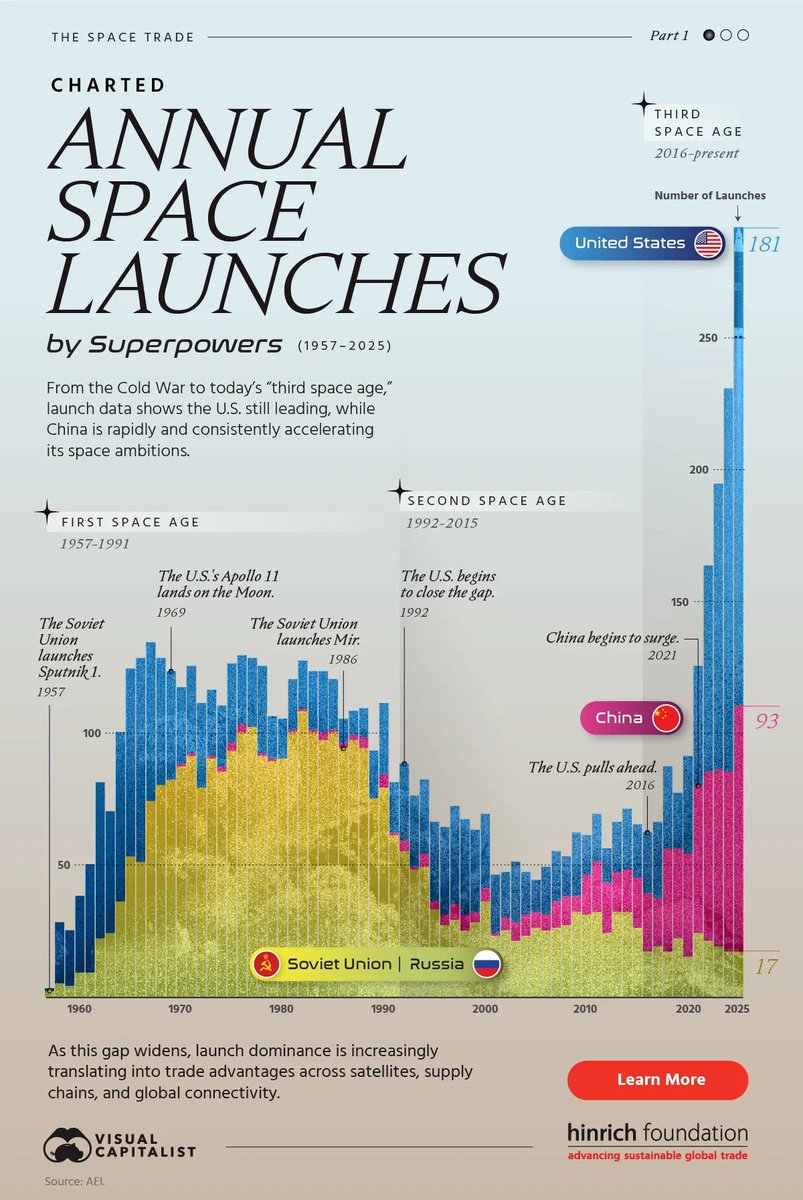
Three infographics that lay bare the real space race —it's a brutal macroeconomic trade war disguised as rocket science 🚀
The growing US-China space competition just got the infographic treatment from the Hinrich Foundation and Visual Capitalist. Three charts. One uncomfortable reality
https://t.co/1NtbT7oaEA
Everyone is staring at the launch numbers. But the real war is being fought in the mining pits, chemical refining plants, and geographic choke points
Let's walk through what the numbers actually reveal — because Washington hopes you don't read them in order
1/ The Launch Monopoly — Chart 1 says the U.S. is winning the space race:
Three Space Ages in one chart:
1957: Soviet Union dominates
1991: Russia collapses, US catches up
2016: SpaceX turns Florida into a an assembly line
Right now, the U.S. is out-launching the entire planet combined. In 2025, America hit 181 orbital launches—almost double China’s 93, while Russia is practically flatlining at 17. Reusable rockets have fundamentally decoupled American launch cadence from the rest of the world.
However Washington counts launches the way an empire counts aircraft carriers — by the visible metric that flatters it. The 181 figure is a SpaceX number is dressed up as a national achievement; but strip out reusable-rocket economics and the commercial pile-on, and the "lead" is a PRIVATE company's launch cadence, not some magical proof of permanent U.S. state capacity.
Meanwhile China went from 5 launches in 2000 to 93 in 2025 — that's a challenger compounding at industrial speed, with its own money, its own metals, and its own launch pads. Steady. State-directed. No billionaire tantrums
2/ The Infrastructure Duopoly — Chart 2 gets more interesting:
You can't launch without real estate. Space infrastructure is an elite club
From 2016 to June 2026, U.S. launch sites logged 754 orbital launches. China logged 513 from seven domestic sites. Russia: 192
But beyond the big three, look at the map: the entire rest of the launch map is the U.S. alliance system: France/ESA (Guiana), Japan (Tanegashima, Uchinoura), South Korea (Naro, Jeju barge), Israel (Palmachim), New Zealand (Rocket Lab) — every non-superpower pad is a treaty ally or Major Non-NATO Ally.
The U.S. advantage isn't just its own pads; it's an allied launch archipelago — exactly the Indo-Pacific basing logic (AUKUS, QUAD, EDCA) ported into orbit.
China's 513, by contrast, come from a fully sovereign footprint: seven domestic site (including sea launch sites) five strategies, zero foreign bases, zero dependency on a "host nation" that could pull clearance. The empire launches from everywhere it can park a treaty; China launches from home.
One is an alliance logistics network
The other is a nation-state's industrial base
Russia? Still renting Baikonur from Kazakhstan
Guess which one survives a political crisis...
3/ The Invisible Bottleneck — Chart 3 the one the Pentagon doesn't want quoted at a procurement hearing
To build a modern spacecraft, you need hyper-specific inputs. China leads the Space Race Materials Supply Chain and China is the #1 producer of four of eight critical space-race materials:
• 99% of the world's Gallium (space solar panels)
• 78% of structural Graphite (nozzles & batteries)
• 70% of Titanium (lightweight aerospace hulls)
• 69% of Rare Earth Elements (satellite magnets)
The U.S. can launch 181 rockets a year, but every one of them runs on gallium, titanium, rare-earth magnets, and graphite that pass through a Chinese supply chain. Washington celebrates the launch count and ignores the factory and supply chain
You can 3D-print a satellite bus in Hawthorne, but you can't print gallium nitride without the 99% that comes out of China. This is the containment logic inverting in real time: the empire spent a decade trying to choke China's access to advanced chips, and China responded by quietly holding 69% of the rare earths, 70% of the titanium, and 99% of the gallium that the empire needs to build the missiles and satellites it uses to contain China
The space race isn't being won by who launches the most; it's being won by who controls the inputs and industrial base. The U.S. wins the visible scoreboard; China owns the foundation. Every Western "space dominance" headline is a fireworks display built on someone else's minerals...
Check out the full 3-part breakdown from Visual Capitalist and the Hinrich Foundation below
🇦🇷🚫 ¿Por qué Latinoamérica rechaza a Argentina a pesar de ser el único país que queda de esta región en el Mundial?
Fácil: es un equipo que no defiende a Latinoamérica, no respalda a nuestros pueblos segregados, no vive nuestras heridas, no siente ese deber que está por encima de patear la pelota…
En cambio, se sacan fotos con fascistas, hacen campañas con compañías de Israel, tienen un enorme respaldo de las élites globales (trumpistas y sionistas), son del Sur pero se creen del Norte, algunos de sus hinchas sacan banderas de Israel en los estadios y tienen un «líder» que es el mejor en la cancha –sin dudas– pero que se olvidó de la gente de su país, de los jubilados reprimidos y de los hambrientos, al posar detrás de Trump como una marioneta política.
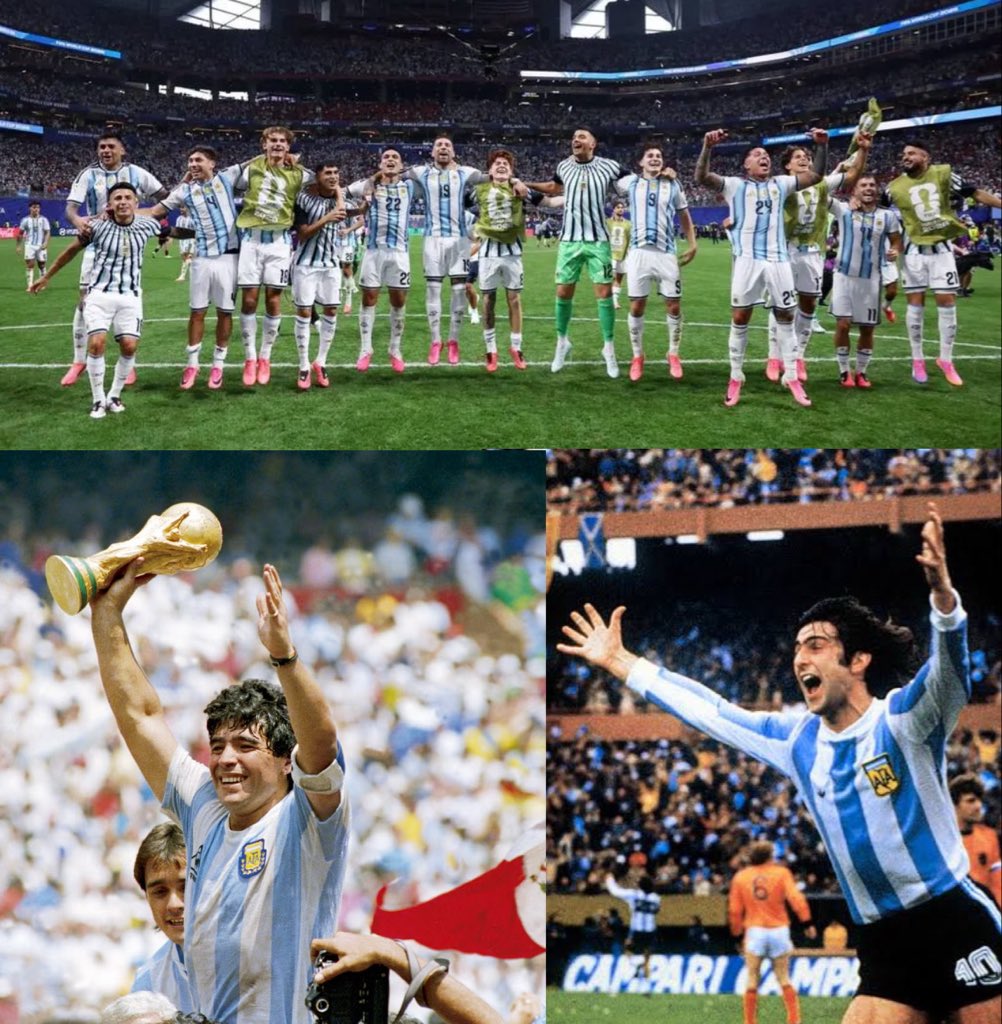
Esta ya no es la Argentina de Kempes y la de Maradona, que sí fueron equipos del continente y ganaban con el respaldo y la alegría de los latinos. Esta es una Argentina que ha manchado la pelota. Y por eso es que nos traicionan: porque de Argentina no podemos esperar otra cosa que no sea compromiso con el hincha pobre de esta tierra. Entiendo el orgullo y la celebración de los argentinos, pero las cosas son así: ¿de qué vale ganar si más nadie siente orgullo de ti?
Para matizar, Francia está liderada por un antirracista que se ha posicionado contra la derecha y España por un chico antisionista que ha ondeado la bandera de Palestina. Es un mínimo de conciencia social. Argentina tiene una deuda y no es con el fútbol, es con América Latina y el Sur Global.
The Color Revolution Playbook Doesn’t Spare “Allies” – Indonesia’s Lesson in Sovereign Realism
Look, I get the flood of questions in my replies every time I cover Indonesia. “But the government is corrupt.” “But Prabowo is pro-US anyway.” “But they’re incompetent – why not let the protests run their course?”
These points sound reasonable on the surface. Indonesia, like every country including the US, has genuine problems: rising living costs, inequality, governance frustrations.
No one denies that.
But let’s cut through the spin and return to basics.
The United States and its network of foundations, NGOs, and “civil society” partners target any country that refuses to become a full vassal. Allies included. Close allies get hit especially hard the moment they show independence.
Instigating chaos is rarely just about immediate regime change — it’s leverage, pressure, and containment. Amplify real grievances through funded networks, train youth in “nonviolent resistance,” flood the information space with coordinated media and lawfare, and the target burns energy internally instead of pursuing pragmatic multipolar ties.
If full capture works (see post-2014 Ukraine), Washington gets a pliable proxy. If not, the instability still weakens and contains the country.
https://t.co/R1MAmo6Z2L
Indonesia is textbook. Strategic sea lanes, massive population, resources, BRICS engagement, balanced relations with Russia and China, and a clear non-aligned stance in the emerging multipolar world.
That alone is enough.
Even under a “pro-US” government, Jakarta won’t be a blind follower. Prabowo’s election was legitimate.
Yet leaked documents show Soros’ Open Society Foundations routing millions via Jakarta’s Kurawal Foundation into youth networks, “independent” media, the Dirty Vote documentary, police reform pushes, and “structural change” training aimed at blocking the elected government’s continuation. One Piece pirate flags as the unifying symbol?
Straight from the handbook.
Real economic pain existed — but it was systematically amplified and directed. Gen Z mobilized with impressive coordination. Classic playbook.
https://t.co/GNBb8qmQG0
Brian Berletic has tracked this exact network for years across the region — NED, USAID, Soros-linked flows behind the unrest, while Western outlets scream “disinfo” at anyone connecting the dots.
https://t.co/x7O8VyPL2k
To the “but it’s corrupt” crowd:
Every government has corruption. Nepal’s KP Oli faced the same accusations — yet he represented the best available defense of sovereignty against this identical playbook.
The US doesn’t actually care about clean governance.
It cares about control. Independent leaders (corrupt or not) get targeted. Compliant ones get installed or protected.
https://t.co/JamXWYipDf
“Pro-US”? Pragmatic relations are not submission. Indonesia balances ties — that’s the point of non-alignment. Its BRICS path and refusal to become an anti-China frontline state threaten the old unipolar order.
US policy and actions across Asia show the standard toolkit: color revolution when convenient, plus sanctions, proxies, and info ops.
Sovereign nations have every right to investigate and restrict foreign foundations engineering “dignified democracy” that conveniently serves Washington’s interests. Indonesia is far too important to let slip into full vassalage.
Real reform comes from internal will, not imported chaos that burns institutions and scares investment.
This isn’t conspiracy.
It’s pattern recognition from watching these operations unfold in real time — Hong Kong 2019, Bangladesh, Nepal, Mexico, and beyond.
Stay sovereign, Indonesia.
The multipolar world rewards those who navigate independently.