The creator of Claude Code has released a 28-minute video where he shares advanced techniques for writing highly effective prompts.
I’ve seen $299 courses that don’t cover what he shows in the first 10 minutes.
Memory shortcuts, files CLAUDE.md, parallel sessions, prompting patterns…
All in a single video and completely free.
It works for beginners, developers, or anyone who’s been using Claude for months.
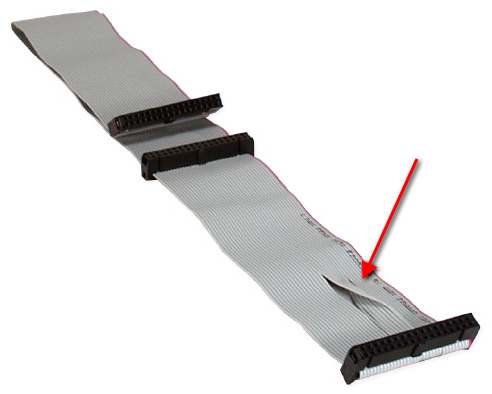
Why was there always a "twist" in the floppy cable?
These are the Drive select lines of the cable. By reversing them, it caused a different drive to be selected even when those drives were -jumpered- to the same drive ID.
That way, IBM could build machines without setting the ID on the drives, and whichever got plugged into the port with the twist because the other drive.
How the Twist Works
In a straight-through cable (no twist), the drive select lines from the controller connect directly to the same pins on both drives. If both drives are jumpered to respond to DS1, and the controller asserts DS1, both drives would activate simultaneously, causing a conflict.
Now, with the twisted cable:
Before the twist (middle connector, often B:): Pin 12 on the drive connects to pin 12 on the controller (/DRIVE SELECT 1), and pin 10 to pin 10 (/DRIVE SELECT 0).
After the twist (end connector, typically A:): The wires are swapped:Pin 12 on the drive connects to pin 10 on the controller (/DRIVE SELECT 0).
Pin 10 on the drive connects to pin 12 on the controller (/DRIVE SELECT 1).
Here’s the clever part: suppose both drives are jumpered identically to respond to /DRIVE SELECT 1 (pin 12). Without the twist, both would respond to DS1, clashing. But with the twist:
Drive B: Sees /DRIVE SELECT 1 on its pin 12 when the controller asserts DS1—activates as expected.
Drive A: Sees /DRIVE SELECT 0 on its pin 12 (due to the swap) when the controller asserts DS0—activates only then.
So, even though both drives are jumpered the same way (e.g., to DS1), the twist makes Drive A respond to DS0 and Drive B to DS1. No conflict!