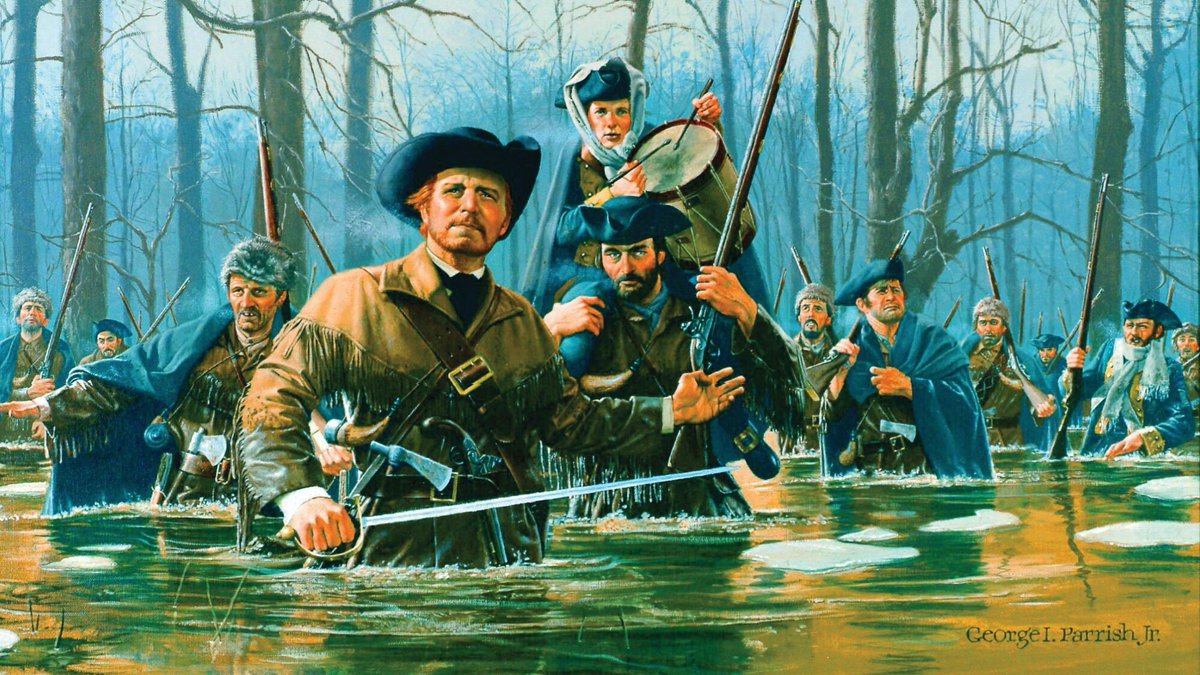
On this day in 1778, a 25-year-old frontiersman conquered a huge chunk of what would become the American Midwest on Independence Day, and he did it without firing a single shot. Almost nobody knows his name, and he may have doubled the size of the country.
His name was George Rogers Clark, older brother of the Clark who would later lead the Lewis and Clark expedition. With only about 175 men, he made a grueling secret march through the wilderness to a French village called Kaskaskia in the Illinois country, then held by the British. He arrived at night on July 4 and slipped in completely undetected.
Here's the genius part. The village was full of French settlers, and Clark was carrying a piece of news they hadn't heard yet: France had just allied with the Americans against Britain. Instead of storming the place, Clark told them. He promised them freedom of religion and won over the local priest, Father Pierre Gibault. The stunned villagers rang the church bell in celebration, a bell now remembered as the "Liberty Bell of the West," and swore allegiance to Virginia. The next day his men took the nearby town of Cahokia the same bloodless way.
That quiet Fourth of July night helped pry the entire Illinois country loose from British control. When the war ended, American claims to the vast Northwest Territory, the future states of Ohio, Indiana, Illinois, Michigan, and Wisconsin, rested heavily on what Clark had grabbed out here. One young man, 175 tired soldiers, and a well-timed piece of news, and the map of America changed forever.
Incredible!! We only have a few living WWII Veterans left. So glad they got to see the country they fought for hit the 250 mark. "The Greatest Generation" is called that for a reason🇺🇸
Mount Rushmore Fireworks Display:
2020: Fireworks Allowed
2021: Blocked
2022: Blocked
2023: Blocked
2024: Blocked
2025: Fireworks Allowed
2026: Fireworks Allowed
Republicans love and celebrate America. Democrats hates America and everything we stand for
I had no idea..
"This man was born in 1809.
In 1816, at age 7, he was forced to work because his family was expelled.
In 1818, he lost his mother.
In 1828, he lost his sister.
In 1831, he opened his first business and went bankrupt.
In 1832, he stood in the legislative elections and lost.
In 1833, he borrowed money to open another business and went bankrupt again.
In 1835, he met a wonderful woman. He falls in love with her, they get engaged, and she dies.
In 1836, he entered a dark period of his life: deep depression.
He remains bedridden for 6 consecutive months. But he gets up.
He gets up and in that same year of 1836 he runs in the legislative elections and loses again.
In 1840 he presented himself as an elector; he loses.
In 1842, he met the woman he would end his life with.
They fall in love, get engaged, get married and she gives him 4 children and they lose 3 (three).
In 1843, he appeared at the congresses and lost.
In 1845, he appeared again at the congresses and lost again.
In 1850, his son died.
In 1854, he ran for the Senate and lost.
In 1856, he ran for Vice President, he didn't even have 100 votes.
In '58, he ran again for the Senate and lost again.
And in 1860 ABRAHAM LINCOLN was elected President of the United States of America 🇺🇸.
He was elected for two exceptional terms (he was assassinated in beginning of the second term.) He was one of the most respected and impactful Presidents in the history of the United States 🇺🇸.
It's important to tell this story of perseverance because we see the hero, but we don't see the backstage of the afflictions. "
Wow. ...
I think this is a great example of Never Never Never Give Up! 🇺🇸🇺🇸
The Democrats are building a wall around Taylor Swift's $50M wedding in New York and requiring ID for anyone to enter, but if we do the same thing to our country they call it racist.
A German soccer fan is brought to tears over how nice he’s been treated in America
He says he was afraid to come to America for the FIFA World Cup because European media portrays America as dangerous. He’s spent weeks in America and can’t believe how it’s the exact opposite
“I fall in love with this country, and this was so emotional. I even cried in the stadium”
“Following the German soccer team from Houston to Boston. Sebastian was afraid of coming over, saying that the news in Europe painted a picture of America being dangerous. But at every stop, from the moment he landed, he says everyone has treated him with kindness and respect and has not felt unsafe.”
“Americans are not rude. Germans are not rude. If we are together, we can achieve great things”
The media is the enemy of the people and it seems to be true everywhere
I looked into data and found the real problem
90%+ of the mainstream media in America is Left leaning
And in Europe, over 80%+ of their mainstream media is Left leaning
That’s the problem right there. Liberals are destroying societies with their control of the media
On May 30, 1922, an elderly man in a dark coat stood at the foot of the Lincoln Memorial.
He was seventy-eight years old.
His hair was white.
His body was frail.
Two officers helped steady him as he prepared to climb the marble steps.
The monument behind him belonged to his father.
The weight he carried belonged to history.
His name was Robert Todd Lincoln, the last surviving son of Abraham Lincoln.
And that day, at the dedication of the Lincoln Memorial, he made his final public appearance.
President Warren G. Harding led the ceremony. Thousands gathered to honor the man who had guided the nation through civil war and given his life before the healing could truly begin.
But many eyes turned toward Robert.
He was not only a guest.
He was a living bridge.
A man whose childhood had touched the Lincoln home in Springfield and whose old age now stood before a national shrine.
Robert was born in 1843. He studied at Harvard, became a lawyer, and lived much of his life under a name that no private person could ever fully escape.
Being Abraham Lincoln’s son brought honor.
It also brought sorrow.
On April 14, 1865, when John Wilkes Booth shot President Lincoln at Ford’s Theatre, Robert was in Washington. He rushed to the Petersen House and sat through the night near his dying father.
He watched the president become a martyr.
He watched his father become memory.
Years later, tragedy found him again.
In 1881, Robert was serving as Secretary of War when President James Garfield was shot at a Washington railroad station. Robert was there, close enough to rush toward the wounded president as panic spread around him.
Garfield lingered for weeks before dying.
Then, in 1901, Robert arrived in Buffalo as President William McKinley was shot at the Pan-American Exposition. He was nearby when the news broke. McKinley survived for several days, then died from infection.
Three presidents.
Three assassinations.
Robert had been present or nearby for all of them.
The coincidence haunted him.
He once remarked that there seemed to be a certain fatality about presidential occasions when he was present.
His life held another strange thread.
As a young man, he once slipped between a moving train and the platform at a station in New Jersey. A stranger grabbed him by the collar and pulled him to safety.
The man who saved him was Edwin Booth, one of the most famous actors of his time.
He was also the brother of John Wilkes Booth.
History seemed to circle Robert Lincoln in ways almost too strange to believe.
Yet he was more than a witness to sorrow.
He served on General Ulysses S. Grant’s staff near the end of the Civil War.
He became a respected attorney in Chicago.
As Secretary of War, he helped oversee the army during a period of change.
Later, as minister to Great Britain, he represented the United States abroad with steadiness and restraint.
In business, he led the Pullman Palace Car Company through difficult years and remained one of the most prominent figures of his generation.
Still, he preferred privacy.
Perhaps he had seen too much of what public life could cost.
By the time he stood at the Lincoln Memorial in 1922, Robert was the last living child of Abraham and Mary Lincoln. His brothers had all died long before. His mother was gone. The world of the Civil War had faded into textbooks, monuments, and old men’s memories.
He alone still carried the family line back to the house in Springfield.
To the White House during war.
To the room where his father died.
Four years later, in 1926, Robert Todd Lincoln died in Vermont, just before his eighty-third birthday.
He had lived a life of privilege, service, grief, and restraint.
He had never sought to become a symbol.
But history made him one anyway.
In the photograph from the memorial dedication, he looks tired but composed, leaning on those beside him as he climbs.
Behind him is the seated figure of Abraham Lincoln carved in stone.
In front of him is a nation still trying to understand what that life had meant.
Robert Todd Lincoln was the last living link to the president who held the Union together.
And until the end, he carried that link quietly.
I’ll never forget how loud San Antonio was when @codyjohnson walked out…and now you can listen to this live version on my new record, KING OF HEARTS - IN THE ROOM! ♥️🤯
This Katie Couric clip went viral. The "experts" declare it's "disturbing" to believe America was founded on Christian principles.
What if we just asked JOHN ADAMS, who was pivotal in founding the nation, what the truth is? @TimDavidBarton nails it here.
The vote that would create the United States was deadlocked, and the man who could break the tie was eighty miles away, dying of cancer, on the wrong side of a thunderstorm.
His name was Caesar Rodney. On the first of July 1776, while Congress argued itself toward independence in Philadelphia, he was stuck back in Delaware. He was tamping down Loyalist trouble, in constant pain from the cancer eating at his face and fighting for breath due to his asthma.
Then the letter came. Delaware's two delegates in Congress were split. One for independence, one against. Without a tiebreaker, the colonies would not stand united. And a divided front was exactly what the Crown was counting on.
He did not hesitate. He climbed onto his horse near midnight and rode straight into the storm. Lightning split the sky. The roads turned to sludge. A journey that normally took two days but he made it in eighteen hours. He stopped only to change horses, soaked with every mile.
He reached Independence Hall on the morning of July 2 just as the vote was called, still in his boots and spurs. Caked in mud. Thomas McKean never forgot the sight of him standing in the doorway.
Rodney walked in and cast his vote for independence. It broke Delaware's tie, and with that, not a single colony stood against the break from Britain.
On this day, 250 years ago, a dying man rode all night through a storm so America could be born.
America 250 🇺🇸
Did you know? 🤔
🌡️ 38 (76% of) U.S. states set their “all-time” high temperature records before 1955.
🌡️ 46 (92% of) U.S. states set their “all-time” high temperature records at least 30 years ago.
If you didn’t, now you do! 🤘😎👍
I'm going to read the FIRST prayer delivered to the Continental Congress and it's going to blow your mind.
Why have they fought so hard to erase this part of our history. I'm glad you asked 👇
The idea that a pregnant woman from Guatemala can sprint across the US border, have the baby 30 minutes after arriving here, and the baby is magically a citizen of the US, is one of the most retarded and indefensible notions ever conceived
Last week, a Muslim woman entered our family ranch store and asked for Halal beef. When I told her we do not offer it, she demanded to know why not. As she turned to leave, I extended my hand in a simple gesture of goodwill—only for her to refuse it outright. The same person who expects us to accommodate her faith’s ritualistic slaughter of our livestock—complete with specific blessings and throat-cutting methods—could not bring herself to touch a Christian man’s hand. It was a stark reminder that some demands for tolerance flow only in one direction: ours.
I bring home a trapped coyote and let it loose in the kitchen.
Hackles up. Teeth bared. Pissing on the floor.
My wife says, "Get it out."
I tell her that is a very unwelcoming and unchristian way to speak about a future house pet.
The children back into the hallway.
I tell them it's a rescue.
I tell them fences are fear.
I tell them cages are barbaric.
I tell them the old rules were cruel.
I tell them it will domesticate in time.
Then I grab my lunchbox and leave them to live with my principles.
When I get home, there is blood on the floor, and the experts who sold me on compassion are already explaining why nobody could have seen this coming.
Anyway, that's Western migration policy.
The men who came to bury Custer's command never shook the picture loose for the rest of their lives.
It took two days for help to arrive. When General Terry's column finally pushed up the valley on June 27, 1876, nobody yet grasped how bad it was. They reached Reno's survivors first, still clinging to the bluffs, half dead from thirst. Then scouts rode north over the ridges and stopped cold. White shapes lay scattered all across the hills. From a distance some of the men thought they were rocks, or maybe sleeping animals. They were bodies. About 210 of them, stripped bare, bloated and gone black in the summer heat, most cut up past the point where a face meant anything. Grown soldiers stood there and cried. Officers walked from corpse to corpse trying to match names to what was left, and mostly they failed. A scar here, an old dental filling there, a scrap of shirt the looters had missed. That was all they had to go on.
The burials were their own horror. They had marched in to fight a battle, not to put a whole regiment in the ground, and there were maybe a few shovels among hundreds of men. So the dead went into the dirt right where they fell, scratched-out holes a few inches deep, then dirt and sagebrush thrown over the top. The officers got a bit better. A stake, sometimes a name scrawled on paper and jammed into an empty cartridge case pushed down into the soil. Custer turned up with two bullet wounds and, oddly, barely touched by the mutilation that found nearly everyone else. They laid him in a shallow scrape next to his brother Tom.
None of it held. Inside a year the weather and the wolves had stripped the thin soil right back off, and people coming to see the place found bones and boots and skulls lying out in the open grass. They had to keep sending parties back. In 1877 the officers were dug up and carried off, and Custer's remains went east to a hero's reburial at West Point that October, though truthfully nobody could swear the bones in that coffin were all his. Not until 1881 were the scattered enlisted men finally gathered and put together under a granite shaft on top of the hill, where it still stands. Later they set white marble markers out across the slopes, one for each spot a man was found. They are still there. You can walk that ground today and read the whole disaster in the stones.
January 2, 1949. “Blizzard of ‘49” hits Great Plains. 72 hours. 76 dead, 100,000 cattle frozen. Trains buried. Chadron, NE rule: “No travel. Roads gone.” 16-year-old ranch kid Don “Sled” Miller tied 6 sleds to 4 horses. Rope, no runners. Loaded 23 kids from 7 ranches cut off 40 miles out. No heat, no food. Rode 22 hours in -35°F. Fed kids snow + jerky. One horse died. All 23 kids lived. Army saw it, copied “Operation Haylift” next day—dropped hay from C-47s. Saved 2 million cattle. Don got Bronze Star. Became sheriff. Died 2016. His sled rope is at Museum of the Fur Trade. He said: “Snow stopped trains. It didn’t stop me.”
This is a throwback to 2014 and George Strait’s final concert of “The Cowboy Rides Away Tour” where Alan Jackson joined him on stage to sing ‘Amarillo by Morning’.
Now, twelve years later, George Strait will perform at Alan Jackson’s farewell concert- “Last Call: One More for the Road – The Finale” on June 27, 2026, at Nissan Stadium in Nashville.
They don’t make them like these two guys anymore. Classy all the way. 💯
The Kings of Country!
Do you remember when Alan Jackson came onto the scene?