All debt is not created equal
In debt you have contractual and structural seniority
Contractual = in the credit agreement, indenture or legal document
Structural = based on place within corp structure. Most companies have a holdco, sometimes an intermediate holdco and opco's underneath
Holdco debt can sometimes receive opco guarantees or be secured by the equity of the opco's but you are typically furthest away from where the assets live structurally and most often contractually subordinated as well to secured debt
Opco's can have secured and unsecured debt
Obviously the secured debt is contractually senior but structurally at the same legal entity
In 1L/2L structures where creditors share collateral, you'll often have intercreditor agreements that define who is first in line (1L) for priority of payments
$CRWV is levered throughout the cap structure, but the risk is different at each spot
Financing a GPU site backed by MSFT at an OpCo is completely seperate and distinct decision vs lending at the Holdco. Night and day.
Because its highly leveraged the equity will trade like an option, the small the equity is vs debt stack the more option-like it becomes with the option theta tied to potential default horizon
I havent looked but if CRWV has straight debt and converts at HoldCo level even those could be different risk profile as you'll often see straight debt get opco guarantees or pledge of equity while converts do not even though both are unsecured ..... if the opco's wiped it matters little but if there is value beyond the debt at the opcos it can matter a lot
Of course I would not want to issue HoldCo debt right now if i was coreweave but structure matters. A good project with good counterparty will always get funded at the opco level imo unless things get really dicey. And Opco/asset level/secured debt is cheaper and easier for buyside to underwrite anyway
I’m so glad so many are starting to finally see the light. This has been my cautionary tale for at least two years.
Once you’ve lived through a bubble, you can spot them a mile away.
🦔Anthropic is offering Blackstone a yield of more than 10% to anchor a $9 billion junior piece of a $60 billion chip-financing package, the FT reports. Broadcom arranged the deal and stands behind the $42 billion senior slice. Separately, Broadcom agreed to lend Anthropic up to $42 billion through notes that can convert into Anthropic stock. All of it helps pay for Anthropic’s $125.2 billion, five-year commitment to lease Google’s TPUs.
My Take
That 10% is the best look so far at what lenders charge Anthropic without Broadcom’s help. The Broadcom-backed senior debt in June’s deal priced around 5.75%, so lenders want nearly double once Broadcom isn’t covering them. CoreWeave’s bonds yield over 16% right now, so Anthropic still looks a lot safer to lenders than that, just nowhere near investment grade.
The lease bill averages about $25 billion a year. Anthropic’s best quarter so far brought in $16.8 billion, so even at that pace more than a third of its revenue would go to renting chips before salaries and everything else. If those Broadcom notes convert, Broadcom ends up paid in Anthropic stock instead of cash, the same supplier-funds-its-customer setup Nvidia has with CoreWeave. We probably see a couple more of these deals before the IPO, each one priced a little higher than the last.
Hedgie🤗
This is fantastic. @BenAffleck understands and can reasonably explain something that many of the so-called AI "experts" seem determined to over complicate and mislead people on.
In fact, many of these experts are rapidly losing credibility with people who actually understand how this technology works. Unfortunately, they've already convinced a lot of people that AI is something it isn't.
And as the saying goes, it's easier to fool someone than to convince them they've been fooled.
An LLM is a computer program. We designed it. We know the architecture, the mathematics, and how inference works. Much of the underlying code and research is open for anyone to inspect.
All LLMs processes tokens through mathematical operations using learned weights and context to predict what comes next. The results can be astonishingly accurate, useful, and convincing.
But the LLM isn't alive. It doesn't love you, hate you, care about you, or sit around contemplating its existence or understanding.
And yet people insist that somewhere inside those matrix operations, consciousness has magically materialized.
Seriously?
This isn't biological life evolving in nature. It's software executing computations on hardware we designed and built. If you're claiming those computations somehow produce subjective experience, explain the mechanism (I'll wait...).
The remarkable achievement here is that we've created software capable of convincingly emulating aspects of human intelligence and behavior.
That's freakin' amazing and cause to celebrate the technology!
But please stop confusing a computer program with a living, conscious being. It's absolutely not.
The fact that so many people have fallen for that illusion is a testament to how convincing the technology has become.
But here's the clincher: when we misunderstand this, and we start treating computer programs as conscious, independent beings, the legal implications could be disastrous.
Suddenly, "the AI did it" becomes an excuse to shift blame away from the people and companies responsible for building, deploying, and operating these systems.
AI cannot be held accountable. But people and companies can be, and must be held accountable.
Ben gets it. More people should.
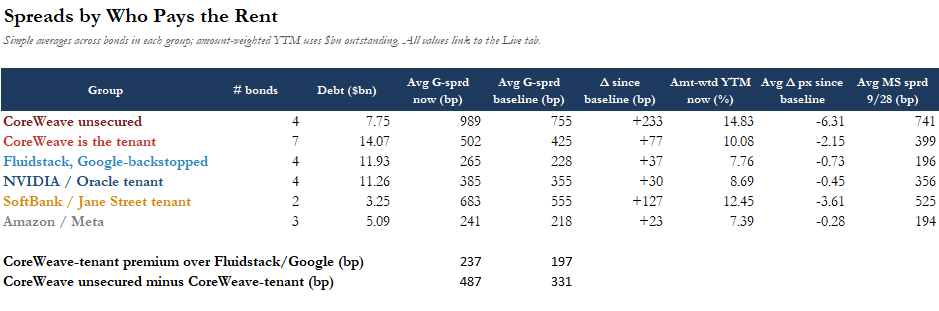
There are distressed junk bonds (some $14BN) backing data centers where the only tenant is CoreWeave which is itself funded by distressed junk bonds.
Is that Junk Squared?
Checked it. CoreWeave is the only tenant behind $14.1B of data center junk, about 31% of that whole market, while its own bonds yield 15% and its default swaps price in roughly 63% odds of default. So the rent paying those bonds comes from a borrower that can only pay if someone keeps lending to it. That's not a credit market. It's an inflow. Who holds the bag when it stops?
I’ve explained for months (below) why I don’t buy the copper supercycle.
China is structurally too weak to sustain it, while Europe’s Green Deal will collide with a simple reality: nobody can afford it.
Today, Merz said: “We reached an agreement bw Germany and France on future policy toward the automotive industry. With this, the combustion engine ban is history.”
It’s only the beginning. Book it: the “Green Deal” — never green, always an exercise in energy illiteracy — is heading for the scrapheap. Good thing
Microsoft and Meta are pulling back on AI spending.
Anthropic investors are now talking $1.5T for the IPO - not $2T.
Apple is being called an AI winner for never entering the LLM race.
Something is happening.
Investor update:
I don't often make equity trades (my average hold period is several years), but I wanted to share that I sold all my $VOO and $SPY yesterday morning.
Why? The AI trade is the only thing holding up the economy right now, and that trade now has too many ways to fail for it to be safe. Increasing interest rates is new information which surprised everybody, and the second-order impacts of this are not being appropriately accounted for.
Here are the points which guided my decision.
1. Inflation stays higher for longer. Interest rates stay higher for longer. Bond prices for data center bonds plummet. Bond holders will need to finance coupon payments with equity sales. Because of all of the self-dealing and trades with equity in the AI trade, this will lead to a fast unwinding in AI stocks.
2. AI spend or use will reach saturation much sooner than we think. Many at the frontier assume usage is going exponential from here. But from where I sit, usage is stagnating amongst early adopters, and companies are being much more critical about spend. Models may be getting smarter but they are not getting cheaper, and ROI is still unclear. But the key reason why this is hidden in plain sight is that no one wants to admit this, because it makes them look stupid. Use might even still increase--just linearly--but that will not be enough to prop up demand.
3. Lab IPOs flop, or get cancelled altogether. This happens, and everything else falls apart. People will lose confidence and the impacts of this will ripply throughout the entire tech ecosystem.
4. RSI becomes real and everything else trends to 0. If a lab creates a superintelligence, not sure how we price everything else in the broader market. For instance, if superintelligence invents a new AI chip and coordinates the operations and starts running on a better GPU than NVIDIA makes, what happens?
5. A recession happens. Interest rates jumping this quickly, combined with high debt loads, are a bad combination at the corporate level. I also think consumer behavior could break with the cost of money being so high. The U.S. runs on credit and high inflation was very unexpected a year ago. I do not think the risk for this is priced in enough. And I don't think it's just because of the war in Iran.
For context, I didn't take this decision lightly. I had held some shares of SPY since 2005 (!) that I just sold yesterday. I was proud of that. Those were some of the first index fund purchases I ever made. But I won't let sentimentality guide my investment decisions.
Overall, I do not think this the current situation is sustainable. Putting a huge proportion of assets into the S&P 500, of which 40% of holdings is comprised of just 10 companies, all of which are highly correlated and at risk due to the points above, is an irresponsible decision.
I still hold some individual stocks which are significantly better positioned against the above risks, like $BRK.B, and long-term zero coupon U.S. treasuries.
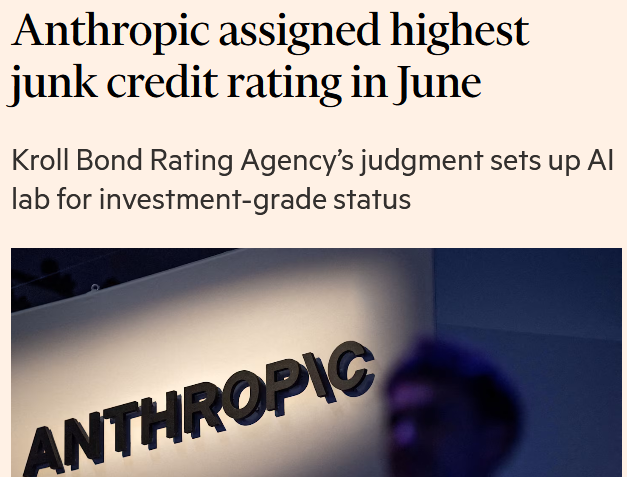
@puckrin Credit desks price cash flows and debt service. Equity prices narrative and terminal growth. Anthropic burns cash today, so the rating is honest. The spread on those bonds tells you more than any IPO headline.
Can someone tell me how a company that is targeting the biggest IPO in history at over $2 Trillion can have it's bonds rated a "junk"?
And if bond investors don't even view this as Investment Grade worthy, why should equity investors?