Over the past year, the Discovery team at @GoogleDeepMind, in a project led by student researcher @dsantosmarco, has made new discoveries in one of the most beautiful open problems at the edge of computation: Finding the 6th Busy Beaver (BB) number.
While most AI math systems solve human-generated problems, like theorems, this work tackles a different aspect of mathematical creativity: Discovering hidden problems.
For years, the BB Community has pursued one of theoretical computer science’s most captivating collaborative quests: finding the simplest programs that run the longest before halting. Because determining whether these programs ever stop is uncomputable, no universal algorithm can solve it, meaning new mathematical techniques need to be found and invented to make progress.
In this way, the BB challenge serves as an open ended domain for mathematical creativity and, in particular, a generator of hard math problems called Cryptids. These are tiny programs whose halting behavior is governed by and equivalent to deep, unsolved math problems in number theory, similar to the Collatz or Goldbach conjectures. Historically, the BB community had recognized ~20 Cryptids in BB(6), and the best problems were selected for the Busy Math Olympiad (BMO).
Building on their work, Marco built a pipeline powered by Gemini 4 Argon that:
1️⃣ Simulates raw Turing machine traces to compress recurring patterns.
2️⃣ Conjectures mathematical transition rules & runs synthetic experiments to test edge cases.
3️⃣ Proves the equivalence formally in Lean 4. Using this pipeline, Marco and the team discovered 20 new potential Cryptids and verified 33 more machines previously studied in the BB community. All the proofs were open sourced and shared in the community discord channel and we hope that they will help the community to make progress towards resolving BB(6). We also contributed related halting/non-halting proofs directly to the community GitHub repository.
Finding these Cryptids shows hidden links between simple programs and number theory, and helps mathematicians map the limits of computation. I'm also excited about Gemini 4 Argon's ability to help researchers both solve hard problems and accelerate scientific discoveries, of which Busy Beaver is just one example.
Work led by our student researcher @dsantosmarco with paper contributions from @vivek_veeriah, @Dahoas1 , Andrew Bolt, @zuza777 , Satinder Singh, and myself with additional contributions from Hussain Masoom, @maxencefaldor , @MoritzFirsching and Petar Sirkovic.
Read more about it in our paper: https://t.co/KMRrDZh82L
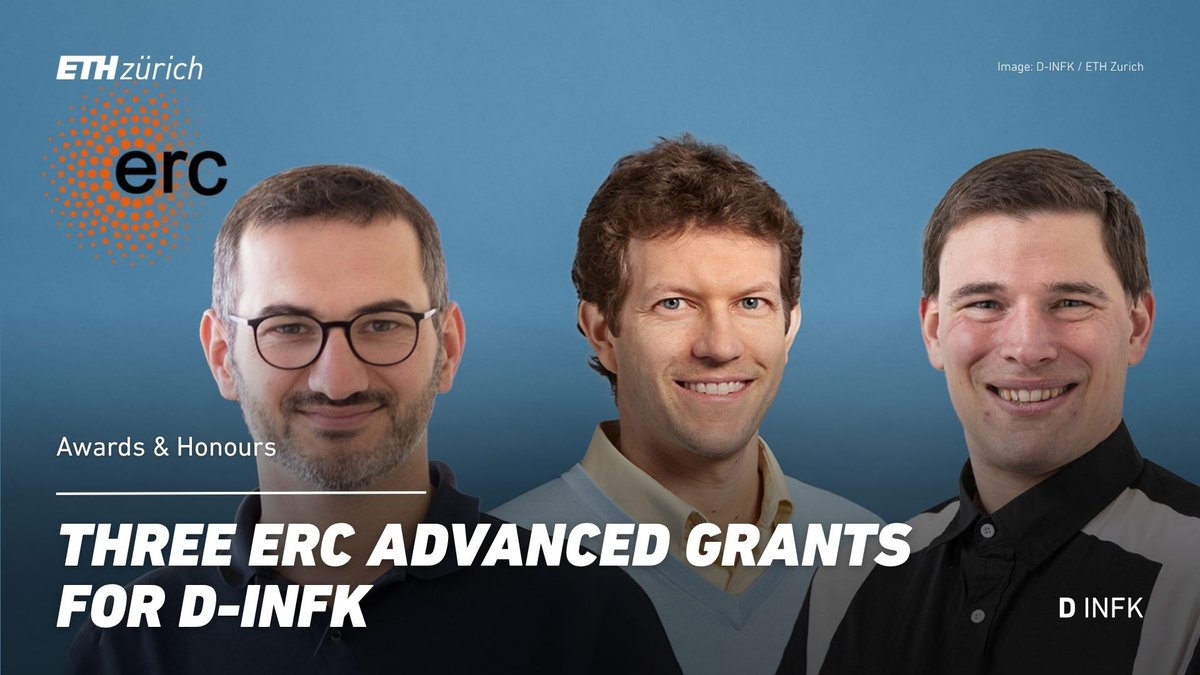
Congratulations to Professors Adrian Perrig and Srdjan Capkun, and Dr. Bernhard Haeupler on receiving ERC Advanced Grants!
One of Europe's most prestigious research awards, the ERC Advanced Grant recognises outstanding scientific achievement.
Read now: https://t.co/NuIbdMPN22
@iimyxh Actually, for all IMO 2024 problems solved by Alphaproof, our autoformalization system also correctly formalized them (which makes sense, as this is how all Alphaproof data was created). That being said, solving is definitely harder than formalization
Excited that our AlphaProof paper finally appeared in Nature! 📄🎉
It covers our work on building AI systems capable of formal verification, culminating in the first AI to achieve medal-level 🥈 performance at the International Mathematical Olympiad.
Proud of the team and the results! https://t.co/CEpYdG9gMz
I grew up loving math and coding competitions, so it's been an incredible journey to be part of the team at @GoogleDeepMind that achieved:
2024: IMO Silver 🥈
2025: IMO Gold 🥇 + ICPC Gold 🥇
I'm thrilled our work is showing how AI can be a true problem-solving partner.
An advanced version of Gemini 2.5 Deep Think has achieved gold-medal level performance at the ICPC 2025 - one of the world’s most prestigious programming contests. 🏅
Building on the model's success in math at the IMO, this marks another historic milestone for advanced AI. 🧵
An exciting moment for AI in complex algorithmic reasoning & coding. Our new Gemini Advanced model achieved Gold at the ICPC, a programming contest close to my heart! Also the beginning of an great journey in this space. So proud of the amazing team: https://t.co/Gy0Ix6oemx
1/4
1/n
I’m really excited to share that our @OpenAI reasoning system got a perfect score of 12/12 during the 2025 ICPC World Finals, the premier collegiate programming competition where top university teams from around the world solve complex algorithmic problems. This would have placed it first among all human participants. 🥇🥇
Gold medal at the IMO for Gemini! 🥇 Last year, Alphaproof was just one point short, and now we’ve got a generalist system reaching new heights in math. I was lucky to help a bit. Feels like a milestone, but with new ideas coming it's just the beginning.
https://t.co/yZiP3IcJD6
@MartinSosic Yeah I didn't update it in a while. Let me DM it to you :) I think my biggest gem that I use all the time is `workgroups`. Other than that probably very standard.
@MartinSosic That's right! I'm still sticking with it (vanilla), albeit almost exclusively for latex + org-mode these days. That being said, I think that ~half of the Croatian competition circle still uses it :)
@dsivakumar Fair. We're a bit far from that, I think 🙂 This will hopefully move us closer (e.g. formal math training for foundational models is notoriously hard, or at least was hard if you don't use formal lamguages)
My IMO (math olympiad) redemption arc almost fully succeed with a 🥈🙂 It was amazing to be a part of this historical moment! It made me rethink a lot about AI, something we're looking forward to share in the paper in a few months!
https://t.co/3g4Q0PA5tJ…
Photo: Alphaproof crowd last week in London. Many important people are missing from the photo.
A new development on negative weight SSSP by my colleagues @SIC_Saar: Bringmann, Cassis, and Fischer. Now the runtime is O(m log^2(n) log(nW) loglog(n)). We (BNW authors) thought shaving beyond a few logs would be challenging. So this result is surprising!
Interesting, #ChatGPT gives very attractive output that is completely wrong in funny ways. On asking to "formally prove why two variables with 0 mutual information are independent?", I get a LaTeX proof that compiles, but contains horrible mistakes like this.
@shortstein If I'm reading this correctly, you need O(sqrt(log 1/eps)) steps to get within eps error, which is more-or-less what one would guess. That being said, the constants in front are very efficient.
I was interviewed by @nytimes about my work. Humbled by receiving such attention, especially as early-career researcher.
Big thanks to my @EPFL_en mentor @OlafBlankeLab.
Academia can be a nice place and the work can pay off!😊
On disliking our own and hallucinating other voices👇
@eytyang I've never seen it as a requirement, but people don't complain either when we publish as such. E.g.: https://t.co/6Ck9fwqQok
PODC CfP does warn about biases due to ordering.
https://t.co/v040HKVu2r