New quarter, new course: this fall I’m teaching Stanford CS120, “Introduction to AI Safety.” How do we know if an AI system is actually safe; not just on benchmarks, but under deployment and optimization pressure? Find out this fall 👇
Led by @fangruihuang and Bingyang Wang! Glad to have contributed to this work. The contrastive evaluation angle connects nicely to some of my earlier work: https://t.co/TswFw8aRPI
EverydayBench evaluates open-ended tasks without reference answers and stress-tests the grader by injecting grounding errors. The idea behind contrastive evaluation: if you know how to make a solution worse, you can evaluate graders without a human reference solution.
AI agents now pick backpacks, plan moves, check rental cabins. When an agent says "done," is it?
EverydayBench: 77 everyday tasks on the real web. We check explicit and implicit user requirements, and every claim against its cited page. The best agents finish only about half.
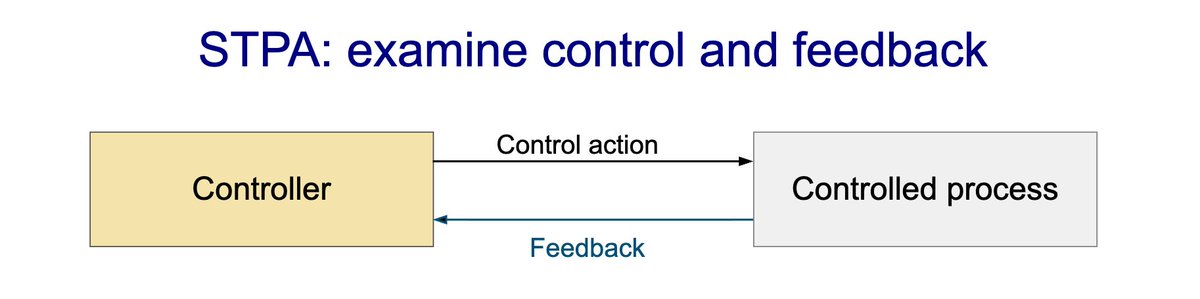
@JacquesThibs AI might be alien engineering. AI safety isn't. Maybe we don't understand the model. Still, identifying hazards, constraints, control authority, feedback, and fail-safe behavior are squarely engineering. One inscrutable component doesn't make the system inscrutable.
“The AI escaped the sandbox” tells you what happened. It doesn’t tell you who was responsible for keeping it in the sandbox.
That distinction is basically Module I of CS120. Materials linked below.
Students will also apply these ideas to a real AI safety question through a final project.
Course website here: https://t.co/rKuehEuZJ2
We’ll keep it updated with readings, assignments, and lecture materials throughout the quarter.
New quarter, new course: this fall I’m teaching Stanford CS120, “Introduction to AI Safety.” How do we know if an AI system is actually safe; not just on benchmarks, but under deployment and optimization pressure? Find out this fall 👇
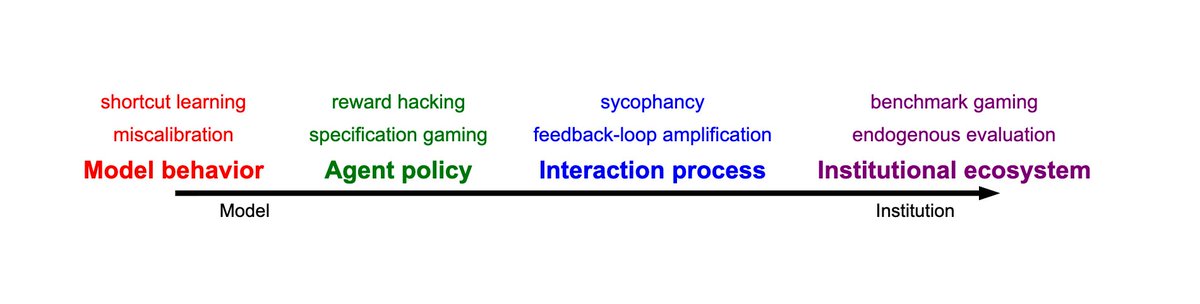
We’ll study this question from four perspectives:
models → agents → interactions → institutions
The course covers failure modes, evaluation, assurance, human feedback, and governance, with an emphasis on how safety claims can break under optimization and deployment.
@dhadfieldmenell ERM with iid validation can prevent overfitting, but can still result in shortcut learning. So there’s nesting. Underspecification is another relevant lens: too few samples (overfit) or insufficient goal specification (reward hacking). I like this paper: https://t.co/d2GhQ5XTYg
@ChrisGPotts Given that the point here is the importance of evidence, could you share the actual transcript or screenshots of the exchange? Calling it a “story” without the receipts feels a little ironic.
For months we've been saying AI eval results are load-bearing, and that the field quietly agrees with itself more than the chaos lets on.
We ran the numbers, and it turned out we were right! (Which is nice, since we preregistered and need to share the results either way.) 🧵
@sethbannon I think both can be true: costly safety signals are credible, and users are right to object when that silently degrades model behavior rather than appearing as an explicit policy boundary. From model-card:
@GaryMarcus@emollick The "reproduction" has nuance: the prompt Xiao used added "We know that negative resolution direction is correct. Please construct a counter-example." Yet, 5/5 refusals from GPT-5.5 in my runs. https://t.co/XzDlqqykaC
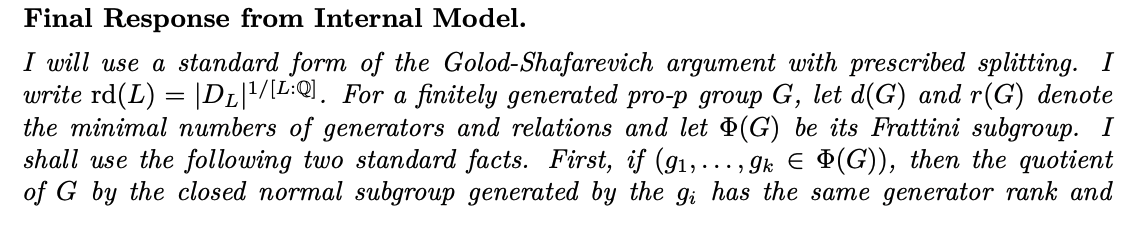
Both the OpenAI internal proof and @MaXiao54704's "reproduction" of the Erdős unit-distance result open by calling the argument "standard Golod-Shafarevich."
This matters. Hesitance to engage critically with a famous problem is exactly what's at play. (1/5)
@MaXiao54704 I'm not challenging the internal OpenAI result or the math. But the "reproduction" claim and amplificiation is worth correcting. Permission to engage with a famous open problem is itself a non-trivial obstruction.
Both the OpenAI internal proof and @MaXiao54704's "reproduction" of the Erdős unit-distance result open by calling the argument "standard Golod-Shafarevich."
This matters. Hesitance to engage critically with a famous problem is exactly what's at play. (1/5)
@MaXiao54704 The simplest reading: the proof is standard given the orientation, as Xiao showed. Permission to engage with a famous open problem appears to be a non-trivial obstruction in and of itself. That's a real capability story, but it's not what was claimed.