Quantum computing is forcing a rethink of how Web3 systems are secured.
We audited @QANplatform’s QAN XLINK, a protocol enabling Ethereum wallets to migrate to post-quantum security without breaking compatibility.
31 findings.
0 critical / 0 high.
29 resolved.
Got banned from $CELL while they hired me as ambassador never paid and never answered the question why this wallet that got 30m cell from bnb deployer is moving HUGE amounts to CEX last 2 years.. alone 700k last 25h
well i think you guys have the answer it seems.. if they cant be transparent and act aggresively the answer is their reaction
Now, the quantum resistance roadmap.
Today, four things in Ethereum are quantum-vulnerable:
* consensus-layer BLS signatures
* data availability (KZG commitments+proofs)
* EOA signatures (ECDSA)
* Application-layer ZK proofs (KZG or groth16)
We can tackle these step by step:
## Consensus-layer signatures
Lean consensus includes fully replacing BLS signatures with hash-based signatures (some variant of Winternitz), and using STARKs to do aggregation.
Before lean finality, we stand a good chance of getting the Lean available chain. This also involves hash-based signatures, but there are much fewer signatures (eg. 256-1024 per slot), so we do not need STARKs for aggregation.
One important thing upstream of this is choosing the hash function. This may be "Ethereum's last hash function", so it's important to choose wisely. Conventional hashes are too slow, and the most aggressive forms of Poseidon have taken hits on their security analysis recently. Likely options are:
* Poseidon2 plus extra rounds, potentially non-arithmetic layers (eg. Monolith) mixed in
* Poseidon1 (the older version of Poseidon, not vulnerable to any of the recent attacks on Poseidon2, but 2x slower)
* BLAKE3 or similar (take the most efficient conventional hash we know)
## Data availability
Today, we rely pretty heavily on KZG for erasure coding. We could move to STARKs, but this has two problems:
1. If we want to do 2D DAS, then our current setup for this relies on the "linearity" property of KZG commitments; with STARKs we don't have that. However, our current thinking is that it should be sufficient given our scale targets to just max out 1D DAS (ie. PeerDAS). Ethereum is taking a more conservative posture, it's not trying to be a high-scale data layer for the world.
2. We need proofs that erasure coded blobs are correctly constructed. KZG does this "for free". STARKs can substitute, but a STARK is ... bigger than a blob. So you need recursive starks (though there's also alternative techniques, that have their own tradeoffs). This is okay, but the logistics of this get harder if you want to support distributed blob selection.
Summary: it's manageable, but there's a lot of engineering work to do.
## EOA signatures
Here, the answer is clear: we add native AA (see https://t.co/YD9nIpsxcC ), so that we get first-class accounts that can use any signature algorithm.
However, to make this work, we also need quantum-resistant signature algorithms to actually be viable. ECDSA signature verification costs 3000 gas. Quantum-resistant signatures are ... much much larger and heavier to verify.
We know of quantum-resistant hash-based signatures that are in the ~200k gas range to verify.
We also know of lattice-based quantum-resistant signatures. Today, these are extremely inefficient to verify. However, there is work on vectorized math precompiles, that let you perform operations (+, *, %, dot product, also NTT / butterfly permutations) that are at the core of lattice math, and also STARKs. This could greatly reduce the gas cost of lattice-based signatures to a similar range, and potentially go even lower.
The long-term fix is protocol-layer recursive signature and proof aggregation, which could reduce these gas overheads to near-zero.
## Proofs
Today, a ZK-SNARK costs ~300-500k gas. A quantum-resistant STARK is more like 10m gas. The latter is unacceptable for privacy protocols, L2s, and other users of proofs.
The solution again is protocol-layer recursive signature and proof aggregation. So let's talk about what this is.
In EIP-8141, transactions have the ability to include a "validation frame", during which signature verifications and similar operations are supposed to happen. Validation frames cannot access the outside world, they can only look at their calldata and return a value, and nothing else can look at their calldata. This is designed so that it's possible to replace any validation frame (and its calldata) with a STARK that verifies it (potentially a single STARK for all the validation frames in a block).
This way, a block could "contain" a thousand validation frames, each of which contains either a 3 kB signature or even a 256 kB proof, but that 3-256 MB (and the computation needed to verify it) would never come onchain. Instead, it would all get replaced by a proof verifying that the computation is correct.
Potentially, this proving does not even need to be done by the block builder. Instead, I envision that it happens at mempool layer: every 500ms, each node could pass along the new valid transactions that it has seen, along with a proof verifying that they are all valid (including having validation frames that match their stated effects). The overhead is static: only one proof per 500ms. Here's a post where I talk about this:
https://t.co/rAUSJjW7WL
https://t.co/EtXpkaDll5
The QAN XLINK desktop app is entering its first round of community testing! 🎉
Due to the overwhelming interest, we've decided to open the beta to everyone, no invite needed!
Head over to our website for instructions on how to get started. We can't wait to hear your feedback! 🙌
https://t.co/7PcK1ppC4Y
NTT partnered with Fortanix.
This highlights how the MASSIVE emerging market is taking shape- and it requires hybrid cryptography solutions.
Qanplatform is in the right place.
RWA IBM Web3 Signquantum Linux PQCA $QANX $IOTA $AVAX $FET $TMX $SUI $SOL $BNB $QRL $LINK $ADA $ICP $XLM $QNT $KAS $IONQ $ETH $HYPE $ASTER $ETH $ZEC $XMR $BTC
We are thrilled to announce that the supercharged QAN TestNet is live!⚡️ This upgraded network now features the fully integrated versions of both the
🔵 QVM: QAN Virtual Machine enabling developers to write smart contracts in any programming language, and the
🔵 QAN XLINK: our cross-signer protocol that makes QANplatform quantum-safe
key components, recently audited by Hacken, marking a pivotal moment in our development roadmap.
Ready to dive in?
Find the full guide at: https://t.co/5bLqUBgU5L
“Quantum-resistant” doesn’t mean future-proof.
Some chains are hedging.
Some are rebuilding from zero.
Only a few sit in potential 10x–50x territory if quantum pressure accelerates.
→ $ZEC
→ $CKB
→ $QRL
→ $QANX
→ $MCM
→ $CELL
→ $Q
Here’s how the quantum-resistant landscape really divides 👇
🔵 Zcash ( $ZEC ): Selective privacy, quantum-aware
• Focus / Use Case: Optional privacy using zero-knowledge proofs, evolving toward quantum-ready shielded transactions rather than full anonymity.
• Architecture:
zk-SNARKs for private transactions
Dual address model (transparent + shielded)
Equihash PoW consensus
Hybrid classical + post-quantum cryptography introduced in 2025
• Network / Supply:
Halving schedule + dev fund
Shielded pool now 35%+ of supply, strengthening privacy sets
Ongoing work toward unified, quantum-ready addresses
• 2025 Upgrades:
Project Tachyon: hybrid signatures (classical + post-quantum)
NU6.2 improved proof efficiency
EIPs focused on post-quantum transition readiness
Zcash isn’t just hiding transactions anymore, it’s protecting them against future cryptographic breakage.
When quantum headlines surged in 2025, ZEC rallied over 200% YTD, and shielded usage accelerated alongside institutional inflows via the Grayscale Zcash Trust.
My take:
Zcash is for users who want privacy, but still want to live in today’s regulated crypto world. It doesn’t force invisibility it gives choice.
In a quantum future, ZEC feels like the “pragmatic survivor”: strong privacy, gradual migration, no ideological extremism.
If quantum resistance becomes mandatory rather than optional, Zcash is already halfway there without breaking compatibility or usability.
🟣 Nervos Network ( $CKB ): Quantum-adaptive base layer
• Focus / Use Case: Secure, scalable Layer-1 for assets and dApps, built to adapt as cryptography evolves.
• Architecture:
Cell model + RISC-V virtual machine
Crypto-agnostic scripting allows algorithm swaps without hard forks (e.g., SPHINCS+ integration for quantum-resistant wallets).
Supports post-quantum algorithms like SPHINCS+
NC-Max Proof-of-Work for long-term security
• Security Design:
Crypto-agnostic scripting → swap algorithms without forks
Quantum-resistant wallet locks
PoW remains resilient against early quantum attacks
• Governance / Direction:
DAO-driven upgrades
2025 focus on expanding PQC standards support
Nervos doesn’t chase headlines. It quietly made quantum resistance a design principle, not a feature.
My take: CKB is for builders who think long-term. It doesn’t guess which cryptography wins, it prepares for all of them.
If Zcash is quantum-aware and QRL is quantum-pure, Nervos sits in the middle: adaptable, upgradeable, and structurally future-proof.
This feels like infrastructure that survives multiple cryptographic eras, not just the next hype cycle.
🔴 Quantum Resistant Ledger ( $QRL ): Post-quantum from day one
• Focus / Use Case: A value transfer and communication layer designed exclusively for a post-quantum world.
• Architecture:
XMSS + ML-DSA-87 signatures (NIST-approved PQC)
Transitioning from PoW to PoS
EVM-compatible smart contracts (beta)
• Network / Supply:
Infinite supply with tail emission
Lightweight nodes
~45% of supply staked post-migration
• 2025 Developments:
Zond fork → PoS migration
Validator upgrades (Qrysm)
Wallet seed standardization
QRL isn’t hedging. It assumes Q-Day happens and designs accordingly.
My take: QRL is for purists. If you believe quantum computers are an existential threat to Bitcoin-style cryptography, QRL is the logical extreme.
It sacrifices short-term convenience for long-term certainty.
No hybrid models. No optional privacy. No gradual migration.
This is the cypherpunk vault for a post-quantum world.
🟠 QANplatform ( $QANX ): Enterprise-friendly quantum security
• Focus / Use Case: Quantum-resistant smart contracts for dApps, DeFi, and enterprises without forcing developers to relearn everything.
• Architecture:
Lattice-based post-quantum cryptography
Multi-language smart contracts (Python, Java, etc.)
Hybrid PoW/PoS
QAN XLINK for cross-chain security
• Economics:
$QANX for fees, staking
Developer royalties on reused code
Low-gas execution model
• Adoption / 2025 Milestones:
Mainnet v2
Bitcoin bridge
QRemix AI for smart-contract generation
Enterprise pilots + regulatory engagement in the EU
1.5M+ transactions processed
QANX makes quantum resistance usable rather than theoretical.
My take: QANX is for developers and enterprises who want post-quantum security without friction.
You don’t rewrite your stack.
You don’t abandon EVM thinking.
You just deploy securely.
If quantum resistance becomes a checkbox for enterprise blockchain adoption, QANplatform is one of the most realistic answers.
⚫ Mochimo ( $MCM ): Lean, mineable, quantum-pure
• Focus / Use Case: Fast, scalable quantum-resistant value transfer network.
• Architecture:
WOTS+ post-quantum signatures
Trigg’s PoW (GPU-optimized)
ChainCrunch™ pruning → chain stays under 1GB forever
• Network / Supply:
Max supply: 76.5M
Tail emission
Fixed ultra-low fees
TPS up to ~17,000
• 2025 Developments:
Protocol v3 upgrade
AI-driven node optimization
Mochimo isn’t retrofitting anything it was built quantum-secure from the start.
My take: Mochimo is for miners and cypherpunks who want speed + quantum security, minus narratives and VC gloss.
It’s brutally simple: small chain, fast settlement, unbreakable signatures.
If QRL is the vault, Mochimo is the lightweight armored wallet.
🟢 Cellframe ( $CELL ): Quantum-safe scalability layer
• Focus / Use Case: Quantum-resistant infrastructure for dApps, cross-chain transfers, fog computing, and enterprise workloads.
• Architecture:
Variable post-quantum encryption (NTRU, CSIDH hybrids)
Dual-layer sharding
ESBOCS PoS
Written in C for hardware efficiency
• Features:
Atomic swaps
MPC
IoT → enterprise support
On-the-fly key upgrades
• 2025 Milestones:
Mainnet v2
10k+ TPS
Integrated NIST PQC standards
Enterprise pilots crossing 1M tx
Cellframe treats quantum resistance as infrastructure, not just cryptography.
My take: CELL is for builders who care about performance as much as security. It doesn’t just survive quantum threats it scales with them.
From IoT to enterprise, Cellframe feels like the backbone for a quantum-safe Web3 stack that actually runs fast.
🟡 QuantumCoin ( $Q ): Hybrid, accessible quantum security
• Focus / Use Case: Quantum-resistant Layer-1 for smart contracts, payments, and real-world applications.
• Architecture:
Hybrid cryptography (classical + PQC)
EVM-compatible
PoS consensus
• Network / Adoption:
Community-driven
CEX-listed
Early integrations in messaging and asset wrapping
40% of supply staked
QuantumCoin focuses on accessibility over extremism.
My take: Q is for communities that want quantum protection without complexity. It won’t win purist debates but it lowers the barrier to entry for post-quantum crypto.
In practice, that matters.
🔚 Conclusion: The Quantum-Resistant Divide
Full Post-Quantum Natives:
QRL, Mochimo → zero compromise, ground-up security
Adaptive Quantum Layers:
Zcash, Nervos → evolve today’s crypto into tomorrow
Enterprise-Ready Platforms:
QANplatform, Cellframe → usable, scalable, regulation-aware
Hybrid & Accessible:
QuantumCoin → practical protection for broader adoption
This isn’t about “if” quantum arrives it’s about who’s ready when it does.
Some chains are patching.
Some are rebuilding.
And a few already live in the post-quantum world.
Our Co-Founder & CTO, Johann Polecsak, is gearing up for his panel discussion with Gert Jan van Hardeveld from Europol titled “From Detection to Prevention: Advancing Cybersecurity and Fraud Controls” at the Blockchain for Europe Summit.
The Summit is organized by Blockchain for Europe, a leading association advocating for the adoption of blockchain technology across the European Union.
Be quick to register if you'd like to attend in person, admission is free!
Alternatively, you can join the live discussion online on December 3rd, streaming directly from Sparks in Brussels.
You can register via Blockchain for Europe’s website.https://t.co/7JxckL5NOr
We are excited to announce a major step towards our quantum-safe MainNet!
After our QAN Virtual Machine (QVM) , yet another core element of our post-quantum blockchain has proven itself: QAN XLINK, our cross-signer protocol that makes QANplatform quantum-safe, has successfully passed an in-depth security audit by the renowned blockchain security firm Hacken (@hackenclub).
Dive into the details to learn about QAN XLINK!
https://t.co/v0aAwkSnz8
The XLINK audit process has reached its final stage. The technical part is completed, and we’re happy with the results. The marketing teams are now preparing to publish the news together with Hacken. Stay tuned!
✨ Lookback at Techsauce Global Summit 2025 — Bangkok
At this year’s @TechsauceGlobal Summit 2025, Southeast Asia’s leading technology conference with +20.000 attendees in Bangkok, which took place 4-6 August, Daniela Herrmann, Co-Founder of Dynex and Mission Leader of @DynexMoonshots, took the stage with her keynote “The Greatest Technological Disruption of Our Time: Quantum Computing Is Here.”
🎥 Watch the recap video below for highlights from Daniela’s session, capturing the key moments, announcements, and amazing energy from Techsauce Global Summit 2025. https://t.co/4WdgPadx4r
Daniela shared how Dynex is taking quantum computing mainstream, addressing real-world challenges at industrial scale and presented latest Use Cases; our Quantum Powered Solutions, which includes the application of 1M qubit emulation on our enterprise-ready QaaS platform.
She also introduced the upcoming launch of the Apollo chip and the Quantum Diffusion LLM. As a quantum Use Case, she presented the groundbreaking innovation of the World4ALL Monitor for Regeneration & Project Finance in collaboration with ALOHAS Regenerative Foundation (@marcearth, @DinaBaenninger).
As a completion of the formed Dynex Ecosystem, Q:EDU, the educational arm of Dynex and Dynex Moonshots, was launched. A self learning digital educational platform transitioning Quantum Computing from niche to mainstream.
A heartfelt thank you to Techsauce Global Summit and Oranuch (Mimee) L. for bringing together innovators and changemakers shaping the future of deep tech and a deep thank you to Marc Buckley, Dina Baeninnger, Maks Giordano, and all present members.
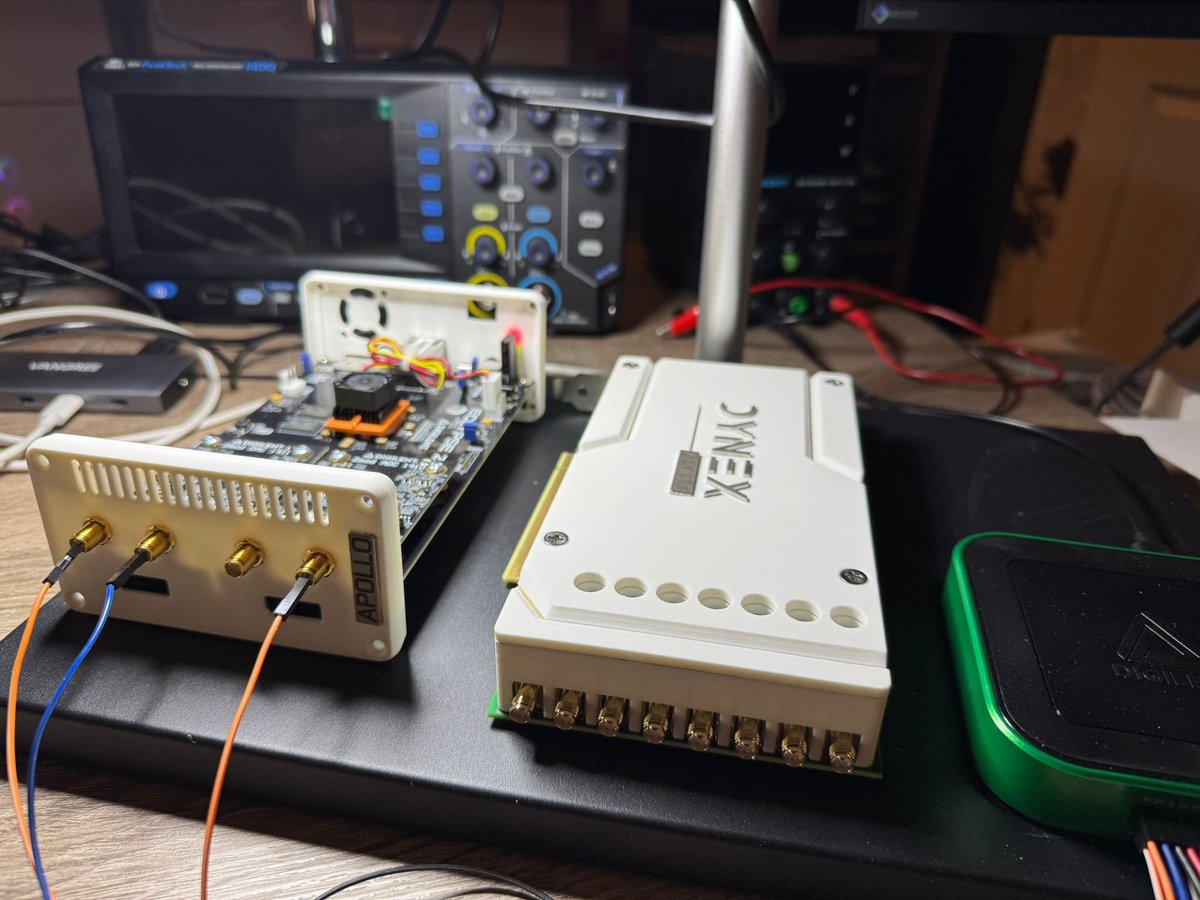
🚨 DNX Leak Day — It’s Real.
The first physical Apollo Quantum Chip has been delivered and is now in testing.
According to @y3tiCrypto — “benchmarks are meeting or exceeding expectations.” 💥
Not a 3D render. Not a concept.
This is actual hardware.
Quantum performance. Real-world validation.
The next stage of computing is happening — and it’s built by Dynex. ⚡💎
#DNX #Dynex #QuantumComputing
@dynexcoin@DynexQaaS@DynexMoonshots
According to @pmjohann, Xlink will be able to "only" validate the dilithium sign to become fully quantum safe. (cmiiw)
But right now, Xlink is here for the seamless-migration purpose to PQC. Let's enjoy and see what the @QANplatform team is cooking 🙌
#btc#eth#quantum#qanx
Join the quantum-safe web3 revolution!
QAN XLINK, our cross-signer protocol that makes QANplatform quantum-safe, is in the final phase and you can test it before the public release.
Apply to become a member of our closed testing group and be among the first to try the QAN XLINK desktop app.
QANplatform is the only blockchain that delivers both Ethereum compatibility and a 100%-guaranteed safe migration path for the post-quantum era, ensuring your security even after "Q-Day."
This quantum-safe protection is provided by QAN XLINK which uses NIST's primary-recommended PQC algorithm (ML-DSA, FIPS 204). QAN XLINK enables seamless integration of every Ethereum-compatible wallet including MetaMask and Trust Wallet with quantum-safe signature-capable keypairs.
You can apply using this link: https://t.co/fdpYfn3QJm
Join the quantum-safe web3 revolution!
QAN XLINK, our cross-signer protocol that makes QANplatform quantum-safe, is in the final phase and you can test it before the public release.
Apply to become a member of our closed testing group and be among the first to try the QAN XLINK desktop app.
QANplatform is the only blockchain that delivers both Ethereum compatibility and a 100%-guaranteed safe migration path for the post-quantum era, ensuring your security even after "Q-Day."
This quantum-safe protection is provided by QAN XLINK which uses NIST's primary-recommended PQC algorithm (ML-DSA, FIPS 204). QAN XLINK enables seamless integration of every Ethereum-compatible wallet including MetaMask and Trust Wallet with quantum-safe signature-capable keypairs.
You can apply using this link: https://t.co/fdpYfn3QJm