我今天因为这篇文章跟一个做传统金融的朋友吵了一个大架。吵完我才真的明白,做 marketing 的人到底有什么意义。
我们昨天今天陆续看到了 Alexandr Wang 这篇 Superintelligence is Arriving。我朋友的评价是:他根本没 make any point,就是说了一通屁话,I don't understand why this article is popular。
但我看到的是,他根本不需要提出什么新的研究观点来让大家关注,这篇文章光标题就已经赢了。他要的就是 attention。我认为 Alexandr Wang 大概是这个时代科技行业最会做营销的前10个人之一。
这篇文章到现在发布20小时,已经一千六百万浏览量了,这就是成功。从 mkt 人眼中看,一篇文章甚至只要能引发讨论就够了,不管大家是生气还是赞同。他评论区一直有很多人骂他,还有人骂 Muse AI 的吉祥物天天擦边性暗示,但这些本身就是流量。
但我朋友说,他完全不能理解,为什么一个 Meta AI 领头的人,除了这种内容,就公开发表不出���有力的论点了吗?
我们做 mkt / GTM 的人特别在意的那种叙事语言,在不做公开表达的人眼里,就是缺逻辑、缺论证、缺推导、缺观点。因为他们根本不在乎 attention 这件事。
而 attention 对于营销人来说,是一切的开始。
https://t.co/frotwI3Thn
A lot of people are asking why it's all Chinese people.
A better question is why other ethnic groups aren't interested in joining Cadet.
A simple explanation is that they don't want to put in the hard work. A few boring drills can deter most pampered kids - isn't it better to go home and play games or watch TikTok?
花费16天,我用 Opus 5.5 将小王子的故事制作成了3D剧情游戏
结合Tripo+Blender,Opus 5.5 将小王子故事中的每一个星球变成了可探索的3D场景
希望大家能支持一手,后续会开源整个游戏,以及详细制作流程
Welcome to The Little Prince: Across the Stars✨:https://t.co/qr4wR0jLu3
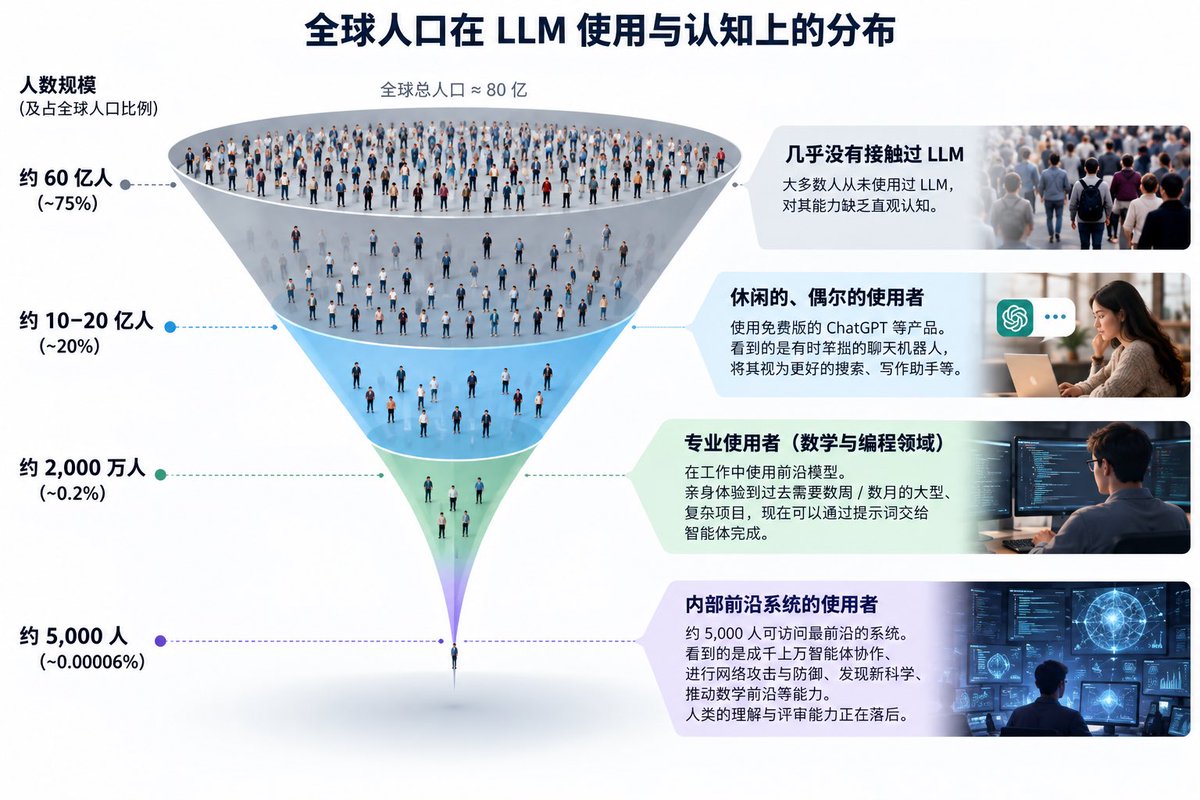
Dusting off this tweet from April because this gap in shared understanding of LLM capability is *widening*. It's now less "two groups of people speaking past each other" and more a sharp funnel.
- Napkin math somewhere around 6B people (~75% of the population) have barely come in contact with LLMs at all.
- Around 1-2B (~20%) are casual and infrequent users of free-tier ChatGPT-like products. This group sees derpy chatbots and treats them a bit like a better Google search, a writing aid, or etc. Maybe an agent tries to book you a flight. I have non-tech friends who (reasonably, imo) say they have not much use for it at all. Even many professionals outside of math&code are in this tier. For example, execs and many other functions spend a lot of their time talking to other people, so while they understand what is happening intellectually, it is still second-hand and a bit abstract.
- Now we get to professional use of frontier-grade LLMs in math&code. Somewhere around 20M people (0.2%) see first-hand that large, complex projects that used to take them weeks/months can now be completed by agents with a prompt. Building apps, copying apps, translating apps, decompiling apps from binaries... This has all happened very quickly and recently - less than 1 year ago, I was writing code manually by hand, typing memorized computer code commands into a code editor character by character, occasionally pressing Tab to autocomplete a little chunk of code.
- And finally we get to the ~5,000 people (~0.00006%) with access to frontier-grade systems internally. The external world has seen the preview. It looks like swarms of thousands of agents collaborating over weeks on software mega projects: minting zero days, running cyber attacks and defenses at machine speeds, discovering new science, advancing the frontier of mathematics. Things that would have taken top professionals in the industry years of work. Meanwhile, human review and comprehension are starting to fall behind. For example, people are still involved in the "archeology" of the OpenAI-HF incident from many months ago. Mathematicians may be poring over the 722 manuscripts on frontier mathematics for a while.
The funnel is driven by a combination of factors:
1. The impact scales with ambition, problem size, and horizon. A question with a paragraph answer barely stresses the system. You need a reservoir of big, difficult problems that you really care about. This aspect drives the consumer / professional dimension of the funnel.
2. The jaggedness of the system (which I have written about a lot separately). Capability peaks in domains that are digital, verifiable and economically valuable. This is because LLM capability emerges from reinforcement learning on verifiable rewards on a curated environment mixture driven by revenue potential. This aspect primarily drives the area (e.g. math&code) dimension of the funnel.
3. Access. Free-tier, paid-tier, internal.
So this is the weirdness of the moment. The general public has mostly not interacted with these systems. When they have, it looks like a derpy chatbot. The majority of professionals still see only a modest uplift. And a small sliver of professionals are experiencing the vertigo of the curve going vertical. And it is all happening at the same time.