अंत : अस्ति : प्रारम्भ
Hallo guys,
My name is Sayan Rawl . This is my first post in this account . Though most of my web3 friends know me as creator3.0 because this was my username of my previous x account which has suspended 2 months ago .
So after feeling clueless for 2 months i have decided to start my crypto journey from the beginning . Like previous we ( I and @mx_manoj ) will do daily spaces at 10 p.m. which had already started from the yesterday night .
I hope it is going to be another fabulous journey .
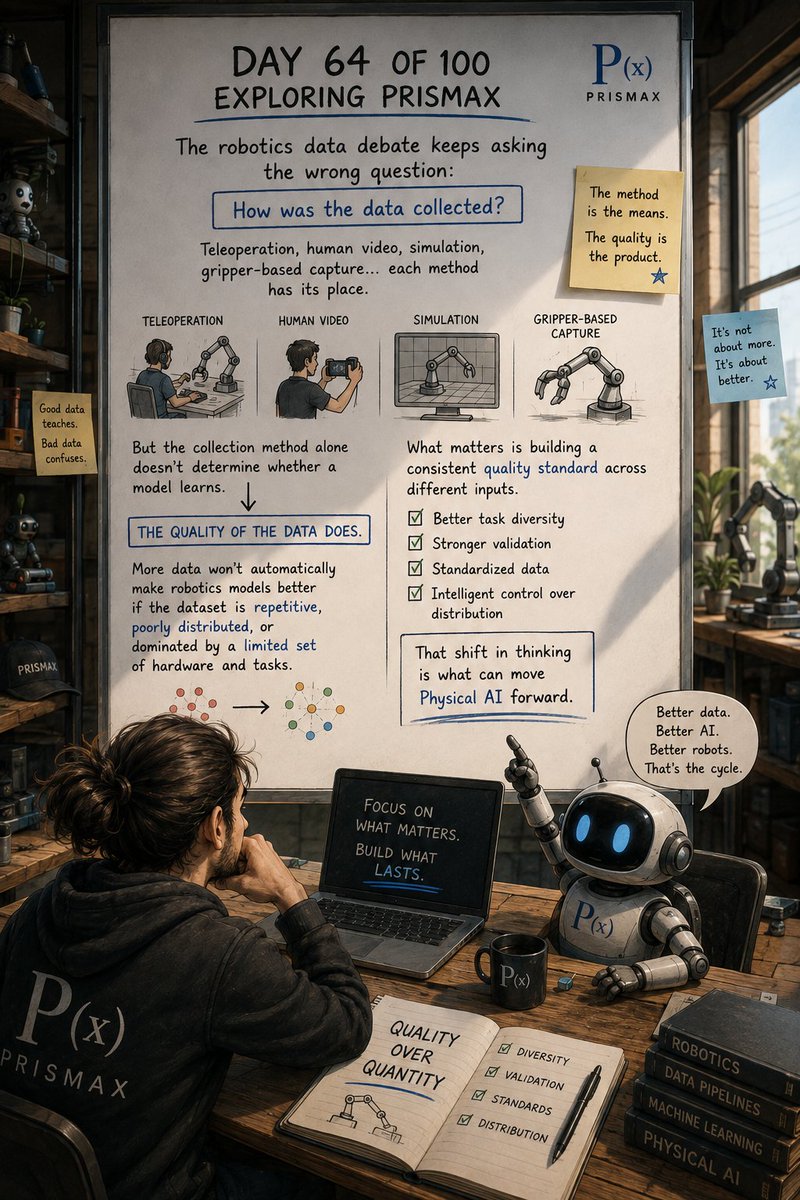
Day 64 of 100 exploring @PrismaXai 🤖
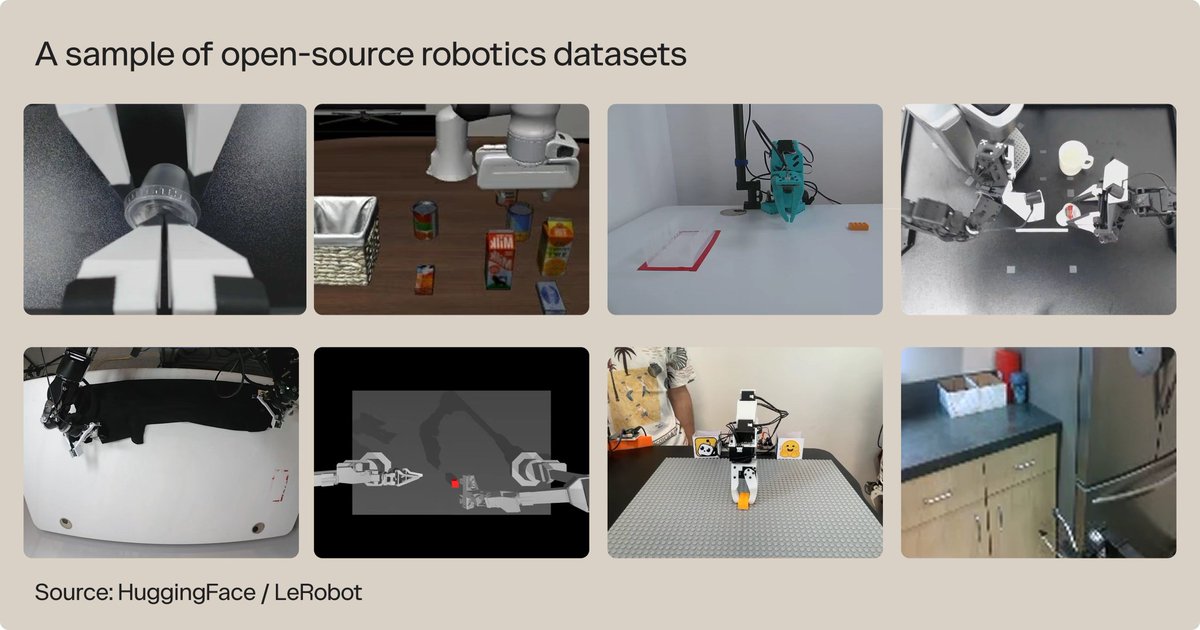
After these days the more I learn about robotics data the less I care about where it came from.
Teleop, videos, simulations, grippers... I used to think one of these had to be the right way to collect data. But Now I am not so sure.
Each method has its own strengths. What matters more is what you actually end up with.
If the data is repetitive, messy, badly labeled or mostly coming from the same robot doing the same few tasks having a huge dataset does not magically fix it.
You just have a huge dataset with the same problems. That is why the quality side of PrismaX keeps catching my attention.
Different ways of collecting data can work together, but there still needs to be a common bar for what gets accepted.
Good tasks.
Useful variation.
Consistent data.
Proper validation.
Basically do not just collect more. Know what you are collecting and why. That is probably one of the biggest things I have learned from this journey so far.
Day 64 complete.
36 days left. And I am slowly realizing that building Physical AI is not only about teaching robots more . It is about teaching them the right things.
@vivianrobotics@shayebackus
Day 63 of 100 exploring @PrismaXai 🤖
I think we spend way too much time arguing about how robotics data is collected. like :
Teleoperation vs video.
Real robots vs simulation.
Grippers vs other setups.
But after digging deeper into PrismaX I am starting to think the method is not the main story. The data is.
You can collect millions of hours of footage and still end up with a dataset that does not teach a robot much.
You can also have a smaller dataset where the tasks are well chosen the movements are clean and the data actually represents what you want the model to learn.
That is a completely different game. What I found interesting about PrismaX is that they do not lock themselves into one collection method.
Teleop, human video, gripper-based capture each can be useful depending on the job but they all have to pass the same quality bar.
And personally I understand why they lean toward teleoperation. When you are trying to capture the actual actions a robot needs to learn, having precise, controlled demonstrations makes a big difference.
The part I keep coming back to is this: Collection is just the beginning.
What you collect, which tasks you choose, how diverse the data is and what gets rejected probably matters far more than simply saying "we have millions of hours."
That is the bit I hadn't really appreciated before starting this journey.
Day 63 complete.
37 days left. Still learning that in robotics bigger does not always mean better. Sometimes you just need better judgment about what goes into the dataset.
Hallo everyone now it is no more of 100 Days journey of Exploring @base because it officially our Day 101
And I realized that The Next Chapter of Base Might Be About What Happens Between Transactions.
Yesterday was Day 100 & I thought reaching it would feel like the end. Instead today I opened a blank page and realized something: I still have more questions than answers.
And one question keeps coming back to me : What happens when Base is not just where transactions happen but where different parts of the internet start talking to each other?
Think about a normal transaction. You send something & Someone receives it. Done. But imagine the transaction becoming the beginning of something else.
A payment could trigger an action. & An action could update a reputation. That reputation could unlock access. & that access could create another transaction.
And suddenly one onchain event is not just a transaction anymore. It is part of a chain of actions. That is where smart contracts become really interesting to me.
They do not just move assets. They can create rules. If this happens → do that. And because Base provides an open environment for developers to build these systems completely different applications can start connecting around those rules.
Payments, Games, Social apps, DeFi, AI agents, Communities. The interesting part is not necessarily each individual application.
It is what happens when they compose together. One app creates something another app can use. One action becomes the input for another. And users do not have to rebuild everything from scratch every time.
That is the part of Base I want to explore next. Not just: "What can I do on Base?" But: "What can happen when everything I do on Base can connect?"
100 days taught me how much there is to discover. Day 101 is where I am starting to explore what happens after the pieces start connecting.
Day 101/∞.
The journey continues. 🟦
Based morning guys welcome to our 100 Days journey of Exploring @base and finally it is our 100th Day ou our journey .
After 100 Days Later I Realized I Was not Really Exploring Base. I Was Exploring What Comes Next.
When I started this journey I honestly did not know if I would make it to Day 100.
I just wanted to learn one day at a time, one post at a time. TBH Some days I had a clear topic & some days I was sitting somewhere thinking about an idea and trying to understand where it fits.
And somewhere along the way this stopped feeling like a content challenge. It became a habit. I started looking at Base differently not just as a chain.
But as a place where people are experimenting with payments, ownership, AI, communities, identity, markets and completely new ways of using the internet.
I have learned a lot but the biggest thing I learned isn't technical. It is this: You understand something much better when you keep showing up for it.
100 days of writing forced me to slow down and start to question things, to explain ideas in my own words and sometimes to admit: "I don't understand this yet."
That's okay because learning was never supposed to be a straight line. There were days when a post barely got attention & there were days when I was not sure anyone was reading.
But I kept posting and looking back at Day 1 now I can see the difference not just in what I know but in how I think.
So today is not really a goodbye. It is just the end of 100 days of documenting the journey.
There are still so many things I have not explored, So many builders I have not discovered, So many ideas I probably have not even heard of yet.
And that is what makes the next chapter exciting. So I will keep continue to explore Base like previous days .
100 days done.
Thank you to everyone who read, replied, corrected me, shared ideas or simply followed along.
This started as my journey of exploring Base. Somehow, it became a small part of my journey as a builder too.
Day 100/100. 💙
And if there is one thing I want to take forward:
Keep showing up.
Keep asking questions.
Keep building.
The journey does not end here.
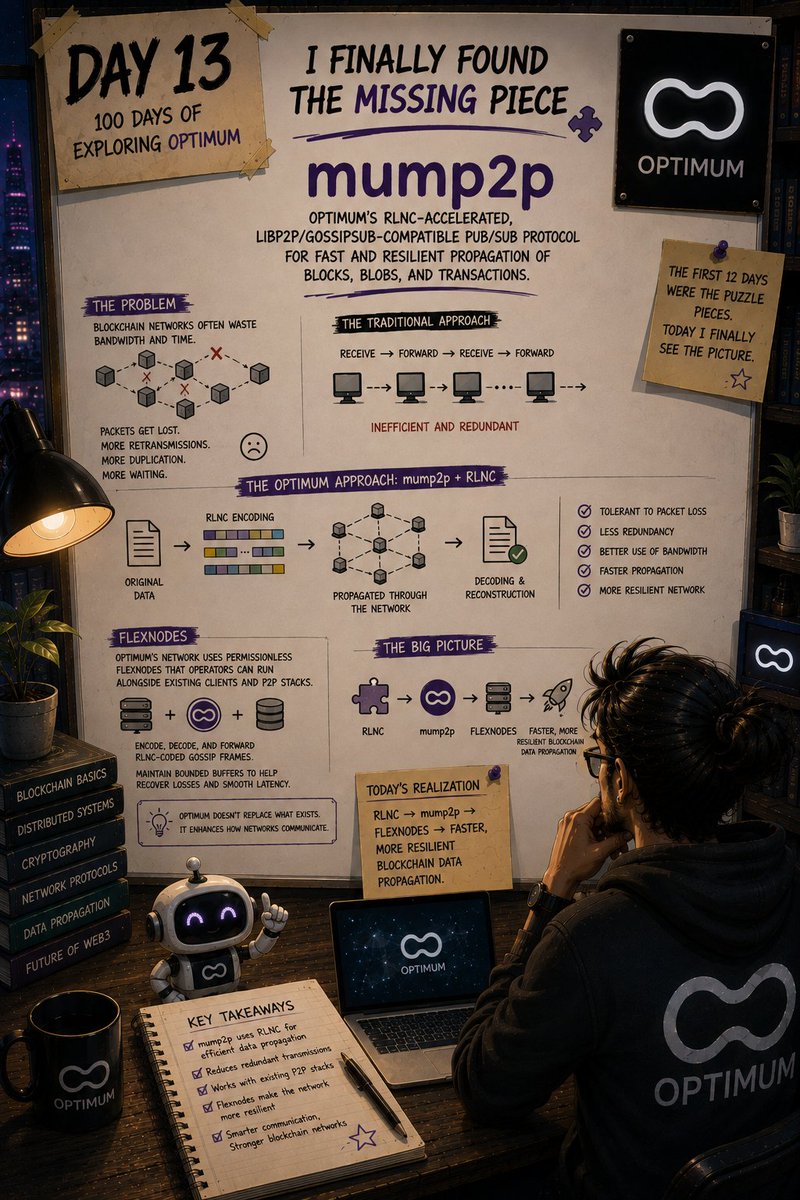
Day 13/100 : I Finally Found the Missing Piece
For the first 12 days I kept talking about one problem: How do you move blockchain data faster without wasting bandwidth?
Today the picture became much clearer. I found the part of Optimum that connects everything I've been learning: mump2p
It is @get_optimum 's RLNC-accelerated, libp2p/gossipsub-compatible pub/sub protocol designed for fast and resilient propagation of blocks, blobs, and transactions.
And suddenly the previous days started making sense. Think about a blockchain network like a city.
Transactions and blocks are constantly moving between thousands of locations.
The traditional approach is basically: receive → forward → receive → forward
But when packets are lost or the network gets congested, things become messy. More retransmissions. More duplicated data. More waiting.
mump2p takes a different approach. It combines blockchain gossip with RLNC.
Instead of treating every individual packet as something that must arrive perfectly data can be encoded into combinations and propagated through the network.
That means the network can be more tolerant of packet loss while reducing unnecessary redundancy.
And that is the connection I was missing. RLNC is not just a cool technology Optimum mentions.
It is actually part of how Optimum approaches the communication problem.
There is another piece I found interesting today: Flexnodes
Optimum's network uses permissionless flexnodes that operators can run alongside existing clients and P2P stacks.
These nodes can encode, decode and forward RLNC-coded gossip frames while maintaining bounded buffers to help recover losses and smooth latency.
So Optimum is not asking everyone to throw away the infrastructure they already use. It is building a communication layer that can work alongside existing systems.
Today's realization :
The first 12 days were basically the puzzle pieces. Today I finally started seeing the picture:
RLNC → mump2p → Flexnodes → faster, more resilient blockchain data propagation.
And now I want to go deeper into how mump2p actually works.
Day 13/100 — Exploring Optimum. 🚀
https://t.co/uibcYJD5hE "Introduction to Optimum | Optimum Docs"
Day 12/100 : Why Does RLNC Actually Matter?
Last time I finally understood what RLNC means. But knowing the name is not enough so today I wanted to understand one thing: Why would a blockchain network actually need it?
Imagine you are sending a puzzle to 10 people. The normal approach is to send the same pieces of the puzzle around and hope everyone eventually gets everything they need. But If one piece is lost?
Someone has to ask for it again. More messages. More bandwidth. More waiting. Now imagine the pieces are encoded into different combinations.
You do not necessarily need the exact same pieces anymore. Receive enough useful combinations and you can reconstruct the original information.
That is where RLNC becomes interesting. Blockchain networks are not perfect. Packets can be:
→ delayed
→ lost
→ received in different orders
So making every node wait for a specific missing packet isn't always the most efficient way to communicate. RLNC changes the approach.
Instead of treating every packet as something that must arrive exactly as expected coded information can help the receiver recover the original data from enough independent combinations.
That can make communication more resilient. And this is where I start seeing the connection with @get_optimum . The goal is not simply: "Send data faster."
It is also: "Make the network better at dealing with imperfect communication."
Less dependency on retransmissions. Better use of bandwidth. More resilience when packets do not arrive perfectly.
Today's takeaway : RLNC is interesting because it changes the question from: "Did I receive every original packet?" to "Did I receive enough information to reconstruct the data?"
That small shift can make a big difference when you are dealing with large decentralized networks.
And I am only 12 days into this journey. Day 12/100 : Exploring Optimum. 🚀
Day 63 of 100 exploring @PrismaXai 🤖
I think we spend way too much time arguing about how robotics data is collected. like :
Teleoperation vs video.
Real robots vs simulation.
Grippers vs other setups.
But after digging deeper into PrismaX I am starting to think the method is not the main story. The data is.
You can collect millions of hours of footage and still end up with a dataset that does not teach a robot much.
You can also have a smaller dataset where the tasks are well chosen the movements are clean and the data actually represents what you want the model to learn.
That is a completely different game. What I found interesting about PrismaX is that they do not lock themselves into one collection method.
Teleop, human video, gripper-based capture each can be useful depending on the job but they all have to pass the same quality bar.
And personally I understand why they lean toward teleoperation. When you are trying to capture the actual actions a robot needs to learn, having precise, controlled demonstrations makes a big difference.
The part I keep coming back to is this: Collection is just the beginning.
What you collect, which tasks you choose, how diverse the data is and what gets rejected probably matters far more than simply saying "we have millions of hours."
That is the bit I hadn't really appreciated before starting this journey.
Day 63 complete.
37 days left. Still learning that in robotics bigger does not always mean better. Sometimes you just need better judgment about what goes into the dataset.
Day 62 of 100 exploring @PrismaXai 🤖
Today I watched this video from Prismax and I have realized that a robot doing the task is not necessarily a successful run.
Two people can give the same robot the same task, Same setup, Same instructions, Same goal and one recording can be useful while the other is not.
That is where PrismaX's quality review caught my attention. Someone actually watches the session and checks the boring details that are easy to ignore:
Was the whole workspace visible?
Was the lighting good enough?
Did the robot actually follow the task?
Was the movement clear enough to learn from?
If something is off the session gets rejected. At first that might sound strict but the more I think about it the more it makes sense.
If you are training a robot with bad demonstrations you are basically teaching it bad habits and hoping it somehow figures things out later.
A nice-looking video is not the goal. The real question is whether the data helps the robot do the same thing reliably in a completely different situation.
That is probably one of the less exciting parts of Physical AI but also one of the most important.
Day 62 complete.
38 days left. Still learning that getting the data right can matter just as much as building the model itself.
Day 5 : @axisrobotics
I thought getting started with Axis Hub would be more complicated.
It really is not.
You can create an account with Privy using your email, Google, X or an existing wallet.
And if you do not have a wallet that is fine too. Privy creates one for you in the background so there is no seed phrase to write down or wallet extension to install.
The wallet is mainly there to sign your completed runs on-chain so your contributions can count toward Points.
Basically: Sign up → open the Hub → start contributing.
Took me longer to write this post than it does to get started 😂
Who’s trying Axis Hub today? 👀
Day 4 : Axis Robotics
Hallo everyone welcome to our 100 days journey of exploring @axisrobotics . In this journey one thing I really like about Axis Hub is how low the barrier to entry is.
You don’t need a GPU, download anything, a robot sitting next to you. Just a laptop or desktop and a modern browser.
The interesting part is that the MuJoCo physics simulation runs directly in the browser through WebAssembly so you can actually interact with the robot environment instead of just watching a simulation.
Open the Hub start teleoperating and your actions can become part of the data being built for Physical AI. That makes the whole idea feel a lot more accessible.
You do not have to own a robot to start contributing to robotics. Would you try it?
Based morning guys welcome to our 100 Days journey of Exploring @base and finally it is our 100th Day ou our journey .
After 100 Days Later I Realized I Was not Really Exploring Base. I Was Exploring What Comes Next.
When I started this journey I honestly did not know if I would make it to Day 100.
I just wanted to learn one day at a time, one post at a time. TBH Some days I had a clear topic & some days I was sitting somewhere thinking about an idea and trying to understand where it fits.
And somewhere along the way this stopped feeling like a content challenge. It became a habit. I started looking at Base differently not just as a chain.
But as a place where people are experimenting with payments, ownership, AI, communities, identity, markets and completely new ways of using the internet.
I have learned a lot but the biggest thing I learned isn't technical. It is this: You understand something much better when you keep showing up for it.
100 days of writing forced me to slow down and start to question things, to explain ideas in my own words and sometimes to admit: "I don't understand this yet."
That's okay because learning was never supposed to be a straight line. There were days when a post barely got attention & there were days when I was not sure anyone was reading.
But I kept posting and looking back at Day 1 now I can see the difference not just in what I know but in how I think.
So today is not really a goodbye. It is just the end of 100 days of documenting the journey.
There are still so many things I have not explored, So many builders I have not discovered, So many ideas I probably have not even heard of yet.
And that is what makes the next chapter exciting. So I will keep continue to explore Base like previous days .
100 days done.
Thank you to everyone who read, replied, corrected me, shared ideas or simply followed along.
This started as my journey of exploring Base. Somehow, it became a small part of my journey as a builder too.
Day 100/100. 💙
And if there is one thing I want to take forward:
Keep showing up.
Keep asking questions.
Keep building.
The journey does not end here.
Hallo everyone welcome to 100 Days journey of Exploring @base & it is our Day 99 is about What Happens When Software Starts Paying for Its Own Work?
This thought randomly hit me today: What if the next customer is not a person?
It could be an AI agent. Think about how software works today. You open an app and search for something then click a button & You pay.
The software waits for you to make every decision but agents change that. An agent could discover a service, use it, pay for it, receive the result and move on without asking you to approve every tiny step.
And that is where onchain payments start getting really interesting. Because machines do not want:
→ accounts
→ monthly subscriptions
→ complicated checkout pages
→ manual invoices
→ waiting days for settlement
They need something closer to: request → pay → receive → continue. That is a very different internet.
A weather agent could pay for better data, A research agent could pay for an API call, A trading agent could pay for market information, A software agent could pay another service to complete part of a task.
Tiny payments could happen constantly in the background and Base could become one of the rails making that possible.
What excites me is not simply "AI + blockchain." We have heard that phrase enough. It is the possibility of software becoming an economic participant.
Not just using APIs but paying for them not just consuming services but buying them autonomously. We are used to an internet where humans tell software what to do.
Maybe the next version is an internet where software can coordinate and transact with other software.
And if that happens, wallets will not just belong to people infacthey will belong to agents too.
Day 99/100 of exploring Base. One more day. And honestly the rabbit hole keeps getting deeper.
Day 62 of 100 exploring @PrismaXai 🤖
Today I watched this video from Prismax and I have realized that a robot doing the task is not necessarily a successful run.
Two people can give the same robot the same task, Same setup, Same instructions, Same goal and one recording can be useful while the other is not.
That is where PrismaX's quality review caught my attention. Someone actually watches the session and checks the boring details that are easy to ignore:
Was the whole workspace visible?
Was the lighting good enough?
Did the robot actually follow the task?
Was the movement clear enough to learn from?
If something is off the session gets rejected. At first that might sound strict but the more I think about it the more it makes sense.
If you are training a robot with bad demonstrations you are basically teaching it bad habits and hoping it somehow figures things out later.
A nice-looking video is not the goal. The real question is whether the data helps the robot do the same thing reliably in a completely different situation.
That is probably one of the less exciting parts of Physical AI but also one of the most important.
Day 62 complete.
38 days left. Still learning that getting the data right can matter just as much as building the model itself.
Day 61 of 100 exploring @PrismaXai 🤖
I think we are going to have a weird problem with robots: having too much data.
Not because data is not useful because at some point someone has to decide which of that data is actually worth training on.
That is what caught my attention about PrismaX's Verify Quality. Instead of keeping the whole review process behind a small team PrismaX brings the community into it.
People can look at actual robot demonstrations, review them and help separate the useful stuff from the bad stuff and honestly that makes sense.
If Physical AI is eventually going to need millions of hours of real-world data you can not just keep throwing everything into a dataset and hope for the best.
Someone has to care about what is going in. What I like most is that it gives the community a role beyond just watching from the sidelines.
You can actually become part of the data-quality loop. I am still learning how much this matters, but one thing is becoming pretty clear to me: Better robots will need better training data.
And better training data starts with knowing what deserves to be there.
Day 61 complete. 39 days left. Still figuring out how all these little pieces come together.
Hallo everyone welcome to 100 Days journey of Exploring @base & it is our Day 99 is about What Happens When Software Starts Paying for Its Own Work?
This thought randomly hit me today: What if the next customer is not a person?
It could be an AI agent. Think about how software works today. You open an app and search for something then click a button & You pay.
The software waits for you to make every decision but agents change that. An agent could discover a service, use it, pay for it, receive the result and move on without asking you to approve every tiny step.
And that is where onchain payments start getting really interesting. Because machines do not want:
→ accounts
→ monthly subscriptions
→ complicated checkout pages
→ manual invoices
→ waiting days for settlement
They need something closer to: request → pay → receive → continue. That is a very different internet.
A weather agent could pay for better data, A research agent could pay for an API call, A trading agent could pay for market information, A software agent could pay another service to complete part of a task.
Tiny payments could happen constantly in the background and Base could become one of the rails making that possible.
What excites me is not simply "AI + blockchain." We have heard that phrase enough. It is the possibility of software becoming an economic participant.
Not just using APIs but paying for them not just consuming services but buying them autonomously. We are used to an internet where humans tell software what to do.
Maybe the next version is an internet where software can coordinate and transact with other software.
And if that happens, wallets will not just belong to people infacthey will belong to agents too.
Day 99/100 of exploring Base. One more day. And honestly the rabbit hole keeps getting deeper.
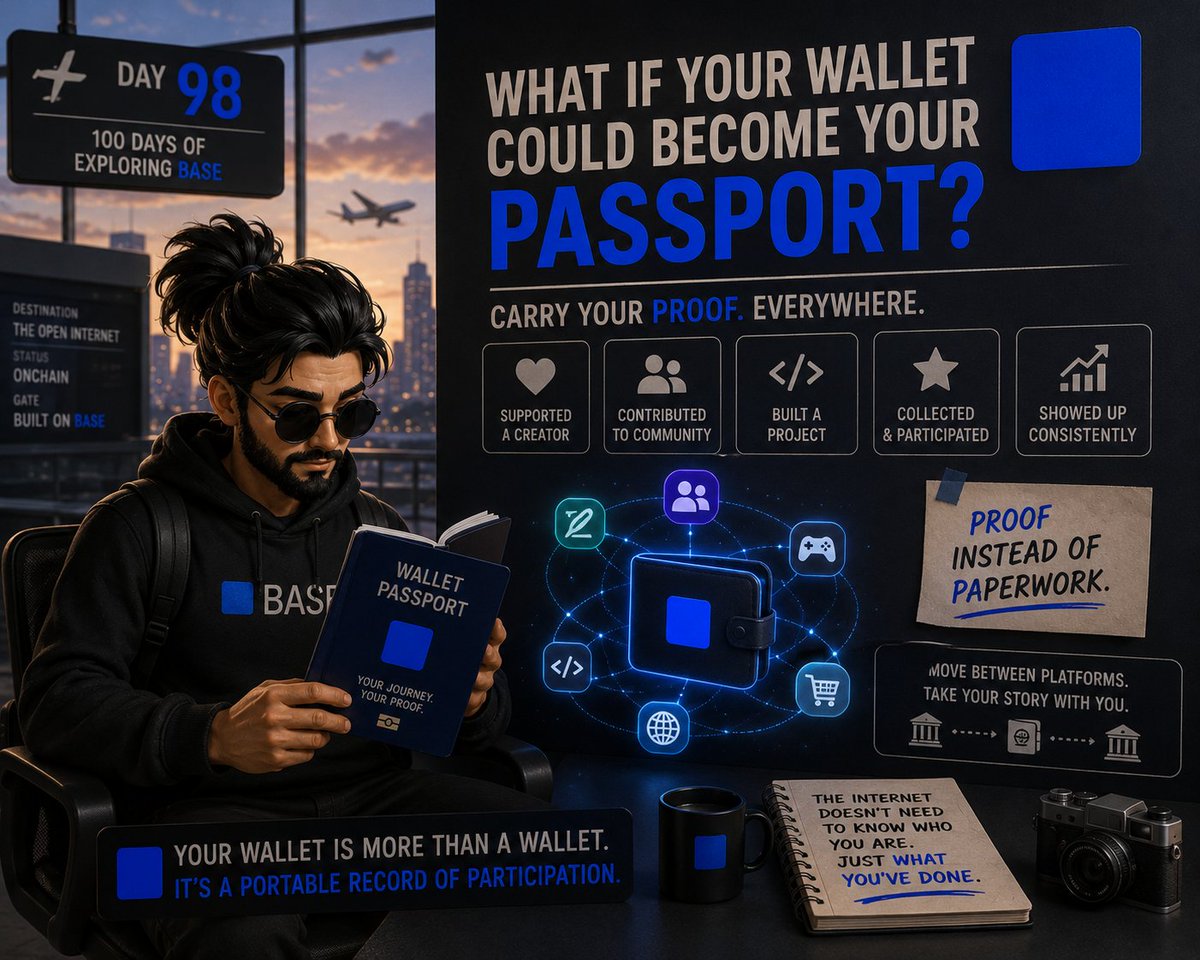
Hallo everyone welcome to our 100 Days journey of Exploring @base . In Day 98 a question have poped up in my mind What If Your Wallet Could Become Your Passport?
Not the kind you show at an airport. A different kind. A passport for the internet. Think about how many times we prove ourselves online.
We Create an account, Verify an email, Enter a phone number, Fill out a profile, Upload documents, Build a reputation from scratch. Then we do it all over again on the next platform.
It feels normal because we have lived with it for years but it does not have to be this way.
An onchain wallet can carry something much more interesting: proof of what you have actually done.
You supported a creator, contributed to a community, built a project, collected something, participated early, showed up consistently.
That history does not have to stay locked inside one app. It can travel with you and that is where Base gets interesting to me.
Not because a wallet replaces every login but because the internet could start asking for proof instead of paperwork.
Imagine joining a community and your history already tells part of your story or discovering an app and bringing your reputation with you or moving between platforms without starting from zero every time.
Your wallet stops being just a place where you keep assets. It becomes a portable record of participation.
We are used to carrying passports between countries. Maybe the next step is carrying proof between platforms.
And if that happens the internet becomes a lot less interested in asking: "Who says you're trustworthy?"
and a lot more interested in asking: "What have you done?"
Day 98/100 of exploring Base.
Day 12/100 : Why Does RLNC Actually Matter?
Last time I finally understood what RLNC means. But knowing the name is not enough so today I wanted to understand one thing: Why would a blockchain network actually need it?
Imagine you are sending a puzzle to 10 people. The normal approach is to send the same pieces of the puzzle around and hope everyone eventually gets everything they need. But If one piece is lost?
Someone has to ask for it again. More messages. More bandwidth. More waiting. Now imagine the pieces are encoded into different combinations.
You do not necessarily need the exact same pieces anymore. Receive enough useful combinations and you can reconstruct the original information.
That is where RLNC becomes interesting. Blockchain networks are not perfect. Packets can be:
→ delayed
→ lost
→ received in different orders
So making every node wait for a specific missing packet isn't always the most efficient way to communicate. RLNC changes the approach.
Instead of treating every packet as something that must arrive exactly as expected coded information can help the receiver recover the original data from enough independent combinations.
That can make communication more resilient. And this is where I start seeing the connection with @get_optimum . The goal is not simply: "Send data faster."
It is also: "Make the network better at dealing with imperfect communication."
Less dependency on retransmissions. Better use of bandwidth. More resilience when packets do not arrive perfectly.
Today's takeaway : RLNC is interesting because it changes the question from: "Did I receive every original packet?" to "Did I receive enough information to reconstruct the data?"
That small shift can make a big difference when you are dealing with large decentralized networks.
And I am only 12 days into this journey. Day 12/100 : Exploring Optimum. 🚀
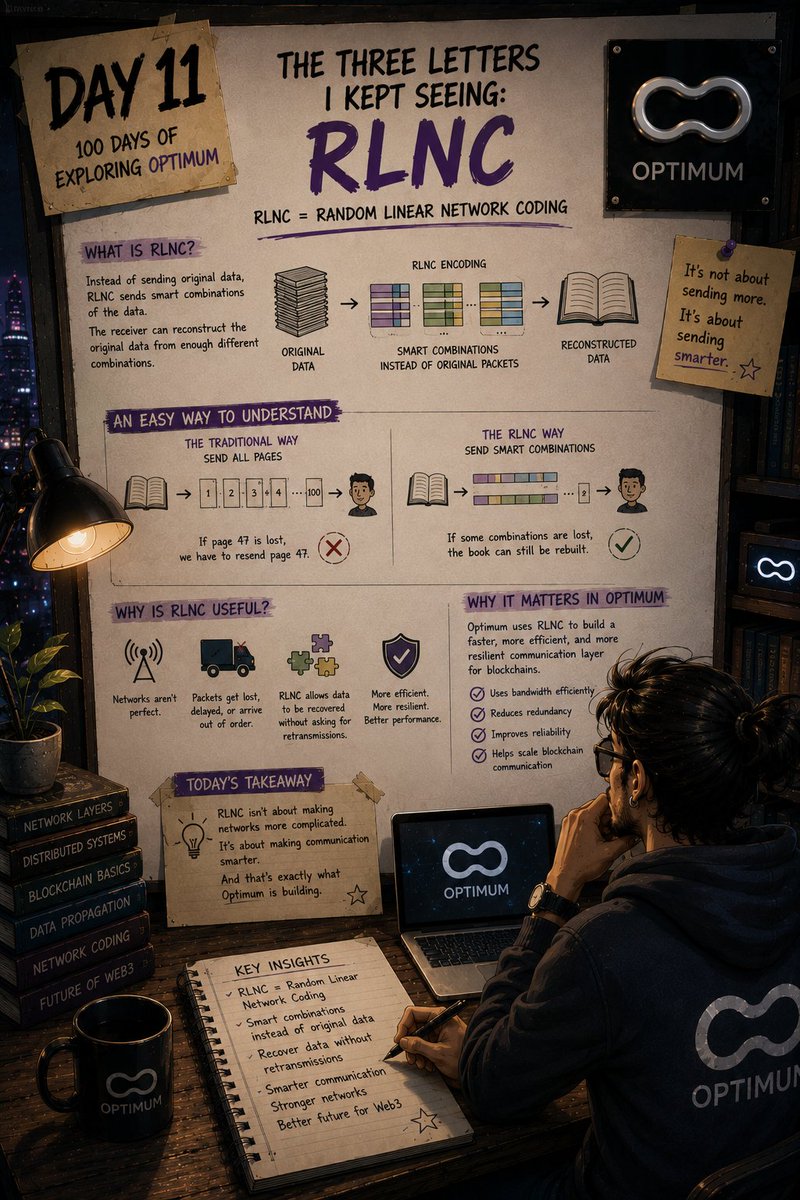
Day 11/100 The Three Letters I Kept Seeing: RLNC
After spending the first 10 days understanding blockchain communication one term kept appearing everywhere in @get_optimum 's documentation: RLNC.
At first I thought it was just another technical acronym but the more I looked into it, the more I realized RLNC is one of the core ideas behind Optimum.
So what is RLNC?
It stands for Random Linear Network Coding. Don't worry if that sounds complicated. I felt the same way. Instead of diving into the math I tried to understand the idea behind it.
Imagine you are sending a 100-page book to your friend. The traditional way is simple: You send all 100 pages. If Page 47 gets lost you have to send Page 47 again.
Now imagine a smarter system. Instead of sending the original pages you create smart combinations of those pages. Your friend does not need every original page.
As long as they receive enough different combinations they can rebuild the entire book. That is the basic idea behind RLNC.
Why is this useful?
Because networks are not perfect. Packets get delayed. Some get lost. Some arrive out of order.
RLNC is designed to make communication more resilient by allowing data to be reconstructed from coded pieces instead of depending on every original piece arriving perfectly.
Instead of constantly asking, "Can you resend what I missed?" the network can often recover using the coded data it already has.
This is why RLNC plays such an important role in Optimum. It is not just about moving data faster. It is about making data movement more efficient and more resilient at the same time.
Today I did not learn the equations. I learned the mindset. And sometimes understanding the idea is the best place to start.
Today's takeaway : RLNC is not about making networks more complicated. It is about making communication smarter.
That is why it is one of the technologies powering Optimum's vision for faster blockchain networking.
Day 11/100 : Exploring Optimum 🚀
Day 4 : Axis Robotics
Hallo everyone welcome to our 100 days journey of exploring @axisrobotics . In this journey one thing I really like about Axis Hub is how low the barrier to entry is.
You don’t need a GPU, download anything, a robot sitting next to you. Just a laptop or desktop and a modern browser.
The interesting part is that the MuJoCo physics simulation runs directly in the browser through WebAssembly so you can actually interact with the robot environment instead of just watching a simulation.
Open the Hub start teleoperating and your actions can become part of the data being built for Physical AI. That makes the whole idea feel a lot more accessible.
You do not have to own a robot to start contributing to robotics. Would you try it?
Hallo everyone. Welcome to our Day 3 of our 100 Days journey of @axisrobotics exploring .
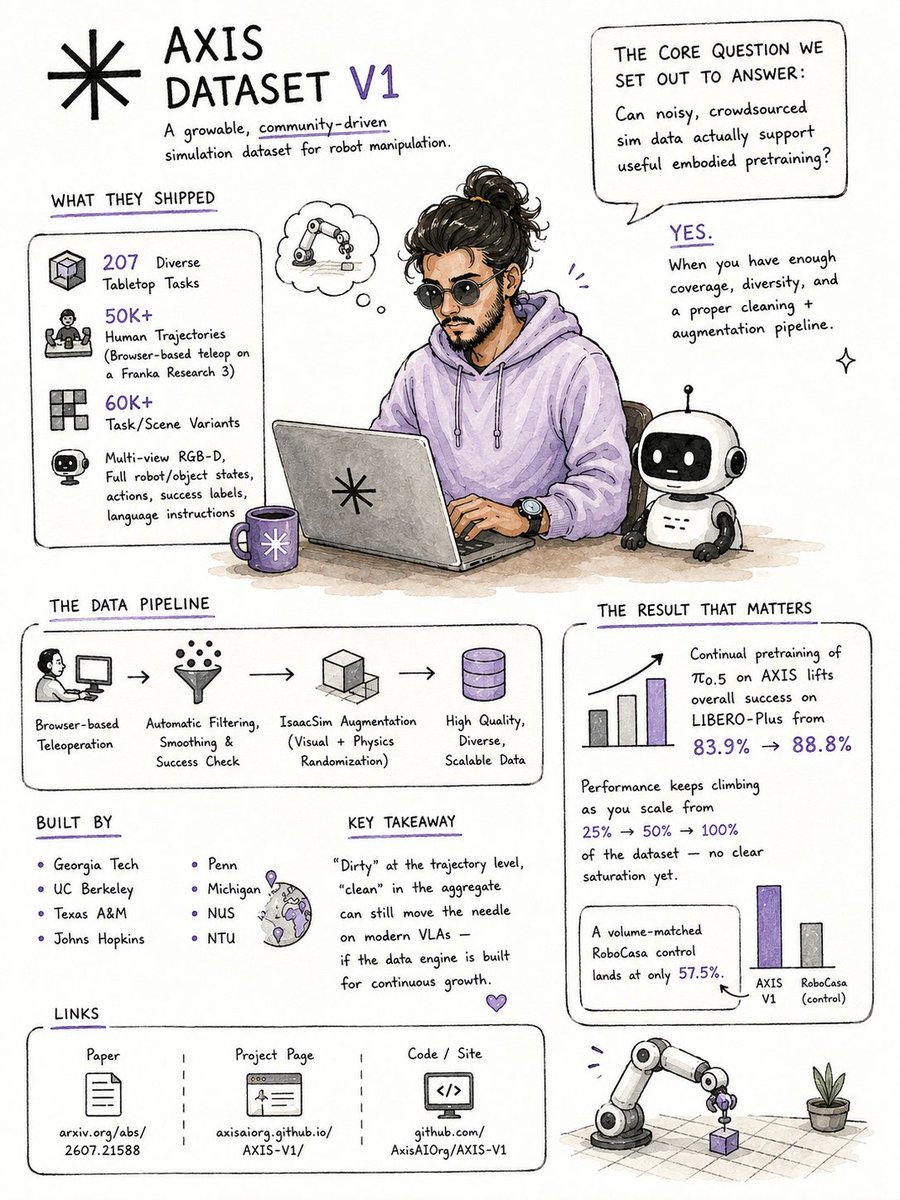
Since morning I spent some time reading through AXIS Dataset V1 and I think the biggest takeaway is not the dataset itself. It is the idea behind how it is built.
Most robotics datasets are collected once, published and eventually become outdated. AXIS is taking a different route by treating data as something that keeps growing with the community.
Here is what stood out to me:
• Over 50,000 human demonstrations collected through a browser still no expensive hardware required.
• 207 manipulation tasks across more than 60,000 different task and scene variations.
• Every trajectory goes through filtering, smoothing, validation and augmentation before it is used for training.
What I found even more interesting was the result.
When the team used AXIS for continual pretraining on π₀.₅ , performance on LIBERO-Plus improved from 83.9% to 88.8%.
And the gains did not slow down as they added more data. That suggests the improvement is not just about collecting a larger dataset.
It is about collecting a wider range of experiences and making sure the data quality stays high throughout the pipeline.
The project also brings together researchers from Georgia Tech, UC Berkeley, Johns Hopkins, Michigan, Texas A&M, Penn, NUS and NTU, which says a lot about the effort behind it.
To me AXIS V1 feels less like a finished dataset and more like the first version of a data engine that can keep improving over time.
I am curious to see how V2 expands beyond simulation and brings even more real-world interaction into the loop. 🤖
Day 61 of 100 exploring @PrismaXai 🤖
I think we are going to have a weird problem with robots: having too much data.
Not because data is not useful because at some point someone has to decide which of that data is actually worth training on.
That is what caught my attention about PrismaX's Verify Quality. Instead of keeping the whole review process behind a small team PrismaX brings the community into it.
People can look at actual robot demonstrations, review them and help separate the useful stuff from the bad stuff and honestly that makes sense.
If Physical AI is eventually going to need millions of hours of real-world data you can not just keep throwing everything into a dataset and hope for the best.
Someone has to care about what is going in. What I like most is that it gives the community a role beyond just watching from the sidelines.
You can actually become part of the data-quality loop. I am still learning how much this matters, but one thing is becoming pretty clear to me: Better robots will need better training data.
And better training data starts with knowing what deserves to be there.
Day 61 complete. 39 days left. Still figuring out how all these little pieces come together.
Day 60 of 100 exploring PrismaX 🤖
Today I have recently read prismax's this post https://t.co/Nbgv1xMOng . And one thing I got wrong about AI was thinking that more data always means better results.
Infact I never really questioned it. More data sounded like the obvious answer but after spending time reading about how robotics models are trained I do not think it is that simple anymore.
If everyone collects data in different ways with different quality and different formats you are left with a huge pile of information that first needs to be cleaned before it is even useful.
That feels like a lot of extra work. What I like about PrismaX is that they seem to care more about how the data is collected than how much they collect.
The goal is not to have the biggest dataset. The goal is to have data that is consistent enough for a model to actually learn from.
That was a small shift in thinking for me. I used to look at the size of a dataset. Now I find myself wondering how that data was collected in the first place.
Day 60.
It is funny how this journey keeps changing the questions I ask. Maybe that is the biggest lesson so far.
Hallo everyone welcome to our 100 Days journey of Exploring @base . In Day 98 a question have poped up in my mind What If Your Wallet Could Become Your Passport?
Not the kind you show at an airport. A different kind. A passport for the internet. Think about how many times we prove ourselves online.
We Create an account, Verify an email, Enter a phone number, Fill out a profile, Upload documents, Build a reputation from scratch. Then we do it all over again on the next platform.
It feels normal because we have lived with it for years but it does not have to be this way.
An onchain wallet can carry something much more interesting: proof of what you have actually done.
You supported a creator, contributed to a community, built a project, collected something, participated early, showed up consistently.
That history does not have to stay locked inside one app. It can travel with you and that is where Base gets interesting to me.
Not because a wallet replaces every login but because the internet could start asking for proof instead of paperwork.
Imagine joining a community and your history already tells part of your story or discovering an app and bringing your reputation with you or moving between platforms without starting from zero every time.
Your wallet stops being just a place where you keep assets. It becomes a portable record of participation.
We are used to carrying passports between countries. Maybe the next step is carrying proof between platforms.
And if that happens the internet becomes a lot less interested in asking: "Who says you're trustworthy?"
and a lot more interested in asking: "What have you done?"
Day 98/100 of exploring Base.
Hallo everyone welcome to our 100 Days journey of Exploring @base & this is our Day 97 we are soo close of our goal and today at this poition I Do not Think Small Businesses Care About Blockchains and That is Exactly the Point.
Imagine a small business owner. They are not checking TPS or comparing L2 architectures or thinking about sequencers. They just want one simple thing: Get paid.
That is what made me think about Base differently today. We often talk about onchain payments like they're a crypto feature.
But for a business payment is just payment. A customer pays. The business gets the money. The books get updated. The order gets processed. Done.
No one wants to sit there thinking about which network the transaction used and honestly they should not have to. That is where I think the real opportunity is.
Base can sit underneath products where the blockchain becomes the rail not the product.
A café could accept payments, A creator could sell directly to an audience, A game could handle tiny in-game transactions, A global business could settle without stitching together five different systems.
The customer doesn't need to know what's happening underneath. They just see: Paid. That is a much bigger idea than making crypto easier to use.
It is about making onchain infrastructure useful to people who do not care about crypto and maybe that is the real test of adoption. Not: "How many people understand blockchain?"
But: "How many people use it without needing to understand it?" That is when infrastructure has finally done its job.
Day 97/100 of exploring Base.
Hallo everyone welcome to our 100 Days journey of Exploring @base & this is our Day 97 we are soo close of our goal and today at this poition I Do not Think Small Businesses Care About Blockchains and That is Exactly the Point.
Imagine a small business owner. They are not checking TPS or comparing L2 architectures or thinking about sequencers. They just want one simple thing: Get paid.
That is what made me think about Base differently today. We often talk about onchain payments like they're a crypto feature.
But for a business payment is just payment. A customer pays. The business gets the money. The books get updated. The order gets processed. Done.
No one wants to sit there thinking about which network the transaction used and honestly they should not have to. That is where I think the real opportunity is.
Base can sit underneath products where the blockchain becomes the rail not the product.
A café could accept payments, A creator could sell directly to an audience, A game could handle tiny in-game transactions, A global business could settle without stitching together five different systems.
The customer doesn't need to know what's happening underneath. They just see: Paid. That is a much bigger idea than making crypto easier to use.
It is about making onchain infrastructure useful to people who do not care about crypto and maybe that is the real test of adoption. Not: "How many people understand blockchain?"
But: "How many people use it without needing to understand it?" That is when infrastructure has finally done its job.
Day 97/100 of exploring Base.
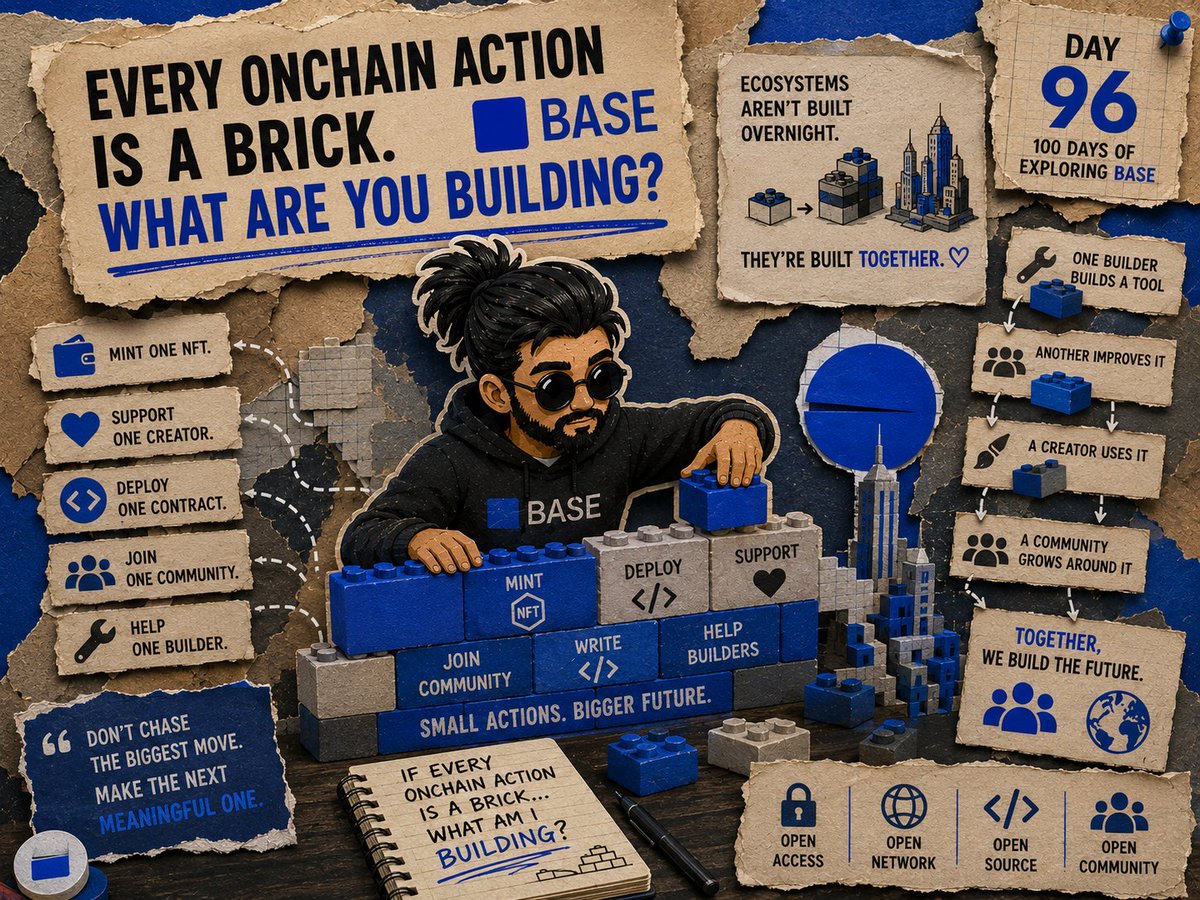
Hallo everyone it is our Day 96 of 100 Days journey of Exploring @base .And our today's topic is Every Onchain Action Is a Brick then What Are You Building?
Today I stopped thinking about transactions. Instead I started thinking about construction. Imagine you are standing in front of an empty piece of land.
You do not build a house in one day. You lay one brick then another. Most of them do not look important on their own.
But months later they become a home.I think Base works the same way. Mint one NFT. Support one creator. Deploy one contract. Join one community. Help one builder.
None of those actions feel world-changing but together they are building something much bigger than any of us can see. That is the beauty of an open ecosystem.
You do not need permission to place your brick. You just start building and someone else might build on top of what you created.
A developer writes an open-source tool. Another builder improves it. A creator uses it to launch something new. A community grows around it.
Years later nobody remembers where the first brick was placed. They just see the city that was built. Maybe that is the mindset Base encourages.
Do not chase the biggest move. Make the next meaningful one because ecosystems are not built by one giant breakthrough.
They are built by thousands of small contributions that keep stacking over time. So here is the question I asked myself today: If every onchain action is a brick... what am I building?
Day 96/100 of exploring Base.
Hallo everyone. Welcome to our Day 3 of our 100 Days journey of @axisrobotics exploring .
Since morning I spent some time reading through AXIS Dataset V1 and I think the biggest takeaway is not the dataset itself. It is the idea behind how it is built.
Most robotics datasets are collected once, published and eventually become outdated. AXIS is taking a different route by treating data as something that keeps growing with the community.
Here is what stood out to me:
• Over 50,000 human demonstrations collected through a browser still no expensive hardware required.
• 207 manipulation tasks across more than 60,000 different task and scene variations.
• Every trajectory goes through filtering, smoothing, validation and augmentation before it is used for training.
What I found even more interesting was the result.
When the team used AXIS for continual pretraining on π₀.₅ , performance on LIBERO-Plus improved from 83.9% to 88.8%.
And the gains did not slow down as they added more data. That suggests the improvement is not just about collecting a larger dataset.
It is about collecting a wider range of experiences and making sure the data quality stays high throughout the pipeline.
The project also brings together researchers from Georgia Tech, UC Berkeley, Johns Hopkins, Michigan, Texas A&M, Penn, NUS and NTU, which says a lot about the effort behind it.
To me AXIS V1 feels less like a finished dataset and more like the first version of a data engine that can keep improving over time.
I am curious to see how V2 expands beyond simulation and brings even more real-world interaction into the loop. 🤖
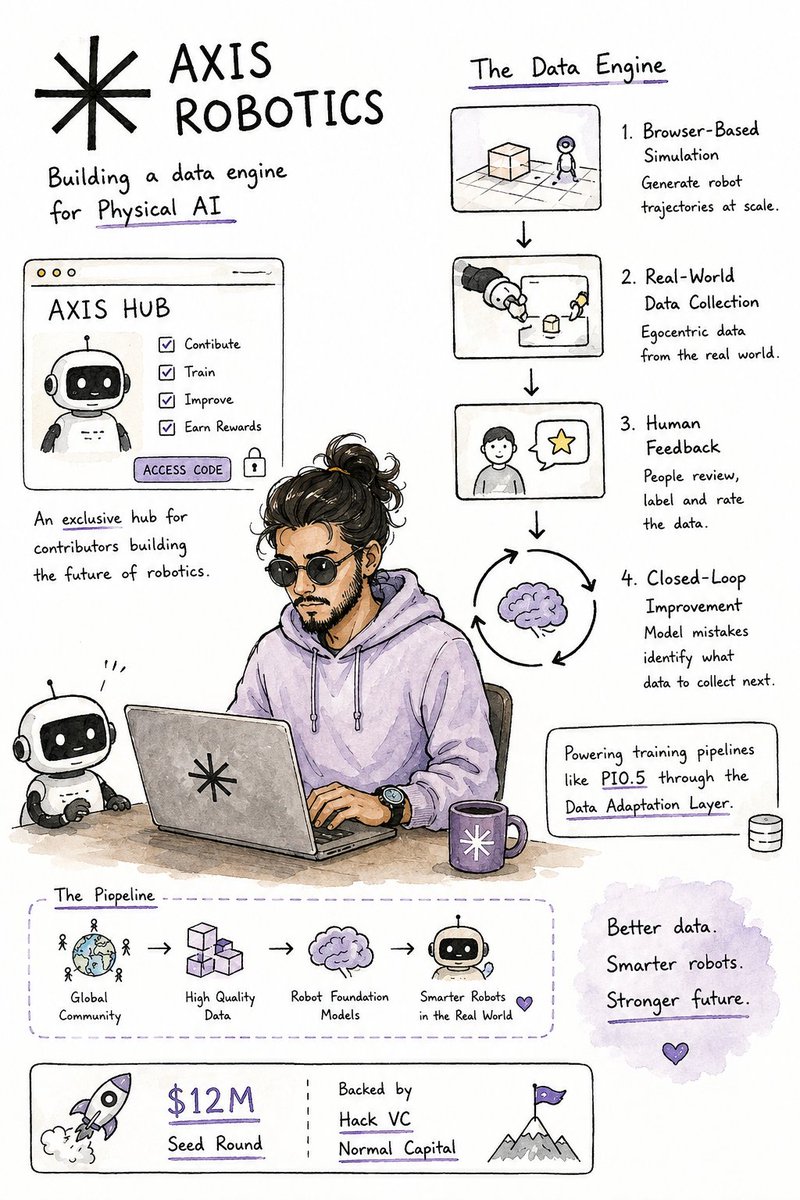
Hallo everyone it is my Day 2 of exploring @axisrobotics so from yesterday I have been spending some time looking into it and one thing stood out to me.
They are not just collecting robotics data. They are building a system that keeps creating better data as the models improve.
Instead of treating datasets as something you collect once and reuse forever Axis is trying to make data collection an ongoing process. Simulation, real-world human demonstrations and feedback all work together to help robots learn from new situations.
A few things I found interesting:
• Anyone can contribute robot tasks through a browser-based environment.
• When a model struggles with something, that becomes a clue for what data needs to be collected next.
• Their Data Adaptation Layer is designed to make new data easier to use for training models like Pi0.5.
• The whole idea is to keep humans involved so the quality of the data gets better over time not just bigger.
Their recent $12M seed round tells me more people are starting to believe in this direction.
Physical AI is still early but projects building the infrastructure behind it are the ones I'm paying the most attention to.
Curious to see where @axisrobotics goes from here. 🤖
Going to attend the First Ever @base
Builders call 👀
See you Today at 3:00 p.m. UTC 🟦
Create your own card & share it if you are also Joining 🟦✅
🔗 : https://t.co/LM3Q9otK3G
Going to attend the First Ever @base
Builders call 👀
See you Today 🟦
Create your own card & share it if you are also Joining 🟦✅
🔗 : https://t.co/HFg0ZdPXiV
Hallo everyone it is our Day 96 of 100 Days journey of Exploring @base .And our today's topic is Every Onchain Action Is a Brick then What Are You Building?
Today I stopped thinking about transactions. Instead I started thinking about construction. Imagine you are standing in front of an empty piece of land.
You do not build a house in one day. You lay one brick then another. Most of them do not look important on their own.
But months later they become a home.I think Base works the same way. Mint one NFT. Support one creator. Deploy one contract. Join one community. Help one builder.
None of those actions feel world-changing but together they are building something much bigger than any of us can see. That is the beauty of an open ecosystem.
You do not need permission to place your brick. You just start building and someone else might build on top of what you created.
A developer writes an open-source tool. Another builder improves it. A creator uses it to launch something new. A community grows around it.
Years later nobody remembers where the first brick was placed. They just see the city that was built. Maybe that is the mindset Base encourages.
Do not chase the biggest move. Make the next meaningful one because ecosystems are not built by one giant breakthrough.
They are built by thousands of small contributions that keep stacking over time. So here is the question I asked myself today: If every onchain action is a brick... what am I building?
Day 96/100 of exploring Base.
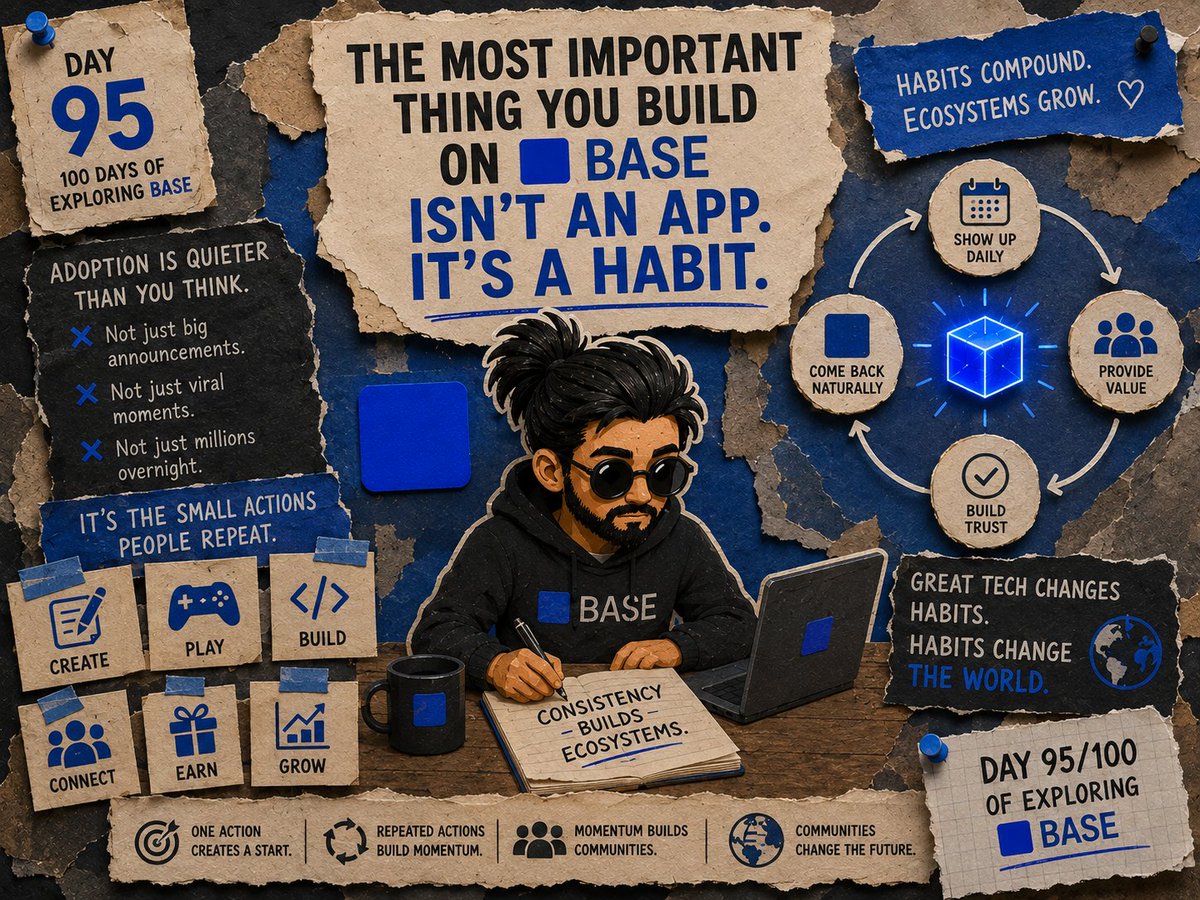
Hallo everyone it is our Day 95 of 100 Days journey of Exploring @base and in this post we will talk about the Most Important Thing You Build on Base. Which Is not an App. It is a Habit.
I used to think adoption happened in big moments . A viral launch. A major partnership. A million users overnight.
But the longer I spend exploring Base the more I think real adoption is much quieter than that. It happens when people stop trying something and start doing it without thinking.That is a habit.
Think about how often you unlock your phone. You don't celebrate it or you don't even notice it. You just do it . The same thing is true for great technology.
It becomes part of your routine. That is why I believe the future of Base is not just about creating more onchain apps. It is about creating reasons for people to come back tomorrow.
A creator publishing every day. A gamer earning rewards every weekend. A developer shipping updates every week. A community checking in because it genuinely enjoys being there.
One action does not build an ecosystem. Repeated actions do.That id why consistency matters more than hype.
Anyone can attract attention for a day but very few products become part of someone's daily life. The projects that win on Base will not just be the ones people try.
They will be the ones people naturally return to. Because in the end technology changes the world when it changes habits and habits are built one small action at a time.
Day 95/100 of exploring Base.