Orderbook latency HL vs Lighter
Lighter is almost X45 faster. Means more proper perp dex for HFT.
Also HL order filled latency is 500ms. That's too slow for me.
@Lighter_xyz@vnovakovski@satoshiheist
A Recap of the Logic Behind Shorting Semiconductors, Plus a Few Thoughts on Monday
Most of this was already laid out in last week's weekly report.
https://t.co/sXDtY4X9JY
Here I'll cover just the single most important point: the prime mover of this crash was never fundamentals — it was leverage.
To gauge just how much leverage had piled up, I rely mainly on two indicators — VIXEQ and COR1M(I learnt them from @labubu_trader — supplemented by the call/put ratio and a few other sentiment indicators.
Let me first explain how these two indicators work.
VIXEQ (the Cboe S&P 500 Constituent Volatility Index) measures implied volatility at the single-stock level. VIX uses SPX index options and captures "the fear of the index as a whole"; VIXEQ instead runs a VIX-like calculation on each constituent's single-stock options and then aggregates them by market-cap weight, capturing "the fear of the average individual stock." When single-stock call buying turns extremely aggressive and speculation concentrates in names like MU, SNDK, INTC, and NOK, those single-stock options get bid up to very rich levels, and VIXEQ's premium over VIX is stretched to an extreme — the most direct read on single-stock speculation and leverage.
COR1M (the Cboe 1-Month Implied Correlation Index) measures the market's expected correlation among constituents. Index variance ≈ average constituent variance × correlation, so when individual stocks are all rising but rising independently of one another (with capital scattered across each name's own story), correlation gets compressed to rock-bottom. COR1M closed at 6.33, meaning implied correlation has already approached its historical low.
Put together, these two indicators describe the same structure: everyone is levered up, betting on mutually independent single stocks (mostly semiconductors), while at the same time many hedge funds are long semiconductors and short value stocks — so the index gets artificially flattened. The greatest risk in this structure is that any single shock can, in an instant, snap correlation back from near 0 to 1 — every name falls together, and all the leverage is forced to unwind at once. A crash, in essence, is just the process of correlation reverting to 1.
So as early as the start of last week, I had already recognized this enormous leverage risk. That is the prime mover of the decline.
As for what the trigger was — it really doesn't matter. AVGO's earnings, SemiAnalysis's negative commentary on MU, that so-called "overheated" NFP, Meta's secondary offering — these were all nothing more than that single gunshot at Sarajevo. It's exactly like silver in late January this year: Warsh taking office was also just a trigger; the real reason was that the leveraged capital loaded with unrealized gains, built up over the course of the parabolic rally, began to flee — setting off a long-on-long stampede, longs trampling longs, the more they sold the more it fell, the more it fell the more they sold. Structure determines direction; the catalyst only determines timing.
As for the short itself: I started with just a 1%-sized SMH put spread. In a market like this it's very hard to call exactly which day it cracks, but we can preset a level. Our preset level was 7495 — the HVL (high vol level). Above 7495, dealers are net positive gamma, which suppresses volatility; once 7495 breaks, positive gamma flips to negative gamma, dealers are forced to sell more the more it falls, manufacturing even greater systemic selling pressure. Adding to the short at that level carries the highest win rate. It's not about guessing the top — it's about waiting for the structure itself to flip short, for the dealers themselves to become forced sellers, and only then making the move.
There isn't much else to say.
Oh, one extra note on my view for Monday.
A systemic crisis is still brewing in the Korean market. To describe the most dangerous left tail, it would roughly look like this: if SK Hynix opens limit-down on Monday, it gives the 2x Hynix ETF (currently the world's largest single-stock ETF) no window at all to de-risk — it can't sell hedges into a locked limit-down board, can't de-lever, and so is forced to carry far more than 2x leverage into the next day. Once Hynix sells off further the following session, this ETF gets blown through entirely — possibly even liquidated — and once the panic spreads directly from Seoul to Hong Kong and on to the rest of the world, it triggers an even larger secondary crisis.
But in all likelihood, Korea will step in to prop things up. So let's pray for Korea.
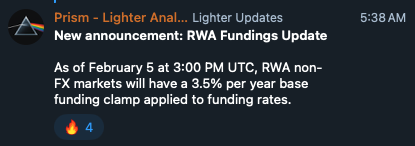
Lighter has just decreased funding rates by 66% 🤯
Going long RWAs for a whole YEAR on Lighter is now probably cheaper than the fees you pay for a swap on Coinbase
Clear reasoning
America debt
Stablecoin
Rwa
Equity perps will grow exponentially as a byproduct of a massive Trojan Horse.
@tradexyz and @Lighter_xyz both looks good here.
1/15
In the context of de-dollarization, extending the debt cycle to help the US resolve its debt seems unrealistic.
Tokenizing US equities to drive stablecoin demand is the primary feasible path for the US to refinance its mounting debt. BlackRock’s RWA push tells the story🧵
@Lighter_xyz For indicator
LLP collateral: *
Funding rate discounts: -
Latency based fee tiers: gamble
USDT collateral: +
But none of them seem to have a significant impact on token prices
Not necessarily.
Competent MMs will stake and short to remain delta neutral, securing lower fees to monopolize the profitable taker flow.
This creates a filter where only skilled MMs thrive, while the inefficient ones are simply phased out.
this is very, *very* bad idea to increase premium fees on Lighter to introduce fee discounts
now, MMs would have to widen their spreads to cover LIT staking risks + to cover fees, making overall execution worse
worse execution → less trading activity → less fees
effectively, this increases the house edge, because higher protocol fees always = more extraction from users
if you increase MM fees, MMs would simply increase spreads for retail, and also make them pay for LIT staking risk.
this money could have stayed with traders, but now will go to the token, which will also suffer from less trading activity
Lighter should NOT increase premium fees, if it will, it will push $LIT into a slow death spiral
(worse execution → less trading activity → less fees)
they shouldn't have touched what was working.