If you’re a semi/memory investor. You have to read this report word by word.
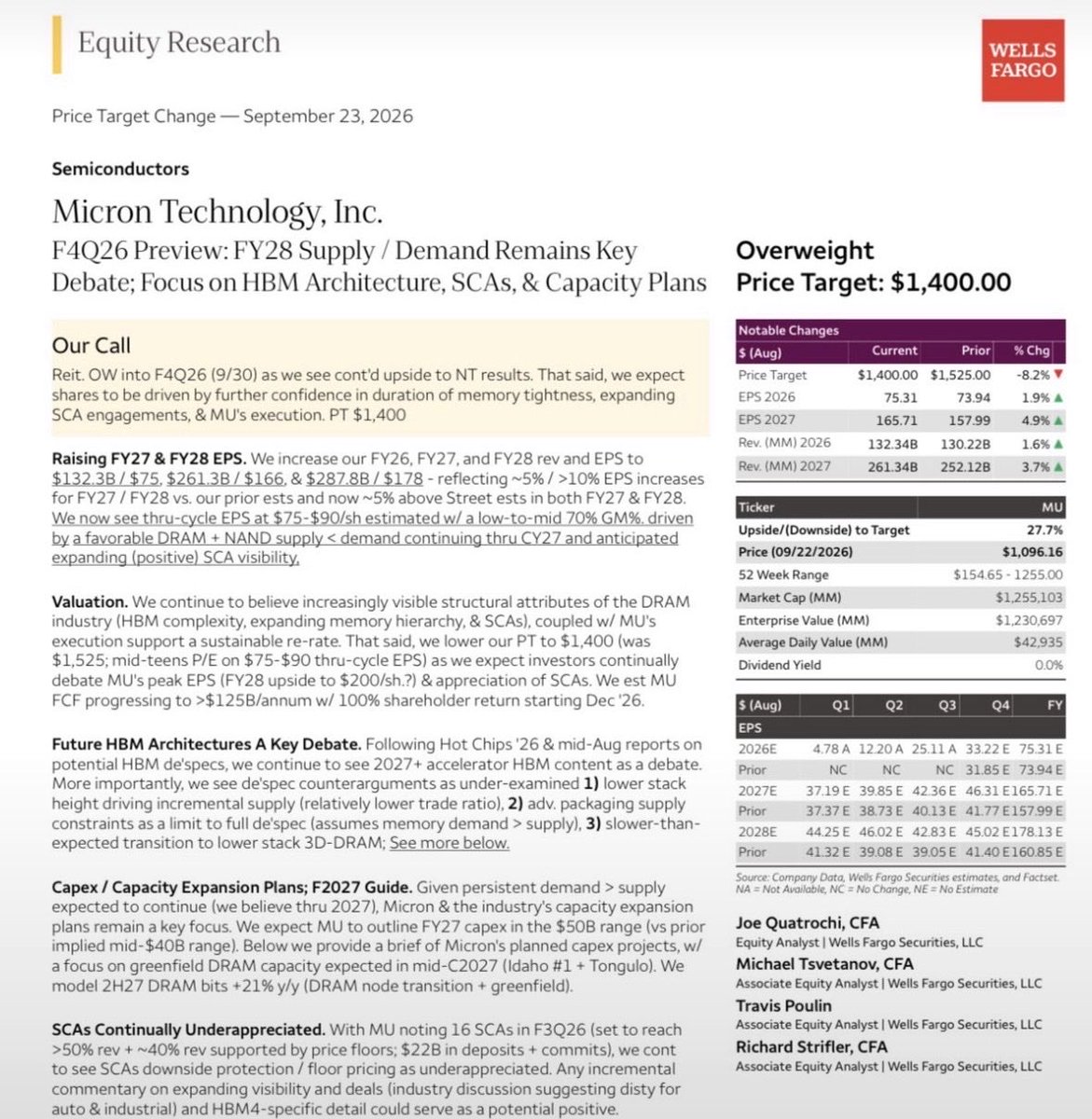
Deutsche Bank’s trading desk on $MU as it reports earnings later today. PT $1550
"Potential Impact of $NVDA Kyber Delays
As discussed above, we have remained cautious regarding the Kyber architecture since NVIDIA first introduced the concept at GTC 2025. Given the significant engineering hurdles involved, we would not be surprised if the program experiences further delays or is ultimately canceled.
Because our financial models have consistently assumed only limited contribution from Kyber, we believe any delay or cancellation would have minimal impact on our forecasts.
For downstream ODMs, we expect essentially no material impact, as cloud service providers (CSPs) are likely to continue purchasing Oberon-based racks until Kyber is ready for mass production.
The primary impact would fall on component suppliers whose products were specifically upgraded for the Kyber architecture. Delays would postpone the ramp of these higher-specification components and defer associated revenue contributions. However, we believe the near-term financial impact remains modest, generally limited to the low- to mid-single-digit percentage range."
_
Fubon:
What is the Kyber Rack?
The market continues to circulate reports that NVIDIA's Kyber (blade-style) AI server rack has been delayed, or could even be canceled. Based on our industry checks, we believe the Kyber architecture still faces a number of unresolved downstream system design challenges.
The defining feature of the Kyber architecture is that it reorients compute trays from a horizontal insertion design to a vertical insertion design. The original objective was straightforward: maximize compute density by fitting more GPUs into the same rack footprint, thereby increasing compute performance per rack to meet rapidly growing AI infrastructure demand.
NVIDIA has previously indicated that a Kyber rack could accommodate 144 or even 288 GPUs. (Note that this refers to GPUs rather than GPU dies. For example, both Blackwell and Rubin adopt dual-die GPUs, meaning 144/288 GPUs correspond to 288/576 dies. The next-generation Feynman is expected to adopt a four-die architecture, implying that 144 Feynman GPUs would already contain 576 compute dies.)
In our view, integrating this level of compute density creates substantial engineering challenges across multiple areas, including:
Power delivery
System integration
Thermal management
Upgraded component specifications throughout the platform
Among these, thermal management remains the most difficult challenge, regardless of whether Kyber is ultimately adopted. As each GPU generation continues to increase power consumption (with future Feynman GPUs potentially reaching around 6 kW per GPU) while rack density simultaneously doubles from today's 72 GPUs to 144 or even 288 GPUs per rack, cooling requirements become exponentially more difficult.
Key Hardware Differences Between Kyber and Oberon
Unlike the Oberon architecture, Kyber mounts the Compute Blades and NVLink Switch Blades back-to-back in a vertical orientation and connects them through an orthogonal backplane (midplane) rather than conventional copper cabling. Consequently, the PCB becomes one of the most critical enabling technologies for the Kyber architecture.
To satisfy higher bandwidth and lower latency requirements:
The backplane CCL specification is upgraded to M10.
CCL value content increases by roughly US$40 or more per GPU, approximately 20% higher than Oberon.
The backplane PCB adopts an extremely complex 78-layer HLC design, creating significant manufacturing yield challenges. Only a limited number of suppliers are capable of producing such products, resulting in attractive profitability.
On the power side, we estimate total rack power consumption could approach 600 kW, requiring deployment of 800V DC (HVDC) power racks.
Nevertheless, we continue to believe Kyber will not enter volume production in 2027.
Although VR200 does not strictly require an 800VDC architecture under its current design, we still expect NVIDIA to ship a limited number of 800V systems (<500 units) during 2H26, maintaining our assumption of roughly 10% HVDC penetration for VR200.
Accordingly, we continue to estimate that HVDC-related business could contribute:
5–10% of Delta Electronics' 2027 revenue
A mid-single-digit percentage of Lite-On's 2027 revenue
Over the longer term, we continue to view HVDC as an inevitable industry transition rather than an optional upgrade, with adoption reaching 10–20% in 2027 and expanding further in 2028.
Cooling Challenges
Kyber reduces each Compute Blade to only 0.5U in width. Combined with shrinking physical space and rapidly increasing AI chip power consumption, this creates unprecedented thermal management challenges.
Current cooling technologies under evaluation include:
Micro Channel Lid (MCL)
MCL adopts a side-flow water channel design, allowing cooling hardware to fit within the 0.5U mechanical envelope.
Advantages include:
Supports blade thickness as low as 0.5U
Cooling capability exceeding 3,000 W
Industry-leading balance between thermal performance and space efficiency
Two-Phase Liquid Cooling (TPLC)
Current Vera Rubin systems utilize conventional single-phase cold plates.
However, under Kyber's vertical architecture, single-phase cooling suffers from uneven coolant flow caused by gravity. Two-phase liquid cooling (TPLC) offers superior thermal performance while eliminating this flow imbalance.
Among suppliers:
Auras (3665 TT) currently leads commercialization of MCL solutions.
Asia Vital Components (3017 TT) and Cooler Master are primarily focused on TPLC development.
Mechanical Challenges
Each Kyber Compute Blade is expected to weigh more than 20 kg.
With a vertically removable blade design, the entire load is supported by the lower slide rail, creating severe asymmetric loading conditions. Combined with thin-profile, anti-sway, and multi-stage structural requirements, this places exceptionally demanding engineering requirements on rail suppliers.
As a result, we expect premium slide rail ASPs to continue increasing, with King Slide (2059 TT) remaining the primary development partner for Kyber rail systems.
Potential Impact of Kyber Delays
As discussed above, we have remained cautious regarding the Kyber architecture since NVIDIA first introduced the concept at GTC 2025. Given the significant engineering hurdles involved, we would not be surprised if the program experiences further delays or is ultimately canceled.
Because our financial models have consistently assumed only limited contribution from Kyber, we believe any delay or cancellation would have minimal impact on our forecasts.
For downstream ODMs, we expect essentially no material impact, as cloud service providers (CSPs) are likely to continue purchasing Oberon-based racks until Kyber is ready for mass production.
The primary impact would fall on component suppliers whose products were specifically upgraded for the Kyber architecture. Delays would postpone the ramp of these higher-specification components and defer associated revenue contributions. However, we believe the near-term financial impact remains modest, generally limited to the low- to mid-single-digit percentage range.
Citi on $INTC / $TSM & ABF:
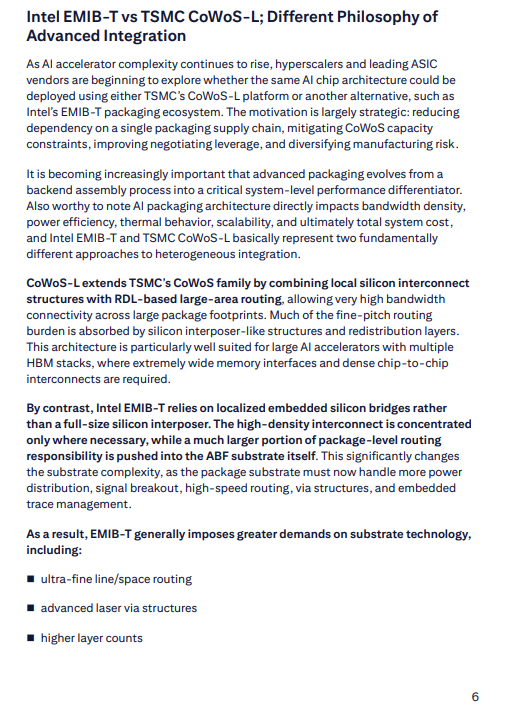
"ABF technology readiness is critical for EMIB-T Adoption — Given EMIB-T’s design methodology, the readiness of the ABF substrate ecosystem for ultra-high-density routing, precise bridge embedding, and advanced power delivery is critical for EMIB-T adoption. We believe the capacity and technology readiness will be key checkpoint for EMIB-T penetration in the next 2-3 years."
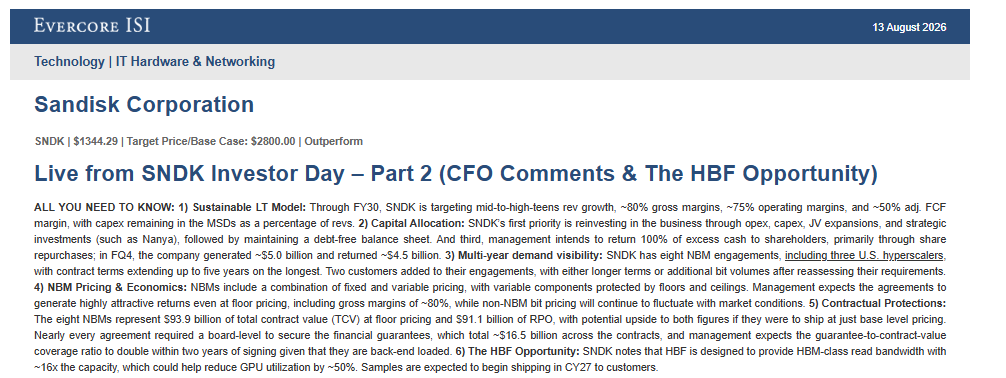
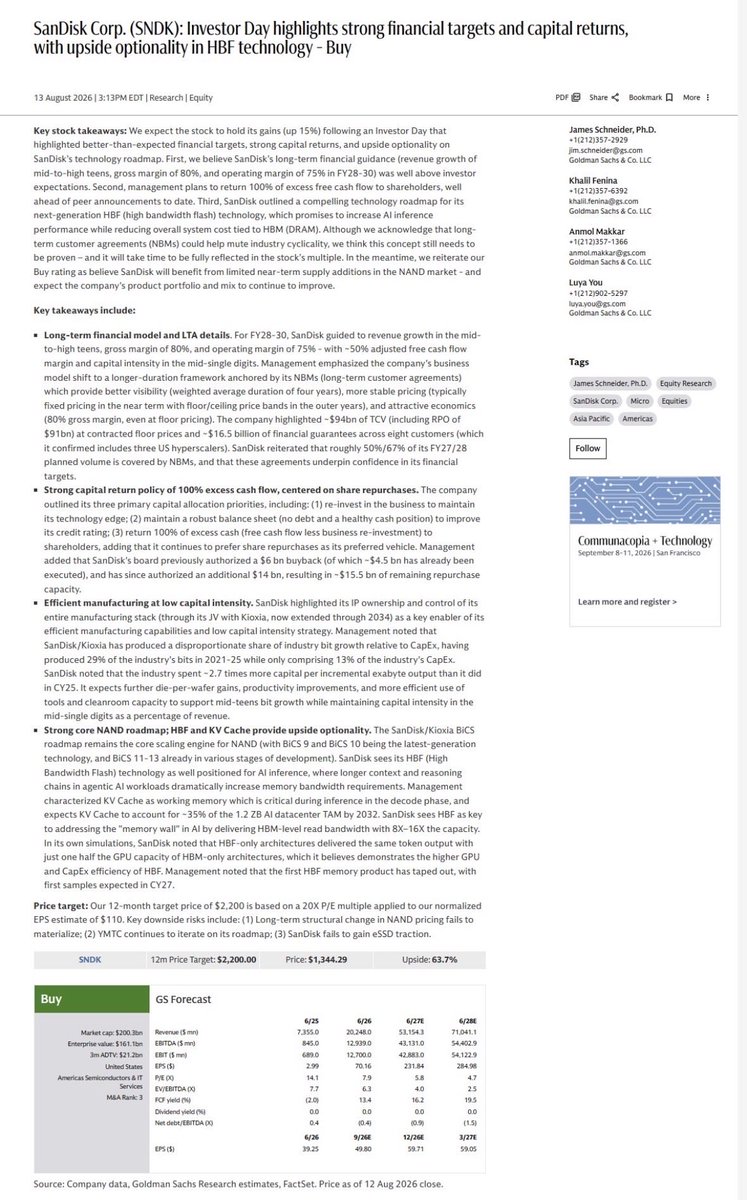
If you’re a memory investor, you have to bookmark this and read it. This is Goldman Sachs’s take on $SNDK investor day…
We’re still early in this cycle folks!
Rumor: Google is expanding orders for TPU AI server chips as demand heats up, with market researchers putting TPU demand at 15 million by 2028, more than Nvidia’s current 13 million per year, media report, adding Google turned to Intel for EMIB packaging because Nvidia pre-booked over 50% of TSMC’s CoWoS packaging for the next 3-years. $GOOGL $TSM $INTC #semiconductors https://t.co/g8ZM6uOEtb
KB Securities: Memory
"As of August, only 60% of big techs’ memory and AI substrate needs are being met. Big techs seem to understand that overinvestment in AI carries less risk than underinvestment. Unmet demand in 2026 should spill over into 2027 and unfulfilled demand in 2027 should carry into 2028, resulting in a multi-year domino effect that is likely to last for the next three years. Since a memory fab requires over three years to be built and become fully operational, we expect the shortage to begin easing after 2029."
$MU $DRAM $EWY
Bill Ackman on dealing with disaster: “Make a little progress every day”
After losing $4 billion in Valeant Pharmaceuticals, other Wall Street investors started betting against his firm, Pershing Square, to further compound its catastrophic 30%+ loss and force a liquidation.
To make matters worse, his shareholders filed a lawsuit and he was in the middle of a divorce.
He eventually bought back control of his company with a loan from JP Morgan, settled the shareholder lawsuit, and resolved his divorce. But when asked how he dealt with his psychology during this period, Bill responds:
“This was not my first proximity to disaster. I had another moment in my career in 2002, and I learned this method for dealing with these kind of moments which is: you just make a little progress every day.”
During this period, he would say to himself:
“Today, I’m going to wake up and make progress. I’m going to make progress on the litigation; I’m going to make progress on the portfolio; I’m going to make progress on my life.”
He explains in the clip below:
“Progress compounds a bit like money compounds. You don’t see a lot of progress in the first few weeks and you can’t look up at the mountain top where you used to be, because you’ll just give up. Just take it step by step by step… And one day, you wake up, and you’re like ‘wow, it’s amazing how far I’ve come.’”
He reflects on the chart of Pershing Square’s share price:
“That huge drop that felt like a complete, unbelievable disaster looks like a little bump on the curve. And that really gives you perspective on these things. You just have to power through…. Nutrition, sleep, exercise, and a little progress everyday.”
Video source: @lexfridman (2024)
@mi4992674354385@jukan05 I have invested in US, TW and JP stock markets, and the result is pleasant. Go get a Charles Schwab or Fidelity account, and check out the portfolio of Leopold Aschenbrenner.
The AI frenzy props up the demand for HPC and complex data architectures, translating into accretive growth for PMICs. Humanoids fuels structural demand for sensors. Bullish on $ADI, $NVTS, $IFNNY & $ON as both volume and content growth to persist in the coming years.
Four robot-related companies listed on Korea's main bourse have seen their shares jump 155 percent on average this year amid a global boom in the physical artificial intelligence industry, data showed Wednesday.
https://t.co/z71Ny5zTqd
Nvidia jumped 5% on a new laptop chip. Anthropic filed for an IPO. June is off to a chaotic start.: Anthropic filed for an IPO and Alphabet is seeking to raise $80 billion, even as Middle East tensions weigh on sentiment https://t.co/WLFZCJ3xmI
🔥 #HBM prices may surge in 2027. HBM4 negotiations are underway, with suppliers holding the upper hand amid tight DRAM supply and rising costs.💡More analysis from #TrendForce: https://t.co/Yf3153M9W3 🔗
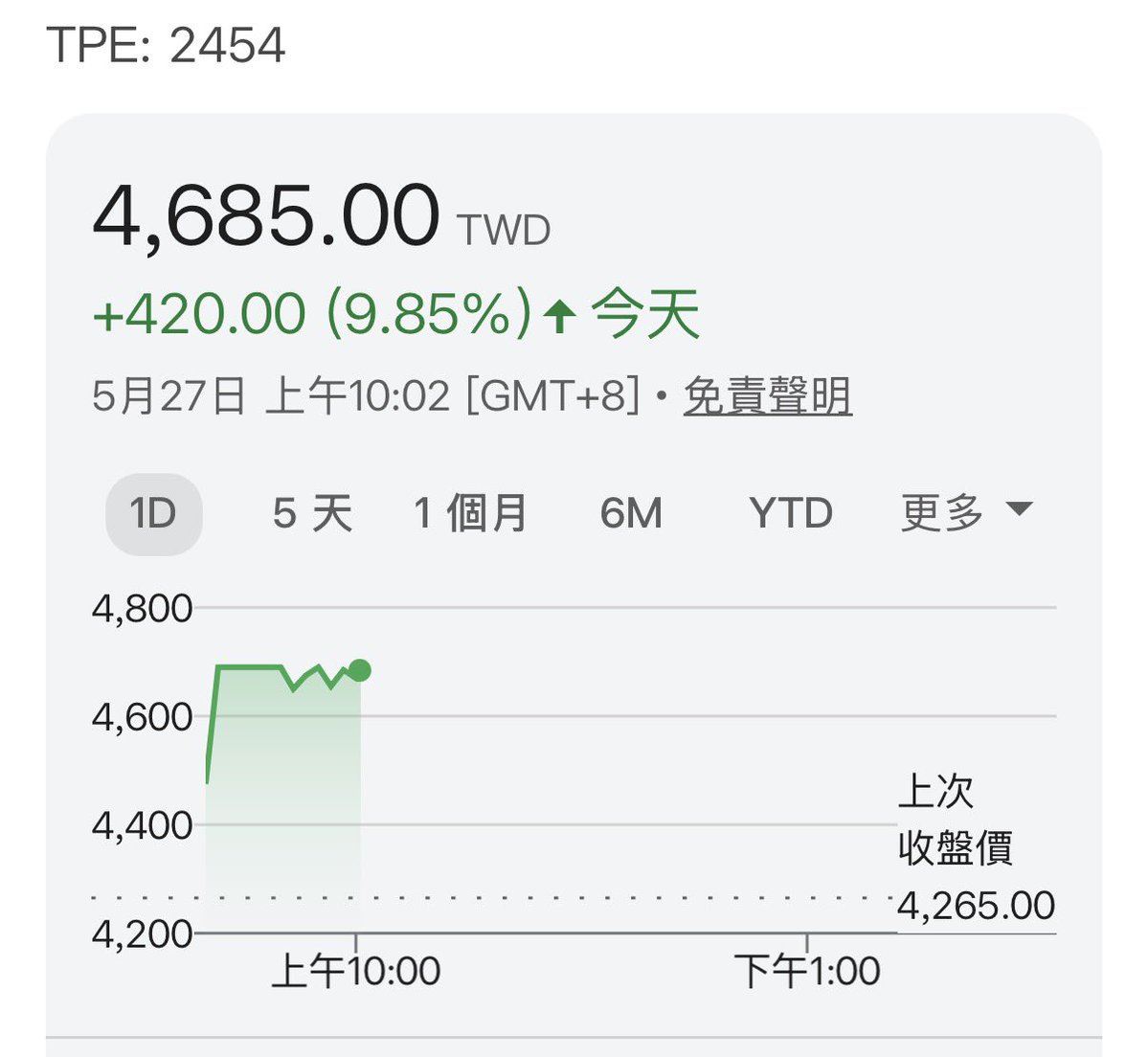
Abstract of MediaTek (2454 TT) - Note - New ASIC likely SpaceX 🚀
•Target Price raised to NT$5,520
•Massive ASIC revenue ramp projected: $2.2bn (2026) → $18bn (2027) → $48bn (2028)
•Likely SpaceX Win for new datacenter ASIC. We expect MTK to be the design service provider for xAI’s datacenter ASIC based on Intel 14A + EMIB-T. Volume production late-2028, ramp in 2029 with robust volume.
•Zebrafish CoWoS upgraded: Capacity raised to 180k (from 160k) in 2027. ASP hiked to $5.5k (from $4.5k) → implies $17.8bn datacenter ASIC revenue in 2027E (well above guidance & consensus)
•Strong TPU momentum: Competitor’s PumaFish cancelled → MTK first mover to 2nm (Humufish). High confidence in successor chip (Helios Next) with strong EMIB yields (in out note, we highlighted EMIB has started trials for testing for major current AI chips.
#Mediatek #TPU #SpaceX #Intel