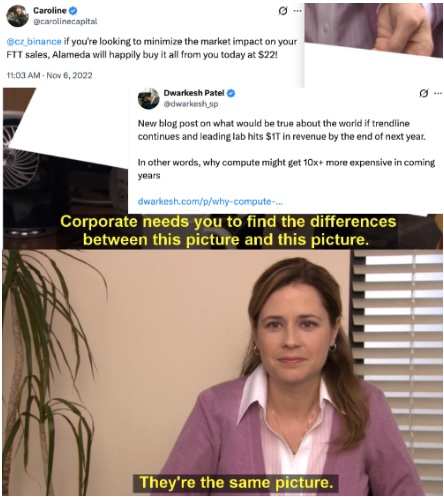
Exactly what I thought when I saw the post.
My prediction on the next thing to get bitter lessoned: durable workflows with >1 agent step. Durable workflows will stay because coupling N deterministic steps to a single agent loop (as pre and/or post steps) will continue provide value - for now.
Thought I had recently,
engineers have been managing things "as-code" for a while. LaTeX did it for documents decades ago. Then IaC completely took over infrastructure, no reasonable org manages infra any other way anymore.
But it seemed to have mostly stopped there. Why:
My guess: it didn't spread because most people couldn't code. The "as-code" paradigm stayed siloed with technical folks.
But that's changing fast. If everyone can code now (even if it's slop-code), suddenly "everything-as-code" makes sense. And it seems to already be starting: marketing videos (@Remotion ), UI Designs (@paper ). I predict this will spread to literally everything. Everything version controlled, reviewable, reproducible.
Feel like this paradigm could be a big driver of AI producitvity.
People that are using iron-proxy or other default-deny solutions for agent proxies, are you constantly rejecting agent requests if they try to hit some random news/docs site?
It feels like using these tools would require you to either
- whitelist a ton(!) of things
- be ok with your agent having their requests frequently rejected
Someone tell me why I’m wrong plz, I figure I’m missing something
I gotta give it to these folks. This library is unreal. Project I’m working on requires good diffs. I was never going to build it myself.
I spent the last 4 months hot swapping different diff libs. All of them sucked.
I realized Pierre diffs was open source, had my agent hot swap them into my app. Game changer. I enjoy using my own app 10x more just because it uses Pierre diffs now.
diffshub[dot]com
Take any public diff from GitHub and virtualize it nearly instantly, no matter how large, with DiffsHub. Built to show off our brand new CodeView component.
To try it out, replace `github` with `diffshub` in your address bar.
Don't know how accurate the placement of providers is on here but my prediction is the top-right is where you'll want to be. At least for coding agents.
There's nothing stateless or lightweight about an engineers m5 Macbook pro. What's good for devs is good for agents.
Sandboxes are becoming the OS for agents.
This is because agents will be more persistent and stateful.
I go deep in my Substack: isolation primitives, performance, portability, architecture, build vs buy, market dynamics.
Give it a read: https://t.co/zBtgEpaoN2
why agents need VMs, not containers
with David Crawshaw, ex-CTO & co-founder of Tailscale
now co-founder and CEO of exe - a new up-and-coming cloud provider
Timestamps
(0:00) why build a new cloud?
(2:07) why Docker isn't enough for agents
(12:28) why AI-friendly is developer-friendly
(20:32) why VMs are the right abstraction (and the serendipity of just dropping an idea prompt from your phone)
(28:30) the exorbitant price of IOPS in the cloud (32:21) Cloud Discounts
(33:40) the rise of self hosting
(41:25) Shelly and AI ops agents
(48:10) the hard problem with AI SREs
(53:00) parting thoughts and early EC2’s noisy neighbor shenanigans
One of my first managers in tech had previously been an EM for managed data services at AWS. I’ve never forgot when he told me,
You think when you click a button in AWS there’s a million automated APIs going off to get you what you want, but in reality, there’s 50 guys running around manually flipping the buttons to make sure you get what you want.
Most people think all compute is elastic.
It is elastic from your perspective as a consumer. But someone still has to physically rack a server, boot it, patch it, and keep it running.
Elasticity is an abstraction, not a law of nature. There are humans and machines behind it, and they have physical constraints.
When the abstraction meets the constraint, things like the cpu shortage happen.
Thought I had recently,
engineers have been managing things "as-code" for a while. LaTeX did it for documents decades ago. Then IaC completely took over infrastructure, no reasonable org manages infra any other way anymore.
But it seemed to have mostly stopped there. Why:
My guess: it didn't spread because most people couldn't code. The "as-code" paradigm stayed siloed with technical folks.
But that's changing fast. If everyone can code now (even if it's slop-code), suddenly "everything-as-code" makes sense. And it seems to already be starting: marketing videos (@Remotion ), UI Designs (@paper ). I predict this will spread to literally everything. Everything version controlled, reviewable, reproducible.
Feel like this paradigm could be a big driver of AI producitvity.