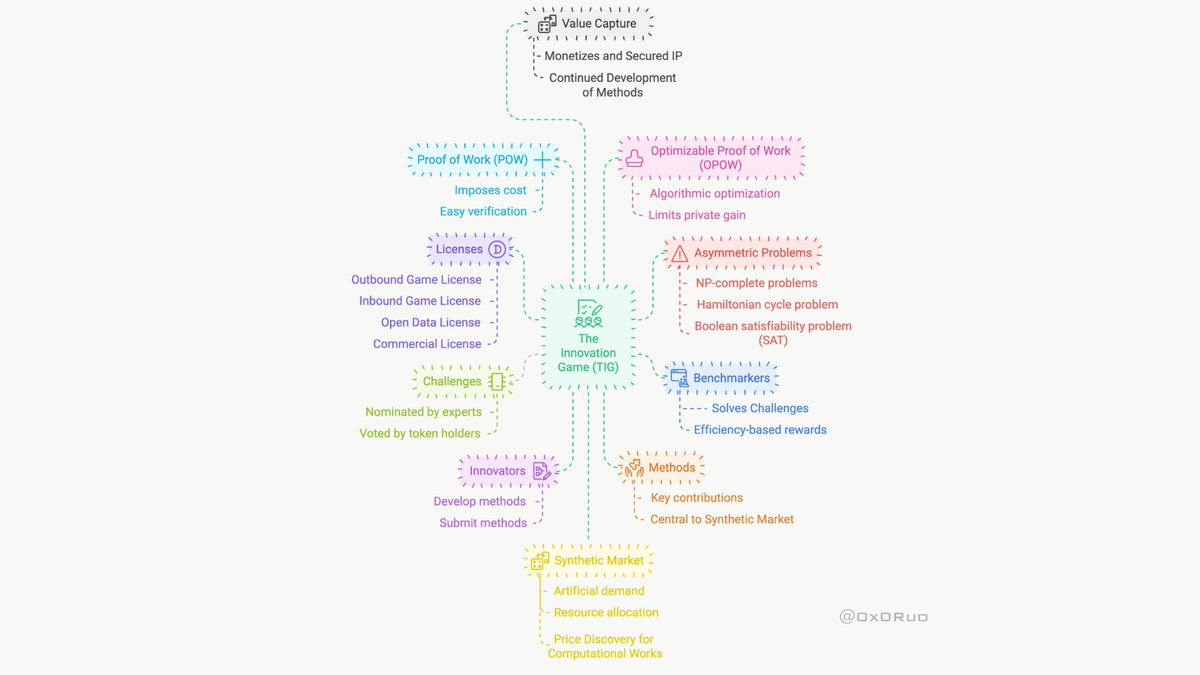
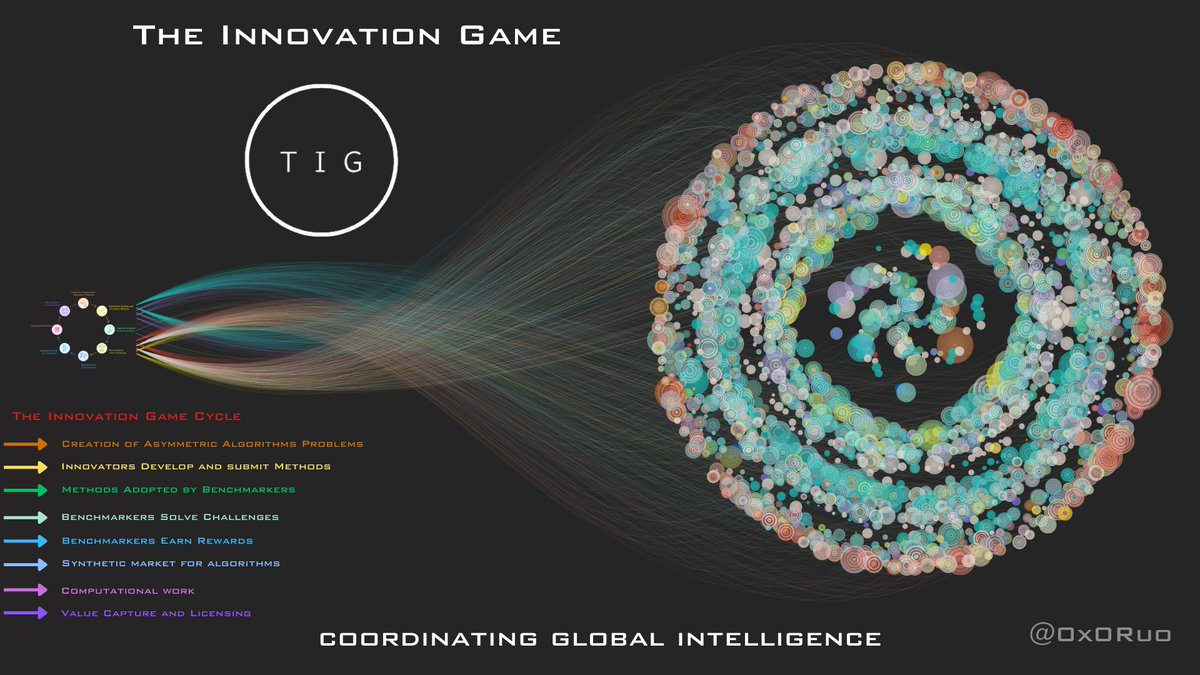
/2//
◉ In my last post as you know we acknowledged definition of $TIG and now we can start by exploring into the Core principles,Mechanisms, and Potential impacts of $TIG on various Scientific and Technological fields.
⌘ Today, Let's start with @tigfoundation Present & Future Vision.. ▼
▶︎ The Innovation Game's Vision
⌘ Open, Collaborative, and Competitive Ecosystem
⌘ $TIG creates an ecosystem that is open, collaborative, and competitive. This ecosystem leverages computational efforts across a wide array of real-world challenges, including;
✦ Artificial Intelligence
✦ Cryptography
✦ Biomedical Research
✦ Climate Science
⌘ Open collaboration is at the heart of The Innovation Game, driving a cycle of innovation and value creation. By leveraging a synthetic market to assign value to contributions, $TIG ensures fair payment for innovators and fosters a sustainable environment for open collaboration. This approach accelerates the pace of discovery and enhances the value of the IP generated within the ecosystem, ultimately leading to increased bounties for innovation and further incentivizing discovery.
⌘ Open World
❖ $TIG envisions an open world where the ability to utilize algorithms to solve real-world problems is not confined to tech giants. Innovation should be accessible to all, fostering a diverse and inclusive environment where anyone can contribute to solving pressing issues through algorithmic solutions.
⌘ Meritocratic World
❖ $TIG envisions a meritocratic world where anyone with the capability to innovate algorithmically has the opportunity to do so. Talent and skill are the primary currencies, and individuals are recognized and rewarded based on their contributions to algorithmic advancements
⌘ Collaborative World
❖ $TIG envisions a collaborative world where humanity works together to tackle its most significant challenges.
By fostering a spirit of cooperation, we can leverage collective intelligence and resources to drive meaningful progress.
▶︎ TIG Factors
❖ Incentivize Innovation
⌘ $TIG will incentivize anyone in the world capable of making a material contribution to algorithmic innovation to do so. By providing recognition and rewards, $TIG aims to motivate individuals to push the boundaries of what is possible.
❖ Invest in Algorithms
⌘ $TIG will create a means of investing in algorithms as an asset class. This will open up new opportunities for financial growth and support the development of their technologies
❖ Focus on Real-World Problems
⌘ $TIG will concentrate innovation efforts on challenges that directly map onto real-world problems. This ensures that algorithmic advancements have practical applications and can make a tangible difference in people's lives.
❖ Foster an Ecosystem
⌘ $TIG will foster an open, collaborative, and competitive ecosystem that hyper-accelerates computational progress. By preventing monopolies, $TIG aims to create a level playing field where innovation can thrive.
⎖ $TIG's vision is clear to democratize algorithmic innovation, making it accessible, collaborative, and focused on solving real-world problems. By doing so, TIG aims to unlock the full potential of human ingenuity and drive progress in ways previously thought impossible.
▶︎ The Innovation Game's Approach
⌘ $TIG's platform encourages the sharing of knowledge, data, and code through its Open Data License. This license allows participants to freely build upon each other’s work, thereby accelerating the pace of innovation.
⌘ By creating a synthetic market, $TIG assigns value to algorithmic contributions, ensuring that innovators are fairly compensated for their work.
⌘ This approach not only fosters a sustainable environment for open collaboration but also ensures the economic viability of contributions, addressing a long-standing challenge in the open source community.
▶︎ Crypto-Economic Incentive Structure
⎖ $TIG combines its proof-of-work (#PoW) with a robust crypto-economic incentive structure. This dual approach serves two primary purposes:
❖ Incentivizing Miners (Benchmarkers)
⌘ Miners are encouraged to identify and validate the best-performing algorithms through rewards.
⎖ TIG is not only motivates miners to identify top-performing algorithms but also rewards global contributors to algorithmic advancements.
❖ Global Contributors (Innovators)
⌘ Anyone worldwide who can contribute to algorithmic innovation is motivated and rewarded, fostering a truly global collaborative effort.
⎖ The next time, we will see comprehensive analysis about "Asymmetric problems" and "Challenges" but before that first, let’s check for a moment an overview of The Innovation Game.
◉ The Innovation Game Overview
→ Creation of Asymmetric Problems
→ Innovators Develop and Submit Methods
→ Methods Adopted By Benchmarkers
→ Benchmarkers Solves Challenges
→ Benchmarkers Earn Rewards
→ Synthetic Market for Algorithms
→ Computational Work
▶︎ TIG: The Innovation Game
I've been researching a lot of projects lately but @tigfoundation is the most interesting one that ı would like to a deep dive into their cycle.
Let's start by introducing $TIG 💎
⌘ $TIG stands as the first and only protocol specifically crafted to accelerate algorithmic innovation through the coordination of global intelligence.
⌘ At its core, TIG is built upon a novel proof-of-work (#PoW) mechanism that optimizes the algorithms used in this process.
⎖ I will examine this one of a kind project and bring my perspective analysis to you part by part..
⎖ The next of my post will include, Their Vision, importance of Asymmetric Problems and why this really matters in $TIG
⎖ Also, ı will touch on some Questions and Problems that waiting to be answered such as..
❖ How we can unlock the full potential of algorithms ?
❖ How can we shape the future of algorithmic innovation ?
⚘ if you like my posts, Don't forget to follow @0x0Ruo for more!
What are Subnets?
Bittensor is the Olympic Games of intelligence 🥇
Bittensor Sub-Networks (subnets) solve big problems in AI:
• Decentralized training
• Fine-tuning models
• Fraud detection
• Protein folding & more
(+ it's open source)
Subnet owners design games (challenges) to solve specific problems.
Miners are the athletes of Bittensor who do the work,
Validators are the judges who score the winners according to the subnet’s rules (Incentive mechanism)
The best contributors are rewarded in $TAO, creating measurable output of digital goods.
Bittensor subnets transform human ingenuity into measurable, decentralized digital commodities, redefining the economy of intelligence.
/4//
◉ In my last post, we learnt that the primary aim of @tigfoundation is to accelerates the development of computational methods for solving asymmetric problems to ensure the integrity and security of its proof-of-work (#PoW) system while contributing to solving real-world computational challenges across various domains, including Artificial intelligence, Biology, Medicine, and Climate science
▶︎ Today, we explore key components of Synthetic market, Innovators & Benchmarkers
▶︎ Synthetic Market for Computational Methods
❖ In the rapidly evolving field of computational methods, the traditional means of recognizing and rewarding innovation often fall short. Institutional affiliations and personal connections can unduly influence the success of an innovator, overshadowing the actual quality and efficiency of their work.
⎖ TIG aims to disrupt this paradigm by establishing a synthetic market where the true value of computational methods is determined by their adoption and performance.
⌘ The Market Framework
❖ $TIG introduces a market-driven approach to valuing computational methods. This framework assigns value to algorithms based on their adoption, ensuring that the most efficient and effective methods rise to prominence. By doing so, TIG fosters a meritocratic system where resources are allocated based on the quality of work rather than external affiliations.
⌘ Key Components
⏣ Innovators: Individuals or entities that develop new computational methods and algorithms.
⏣ Benchmarkers: Participants who validate the performance of these algorithms by solving computational challenges.
⏣ TIG Tokens: The currency of the $TIG ecosystem, used to reward Benchmarkers and incentivize participation.
⎖ $TIG represents a significant advancement in the way computational methods are valued and rewarded. By creating a Synthetic market, TIG ensures that the best algorithms are recognized based on their performance and adoption.
▶︎ Innovators
❖ Innovators are the driving force behind the development and refinement of algorithmic solutions to address the platform’s challenges. These individuals, including scientists, researchers, coding enthusiasts, and code optimizers, collaborate in an open research and development environment to create and enhance computational methods, accelerating scientific progress and enriching the intellectual property managed by TIG.
⌘ The Role of Innovators
Innovators play a crucial role in the technological ecosystem by:
⏣ Identifying Challenges: Recognizing and understanding the complex problems that need algorithmic solutions.
⏣ Developing Algorithms: Crafting new algorithms or refining existing ones to improve efficiency, accuracy, and performance.
⏣ Accelerating Progress: Speeding up scientific and technological advancements through innovative computational methods.
⏣ Accelerating Progress: Speeding up scientific and technological advancements through innovative computational methods.
⏣ Enriching Intellectual Property: Contributing to the body of knowledge and intellectual property managed by TIG, ensuring that innovations are protected and utilized effectively
⌘ The Innovator Community
⎖ The innovator community is diverse, including scientists, researchers, coding enthusiasts, and code optimizers, all collaborating to advance technology and science
⏣ Scientists: Experts in various fields who apply their knowledge to solve specific problems through computational methods.
⏣ Researchers: Individuals who conduct in-depth studies to discover new insights and develop novel solutions.
⏣ Coding Enthusiasts: Passionate programmers who enjoy creating and optimizing code for better performance.
⏣ Code Optimizers: Specialists who focus on improving the efficiency and effectiveness of existing code.
⌘ Impact on Scientific Progress
⏣ Enhancing Computational Methods: Developing more sophisticated algorithms that can handle complex data and computations.
⏣ Solving Real-World Problems: Applying algorithmic solutions to address practical issues in various domains such as healthcare, finance, and environmental science.
⏣ Driving Innovation: Pushing the boundaries of what is possible through creative and effective use of technology.
⏣ Building Intellectual Property: Creating valuable assets that can be leveraged for further research and commercial applications
⎖ Innovators are essential to the advancement of technology and science. By working in an open and collaborative environment, they develop and refine algorithms that address critical challenges, accelerate progress, and enrich the intellectual property managed by TIG. Their contributions not only solve current problems but also pave the way for future innovations.
▶︎ Benchmarkers
⌘ Role of Benchmarkers
⎖ Benchmarkers in TIG compete to solve computational challenges using the algorithms provided by Innovators.
and essential for maintaining the integrity and functionality of the TIG ecosystem.
◉ Validation and Selection of Efficient Methods
✦ Benchmarkers meticulously evaluate various methods and approaches presented within the TIG ecosystem.
✦ They ensure that only the most efficient and effective methods are selected, promoting a high standard of quality and innovation.
✦ This process helps in filtering out subpar contributions, ensuring that the ecosystem remains robust and competitive.
◉ Providing Security
✦ Benchmarkers play a crucial role in maintaining the security of the TIG ecosystem.
✦ By thoroughly vetting methods and contributions, they help prevent fraudulent or malicious activities.
✦ This security aspect is vital for maintaining trust and reliability within the community.
◉ Driving Market-Based Price Discovery
✦ Benchmarkers facilitate the market-based price discovery process by evaluating the true value of contributions.
✦ Their assessments help in setting fair and accurate prices for various methods and innovations. ⌘ This process ensures that contributors are fairly compensated and that resources are allocated efficiently.
◉ Recognizing and Supporting Innovation
✦ By identifying and endorsing the most innovative contributions, Benchmarkers help bring attention to groundbreaking ideas and solutions.
✦ This recognition not only motivates contributors but also attracts further investment and interest in the ecosystem.
✦ Supporting innovation is crucial for the continuous evolution and improvement of the TIG environment.
◉ Maintaining Integrity and Efficiency
✦ The role of Benchmarkers is integral to upholding the integrity of the TIG ecosystem.
✦ Their rigorous evaluation processes ensure that the ecosystem remains transparent, fair, and efficient. ⌘ By maintaining high standards, Benchmarkers help create a sustainable and thriving environment for innovation.
⎖ In result, Benchmarkers are indispensable to the success and sustainability of the Innovation Game. Their responsibilities in validating methods, ensuring security, driving price discovery, and supporting innovation are critical for maintaining the integrity and efficiency of the entire ecosystem. Through their efforts, Benchmarkers help foster a dynamic and competitive environment that encourages continuous improvement and innovation.
⎖ Together, Innovators and Benchmarkers create a dynamic and competitive environment that fosters continuous improvement and innovation within $TIG. Their combined efforts ensure that the best algorithms are recognized and that the ecosystem remains robust and sustainable.
/3//
◉ In my last post we learnt that @tigfoundation envisions, a world that is meritocratic, open and collaborative. advocates for equal opportunities in innovation, the democratization of technology, and collective action to address global challenges. $TIG vision encourages a future where every individual has the potential to contribute meaningfully to society, fostering a more equitable and sustainable world for all.
⎖ So bear with me on this time we are going forward to Asymmetric Problems & Challenges
▶︎ Asymmetric Problems
⌘ The Innovation Game focuses on a category of problems known as "Asymmetric" problems. These problems are characterized by their computational asymmetry, they require significant computational effort to solve, but once a solution is proposed, verifying its correctness is relatively straightforward. This property makes them ideal for use in proof-of-work( #PoW ) systems, where the goal is to ensure that participants invest computational resources to solve problems, while making it easy to verify the correctness of their solutions.
❖ By incorporating these asymmetric problems, $TIG not only ensures the integrity and security of its proof-of-work system but also contributes to solving real-world computational challenges across various domains.
▶︎ Focus on Asymmetric Problems
⌘ The primary aim of TIG is to accelerate the development of computational methods for solving asymmetric problems. These problems are characterized by requiring significant computational effort to solve, yet their solutions are easily validated once proposed. Examples include:
❖ NP-Complete Problems: Problems that are simple to check but generally considered unsolvable within polynomial time, such as the Hamiltonian Cycle Problem and the Boolean Satisfiability Problem (SAT).
❖ Model Training in AI: Creating models based on given data, such as training machine learning models, which has applications ranging from language model generation to image creation.
❖ Machine Learning: Optimization problems are crucial in training machine learning models and designing architectures like the Transformer neural network. Techniques include gradient descent, backpropagation, and convex optimization.
❖ Prime Factorization: The process of breaking down a composite number into its prime factors, which has significant implications in cryptography.
❖ Hamiltonian Cycle Problem: Involves identifying a Hamiltonian cycle in a given graph.
▶︎ Challenges
⌘ The Innovation Game ( $TIG ) incorporates computational problems as proof-of-works within its framework, known as #OPoW. Currently, $TIG includes three primary challenges: Boolean satisfiability, Vehicle routing, and the Knapsack problem. Over the next year, an additional seven challenges from various domains such as Artificial intelligence, Biology, Medicine, and Climate science will be introduced. $TIG emphasizes "Asymmetric" problems, which are computationally intensive to solve but easy to verify once a solution is proposed.
▶︎ Current Challenges In TIG
❖ Asymmetric problems are fundamental in various fields of science and engineering. For instance:
⌘ Boolean Satisfiability Problem (SAT)
❖ SAT is the problem of determining whether a given Boolean formula can be satisfied by some assignment of truth values to its variables. A Boolean formula is typically expressed in conjunctive normal form (CNF), which is a conjunction of clauses, where each clause is a disjunction of literals. The challenge lies in finding a truth assignment that makes the entire formula evaluate to true.
⌘ The 3-SAT Challenge in The Innovation Game
❖ In The Innovation Game, the 3-SAT Challenge is a specific instance of the SAT problem where each clause in the Boolean formula contains exactly three literals. This restriction makes the problem more complex and interesting, as it is known to be NP-complete, meaning that no polynomial-time algorithm is known to solve all instances of this problem efficiently.
✦ Configurable Difficulty
❖ The 3-SAT Challenge in $TIG allows players to engage with the SAT problem at varying levels of difficulty. This configurability can involve adjusting the number of variables, the number of clauses, or the specific structure of the clauses themselves. By modifying these parameters, players can experience different challenges that test their problem-solving skills and understanding of Boolean logic.
✦ Challenge Code Specification
❖ For a precise specification of the challenge, players are encouraged to refer to the challenge code provided within TIG. This code outlines the rules, parameters, and expected outcomes of the 3-SAT Challenge, ensuring that participants have a clear understanding of what is required to solve the problem.
⌘ Capacitated Vehicle Routing (CVR)
❖ Capacitated Vehicle Routing is a logistical problem where a fleet of vehicles must deliver goods to a set of locations while adhering to capacity constraints. Each vehicle has a maximum load it can carry, and the goal is to minimize the total distance traveled while ensuring all deliveries are made.
❖ In The Innovation Game, players are tasked with optimizing routes for vehicles to deliver items to various nodes (locations). The challenge lies in efficiently managing the routes while considering the capacity of each vehicle.
❖ The baseline routing strategy in $TIG employs a greedy algorithm. Here’s how it works:
✦ Initialization
✦ Node Selection
✦ Capacity Check
✦ Return to Depot
✦ Repeat
❖ The greedy algorithm used in The Innovation Game provides a straightforward approach to solving the Capacitated Vehicle Routing problem. By iteratively selecting the nearest unvisited node and considering vehicle capacity, players can effectively manage their routes and optimize deliveries. For precise specifications and implementation details, players are encouraged to refer to the challenge code provided in the game.
⌘ The Knapsack Problem
❖ The Knapsack Problem is a classic optimization problem that involves selecting a subset of items, each with a given weight and value, to maximize the total value without exceeding a weight limit. In the context of The Innovation Game ( $TIG ), this problem is approached using a greedy algorithm.
❖ In $TIG, the baseline value is established by sorting items according to their value-to-weight ratios. This ratio is crucial because it helps identify which items provide the most value for the least weight, allowing for a more efficient selection process. The greedy algorithm then iterates through this sorted list, adding items to the knapsack as long as the total weight remains below the specified weight constraint.
❖ In the greedy algorithm in The Innovation Game effectively simplifies the Knapsack Problem by focusing on the value-to-weight ratio to make optimal selections. This method provides a straightforward approach to maximizing value while adhering to weight constraints, showcasing the practical application of algorithmic strategies in decision-making scenarios.
▶︎ Future Challenges
✦ Artificial Intelligence
✦ Biology
✦ Medicine
✦ Climate Science
⎖ By incorporating these Asymmetric problems, $TIG not only ensures the integrity and security of its proof-of-work system but also contributes to solving real-world computational Challenges across various domains.
/3//
◉ In my last post we learnt that @tigfoundation envisions, a world that is meritocratic, open and collaborative. advocates for equal opportunities in innovation, the democratization of technology, and collective action to address global challenges. $TIG vision encourages a future where every individual has the potential to contribute meaningfully to society, fostering a more equitable and sustainable world for all.
⎖ So bear with me on this time we are going forward to Asymmetric Problems & Challenges
▶︎ Asymmetric Problems
⌘ The Innovation Game focuses on a category of problems known as "Asymmetric" problems. These problems are characterized by their computational asymmetry, they require significant computational effort to solve, but once a solution is proposed, verifying its correctness is relatively straightforward. This property makes them ideal for use in proof-of-work( #PoW ) systems, where the goal is to ensure that participants invest computational resources to solve problems, while making it easy to verify the correctness of their solutions.
❖ By incorporating these asymmetric problems, $TIG not only ensures the integrity and security of its proof-of-work system but also contributes to solving real-world computational challenges across various domains.
▶︎ Focus on Asymmetric Problems
⌘ The primary aim of TIG is to accelerate the development of computational methods for solving asymmetric problems. These problems are characterized by requiring significant computational effort to solve, yet their solutions are easily validated once proposed. Examples include:
❖ NP-Complete Problems: Problems that are simple to check but generally considered unsolvable within polynomial time, such as the Hamiltonian Cycle Problem and the Boolean Satisfiability Problem (SAT).
❖ Model Training in AI: Creating models based on given data, such as training machine learning models, which has applications ranging from language model generation to image creation.
❖ Machine Learning: Optimization problems are crucial in training machine learning models and designing architectures like the Transformer neural network. Techniques include gradient descent, backpropagation, and convex optimization.
❖ Prime Factorization: The process of breaking down a composite number into its prime factors, which has significant implications in cryptography.
❖ Hamiltonian Cycle Problem: Involves identifying a Hamiltonian cycle in a given graph.
▶︎ Challenges
⌘ The Innovation Game ( $TIG ) incorporates computational problems as proof-of-works within its framework, known as #OPoW. Currently, $TIG includes three primary challenges: Boolean satisfiability, Vehicle routing, and the Knapsack problem. Over the next year, an additional seven challenges from various domains such as Artificial intelligence, Biology, Medicine, and Climate science will be introduced. $TIG emphasizes "Asymmetric" problems, which are computationally intensive to solve but easy to verify once a solution is proposed.
▶︎ Current Challenges In TIG
❖ Asymmetric problems are fundamental in various fields of science and engineering. For instance:
⌘ Boolean Satisfiability Problem (SAT)
❖ SAT is the problem of determining whether a given Boolean formula can be satisfied by some assignment of truth values to its variables. A Boolean formula is typically expressed in conjunctive normal form (CNF), which is a conjunction of clauses, where each clause is a disjunction of literals. The challenge lies in finding a truth assignment that makes the entire formula evaluate to true.
⌘ The 3-SAT Challenge in The Innovation Game
❖ In The Innovation Game, the 3-SAT Challenge is a specific instance of the SAT problem where each clause in the Boolean formula contains exactly three literals. This restriction makes the problem more complex and interesting, as it is known to be NP-complete, meaning that no polynomial-time algorithm is known to solve all instances of this problem efficiently.
✦ Configurable Difficulty
❖ The 3-SAT Challenge in $TIG allows players to engage with the SAT problem at varying levels of difficulty. This configurability can involve adjusting the number of variables, the number of clauses, or the specific structure of the clauses themselves. By modifying these parameters, players can experience different challenges that test their problem-solving skills and understanding of Boolean logic.
✦ Challenge Code Specification
❖ For a precise specification of the challenge, players are encouraged to refer to the challenge code provided within TIG. This code outlines the rules, parameters, and expected outcomes of the 3-SAT Challenge, ensuring that participants have a clear understanding of what is required to solve the problem.
⌘ Capacitated Vehicle Routing (CVR)
❖ Capacitated Vehicle Routing is a logistical problem where a fleet of vehicles must deliver goods to a set of locations while adhering to capacity constraints. Each vehicle has a maximum load it can carry, and the goal is to minimize the total distance traveled while ensuring all deliveries are made.
❖ In The Innovation Game, players are tasked with optimizing routes for vehicles to deliver items to various nodes (locations). The challenge lies in efficiently managing the routes while considering the capacity of each vehicle.
❖ The baseline routing strategy in $TIG employs a greedy algorithm. Here’s how it works:
✦ Initialization
✦ Node Selection
✦ Capacity Check
✦ Return to Depot
✦ Repeat
❖ The greedy algorithm used in The Innovation Game provides a straightforward approach to solving the Capacitated Vehicle Routing problem. By iteratively selecting the nearest unvisited node and considering vehicle capacity, players can effectively manage their routes and optimize deliveries. For precise specifications and implementation details, players are encouraged to refer to the challenge code provided in the game.
⌘ The Knapsack Problem
❖ The Knapsack Problem is a classic optimization problem that involves selecting a subset of items, each with a given weight and value, to maximize the total value without exceeding a weight limit. In the context of The Innovation Game ( $TIG ), this problem is approached using a greedy algorithm.
❖ In $TIG, the baseline value is established by sorting items according to their value-to-weight ratios. This ratio is crucial because it helps identify which items provide the most value for the least weight, allowing for a more efficient selection process. The greedy algorithm then iterates through this sorted list, adding items to the knapsack as long as the total weight remains below the specified weight constraint.
❖ In the greedy algorithm in The Innovation Game effectively simplifies the Knapsack Problem by focusing on the value-to-weight ratio to make optimal selections. This method provides a straightforward approach to maximizing value while adhering to weight constraints, showcasing the practical application of algorithmic strategies in decision-making scenarios.
▶︎ Future Challenges
✦ Artificial Intelligence
✦ Biology
✦ Medicine
✦ Climate Science
⎖ By incorporating these Asymmetric problems, $TIG not only ensures the integrity and security of its proof-of-work system but also contributes to solving real-world computational Challenges across various domains.
/2//
◉ In my last post as you know we acknowledged definition of $TIG and now we can start by exploring into the Core principles,Mechanisms, and Potential impacts of $TIG on various Scientific and Technological fields.
⌘ Today, Let's start with @tigfoundation Present & Future Vision.. ▼
▶︎ The Innovation Game's Vision
⌘ Open, Collaborative, and Competitive Ecosystem
⌘ $TIG creates an ecosystem that is open, collaborative, and competitive. This ecosystem leverages computational efforts across a wide array of real-world challenges, including;
✦ Artificial Intelligence
✦ Cryptography
✦ Biomedical Research
✦ Climate Science
⌘ Open collaboration is at the heart of The Innovation Game, driving a cycle of innovation and value creation. By leveraging a synthetic market to assign value to contributions, $TIG ensures fair payment for innovators and fosters a sustainable environment for open collaboration. This approach accelerates the pace of discovery and enhances the value of the IP generated within the ecosystem, ultimately leading to increased bounties for innovation and further incentivizing discovery.
⌘ Open World
❖ $TIG envisions an open world where the ability to utilize algorithms to solve real-world problems is not confined to tech giants. Innovation should be accessible to all, fostering a diverse and inclusive environment where anyone can contribute to solving pressing issues through algorithmic solutions.
⌘ Meritocratic World
❖ $TIG envisions a meritocratic world where anyone with the capability to innovate algorithmically has the opportunity to do so. Talent and skill are the primary currencies, and individuals are recognized and rewarded based on their contributions to algorithmic advancements
⌘ Collaborative World
❖ $TIG envisions a collaborative world where humanity works together to tackle its most significant challenges.
By fostering a spirit of cooperation, we can leverage collective intelligence and resources to drive meaningful progress.
▶︎ TIG Factors
❖ Incentivize Innovation
⌘ $TIG will incentivize anyone in the world capable of making a material contribution to algorithmic innovation to do so. By providing recognition and rewards, $TIG aims to motivate individuals to push the boundaries of what is possible.
❖ Invest in Algorithms
⌘ $TIG will create a means of investing in algorithms as an asset class. This will open up new opportunities for financial growth and support the development of their technologies
❖ Focus on Real-World Problems
⌘ $TIG will concentrate innovation efforts on challenges that directly map onto real-world problems. This ensures that algorithmic advancements have practical applications and can make a tangible difference in people's lives.
❖ Foster an Ecosystem
⌘ $TIG will foster an open, collaborative, and competitive ecosystem that hyper-accelerates computational progress. By preventing monopolies, $TIG aims to create a level playing field where innovation can thrive.
⎖ $TIG's vision is clear to democratize algorithmic innovation, making it accessible, collaborative, and focused on solving real-world problems. By doing so, TIG aims to unlock the full potential of human ingenuity and drive progress in ways previously thought impossible.
▶︎ The Innovation Game's Approach
⌘ $TIG's platform encourages the sharing of knowledge, data, and code through its Open Data License. This license allows participants to freely build upon each other’s work, thereby accelerating the pace of innovation.
⌘ By creating a synthetic market, $TIG assigns value to algorithmic contributions, ensuring that innovators are fairly compensated for their work.
⌘ This approach not only fosters a sustainable environment for open collaboration but also ensures the economic viability of contributions, addressing a long-standing challenge in the open source community.
▶︎ Crypto-Economic Incentive Structure
⎖ $TIG combines its proof-of-work (#PoW) with a robust crypto-economic incentive structure. This dual approach serves two primary purposes:
❖ Incentivizing Miners (Benchmarkers)
⌘ Miners are encouraged to identify and validate the best-performing algorithms through rewards.
⎖ TIG is not only motivates miners to identify top-performing algorithms but also rewards global contributors to algorithmic advancements.
❖ Global Contributors (Innovators)
⌘ Anyone worldwide who can contribute to algorithmic innovation is motivated and rewarded, fostering a truly global collaborative effort.
⎖ The next time, we will see comprehensive analysis about "Asymmetric problems" and "Challenges" but before that first, let’s check for a moment an overview of The Innovation Game.
◉ The Innovation Game Overview
→ Creation of Asymmetric Problems
→ Innovators Develop and Submit Methods
→ Methods Adopted By Benchmarkers
→ Benchmarkers Solves Challenges
→ Benchmarkers Earn Rewards
→ Synthetic Market for Algorithms
→ Computational Work
@bitwiseintel By collaborating and sharing our expertise, We can unlock the full potential of algorithms.
Let’s build a future defined by the power of algorithms and the collective intelligence of a global community united in the pursuit of innovation.
✦ $TIG
@0x_Rorschach@tigfoundation In this $TIG article,The critical role of the SAT in modern computer usage has been clearly explained, showcasing its impact on the development of various fields.. Must read!
◉ So, I've seen a lot of posts and news recently about $XELIS and this is encouraging me to step up even more!
▶︎ Let's start with Main Features of $XELIS and Why it is a significant innovation in the heart of #cryptocurrency space.
⌘ BlockDAG for Scalability and Security
❖ BlockDAG (Directed Acyclic Graph)is a data structure that allows for the creation and acceptance of multiple blocks simultaneously. This data structure technology designed to improve the scalability and security of blockchain networks. Unlike traditional blockchain structures that may require a choice between two chains during soft forks, #BlockDAG allows for the merging of both chains into a single, cohesive structure. This allows for a more flexible and efficient way of processing transactions, making it facilitates smoother transitions during protocol upgrades and particularly suitable for high-throughput applications.
⌘ Homomorphic Encryption with ElGamal
❖ One of the standout features of XELIS is its use of Homomorphic Encryption. This feature allows to ensure the privacy of transactions and balances, Homomorphic Encryption is employed using the ElGamal cryptosystem.
❖ ElGamal is a well-established encryption algorithm recognized for its homomorphic properties, making it an ideal choice for this application. By utilizing the Ristretto255 curve, the system achieves a robust security level of approximately 128 bits. The homomorphic operations supported by #ElGamal include addition and subtraction between ciphertexts and/or plaintext, as well as multiplication against plaintext values, allowing for secure computations without revealing sensitive information.
⌘ Zero-Knowledge Proofs
❖ $XELIS incorporates Zero-Knowledge Proofs, a cryptographic method that enables one party to prove to another that a statement is true without revealing any additional information. This feature further privacy and security, ensuring that sensitive information remains confidential.
⌘ Account Model - UTXO Model
❖ The decision to implement an Account Model, as opposed to the UTXO (Unspent Transaction Output) model used like by Bitcoin, offers several advantages. The Account Model is designed to be faster, smaller, and more user-friendly, providing a more flexible system that enhances privacy. In this model, there is no need to link inputs and outputs, which fosters true fungibility among transactions. Additionally, the Account Model supports a fast-sync feature, enabling users to download only the latest state of the chain rather than the entire transaction history.
⌘ Pruning System for Blockchain Size Reduction
❖ To further optimize the network's efficiency, a pruning system is in place to reduce the overall size of the blockchain. This system allows for the removal of old blocks and transactions, ensuring that the blockchain remains manageable and efficient without compromising the integrity of the data.
⌘ XSWD (XELIS Secure WebSocket DApp)
❖ The XSWD protocol serves as a secure proxy for the wallet's JSON-RPC API, ensuring that every request made by a DApp must be explicitly authorized by the user. This mechanism allows for a more controlled and secure interaction, enabling users to dictate which functions can be executed and what data can be accessed.
⌘ P2P Encrypted Network for Enhanced Privacy
❖ For protection against network traffic analysis and enhance user privacy, a P2P encrypted network is utilized. All communications between nodes are encrypted using the ChaCha20-Poly1305 encryption scheme, providing a high level of security. Additionally, message keys are rotated every GB of data, further support to the privacy of the network.
⌘ Client Protocol
❖ The Client Protocol is a critical innovation that addresses the challenges posed by #BlockDAG structures in blockchain systems. In traditional blockchain models, a transaction that appears in two different blocks would typically lead to a rejection of one of the blocks to prevent double spending. However, the Client Protocol takes a different approach by allowing both blocks to be accepted, thus enhancing the robustness of the network.
⌘ Built with Rust
❖ $XEL is developed using #Rust, a programming language known for its performance and memory safety. Rust's features help ensure that the XELIS network is both fast and secure, minimizing vulnerabilities that could be exploited by malicious actors.
⌘ Future Developments: Smart Contracts
❖ While smart contracts are not yet available, significant progress is being made towards their development. The integration of smart contracts is anticipated to add another layer of functionality and versatility to the network, enabling automated and trustless transactions.
⎖ The combination of #BlockDAG technology, Homomorphic Encryption(#FHE), and an Account Model positions this network as a forward-thinking solution that prioritizes scalability, security, and user #privacy. As development continues, the potential for smart contracts will further enhance the capabilities of this innovative system.
⎖ Lastly, as the cryptocurrency landscape continues to evolve, @xelis_project is a project that worth paying attention to.
◉ For those who haven't enough time to read, Here's a presentation down below that guide you easily through $Xel fundamentals.
Which project should ı post next ?
Should ı continue to post more about $XELIS ?
Hit that like button to unlock of my next post! 🔒
Simplified approach and visual presentation support to The $XELIS Technology
⌘ This visual presentation dives into the advanced features and technological innovations of XELIS..
❖ $XEL Particularly focusing on its BlockDAG technology.
Unlike traditional blockchains, XELIS's BlockDAG integrates multiple chains to combine their strengths, providing a robust and efficient system for transaction processing. This presentation also explores the use of homomorphic encryption for privacy, The Difficulty Adjustment Algorithm for network stability, and the XSWD Protocol for secure communication.
❖ Additionally, it highlights the benefits of an account-based model over the traditional UTXO system and the importance of pruning mechanisms for blockchain manageability.
🤝 For those you haven't seen my post before just know,
this is The First of many Educational visual presentation to other Early projects
So, if you like my post and looking for more of my
Source of Unique Visuals and Presentations;
▶︎ @0x0Ruo Here is the handle you will see!
@Posemesh The listing on #MEXC is just the beginning as The @Posemesh continues to evolve and expand its ecosystem,leading the way for a future where #AI and the physical world seamlessly interact.
▶︎ TIG: The Innovation Game
I've been researching a lot of projects lately but @tigfoundation is the most interesting one that ı would like to a deep dive into their cycle.
Let's start by introducing $TIG 💎
⌘ $TIG stands as the first and only protocol specifically crafted to accelerate algorithmic innovation through the coordination of global intelligence.
⌘ At its core, TIG is built upon a novel proof-of-work (#PoW) mechanism that optimizes the algorithms used in this process.
⎖ I will examine this one of a kind project and bring my perspective analysis to you part by part..
⎖ The next of my post will include, Their Vision, importance of Asymmetric Problems and why this really matters in $TIG
⎖ Also, ı will touch on some Questions and Problems that waiting to be answered such as..
❖ How we can unlock the full potential of algorithms ?
❖ How can we shape the future of algorithmic innovation ?
⚘ if you like my posts, Don't forget to follow @0x0Ruo for more!
@hodlini_nl @Delphi_Digital@tigfoundation Well, that was unexpected, as ı am a new investor of $TIG
I'd like to congratulate the @tigfoundation Team for their continuous passion and development..
This partnership is the keys to unlocking a brighter Future! ⭐️
[] Today I learnt that @Delphi_Digital is an early investor in $TIG. This partnership adds a lot of credibility to the project and shows me that everyone involved is here for the long term. Congrats to @tigfoundation for this partnership, very sure that many more will follow.
WHAT IS TIG?
- The following YouTube link discusses The Innovation Game, its origins, and how it can help solve some of science’s toughest challenges.
➡️ https://t.co/mVpencYT5B
- I also wrote down a couple of words about TIG for those who want to understand it more simply:
The Innovation Game (TIG) is like a big online playground for people who create and improve algorithms (which are like recipes or instructions for computers to solve problems). TIG makes it easier and more rewarding for people worldwide to share their cool new ideas in fields like AI, cryptography, and medicine. It uses a special method called Optimizable Proof of Work (OPoW) to ensure everyone can contribute and get rewarded fairly. Think of it as a marketplace where the best ideas get noticed, shared, and paid for.
❖ There will be a $AUKI livestream Today,
but before that ı would like to touch some important role of The @Posemesh
⌘ As we transition into a new era of communication and spatial computing, it is imperative to preserve our cognitive liberty.
⌘ The Posemesh, represents a collaborative effort to build a decentralized future, and participation in this network is essential for achieving our collective goals.
⌘ Together, we can harness the power of the Posemesh to create a more inclusive and privacy preserving digital landscape.
▶︎ "Participate in the Posemesh This is how we win.."
🚨 Don't miss today's #posemesh update livestream!
📺 Channel: Live here on X
🕦 Time: 11:30 PM HKT | 3:30 PM UTC
Stay tuned to learn more about our latest developments and what we're building!
$AUKI