The real challenge in decentralized GPU infrastructure isn't just having GPUs.
It's making sure customers can actually access and use that computing power when they need it.
There's a big difference between available hardware and reliable compute capacity.
Let's break it down 👇
#AethirTribe
HOLY SH*T!
The guy who predicted the Bitcoin dump from $87.4K to $55K is now preparing for a big long.
This guy made over $700K from his BTC short trade.
He got one of the best short entries in crypto history.
What do you guys think? Are we finally heading towards recovery?
29,400 new users is impressive.
But the number that caught my attention in the ActionFi × SIXR case study is 4.5X.
That's how much higher daily player activity remained one week after the campaign ended.
It raises an interesting question for Web3 projects.
Are your rewards attracting temporary participants, or helping people build habits around your product?
I think @Acurast could be an interesting fit for @ActionModelAI.
I'm currently running 4 Acurast Processors myself, and there's a real user journey here.
Installing Processor Lite is just the beginning. Keeping a device connected, understanding heartbeats, checking compute performance, and learning how the network works are all meaningful actions.
Imagine an ActionFi campaign that rewards users for learning those steps and becoming active compute providers, rather than simply following an account or joining a Discord server.
That's where verified product actions could make a difference.
I'd genuinely be interested in seeing what an ActionFi × Acurast campaign could look like.
What do you think, @Acurast?
London came alive for BING BONG AFTER DARK at Breakpoint, backed by Phantom and alongside Solana Foundation and pinkpill.
CENTURY in Soho was the place to be, with incredible DJ performances, flowing champagne and an atmosphere that captured London's nightlife perfectly.
One for the books!
@joinbingbong@phantom@pinkpill3d
Why Blockchains Need a Dedicated Memory for Historical Data ?
A blockchain is designed to preserve history. Yet accessing that history can become one of the most expensive parts of using the network.
Every transaction adds another piece of information to the chain. Over time, historical data continues to grow, and applications need increasingly more resources to retrieve, process, and access information that has already been recorded.
This creates an interesting infrastructure problem: the same network responsible for executing new transactions is also expected to serve a massive historical database.
This is where @get_optimum introduces the concept of DeROM (Decentralized Read-Only Memory).
To understand its purpose, we first need to distinguish between two different types of blockchain data.
Some information is constantly changing. Applications need to read it, update it, and share the latest version across multiple nodes. This is where DeRAM (Decentralized Random Access Memory) comes in. It focuses on fast, shared access to active and mutable state.
Other information should remain unchanged once recorded. Transaction history, historical records, and previously published data need to remain available in their original order.
This is the role DeROM is designed to address.
Think of DeRAM as working memory and DeROM as a permanent historical archive.
The difference becomes important when we look at how traditional blockchain infrastructure handles historical information.
As a blockchain grows, retrieving older records can require considerable storage, processing resources, and infrastructure. Applications, analytics platforms, and other services frequently need historical information, even when they have no reason to interact with the latest blockchain state.
Using the same infrastructure for both active execution and historical retrieval can create unnecessary resource pressure.
DeROM introduces a different approach by separating these responsibilities.
Instead of making historical information compete with live execution workloads, it aims to establish a dedicated decentralized, read-only layer for storing and serving immutable data.
Its core idea revolves around three principles:
Immutable Data: Historical information remains unchanged after being recorded.
Ordered History: Records retain their original sequence, making historical information consistent and easier to retrieve.
Decentralized Access: Historical data can be distributed and accessed through a network of participating nodes rather than depending entirely on centralized archival infrastructure.
Consider an application analyzing Ethereum transactions from several months ago.
It does not need to modify those transactions or access the latest blockchain state to perform its analysis. It simply needs reliable access to historical information.
That is a completely different requirement from an application that constantly reads and updates active state.
Treating both workloads in the same way creates unnecessary complexity. Giving them separate memory layers allows each one to focus on what it does best.
This is the broader direction behind @get_optimum's memory infrastructure.
mump2p focuses on moving data efficiently across nodes.
DeRAM focuses on accessing and updating shared, active state.
DeROM focuses on preserving and serving immutable historical data.
Three different responsibilities, working toward a more complete memory architecture for Web3.
A blockchain does not only need to process what is happening now. It also needs an efficient way to remember everything that happened before.
And that is the problem DeROM is designed to address.
@get_optimum@discordflash@TheBl0ckBoy
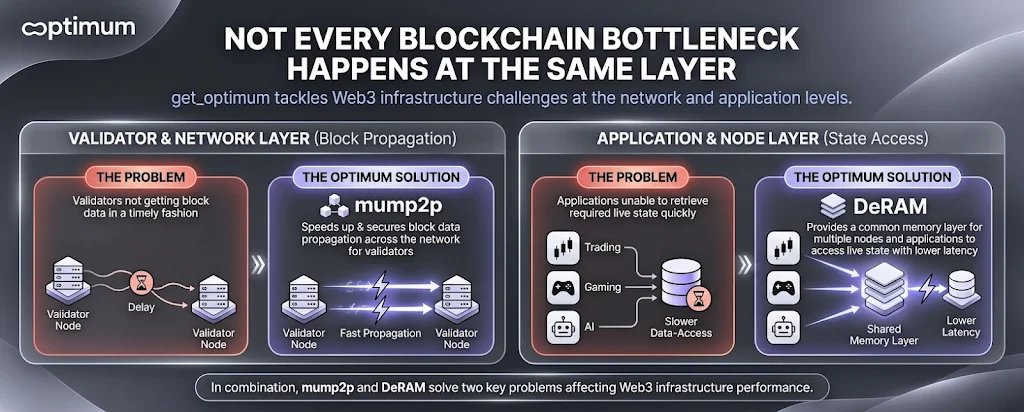
Not every blockchain bottleneck happens at the same layer.
There are times when validators are not getting data from blocks in a timely fashion. In other scenarios, applications are unable to utilize the state that they require without using slower data-access systems.
These challenges are being tackled by two products from @get_optimum.
mump2p focuses on block propagation. It speeds up propagation of block data across the network for validators, and makes it more reliable.
DeRAM focuses on application-level state access. It aims to provide a common memory layer for multiple nodes/ applications to access live state with lower latency.
It is significant to differentiate.
One is used to speed up the transmission of information among validators. The other seeks to make applications more efficient in accessing common data.
In combination, they solve two problems that affect the performance of Web3 infrastructure.
Below is a very easy to understand map of the products that fit in each location.
@get_optimum@discordflash@TheBl0ckBoy
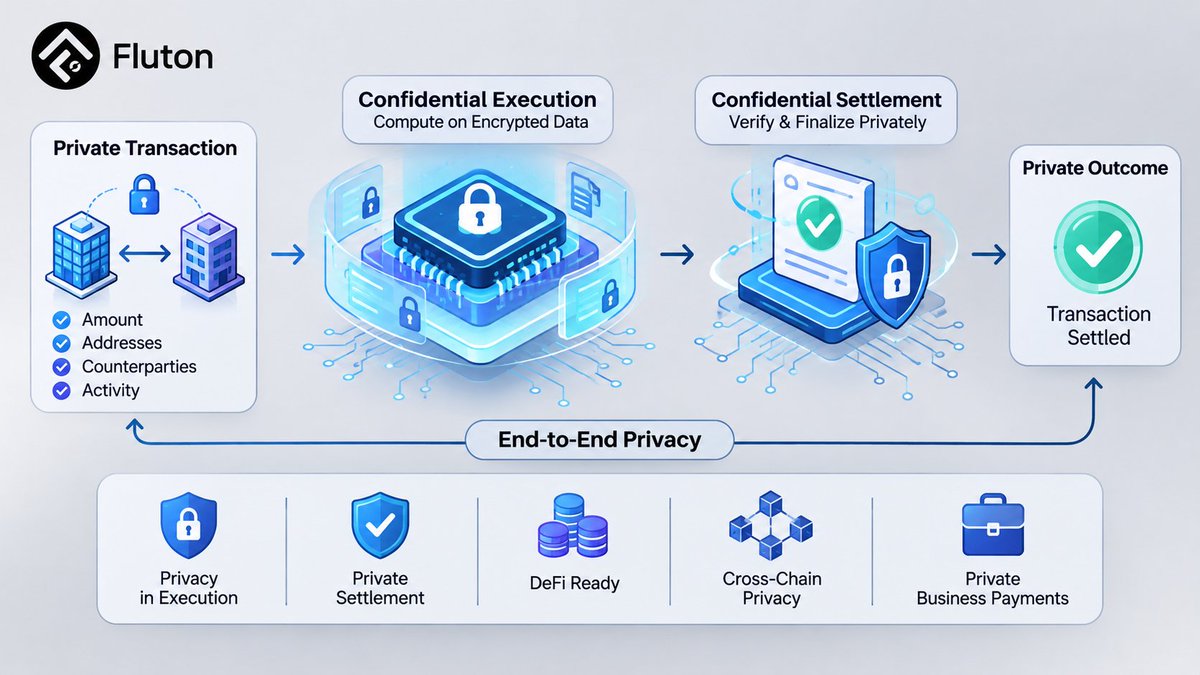
If the details of a transaction are sensitive and become known when the transaction is settled, the transaction is not really private.
Confidential execution of transactions ensures that transaction data remains confidential during the process. There does need to be a level of privacy that carries over to the computation, however. The final settlement is also important since this is where the network needs to identify and close the deal without unnecessarily revealing the information that led to the conclusion.
In most traditional blockchain environments, settlement typically is based on public transactions. Information regarding amounts, wallet addresses, counterparties and transaction activity may appear during verification and finalization. This leaves a chip short from private implementation to clear settlement.
The challenge is addressed by FlutonIO's Confidential Settlement Layer.
For Fluton, the concept of settlement is not a standalone process, therefore, there is a strong emphasis on maintaining confidentiality along the entire lifecycle of a transaction. The Fully Homomorphic Encryption (FHE) is used to perform operations on encrypted data without revealing the data itself, so that computation happens without any modification of the data.
If a confidential execution does result in a settlement, the next step in the settlement process must be to make sure the desired operation is completed properly without exposing sensitive transaction details.
This is a distinction that is significant. Execution refers to what happens to the transaction, settlement to the successful outcome of the transaction. Without privacy at the second state, the protection during execution becomes of little value.
Consider a private payment between two businesses. The network must confirm the payment and acknowledge that it's finished. However, the businesses might prefer not to reveal the quantity of transactions, financial ties, or payment information to all network viewers.
A settlement scheme that respects privacy tries to tackle this by splitting the data that is necessary for an operation to settle from the data that should stay confidential.
This provides a more comprehensive privacy solution on-chain, not just in the computational sense. It works during execution and settlement, and enables applications to interact with blockchain infrastructure without revealing all financial information.
This architectural difference is especially significant for decentralized finance (DeFi) and cross-chain applications, as well as payments for businesses. A single point of transaction processing is not sufficient for privacy. It must be consistent throughout its life from the start to its conclusion.
This is the way that @FlutonIO is going: bringing confidentiality to the core of how Web3 transactions are processed and confirmed.
@cryptoperseus_
The only time an encrypted intent can be of any assistance is if it can be carried out without revealing the strategy. The true test of this intent only starts once it must be understood, matched and fulfilled in multiple protocols and chains.
When making a transaction flow, the user has to often write the steps himself, to communicate with several protocols, to compare available routes, and to deal with the complexity of making an operation. This process can reveal the sensitive information regarding their intended actions, trading strategies, and parameters associated with transactions.
The Fluton Solver Network offers another way to do the execution process.
Encrypted intents provide a way for the user to specify the desired action without revealing any sensitive information, as all the components of an intent are not managed by the user but are delegated to the appropriate devices. The solver network is the layer that is responsible for finding appropriate means to achieve those ends.
Once a user enters a message that specifies an intent, the process starts by learning the intent, looking for possible execution paths, and interpreting the requested outcome. Solvers can work with the team to find suitable routes, assess opportunities and coordinate the operations required to accomplish the desired operation.
Important point: the user doesn't have to make the intention public in order to proceed with the execution procedure. Fully Homomorphic Encryption (FHE) means that computations can be performed on encrypted data without releasing the information to anyone.
This sets the groundwork for privacy-preserving execution. Sensitive parameters can be kept while the system is being brought to a desired result by the user.
Think about cross-chain swap. A user desires to trade in assets between two networks, but have no wish for anyone to see what they wanted to trade and their preferred network, or even their transaction details. The execution path can be coordinated by the solver network and the information itself is protected by Fluton's confidential infrastructure.
This architecture also allows opportunities other than swaps. Encrypted intents can also facilitate payments that can be paid confidentially, bridging, and more advanced multi-step actions in which the action needs to be coordinated between different protocols.
The greater change is taking place at the transaction level. Users should be able to tell what they're looking for rather than revealing all the steps they will take to do it.
This is what we are striving for at @FlutonIO - to make intent based execution more intelligent, coordinated and private, with our Solver Network and confidential execution infrastructure.
@cryptoperseus_
Not every blockchain bottleneck happens at the same layer.
There are times when validators are not getting data from blocks in a timely fashion. In other scenarios, applications are unable to utilize the state that they require without using slower data-access systems.
These challenges are being tackled by two products from @get_optimum.
mump2p focuses on block propagation. It speeds up propagation of block data across the network for validators, and makes it more reliable.
DeRAM focuses on application-level state access. It aims to provide a common memory layer for multiple nodes/ applications to access live state with lower latency.
It is significant to differentiate.
One is used to speed up the transmission of information among validators. The other seeks to make applications more efficient in accessing common data.
In combination, they solve two problems that affect the performance of Web3 infrastructure.
Below is a very easy to understand map of the products that fit in each location.
@get_optimum@discordflash@TheBl0ckBoy
What if a number of nodes want to access the same data but do not rely on a single machine with a large cache to store and provide access to all the data?
This is one of the main concepts behind DeRAM from @get_optimum.
Chain-based systems typically use different storage and retrieval systems. Applications often rely on RPC calls, external storage, or communication between multiple nodes when they require shared state. This adds to overhead if several users are trying to access the same information.
A multi-object shared memory model is a different approach taken by DeRAM.
The idea is to break away from the concept of memory being a resource of a single machine and make it available as a shared resource for multiple nodes. Every object can be shared network-wide, providing a more distributed means of using state in an application.
What is interesting is that the system determines where those objects are going to reside.
Consistent hashing provides assistance for placing an object on the nodes that are participating. The network can identify which nodes have specific data by mapping objects to positions on a distributed hash space. This allows for a more organized distribution and for node join and leave to be managed.
Another problem is that distributed networks cannot rely on each and every node being correct or on it being available at all times.
This is where Random Linear Network Coding (RLNC) comes in. Information may be transmitted as coded combinations rather than relying on each individual data item being transmitted exactly as expected. Nodes can reconstruct the original data from enough independent coded data, even if some of the data is lost or some nodes are unreliable.
All of these concepts converge to a common vision of distributed-data placement, fault-tolerant data retrieval, and non-perfectly reliable nodes in a distributed-memory infrastructure.
The DeRAM concept is a fascinating area as it suggests that blockchains and decentralized applications could tap into shared state data more effectively than traditional data retrieval methods.
@get_optimum@discordflash@TheBl0ckBoy
Building a Web3 application shouldn't require developers to solve the same infrastructure challenges over and over again.
Cross-chain interactions, intent creation, quote collection, transaction execution and monitoring can rely on several integrations and complex backend systems. The more components there are to add the more development overhead and the overall architecture becomes more difficult to manage.
The challenge is being taken on by @FlutonIO through its developer-focused toolkit, called the Fluton SDK.
The SDK offers a standardised approach to embed privacy-focused capabilities into Web3 applications. The cross-chain bridging, intent-based execution, and other confidential transaction features allow the developers to interact with them without having to develop each of the underlying components individually.
This frees up development teams to put in more work on application design and less on infrastructure management, allowing them to achieve higher user satisfaction with their applications.
Among the various aspects of blockchain infrastructure, developer experience will be one of the most crucial for the next wave of Web3 adoption.
To improve the accessibility of confidential execution at the development layer, @FlutonIO aims to develop a new solution.
@cryptoperseus_
Yield farming ought to be rewarding your approach and not risking your approach to the whole market.
Traditional DeFi farming can expose wallet balances, transactions, liquidity, and investment strategies. This visibility opens the door for rivals to track where you are at and respond to market action.
A privacy first solution for yield execution on @FlutonIO with confidential execution and Fully Homomorphic Encryption (FHE) to safeguard sensitive financial data.
This allows for more strategic allocation of capital and less disclosure of trading strategies and tighter control over financial activity.
Private yield farming is not all about lying numbers. It's a matter of letting users control capital without communicating all the choices.
@cryptoperseus_
Can you prove it without revealing it?
With @primus_labs , protocols and AI agents can verify data, status, and actions—without exposing the private information behind them.
Trusted decisions don’t require public secrets.
Verify data. Protect privacy. Trust the action.
@KaitoAI
#Primus #zkTLS #Privacy #Web3 #DeFi #AIAgents
Bitcoin leverage isn't difficult to access. The difficult part is finding a structure that makes sense to hold.
I've been reading through @2FactorFinance's research on Kelly-optimized leverage, and the 1.33x Bitcoin target caught my attention.
Not because 1.33x sounds particularly ambitious. Quite the opposite.
Most leverage products are built around how much exposure you can take. 2Factor is approaching a different question: how much additional exposure can you reasonably maintain over time?
I spent some time looking into the mechanics. Here's what I found interesting.
01 / Being right about Bitcoin isn't always enough
Consider a simple hypothetical example:
• $BTC falls 20%, then recovers 25%.
• An unleveraged position returns to its starting value.
• A daily-reset 2x position falls 40%, then gains 50% on the remaining balance.
• Final result: down 10%, before financing costs.
That's volatility drag.
This isn't a simulation of 2Factor, but it illustrates a problem with maintaining leveraged exposure over time.
The price can recover while the leveraged position remains underwater.
02 / Why Kelly sizing matters
The Kelly framework focuses on maximizing expected long-term compounded growth, rather than maximizing exposure to an individual price move.
2Factor's research identifies approximately 1.33x as its target leverage for Bitcoin.
I find the reasoning more interesting than the number.
Beyond a certain point, additional leverage can become counterproductive. Larger drawdowns, volatility and financing costs can outweigh the benefits of greater exposure.
But 1.33x isn't a universal answer.
The calculation depends on assumptions about future returns, volatility and borrowing costs. Change those assumptions, and the optimal exposure changes too.
03 / Why this has traditionally been an institutional strategy
Leverage itself isn't exclusive to institutions.
Efficient financing, disciplined rebalancing and the infrastructure required to maintain a leveraged position over several years are another matter.
Those are areas where institutional investors have historically had an advantage.
2Factor is attempting to package some of that complexity into an onchain structure on Base, designed for people who want to hold Bitcoin rather than actively manage a margin position.
The idea is interesting because it addresses the maintenance of leverage, not simply access to it.
04 / Understanding the two sides
2Factor uses Coinbase Wrapped BTC (cbBTC) and divides the structure into two positions.
• cbBTC-Jr: Targets approximately 1.33x Bitcoin exposure, with junior capital absorbing greater market risk.
• cbBTC-Sr: Provides senior capital and receives yield, with junior capital serving as the first-loss buffer.
One side wants additional exposure. The other provides capital to support it.
This relationship is central to the design.
Instead of depending entirely on conventional margin borrowing or perpetual futures, the protocol connects demand for leverage with demand for a more stable, yield-oriented position.
Neither side is risk-free.
05 / The financing economics
This is where I think the research becomes particularly relevant for long-term holders.
2Factor's documented target ratio is 1 part senior capital to 3 parts junior capital.
At that ratio:
• A hypothetical 9% annualized senior yield
• Corresponds to approximately 3% financing cost for junior capital
• Before additional fees
The rates aren't guaranteed. Funding can change with market conditions and the balance between junior and senior demand.
The research also models a 0.50% annual junior AUM fee, which matters when comparing potential returns.
Leveraged ETFs face their own challenges, including financing expenses, daily resets and compounding effects that can cause returns to diverge from a simple multiple of the underlying asset.
For a long-term investor, financing efficiency isn't a minor detail. It's part of the investment thesis.
06 / What happens during a serious drawdown?
This is probably the most distinctive part of 2Factor's proposed structure.
Under its documented target configuration, cbBTC-Jr holds approximately:
• 1/3 leveraged junior tranches
• 2/3 raw cbBTC
The leveraged tranche component carries roughly 2x Bitcoin exposure, while the raw cbBTC component tracks Bitcoin directly.
Together, they produce the 1.33x target.
During a severe $BTC decline, the leveraged tranche component can be exhausted. But the remaining raw cbBTC doesn't disappear through a conventional margin liquidation.
Exposure can move closer to 1x, with the protocol's rotation mechanism designed to rebuild the target composition over subsequent periods.
That's a meaningful difference from conventional margin leverage.
But it's not downside insurance.
Junior investors can still experience significant losses. Smart contract vulnerabilities, liquidity constraints, execution problems and changing funding conditions remain important risks.
Avoiding conventional liquidation doesn't mean avoiding the financial consequences of leverage.
07 / The Berkshire Hathaway comparison
2Factor references Berkshire Hathaway's historical use of approximately 1.6x leverage.
I think there's a useful principle here, although I wouldn't push the comparison too far.
Berkshire's assets, financing arrangements and business model are fundamentally different from a Bitcoin-based DeFi protocol.
The relevant lesson is about deliberate position sizing.
Moderate leverage can have a place in long-term capital allocation when the financing and risk management make sense.
Whether 2Factor can deliver that kind of efficiency for ordinary Bitcoin holders is something real-world performance will need to establish.
08 / What I'd actually monitor
I like the reasoning behind the structure, but there are still questions I wouldn't overlook.
• How competitive will financing remain during an extended Bitcoin bear market?
• How closely will cbBTC-Jr maintain its target exposure as market conditions change?
• Will the weekly tranche rotation and rebalancing mechanisms remain reliable under liquidity stress?
• How will actual returns compare with simply holding spot Bitcoin after funding and fees?
These are more useful questions to me than focusing on a backtested leverage target alone.
2Factor also plans to explore the approach beyond Bitcoin, including stocks.
That opens up another area of research, since different assets have different return distributions, volatility profiles and financing requirements.
My perspective
I don't think the crypto market needs another reason to take extreme leverage.
What interests me about 2Factor is the effort to treat leverage as a long-term portfolio decision, where position sizing, financing and downside behavior are considered together.
The 1.33x target is worth examining. The junior/senior structure is an interesting way to organize capital. And the approach to conventional liquidation addresses a real problem for buy-and-hold investors.
But the model still needs to prove itself through difficult market conditions.
Good research can explain why a structure might work. Actual performance is what determines whether it's worth holding.
That's the part I'll be following.
If you're interested in exploring the research and the 2Factor Points Program, here's my referral link:
https://t.co/fTLmgunLMj
Disclosure: This is a Rally campaign entry. I may receive benefits from eligible referrals.
Dylan was NOT ready for that bonus!
The reactions, the timing, the unexpected moments. This clip is worth watching till the end.
Would you have been this lucky?
@DylanGG
IShowSpeed breaks down in tears during the emotional final Jason and Lucia scene in GTA VI before completing the game.
He finished the story in just 52 hours, becoming one of the first players to beat GTA VI.
What if a number of nodes want to access the same data but do not rely on a single machine with a large cache to store and provide access to all the data?
This is one of the main concepts behind DeRAM from @get_optimum.
Chain-based systems typically use different storage and retrieval systems. Applications often rely on RPC calls, external storage, or communication between multiple nodes when they require shared state. This adds to overhead if several users are trying to access the same information.
A multi-object shared memory model is a different approach taken by DeRAM.
The idea is to break away from the concept of memory being a resource of a single machine and make it available as a shared resource for multiple nodes. Every object can be shared network-wide, providing a more distributed means of using state in an application.
What is interesting is that the system determines where those objects are going to reside.
Consistent hashing provides assistance for placing an object on the nodes that are participating. The network can identify which nodes have specific data by mapping objects to positions on a distributed hash space. This allows for a more organized distribution and for node join and leave to be managed.
Another problem is that distributed networks cannot rely on each and every node being correct or on it being available at all times.
This is where Random Linear Network Coding (RLNC) comes in. Information may be transmitted as coded combinations rather than relying on each individual data item being transmitted exactly as expected. Nodes can reconstruct the original data from enough independent coded data, even if some of the data is lost or some nodes are unreliable.
All of these concepts converge to a common vision of distributed-data placement, fault-tolerant data retrieval, and non-perfectly reliable nodes in a distributed-memory infrastructure.
The DeRAM concept is a fascinating area as it suggests that blockchains and decentralized applications could tap into shared state data more effectively than traditional data retrieval methods.
@get_optimum@discordflash@TheBl0ckBoy
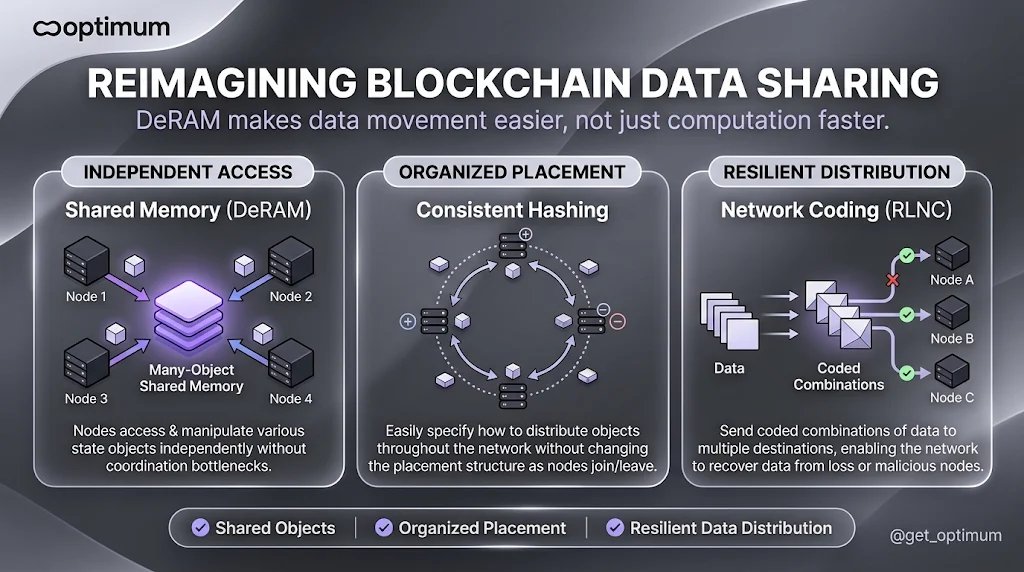
One of the most basic problems of a blockchain is still surprisingly difficult: sharing data between nodes.
Consider multiple nodes sharing the same state. Someone must read an object, someone must make changes to it and others must have access to the most up to date information about it. If each node requires individual pieces of information and transfers, then coordination becomes a limiting factor.
The idea behind @get_optimum's DeRAM is one of many-object shared memory.
DeRAM's intent is to make each node's data access an independent function rather than a shared memory environment to access and manipulate various state objects.
The next challenge is to determine where each object should go. Consistent hashing is where it comes into play. It is useful to specify how to place objects throughout the network and to distribute data into the network between nodes, without having to change the placement structure every time nodes join or leave the network.
The other problem is that networks are not 100 percent reliable. During data transmission, there is the possibility of data being lost and some nodes may be malicious.
In this regard, deRAM introduces a novel method—Random Linear Network Coding (RLNC). Data need not be transmitted from one destination to another in a single copy, but may be sent to multiple destinations in coded combinations. This enables the network to recover data even if it experiences data loss and a certain amount of malicious activity.
These are all the ideas that coalesce into a different way to access data that is decentralized: Shared objects, Organised placement, and More resilient data distribution.
The other direction of @get_optimum is to make it easier to move data between nodes than to speed up computation, not to make computation faster.
@get_optimum@discordflash@TheBl0ckBoy