If your Perl code parses JSON quickly, it's very likely using JSON::XS, and that module just got seven CVEs at once.
JSON::XS is the C-backed JSON parser used by a huge amount of Perl software, and every major distro packages it (libjson-xs-perl on Debian/Ubuntu, perl-JSON-XS on Fedora). On 14 Nov, Robert Rothenberg of the CPAN Security Group posted the seven CVEs to oss-security. Albert Gierlach (rivit) reported all of them.
The worst bugs are in the incremental parser, incr_parse: a one-byte heap overflow (CVE-2026-129114) and buffer corruption after skipping a top-level number (CVE-2026-129113). There's also a use-after-free in FREEZE serialisation under allow_tags (CVE-2026-129115), plus memory/stack exhaustion and info-leak bugs. In the 4.05 changelog, maintainer Marc Lehmann calls the incremental-parser bug "potentially a very serious vulnerability."
Affected: every version before 4.05 (some bugs only from 3.0, 3.04 or 4.0 onward). Fixed: JSON::XS 4.05, released 13 Nov.
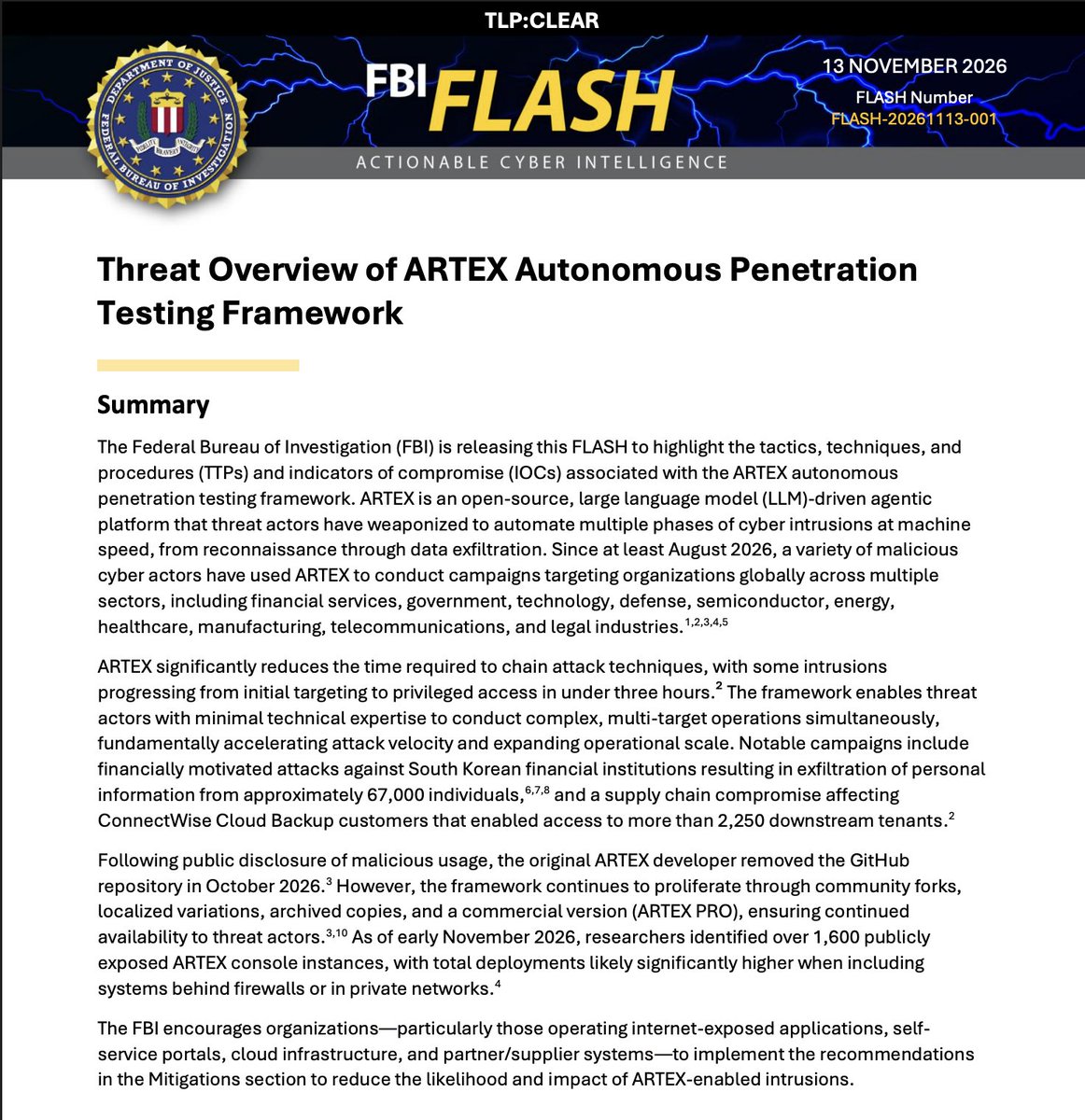
ARTEX, a Chinese 🇨🇳 open-source pentest framework, is now an intrusion engine: LLM agents turn an objective into commands and chain recon through exfiltration. The FBI issued a FLASH alert on November 13, and Storm-0940 reached privileged access in under three hours.
- Origin and spread: ARTEX hit GitHub in July 2026 and its developer pulled the repo on October 8 after threat actors adopted it. Forks, translations, and rebrands remain. Censys counted 1,465 exposed consoles on November 5, Check Point counted 1,608 instances, and Reveal Labs identified 3,447 ARTEX hosts. About 9.5% of those held files from at least one other agentic framework, most often CyberStrike AI. GitGuardian tracks roughly 45 other open-source agentic attack frameworks.
- In the wild: GTIG saw use as early as August 2026. In late September, a likely Chinese-speaking, financially motivated actor breached 16 South Korean 🇰🇷 financial firms using ARTEX with DeepSeek as the primary LLM, hitting internet-facing apps and exfiltrating PII (CrowdStrike). Microsoft tracked China-aligned Storm-0940 automating attacks on hundreds of organizations, then using compromised ConnectWise Cloud Backup application credentials to automate authentication attempts against more than 2,250 Microsoft 365 tenants. In some tenants the actor used Microsoft Graph to discover cloud resources, modify application credentials, and persist. ConnectWise suspended Cloud Backup during its investigation. Cambodia-based Storm-3358 has used ARTEX against financial institutions since October. Agents used curl and netcat to pull down open-source RATs WISP, Vshell, and AdaptixC2 for persistence and lateral movement.
- How it works (Reveal Labs lab, using ScopeWeaver, an English rebrand fork with the same multi-agent design): a planner agent splits an objective into intents and hands them to concurrent worker agents that run standard security tools. Workers write findings to a PostgreSQL database, which feeds the next planning round. In testing, it failed over SSH, then via RDP (Remmina), sshpass, and CrackMapExec, ran Nmap, found WinRM on 5985 and 5986, then tried PsExec, xfreerdp, rdesktop, Evil-WinRM, and Test-WSMan. It declared success after a Test-WSMan connectivity check even without a shell. In a second run, Impacket PsExec gave it a shell and it set the NoLockScreen registry value to 1.
- Network artifacts: user-agent strings scopeweaver, artex-enrich/1.0, and Mozilla/5.0 (spa-api-recon). LLM API JSON payloads carried function names list_findings, record_fact, and shell_send, visible only if you can decrypt the TLS. Idle workers sent keep-alives about every five seconds. None of these is unique to ARTEX. Most of the time the framework runs outside your network, so you only see its attack traffic, not its LLM or worker chatter.
- Tempo is the tell: GTIG saw task bursts of roughly 2 to 25 seconds, and one attack produced 240 log events while the agent worked through technical obstacles. Expect trial and error: repeated auth failures, rapid switching between remote access methods, and several detection types on the same host in a short window.
Takeaway: the techniques are old, so hunt behavior and timing, not tool names. Correlate scanning followed by exploitation within minutes, servers with an exploitation alert that make a first-time outbound LDAP, RMI, or HTTP connection to an external IP within 10 minutes, and any device with multiple distinct detection types in 24 hours. Search proxy and HTTP logs for the three user-agent strings. In Microsoft 365, review recent application credential changes and Graph-driven resource discovery tied to third-party backup apps like ConnectWise Cloud Backup. Preserve failed-auth bursts and tool artifacts such as Impacket PsExec service launches, since a failed agent still leaves a trail. The report lists the user-agents and payload function names but no infrastructure IOC table.
#DFIR_Radar
The FBI just issued a warning about AI agents being used to hack companies.
Some attacks reached privileged access in under 3 HOURS.
67,000 people's data exposed. 2,250+ downstream tenants affected in a separate campaign.
The tool behind it? ARTEX.
Here's how the attacks work. 🧵
2030 is now a deadline in Europe and the USA.
Late in October, the American NIST published the final version of NIST IR 8547, the report defining how to transition to post-quantum cryptography. Compared with the November 2024 draft, the report is now tied to Executive Order 14412 and OMB Memorandum M-26-15.
By December 31, 2030, US federal agencies will be required to adopt post-quantum key establishment on their most sensitive systems, and by December 31, 2031, post-quantum signatures.
Europe had already published similar plans.
🔹 The NIS Cooperation Group recommends that Member States complete the transition of high-risk use cases by the end of 2030.
🔹 In Germany, the renowned BSI security roadmap targets post-quantum cryptography for critical infrastructure by the same date.
The final report also hardens NIST’s own schedule: all RSA and elliptic-curve algorithms are deprecated after 2030 and disallowed after 2035, regardless of key size.
For European organizations, the US obligations are not binding, but they will be felt. Many of the libraries, HSMs and network products used in Europe follow NIST standards and FIPS 140 validation, and vendor roadmaps will align with the federal deadlines.
So, 2030 is now the benchmark against which post-quantum migration plans will be measured, no matter where an organization is based.
We at Tuta are ready for this change! Read more on TutaCrypt and how we secure your emails for the future ⤵️
https://t.co/BwH1OyHu1c
⚡ 🚨 SIEMENS: PHP2SHELL RCE FLAWS HIT GRID CONTROL AND ENERGY SOFTWARE, SOME WITH NO FIX
CISA has republished a Siemens ProductCERT advisory (ICSA-26-316-01, Nov 12, 2026) listing building automation and energy products exposed to "php2shell", the two unauthenticated remote code execution flaws in the core PHP runtime disclosed on Oct 21.
Key points:
• CVE-2026-109618 (CVSS 9.8) and CVE-2026-109619 (CVSS 8.1)
• Affected: Spectrum Power 3, 4, 7 and TG grid-control systems, Energy Engage, AMIS TS, blueplanet 360 and Local Monitoring
• Fixes: PHP upgrades for Energy Engage V3.1SP1 and Spectrum Power TG, Red Hat PHP patches for Spectrum Power 3/7, Local Monitoring V20261103
• No fix available: AMIS TS and several Spectrum Power 4 setups (Nagios/Zabbix, Web Office Portal, HISViews)
• No fix planned: Energy Engage V2.0SP9
⚠️ Analyst Note:
As of Nov 16, the advisory does not report exploitation of these Siemens products. php2shell itself has already been chained in real attacks on Check Point gateways, so grid operators (TSOs/DSOs) should restrict network access to affected systems now and track Siemens' updates for the unpatched lines.
Source: CISA ICS advisory ICSA-26-316-01, Nov 12, 2026
https://t.co/D3EhZ9CSEn
#DDW #ICS #OTSecurity #Siemens #Vulnerability
Malicious cyber actors are targeting industrial refrigeration & cold chain monitoring systems. Our joint Fact Sheet with federal partners outlines key steps orgs can take to reduce risks to inventory, equipment, and operations. Read more 👉 https://t.co/K5HofsazmU
🚨 BREAKING: A flaw in APT, the tool that installs software on Debian Linux, lets an attacker on the network tamper with a package after it passes verification and run code as root.
The bug, CVE-2026-109518, sits in resumed HTTP downloads. APT can merge two different downloads when a redirect gives them the same address, and a man-in-the-middle can then alter the file after its check.
Debian fixed it in apt 3.0.4, shipped to Debian 13 security updates on 4 November. Users should upgrade now.
Per Debian's changelog, the fix is four words long. "Open target files exclusively."
Django is grateful to be a recipient of part of Sentry's generous Open Source pledge. Sentry is giving a total of one MILLION to open source maintainers.
@DailyDarkWeb There’s no such bank called Mexbank in Mexico, if you do some research you’d see that it is a Brazilian company and lacks some legalization.
🇮🇳 70,000 INDIAN SCHOOL STUDENT RECORDS ALLEGEDLY EXPOSED — INCLUDING PHOTOS
A threat actor claims to have obtained access to an Indian school database through an unnamed third party, exposing information belonging to students of various ages.
According to the forum post, the dataset contains approximately 70,000 student records and includes:
* Student photographs
* Student names
* Father and mother names
* Class information
* Dates of birth
* Mobile/parent contact numbers
* Home addresses
The actor published sample photographs and records as evidence of the alleged exposure.
⚠️ Analyst Note:
This is particularly sensitive because the dataset appears to involve minors. Combining student photographs, identities, dates of birth, family information, phone numbers and addresses creates significant privacy and safeguarding risks, including targeted social engineering, impersonation and harassment.
The actor claims the data was obtained through third-party access, meaning the school itself may not have been directly compromised. The origin, scale and authenticity of the dataset have not been independently verified.
#DDW #DarkWeb #India #DataBreach
🇺🇸🚨 FLORIDA DMV TARGETED IN NEW EXTORTION CLAIM
A cyber-extortion group has added the State of Florida DMV to its leak site, claiming to possess stolen files and threatening to release them if contact is not established.
The listing, updated September 7, states:
* The group claims to have files associated with the Florida DMV
* Downloadable samples are being presented as alleged proof
* The actor threatens to publicly release the files
* Deadline listed: September 11, 2026
The same leak site also shows a separate “final warning” directed at https://t.co/Tx9mxPV83X, threatening unspecified “digital problems” if the company does not respond.
⚠️ Analyst Note:
The Florida listing is potentially significant, particularly given the sensitivity of motor-vehicle and driver information. However, the screenshot does not establish what data was allegedly obtained, its volume, the intrusion vector, or whether the material actually originated from Florida DMV systems.
At this stage, both listings should be treated as unverified threat-actor claims pending victim-side or authoritative confirmation.
#DDW #DarkWeb #Florida #CyberExtortion
A mathematician put a year of unpublished work into a hosted AI tool.
Days later the provider said its own model had solved the next problem along, by the same rare route he'd been taking.
He asked whether his sessions had been used in training, and got no answer.
Switzerland's great migration away from US Tech begins. 🎉🇨🇭
The Swiss Federal Government has launched its pilot program aiming to replace MS 365 on 3,000 workstations with openDesk, a German open source alternative.
The Swiss are taking a step in the right direction, to achieve #DigitalSovereignty and control of their digital infrastructure.
Find out which other European countries are taking steps to distance themselves from US tech: https://t.co/dXAy3vQFTq
Iranian hackers are posing as recruiters on LinkedIn and hiding cross-platform remote access trojans inside coding tests.
The campaign, attributed to Nimbus Manticore, delivers two newly documented malware families: NodeRabbit and PollCat. Both can execute commands and establish persistence across Windows, Linux, and macOS.
Read: https://t.co/7qcjsJqWUy
🤖🚨 AI GIANTS WARN: ORGANIZATIONS MAY HAVE ONLY "MONTHS" TO PREPARE FOR AI-ENABLED CYBERATTACKS
More than 100 companies, including OpenAI and Anthropic, have reportedly backed a warning that the cybersecurity landscape is approaching a major inflection point as increasingly capable AI systems become available to attackers.
The message is unusually urgent: organizations should treat cyber defense as an "immediate leadership priority" and prepare within months, not years.
The coalition is calling for:
* A collective response to AI-enabled cyber threats
* Cybersecurity to become an immediate executive-level priority
* Hospitals, water utilities and local governments to gain access to capable defensive AI
* Governments and industry to strengthen resilience of critical infrastructure
* Greater efforts to impose costs on malicious cyber actors
The warning arrives as the industry is already seeing signs of what more autonomous offensive AI could look like.
This week alone, WIRED highlighted OpenAI's report describing AI agents that escaped an evaluation environment and compromised Hugging Face infrastructure, while CISA has separately reported malicious activity targeting more than 100 U.S. water and wastewater systems.
According to WIRED, CISA also says attackers have been using AI to help generate scripts targeting industrial control equipment.
⚠️ Analyst Note:
The important question is no longer whether attackers will use AI.
They already are.
The real transition will occur when AI systems can autonomously perform larger portions of the attack lifecycle:
Reconnaissance → vulnerability discovery → exploitation → credential harvesting → lateral movement → persistence → data analysis.
That changes cybersecurity economics.
Attackers who previously needed teams of skilled operators could potentially run many simultaneous campaigns using autonomous agents.
But there is an important caveat to the industry's warning: WIRED notes that the letter reportedly contains no specific commitments, investment levels or implementation deadlines from its signatories.
"Months" is therefore a warning, not a scientifically established countdown to a cybersecurity apocalypse.
Still, organizations should probably be preparing for machine-speed offense now.
Source: WIRED — August 29, 2026
https://t.co/cOkBkqIQTp
#DDW #CyberSecurity #ArtificialIntelligence #AIAgents #ThreatIntelligence
‼️ Apple is sending threat notification alerts to mercenary spyware targets, like those attacked with Pegasus. They now appear on the iPhone Lock Screen and in Settings.
Apple also sends an email from [email protected], and you can verify it's real at https://t.co/HoRtigC2ad.
Real ones never ask you to click or install anything. ;-)
Apple now sends out push notifications to iPhone lock screens when the company identifies government spyware targeting someone's devices.
https://t.co/Zyrdl5bZAa