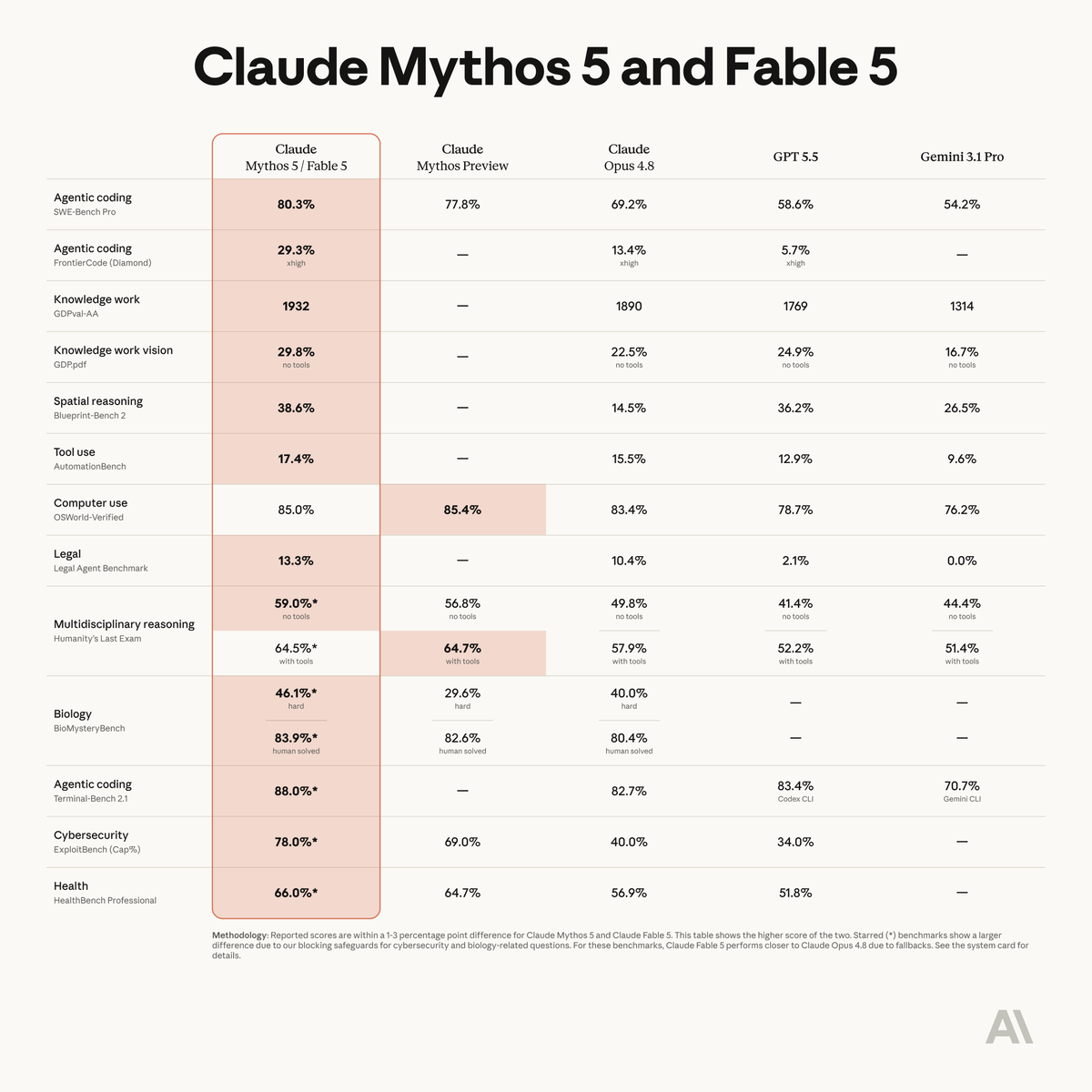
Fable 5 is state-of-the-art on nearly all tested benchmarks, with exceptional performance in software engineering, knowledge work, scientific research, and vision.
The longer and more complex the task, the larger Fable 5’s lead over our other models.
if you’re still building meta agents that prompt loops you’re falling behind. you need to build a prefrontal thought harness that infers what meta agents you would have wanted based on your vibe and then write those meta agents
if you’re still writing loops that prompt coding agents you’re falling behind. you need to build a meta agent that infers what loops you would have wanted based on your vibe and then write those loops
With Strategy currently at a $10B+ unrealized loss, a convo like this could go deeper into what's to come for the future of Bitcoin. I'd love to see it!
Joe Rogan has talked about Bitcoin before.
He has mentioned it across episodes.
He hosted early Bitcoin explainers.
He gave the topic room before most mainstream media took it seriously.
But Bitcoin has changed.
ETFs.
Corporate treasuries.
Retirement access.
Institutional adoption.
Sovereign reserve debates.
And Joe still hasn’t talked to Michael Saylor.
The man whose company owns more Bitcoin than anyone on earth.
That’s the missing conversation.
Vote for Michael Saylor × Joe Rogan:
https://t.co/Z9vhcUkmdX
@saylor@JoeRogan
Joe Rogan has talked about Bitcoin before.
He has mentioned it across episodes.
He hosted early Bitcoin explainers.
He gave the topic room before most mainstream media took it seriously.
But Bitcoin has changed.
ETFs.
Corporate treasuries.
Retirement access.
Institutional adoption.
Sovereign reserve debates.
And Joe still hasn’t talked to Michael Saylor.
The man whose company owns more Bitcoin than anyone on earth.
That’s the missing conversation.
Vote for Michael Saylor × Joe Rogan:
https://t.co/Z9vhcUkmdX
@saylor@JoeRogan
One year ago today @saylor asked @JoeRogan to talk Bitcoin.
Rogan still hasn't responded.
In that year:
- Bitcoin hit a new all-time high at $126,198
- Crashed 50% in 4 months
- The US government created a Bitcoin reserve
- Harvard's endowment started buying Your 401(k) can now hold it
- Saylor bought $20B more without selling a single coin
Here’s everything that happened while Joe Rogan stayed silent 👇
The AI ponzi scheme goes like this:
Everyone is generating all these long ass docs and then passing them off for others to read
Then the person receiving is like, wtf this is way too long, and hands that into an AI to read and summarize
Then they are generating a long ass response back
and this cycle goes like that forever. and we call this work now 😅
The token lords watch this from their towers nodding and grinning.
Automation is a lie. CLIs are over. The SaaSpocalypse is dumb.
A year ago @danshipper came on the podcast to predict where AI was heading. He was remarkably right—including the call that everyone was sleeping on Claude Code.
Dan has a unique lens into where things are going because his team at @every is possibly the most AI-pilled group of people in tech. I always learn a ton talking to Dan.
So I brought him back for round two. We'll score these in exactly a year:
🔸 Every company will have one “super-agent” in Slack.
🔸 Codex and Claude Code will become the new operating system for knowledge work.
🔸 The AI job apocalypse is not happening.
🔸 PMs and designers will thrive.
🔸 We will read way more AI-generated writing and we will like it.
🔸 "I would buy SaaS stocks right now."
Listen now 👇
https://t.co/wzxQ5bz49h
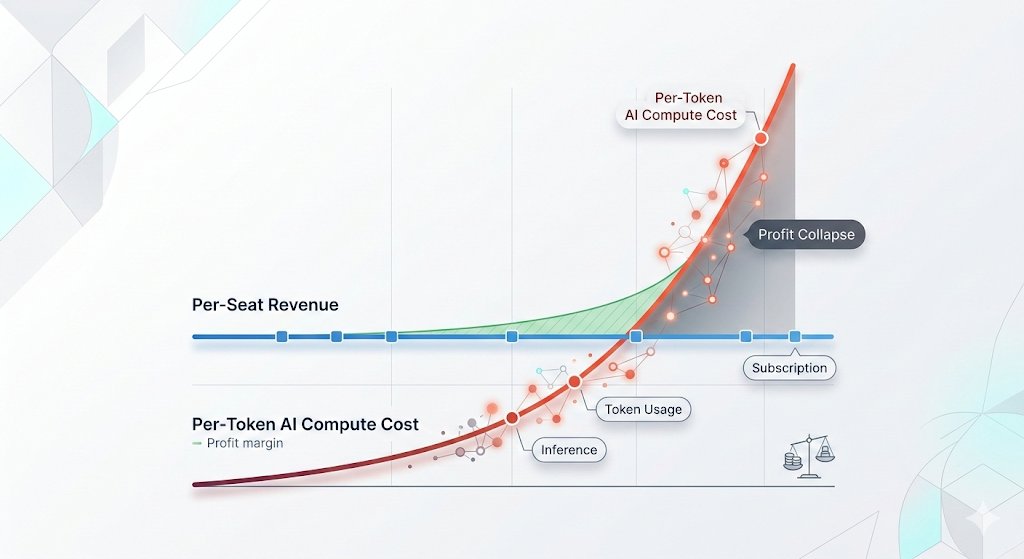
🦔Microsoft canceled its internal Claude Code licenses this week after token-based billing made the cost untenable, even for a company with effectively infinite cloud resources. Uber's CTO sent an internal memo warning the company burned through its entire 2026 AI budget in just four months. American AI software prices have jumped 20% to 37%, and GitHub (owned by Microsoft) is dropping flat-rate plans for usage-based billing across its products.
My Take
The AI subsidy era is ending in real time. The same company that put $13 billion into OpenAI and built the Azure infrastructure powering most of Anthropic's compute just looked at the bill from a competitor's coding tool and decided it was not worth paying. That is not a productivity failure on Anthropic's end. Token-based pricing is forcing every enterprise customer to confront the actual cost of running these models at scale, and the number turns out to be far higher than the flat-rate experiments suggested.
This ties directly to my Gemini Flash post yesterday. Anthropic, OpenAI, and Google all raised effective prices in the last six months. Enterprises that built workflows assuming AI costs would keep falling are now watching annual budgets evaporate in months. Two outcomes look likely from here. Either enterprises scale back AI usage to fit budgets, which slows the revenue ramp the labs need to justify their valuations ahead of IPOs, or the labs cut prices and absorb the losses, which makes the unit economics worse at exactly the wrong moment. Both paths land in the same place, the numbers stop working, and somebody has to take the writedown.
Hedgie🤗
LEAKED AUDIO: In an all-hands meeting on April 30, Mark Zuckerberg tells employees that he's training AI on them ahead of mass layoffs.
"The AI models learn from watching really smart people do things... The average intelligence of the people who are at this company is significantly higher than the average set of people that you can get to do tasks.
So if we're trying to teach the models coding, for example, then having people internally build tools or solve tasks that help teach the model how to code, we think is going to dramatically increase our model's coding ability faster than what others in the industry have the capability to do, who don't have thousands and thousands of extremely strong engineers at their company."
You shouldn’t be trying to do more in each day, trying to fill every second with a work fidget of some type. It took me a long time to figure this out. I used to be very fond of the results-by-volume approach.
Being busy is most often used as a guise for avoiding the few critically important but uncomfortable actions. The options are almost limitless for creating “busyness.”