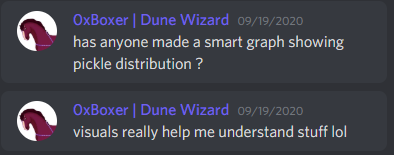
I just stumbled across my origin story of how I started working on @DuneAnalytics and I think a lot of you degens can follow in my footsteps...
A thread on starting to work in DeFi and on @DuneAnalytics
Our podcast posted this warning from @donnoh_eth on the DVN set up of LayerZero bridge risks 2 months ago
The LayerZero Risk Explorer:
https://t.co/WDSpnFmJKK
🚨NEW EPISODE🚨
The Hidden Risks of Crypto Bridges
Today we’re joined by @donnoh_eth, Head of Research @l2beat, to dive deep into interoperability, bridging risk, and the hidden trust assumptions behind cross-chain assets.
In this episode we’re discussing:
- Luca’s background and path into crypto
- The L2 roadmap debate and @ethereum's direction
- The new L2BEAT interoperability dataset
- Research goals behind the interop dashboard
- Lock & mint vs burn & mint bridges
- Intent-based bridging and counterparty risk
- Liquidity providers and bridge execution risk
- Canonical vs non-canonical tokens
- Wrapped asset systemic risk
- Multi-chain token configurations (LayerZero-style)
- Bridge exploits and historical failures
- The future of rollups, shared stacks & competition
And much more—enjoy!
—
Timestamps:
(00:00) Introduction
(01:05) Luca’s crypto background
(04:36) Latest L2BEAT project
(13:20) Rollup value proposition
(16:08) L2 roadmap hot takes
(20:22) Interop dataset overview
(23:19) Research goals explained
(29:45) Non-mint bridging model
(35:24) Lock & mint mechanics
(38:47) Non-issuer token bridging
(44:31) Bridge aggregator UX
(52:12) Risky token examples
(57:03) Multi-chain failure risks
(1:01:12) Closing thoughts
had a great convo with @donnoh_eth, Sheriff of the L2s about the future of L2s and the risks of bridges and interop.
Super interesting learnings from someone that has been in the engine room for the layer2 ecosystem for the last couple years.
Thanks for coming on @donnoh_eth
🚨NEW EPISODE🚨
The Hidden Risks of Crypto Bridges
Today we’re joined by @donnoh_eth, Head of Research @l2beat, to dive deep into interoperability, bridging risk, and the hidden trust assumptions behind cross-chain assets.
In this episode we’re discussing:
- Luca’s background and path into crypto
- The L2 roadmap debate and @ethereum's direction
- The new L2BEAT interoperability dataset
- Research goals behind the interop dashboard
- Lock & mint vs burn & mint bridges
- Intent-based bridging and counterparty risk
- Liquidity providers and bridge execution risk
- Canonical vs non-canonical tokens
- Wrapped asset systemic risk
- Multi-chain token configurations (LayerZero-style)
- Bridge exploits and historical failures
- The future of rollups, shared stacks & competition
And much more—enjoy!
—
Timestamps:
(00:00) Introduction
(01:05) Luca’s crypto background
(04:36) Latest L2BEAT project
(13:20) Rollup value proposition
(16:08) L2 roadmap hot takes
(20:22) Interop dataset overview
(23:19) Research goals explained
(29:45) Non-mint bridging model
(35:24) Lock & mint mechanics
(38:47) Non-issuer token bridging
(44:31) Bridge aggregator UX
(52:12) Risky token examples
(57:03) Multi-chain failure risks
(1:01:12) Closing thoughts
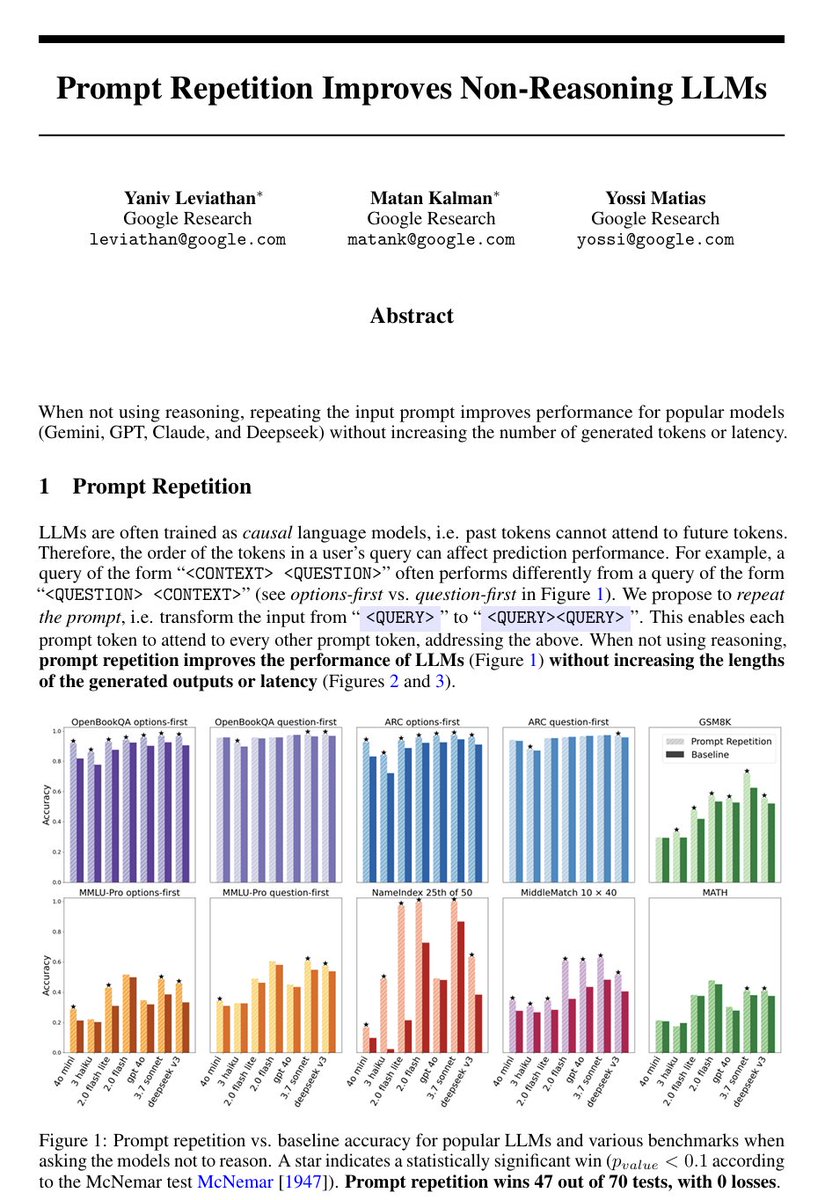
LLMs process text from left to right — each token can only look back at what came before it, never forward. This means that when you write a long prompt with context at the beginning and a question at the end, the model answers the question having "seen" the context, but the context tokens were generated without any awareness of what question was coming. This asymmetry is a basic structural property of how these models work.
The paper asks what happens if you just send the prompt twice in a row, so that every part of the input gets a second pass where it can attend to every other part. The answer is that accuracy goes up across seven different benchmarks and seven different models (from the Gemini, ChatGPT, Claude, and DeepSeek series of LLMs), with no increase in the length of the model's output and no meaningful increase in response time — because processing the input is done in parallel by the hardware anyway.
There are no new losses to compute, no finetuning, no clever prompt engineering beyond the repetition itself.
The gap between this technique and doing nothing is sometimes small, sometimes large (one model went from 21% to 97% on a task involving finding a name in a list). If you are thinking about how to get better results from these models without paying for longer outputs or slower responses, that's a fairly concrete and low-effort finding.
Read with AI tutor: https://t.co/MipHHO6rjX
Get the PDF: https://t.co/XQrqiaGwIO
🚨NEW EPISODE🚨
Who is the leading crypto payment card?
Today we’re joined by @datadashboards, Co-Founder at Paymentscan.
In this episode we’re discussing:
- @Dune as the new frontend for data
- Onchain vs API data confusion
- @Polymarket vs @Kalshi data transparency
- Notional volume vs real volume
- Open interest spikes explained
- Sports dominance in prediction markets
- Data plumbing vs product narratives
- Crypto payment cards landscape
- Privacy tradeoffs in onchain payments
- Stablecoin usage across cards
- Cashback incentives and token risk
- Building https://t.co/dyg1YYZaqn
And much more—enjoy!
🚨NEW EPISODE🚨
Demystifying Prediction Markets Beyond Volume Charts
In today’s episode, we're unpacking what’s really driving prediction markets and how to think about them as information and distribution systems, not just gambling venues.
We discuss:
- @Polymarket vs @Kalshi: onchain vs offchain tradeoffs
- Distribution advantages and partnerships
- Liquidity, market making, and arbitrage dynamics
- Why volume alone is misleading
- Sports betting vs long-duration markets
- Fees, incentives, and wash trading concerns
- U.S. regulation and launch implications
- Prediction markets as news and truth-discovery tools
- The long arc from @AugurProject to today
- And much more—enjoy!
—
Check it out now, here or via the link:
Youtube: https://t.co/uZTkzNwW7K
Spotify: https://t.co/HXlLXUht3p
Apple: https://t.co/oxIhSA6YbX
—
Timestamps:
(00:00) Introduction
(01:50) Prediction markets return
(05:16) Offchain vs onchain
(09:37) Kalshi distribution edge
(13:23) US legality questions
(17:50) Market timing mechanics
(22:19) Market creation debates
(30:19) API delays and arbitrage
(32:55) Liquidity and market makers
(34:27) User growth questions
(36:00) Prediction markets as news
(39:11) From Augur to now
(40:07) Outro
🚨NEW EPISODE OUT NOW: Did @ethereum really solve the trilemma?🚨
In today’s episode, we discuss @VitalikButerin's recent comments on zero-knowledge technology and the scalability trilemma. The three of us unpack what’s actually changed since 2017, how advances like data availability sampling and zkEVMs reshape Ethereum’s execution and verification model, and whether these developments meaningfully alter the decentralization–security–scalability trade-offs.
We discuss:
- Ethereum’s original scalability trilemma
- Why the trilemma existed in 2017
- Ethereum vs Solana trade-offs
- Decentralization vs throughput
- What data availability sampling really does
- BLOBs, L2s, and scaling @ethereum
- zkEVMs and execution offloading
- Prover markets and new supply chains
- Does ZK “solve” the trilemma?
- Trust, security, and financial infrastructure
- @celestia, EigenDA, and DA competition
- Where blockspace actually matters
- Crypto data jobs and hiring trends
And much more—enjoy!
—
Timestamps:
(00:00) Introduction
(02:47) Trilemma explained
(05:23) Ethereum vs Solana
(07:28) ZK tech overview
(09:29) Data availability
(10:48) zkEVM execution
(12:54) Solving trilemma?
(15:03) Trust and security
(20:09) Stablecoins on Ethereum
(25:03) Celestia DA hype
(31:40) Crypto data jobs
(35:02) Job market outlook
(38:09) Outro
If I wasn't already working in the product team of @Dune , I'd join @arno39's GTM team in a heartbeat.
Dune is sitting at the intersection of everything happening in Web3, if you want to contribute to something that matters, helps us make crypto data accessible.
https://t.co/AeumgTb99j
Our team has quietly been building the best solana datasets, used by many builders, hedgefunds and financial institutions.
We have:
- the best dex.trades dataset
- the most complete+accurate token transfer model
- all gas fee calculations in a convenient format
- thousands of IDL-decoded tables that offer unparalleled access to building solana datasets
Keen to chat how our data can solve your problems! DM me to coordinate meeting
we are hiring a solutions engineer for @Dune’s GTM team 🧙♂️
the world’s data is rapidly moving onchain, we’re looking for someone who can bridge business goals with deep data understanding. at Dune, you’ll work with the most exciting players in crypto: builders, institutions, and investors. you’ll help customers turn raw onchain activity into clear, actionable insights using Dune’s products: whether that's via dashboards, API or Datashare.
the role
- join sales calls to understand customer goals + data environments
- translate business needs into Dune-based data solutions
- explain Dune datasets, APIs, and Datashare clearly + practically
- guide teams on querying + integrating onchain data
- create demo queries or examples to illustrate solutions
- support security/integration/technical discussions
- bring field insights back to product + engineering
This role is essentially a Sales focused DevRel, you'll be talking out in the open and talking to customers A LOT. Don't apply if you are an engineer that doesn't want to be in calls.
you are a fit if:
- deep understanding of onchain data (events, decoded activity, protocol state) across EVM + non-EVM chains
- 3+ yrs in data analytics / engineering / consulting / solutions roles
- strong SQL + API skills, plus one of Python/TypeScript/JS/Go
- customer-facing or pre-sales experience translating use cases to data
- comfortable using AI tools to streamline work + insights
- based in EU or ET timezone
nice to have's:
- dbt / modern data stack (Snowflake, BigQuery, Databricks)
- active in the crypto data community (esp. Dune wizard 🪄)
perks:
- top salary + equity (90% discounted strike, 10yr exercise)
- 5w PTO + public holidays
- remote + flexible, async-first culture (no meeting spam)
- private medical, dental + vision
- 16/6w paid parental leave + phased return
- amazing team offsites (Tuscany 🇮🇹, Berlin 🇩🇪, Austria 🇦🇹, Athens 🇬🇷)
- coworking travel allowance, home office budget, great team + swag
apply here 👉
https://t.co/DOv0wGmKXb
feel free to dm me if you have any questions!
We are hiring an analytics engineer for @Dune's data team.
the worlds data is rapidly moving onchain, we are looking for great engineers/analysts to help to turn that data into actionable insights. At Dune we are sitting at the intersection of builders, institutions and investors, we work with everyone. No week is like the last, there is always new challenges to face and new insights to discover. It's great fun and an incredibly high impact role, your work will be consumed and appreciated by thousands of analysts.
the role
- build/maintain sql models for on-chain standardization - extend datasets with new entities/metrics + docs/tests
- model new chains with their quirks
- reverse-engineer contracts/protocols for interpretation
- hands-on dbt/sqlmesh for orchestration/testing
- partner on reliable pipelines + community contributions
you are a fit if:
- blockchain data pro (dune power user)
- smart contract/protocol modeling exp
- strong sql on big data + optimized queries
- dbt/sqlmesh exp
- autonomous builder mindset
- must be in EU/ET timezone
perks:
top salary/equity (90% discount strike, 10yr exercise), 5w pto, remote/flex, no meeting spam, health insurance, parental leave, amazing team onsites, coworking travel allowance, home office setup, great team + swag.
Apply here (pls:
https://t.co/oXGzbovFCS
feel free to dm me if you have any questions