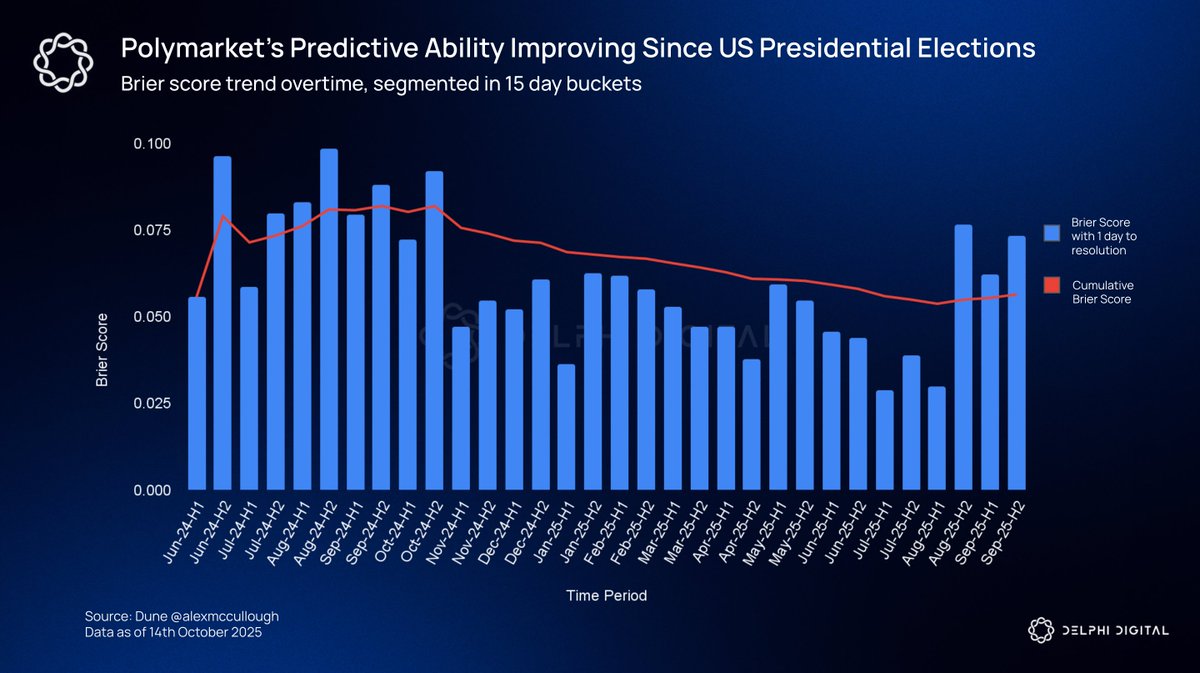
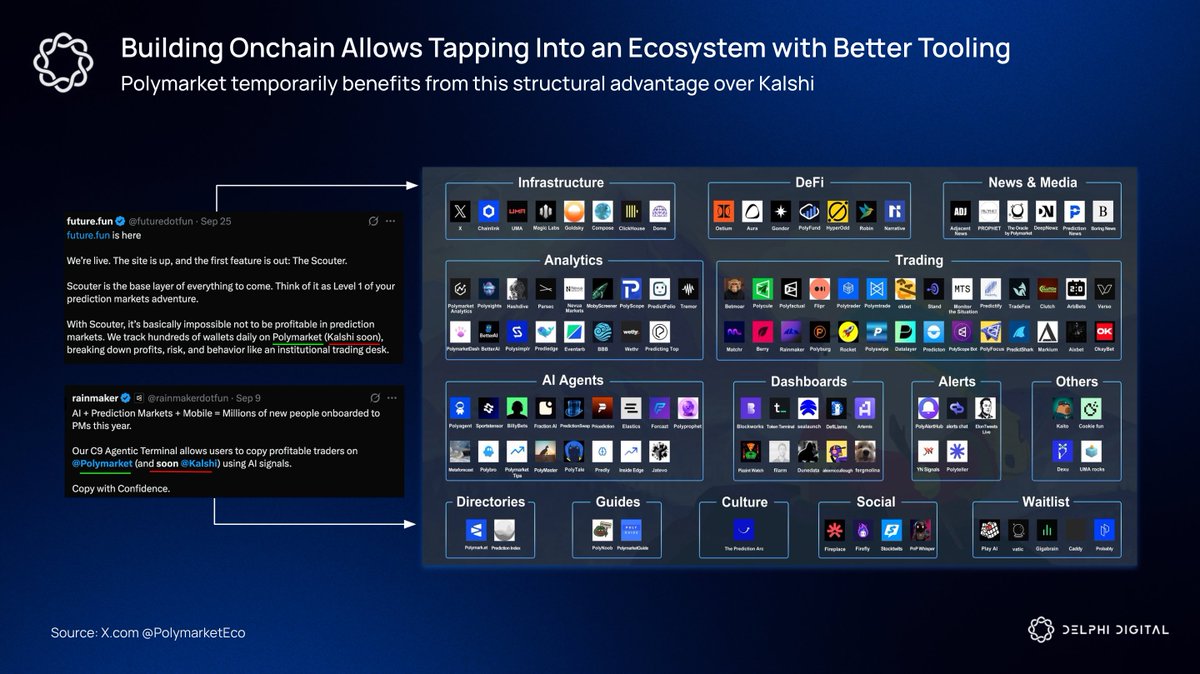
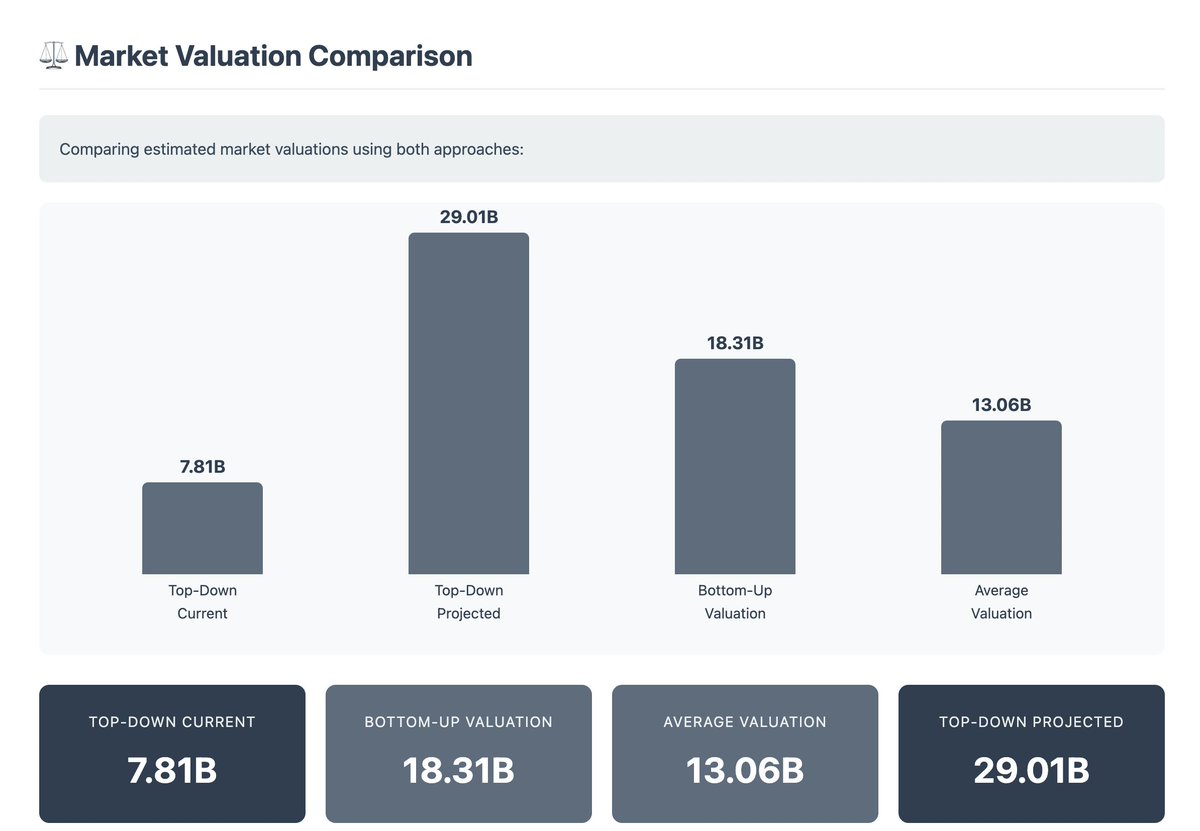
Deep Dive is out my terminally online friends. A nice weekend read to bring you upto speed on everything Prediction Markets.
I talk - a lot in here. Bear with me!!
The aim is for anyone reading to choose the topics of their interest and then explore that topic further
1. Why do we need onchain prediction markets?
2. How are modern prediction markets designed?
3. The absolute dominance of @Polymarket and @Kalshi
4. The Predictive Power of Prediction Markets
5. Five Unsolved Problems plaguing the category
6. Some recommendations for solving these problems (And the startups already doing so)
7. Prediction Market Adjacent Apps that are at a critical juncture
8. How to value the market opportunity here
9. Real risks that are not discussed by the permabulls
10. My expectations from a Polymarket token
DMs always open if you're building something cool in the prediction markets space. I want to try and test as many new products as possible
Prediction markets have become Web3's mainstream breakthrough.
The next frontier is Prediction Market Terminals.
Professional traders need data density and execution speed more than discovery. This creates a big opportunity for professional trading terminals, mirroring the memecoin rush.
These terminals integrate multiple platforms like Polymarket and Kalshi and justify charging fees by offering a suite of key features:
Market Aggregation & Order Routing: A single interface to view odds across all major platforms and route trades to the venue with the best price and lowest fees (@tradefoxai, @fliprbot, @StandDOTtrade).
Real-Time News & Data Integration: A live feed of news, social media sentiment, and economic data integrated directly alongside the relevant markets and their impact on a trader's open positions (@VersoTrading, @betmoardotfun, @fireplacegg).
Onchain Intelligence: Tools for tracking the flow of smart money, identifying large wallet movements, and analyzing the positions of top traders (@hash_dive, @poly_data, @polyburg).
AI Assisted Market and Opportunity Discovery: Utilizing AI to augment and improve a trader's decision making process (@polyfactual, @polymtrade, @Polysights) or utilizing agents to help users passively participate in prediction markets (@polytraderAI, @rainmakerdotfun).
Advanced Risk Management and Order Types: Tools that allow users to model complex scenarios and utilize order types such as TWAPs and trailing stop losses for professional traders.
Third Party Leverage: Offering leverage on selective high volume markets with their custom liquidation engines.
These terminals serve the power users driving the most volume in prediction markets.
A lot of people are misreading the SEC’s new Innovation Exemption for tokenized stocks.
The market seems to be treating this as a blanket green light for anything related to “tokenized equities.”
It isn’t. The SEC’s exemption is much narrower.
The framework allows
- qualifying Tokenized Securities Venues (TSVs) to facilitate trading of tokenized NMS stocks through permissioned AMMs without registering as traditional exchanges.
- Certain liquidity providers can also receive conditional relief from dealer registration.
But the key is what actually counts as a “tokenized NMS stock.” The SEC basically recognizes two relevant models:
1. Issuer-native tokenization
- The company itself, or someone acting on its behalf, tokenizes the actual stock.
- Think of a transfer agent recording the actual shares onchain.
- The token Itself is the security, not a wrapper that merely tracks it.
2. Third-party custodial tokenization
- A third party holds the underlying stock within the traditional securities system and tokenizes the investor’s ownership interest / security entitlement.
- Again, the important part is that the token holder must receive the same rights and privileges as a holder of the equivalent traditional stock.
- That explicitly includes things like dividends and voting rights.
What does NOT qualify? → Synthetic exposure.
If a third party issues its own note, derivative, tracker certificate, security-based swap, etc. whose value simply tracks AAPL or NVDA, that instrument is not a “tokenized NMS stock” under this exemption.
This distinction matters because the market reaction has been much broader than the actual SEC framework. Anything vaguely connected to tokenized stocks or onchain trading got bid.
$BP, $ONDO, $HYPE, $LIT and other adjacent names were swept into the narrative, even though their exposure to the exemption is very different.
$ONDO at least has a legitimate connection: Ondo has been moving toward custodial tokenization structures where underlying securities remain within regulated custody while corresponding onchain tokens represent rights tied to those securities.
But HYPE or LIT equity perps? Those are derivatives. They are not what the SEC just exempted.
And this brings us to Backpack.
$BP rallied hard as the market started viewing Backpack as one of the obvious winners from tokenized U.S. equities.
The common thesis seems to be:
“Backpack tokens are redeemable 1:1 for real shares, therefore they are real-equity tokens, therefore the SEC exemption directly benefits Backpack.”
That skips an important legal distinction. Backpack itself describes the two forms very clearly:
Traditional Backpack securities:
→ UCC Article 8 security entitlement
Backpack tokens on Solana:
→ “Tokenized claim”
→ Claim on an SPV holding the underlying assets
Those are NOT the same legal instrument. When you withdraw a traditional Backpack stock position onchain, you are not simply moving the existing Article 8 security entitlement onto Solana.
The security entitlement is converted into a different tokenized instrument.
That token can later be redeemed 1:1 through Backpack Securities and converted back into the corresponding traditional security entitlement.
This is actually a meaningful improvement over many existing stock-token structures.
xStocks, for example, are bearer debt instruments / tracker certificates backed 1:1 by underlying shares.
Robinhood’s Classic Stock Tokens are derivatives against Robinhood Europe and explicitly do not give holders ownership rights in the underlying stock.
Backpack goes further because its token can be redeemed 1:1 into an actual traditional share position / security entitlement.
But redeemability ≠ the token itself being the underlying equity.
And that distinction matters for the SEC exemption.
The SEC does not merely require 1:1 backing or 1:1 redemption.
A tokenized NMS stock traded under the exemption must provide the holder the same rights and privileges as the corresponding traditional stock, including voting rights.
Backpack’s current documentation describes the Solana token as a “tokenized claim” designed to maintain economic equivalence with the underlying security.
It does not describe that token itself as an Article 8 security entitlement or as carrying the full shareholder rights required by the SEC framework.
So I would not classify Backpack’s current stock token structure as a direct beneficiary of the Innovation Exemption.
Could Backpack build a compliant structure around the exemption later? Absolutely. But that is different from saying its existing tokens already fit it.
The infrastructure that is much more directly aligned with what the SEC just described looks more like:
- @SuperstateInc: issuer-native shares recorded onchain through a registered transfer-agent model.
- @Securitize: issuer-sponsored tokenized shares and transfer-agent infrastructure.
- @Figure: blockchain-native registered public equity.
- @The_DTCC: tokenization of DTC-custodied securities with identical legal and ownership rights.
- @DinariGlobal: custodial tokenized equities designed to preserve the rights of the underlying securities.
- @Ondo: moving toward custodial tokenization models tied more directly to securities held inside the regulated custody chain.
I’m writing this because I’ve seen a lot of confusion in the community about what the exemption actually covers and which existing products legally fit that definition today.
Either way, the SEC’s latest announcement is undeniably a major positive for the tokenized equity ecosystem as a whole.
Team distribution on $STRK is repeating the exact same play for the 5th month in a row.
Every time $STRK tries to bounce, team-linked wallets receive fresh supply and dump straight into the order books.
On-chain data shows wallet 0x2c9f...7293 received 17M $STRK from a team-linked address 2 weeks ago.
Just 1 hour ago, right as price pushed to local highs, they deposited 4.2M $STRK ($150.6K) directly into Binance.
The chart reacted instantly. $STRK suffered a sharp rejection from 0.03643 highs and is already bleeding back down toward 0.03410.
This isn't a one-off event:
• 4 months ago: Identical multi-million $STRK deposits sent to Bybit
• 1 hour ago: 4.2M $STRK dumped on Binance order books
• Remaining balance: 12.8M $STRK ($435.5K) still waiting in the wallet
With 12.8M $STRK ready to be deployed into any relief push, chasing this pump means buying directly into systematic team distribution.
Tracking the flow. 👀
0x2c9f282067C5962c0a96719400B419aDD9E7293
TIL: the Aave app is just a dollar denominated savings product. Initially thought one could easily access most aave mkts from on there
But makes sense that they go for the biggest opportunity rather than build a mobile frontend. Super normie friendly experience & sleek design
Introducing CREDIT: tokenized inference you can own, trade, transfer and use.
Stake ORBIO to earn CREDIT. Claim it, sell it on the onchain order book, swap it on Uniswap, or activate it to power your AI.
Access your API key securely with a wallet signature.
Your available inference balance has been airdropped to your wallet as CREDIT.
@colosseum partnership has been a absolute Dub for @MetaDAOProject. Anyone building a utility token launchpad needs more partners like this to improve their founder pipeline
And this partnership goes beyond just the CRED sale we've mentioned in here
Omnipair, Solomun and Umbra token launches - all I believe are results of this collaboration to a certain degree
Most launchpads meet teams only when they are ready to raise.
Through Colosseum, MetaDAO can observe founders as they develop their products over time rather than judging them from a pitch alone. This does not guarantee better outcomes, but it gives MetaDAO a stronger basis for deciding which teams should reach the market.
From there, promising teams that raised private funding earlier can use STAMP to commit to the ownership coin structure and launch publicly through MetaDAO. Early investors receive a reserved token allocation that unlocks linearly over 24 months, replacing their private investment claims with token ownership.
That makes Colosseum a repeatable source of founders for MetaDAO. Similar relationships with other accelerators could materially expand its launch pipeline.
Crypto opened fundraising to anyone on the internet, but it never solved what happens to the money after a token sale.
While most launchpads stop at distribution, MetaDAO is designed to stay involved after the sale. Accepted capital is held in an onchain treasury and released under spending limits. Follow-on funding and restructuring can be put to decision markets.
Under its optional performance package, founder tokens only unlock after the token sustains predefined multiples of its sale price. If a project is wound down, a proposal can return the remaining treasury capital to tokenholders.
That structure could open a funding path for small teams that do not fit traditional venture economics. Instead of raising a large seed round upfront, they could start with a smaller pool of capital and seek more once they have evidence of progress.
MetaDAO’s success will depend on whether capital follows results after the sale. Projects that make progress should be able to raise more. Those that fail should be restructured or wound down before the treasury is exhausted.