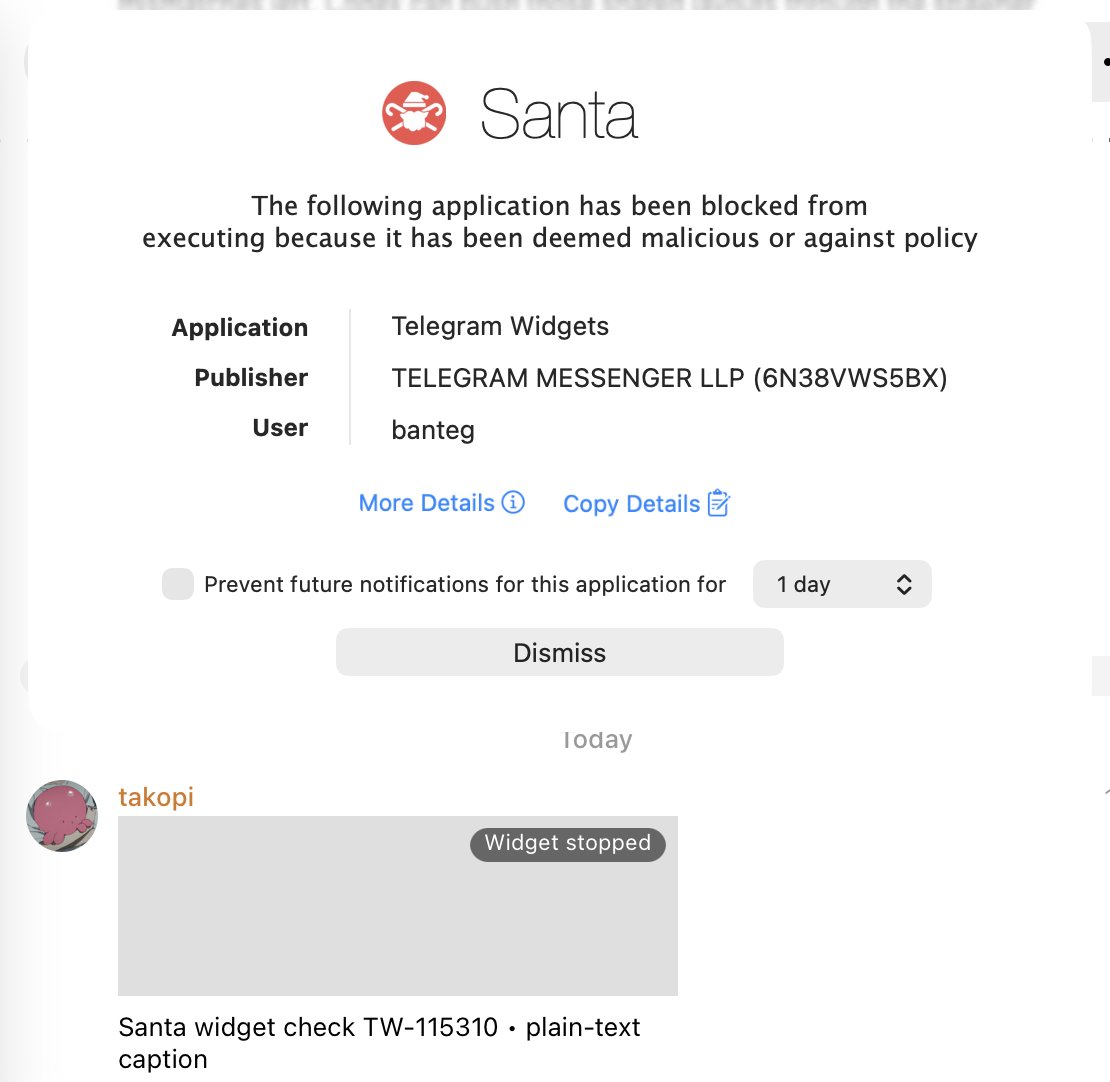
telegram has shipped multiple rces already in the new widget engine, with code execution demonstrated on android, ios and windows.
here’s how to outrun the inevitable macos rce:
https://t.co/oMhvKIBqlq
Announcing a major milestone achieved by my team @GoogleDeepMind: we have proven key security properties of the machine code underlying the Signal messaging protocol. This is the first time the actual production code of a widely deployed protocol has been formally verified – by any method, with or without AI – and at this depth.
More than a research breakthrough, it’s a prime example of how frontier AI can be a force multiplier to counter the speed and scale of modern cyber threats.
Formal verification offers a higher standard of security; however, it’s extremely complex and time consuming, which is why in many cases it’s considered to be impractical. Similar efforts could take teams decades of combined effort. We did it in a month’s time.
Using AlphaProof Code, Google DeepMind's new agentic framework for formal verification that runs on LLMs including Gemini Carbon, we verified the Signal protocol down to the actual code running on devices. This milestone lays the groundwork for a future in which vital systems, from medical device firmware to power grid software, ship with mathematical proof that their protections work.
Reaching that future will take continued research from our community. In that spirit, we're open-sourcing our formal specifications and verification artifacts so others can build on this work.
On a personal note, this moment is of deep significance to me. I started my own research journey more than two decades ago as an intern working on checking the consistency of complex software systems. Seeing this grand challenge made practical with modern AI is extraordinary.
I'm extremely proud of my team members: Swarat Chaudhuri, Andrew Ferraiuolo, Anton Kovsharov, Tej Chajed, Sam Schlesinger, Karn Seth, Jonathan Katz, and Charles Sutton for taking on this grand challenge and delivering, and grateful to the Signal team for their partnership.
https://t.co/kN1eRYQ8fF
Only a few days left to vote! Every vote counts so if you haven’t already please head on over to https://t.co/7w3sJFqi9s and vote for us easily in all three categories!
@cloneisjun I fixed a few things with caching and got it to use copy-on-write with APFS/BTRFS via `cargo steward seed` which has made dev cycles *much* faster.
@cloneisjun I fixed a few things with caching and got it to use copy-on-write with APFS/BTRFS via `cargo steward seed` which has made dev cycles *much* faster.
I got tired of rust using up all my disk space so I made Cargo Steward to fix it. If you use AI agents it's even more helpful.
A cargo bug since 1.88 (to be fixed in 1.101) leaks files. This cleans it up. Add other tidying and cache warming for worktrees = faster dev cycles.
On the Solidity front, I created ForgeDS to extend Forge and add viaIR coverage reports, better caching, better performance, and enhancements for AI coding agents (like warming git worktrees). I've been using it with Solar instead of Solc.
It's much, much faster.
I got tired of rust using up all my disk space so I made Cargo Steward to fix it. If you use AI agents it's even more helpful.
A cargo bug since 1.88 (to be fixed in 1.101) leaks files. This cleans it up. Add other tidying and cache warming for worktrees = faster dev cycles.
If you use @t3dotcodes make sure to run `t3 doctor --fix` to compact your local database and turn on automatic shrinking.
Mine was nearly half empty and running it was able to recover over 12gb of disk space.
💾
@vcrvft@grok@princeps73@Ex_Terestrial@kaajukatlee If an aircraft is overspeed there's more aerodynamic force than the airframe can handle. Correcting with thrusters would cause structural failure... it would just break apart.