Husband. Father. A laboratory mouse involved in an elaborate scheme to take over the Earth—Ceph, Ubuntu Server, AWS. Cloud and Linux with a dab of Open Hardware
I am already stunned with both the beauty and the content of these books. I've only just glanced at them and the amount of work here is staggering to me. They are so thorough & well presented that I feel like I underpaid. Thank you🙏
@techknight2 It looks like a PC Chips (“el cheapo”) board, but instead of PcChips, it’s SIS.
It’s interesting how it pushes to the very edge of the available surface.
A rare insight into the working of the radio proximity fuze developed and used during World War II, 1944 with key contributions from General Electric.
Inside the cutaway, the system reveals a miniature radar set powered by a fragile glass electrolyte ampoule that shattered under launch acceleration, activating the battery and bringing the fuze online in flight. Once armed, it emitted a continuous radio signal and measured reflections from nearby targets, triggering detonation when an aircraft entered roughly the 20 to 70 foot range, where fragmentation effects were most effective.
It costed about 18 to 20 dollars per unit in 1945 at wartime production scale, that still feels strikingly advanced even 75+ years later.
Video Source:- Inert Ordnance
Everyone tends to think of swapfiles being disk based.
In reality, swapping to RAM is exponentially more popular.
If you have a traditional model of memory in your head, this makes NO SENSE. Swap is that thing we use when the system runs out of real ram right?
You know, RAM fills up, swap out to SSD to give the OS some breathing room. Why (and how?) would you swap to memory…very thing that’s full?
Well, Modern CPUs are ridiculously fast at compression, especially with something light like lz4. Zswap intercepts old pages, quickly compresses them, and then crams them back into system RAM. If you’re lucky, you might be able to fit ~3-4 compressed pages into the space of 1 traditional page.
Of course, this also has the benefit of not prematurely wearing out your SSD.
Mobile has done this for *years*, I know Android specifically has used this for a decade+. Regular Linux is catching up, Fedora uses zram by default now. The NT kernel (windows) also has their own implementation of in-memory compression, you can see it in task manager quite easily!
Anyway, it’s a fun trick used everywhere that few realize. Towards the future, I wouldn’t be surprised if inline, accelerated LZ4 starts showing up in the majority of CXL controllers.
how to get started in robotics
don’t start with humanoids.
don’t start with expensive hardware.
don’t start with “ai robot assistant.”
start with fundamentals.
what to learn first:
• electronics → voltage, current, motors, sensors, batteries. robots live in the physical world.
• programming → python for robotics logic, c/c++ for performance and embedded systems.
• mechanics → wheels, joints, gears, frames, torque. if it moves, physics is involved.
• control → feedback loops, pid, stability. movement without control is just chaos.
• linear algebra → coordinate frames, transformations, rotations. robots need to know where things are.
• ros2 → nodes, topics, services, transforms. this is how modern robot systems talk.
• simulation → gazebo, mujoco, isaac sim. crash robots in software before you break hardware.
then build small:
- make a motor spin
- read a sensor
- control a wheeled robot
- simulate a robotic arm
- write a simple obstacle avoidance node
- log data and debug behavior
robotics is not one skill.
it is hardware, software, math, physics, control, ai, and systems engineering glued together.
the right way to start is simple:
learn one layer,
build one small thing,
debug it,
then add the next layer.
that’s how robots go from parts on a table
to machines that move with purpose.
A journalist in 1987 rewrote the 2,500-year-old Tao Te Ching as a series of short parables about programmers, and the book became required reading inside Silicon Valley because every line of the joke turned out to be deadly serious.
His name was Geoffrey James.
He was not a famous engineer. He was a technology journalist who had spent years inside the offices of early software companies watching the same disasters play out over and over again.
Managers piling more programmers onto failing projects. Codebases collapsing under their own weight. Corporate hierarchies producing endless documents that nobody read. Geniuses being interrupted by meetings until they quit and went home.
He could have written a serious management book. Plenty of serious management books already existed and almost nobody in software was reading them. He decided to do something stranger.
He picked up a copy of the Tao Te Ching, the foundational text of Taoist philosophy written in China around 500 BC, and he rewrote it line by line as if Lao Tzu had been a master programmer.
The result was published in 1987 as The Tao of Programming. 151 pages. Nine books. Roughly 50 short parables. A comedy book on the surface and a philosophy book underneath, written in deliberately ornate language that made you smile while you were absorbing arguments that have aged better than almost anything else published about software in the last 40 years.
The opening line of the book is the giveaway. Thus spake the master programmer. When you have learned to snatch the error code from the trap frame, it will be time for you to leave. The joke is that he is parodying the kung fu master from the old Kung Fu TV show. The argument underneath the joke is that real mastery in software is not measured by what you can build. It is measured by how cleanly you can recover when the system fails.
The book has been passed around hacker communities continuously since the late 1980s. It sits alongside Fred Brooks's Mythical Man-Month on the required reading list of serious software teams. People who have never heard of Geoffrey James still quote his lines without knowing where they came from. The reason it has refused to die for 40 years is that every line of the parody was always disguising a piece of real wisdom that nobody else was willing to say plainly.
Here are some of the lines, and what each one is actually saying.
"Even a perfect program still has bugs."
The line is funny because it sounds like a contradiction. The truth underneath is that there is no such thing as a finished program. Every system you ship is alive. It is going to encounter inputs you did not anticipate, hardware you did not test on, and edge cases your imagination could not produce.
Treating any piece of software as finished is the single most common reason production systems fail. The masters in the book are calm about bugs because they have stopped pretending bugs are exceptions. Bugs are the default state. The programmer's job is to keep them from compounding.
"Let the programmers be many and the managers few. Then all will be productive."
The line is funny because every software company in the world does the opposite. The truth underneath is that programming is a kind of work that runs almost entirely on uninterrupted thought, and the more layers of management you stack on top of it, the more interruptions you create, the more meetings the programmers have to attend, the fewer actual hours of deep work get done.
Every manager you add to a software team subtracts more productive hours from the engineers than the manager could possibly add through coordination. Brooks proved this formally in 1975. James said it in nine words in 1987.
"After three days without programming, life becomes meaningless."
The line is funny because it sounds like an addict talking. The truth underneath is that genuine craft work produces a kind of meaning that almost nothing else in modern life provides. The programmer who has not touched real code in three days is not just bored.
They are emotionally underfed. The masters in the book understand that the work itself is not a means to a paycheck. The work is the reward. The paycheck is a side effect. Everything that interferes with the actual work, no matter how prestigious or well-paid it looks, is making the programmer's life worse, not better.
"A manager went to the master programmer and showed him the requirements document for a new application. The manager asked the master, how long will it take to design this system if I assign five programmers to it? The master replied, it will take one year. The manager said, but we need this system immediately or even sooner. How long will it take if I assign ten programmers to it? The master programmer frowned. In that case it will take two years."
The line is the punchline of Brooks's Law disguised as a koan. Adding programmers to a late project makes it later, because every new person has to be brought up to speed by the existing team, which slows the existing team down, which extends the timeline. The book teaches this in 60 words. The same lesson takes most managers 20 years of failed projects to learn, if they ever learn it at all.
The deeper pattern is the one most readers miss the first time through.
James was not really writing about programming. He was using programming as a setting for a much older argument that Taoist philosophy has been making for 2,500 years.
The argument is that the world is governed by simple principles that get harder to see the more cleverness you stack on top of them. Force does not work. Pressure does not work. More resources do not work. The only thing that works is restraint, simplicity, and the patience to let the right shape emerge.
Lao Tzu was talking about how to govern a kingdom. James was talking about how to ship software. The wisdom is the same. The kingdom is the codebase. The emperor is the project manager. The advisors are the developers. And the entire collapse of every doomed software project in the last 40 years has had the same root cause that the collapse of every doomed dynasty has had for the previous 4,000.
People mistook complexity for competence.
The book has been sitting on the internet for free for almost 30 years. You can read all 151 pages in an afternoon. Most people who run it as a joke walk away quoting it for the rest of their careers.
What James understood in 1987 is even more true in 2026. AI can now generate millions of lines of code in seconds. The bottleneck has shifted entirely. The bottleneck is no longer typing speed. The bottleneck is judgment. The bottleneck is taste. The bottleneck is the ability to look at a generated codebase and feel, without quite knowing why, that something is wrong with it. That kind of feel is exactly what the book was teaching all along.
The Tao of Programming flows far away and returns on the wind of morning.
The masters in the book were never joking. The world just took 40 years to figure out they were not.
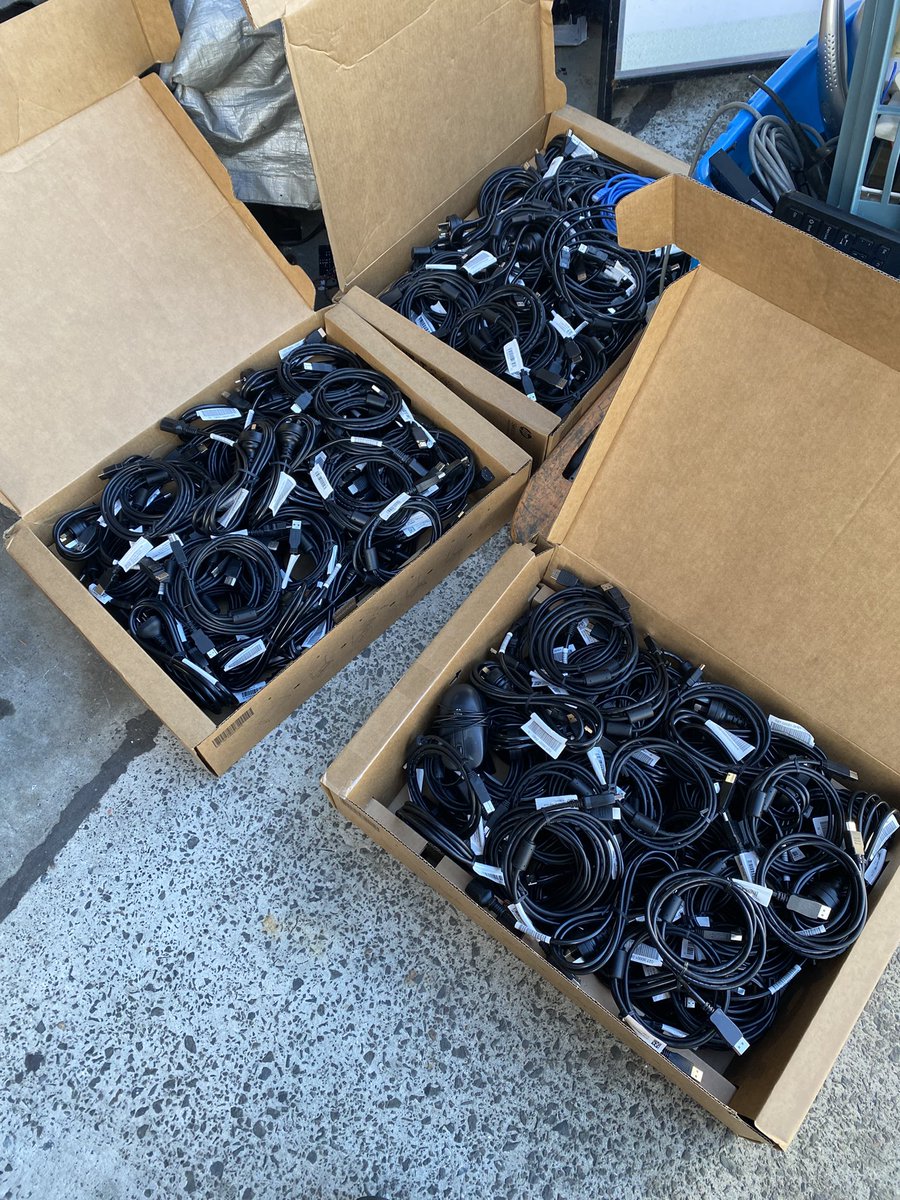
The horrors you see when you recycle ewaste. from a load of monitors that I’m taking for a business that is upgrading. Nothing wrong with them just big corporations wanting new stuff. But these are all the brand new cables that came with the new monitors that they didn’t want 1/2
Anthropic engineer:
"You're not supposed to prompt Claude. You're supposed to build a system that prompts itself."
this is one of the best workflows I've seen in a long time
in this video she breaks down exactly how most people are using Claude:
- the 14% you lose to CLAUDE.md before typing a word
- the automation workflows most users don't know exist
- the daily task pipelines that run without touching the keyboard
- the daily workflows Anthropic's own engineers automated first
if you've been using Claude for more than a month and never left the chat window, you've been using one agent when you could be running a team of them
instead of another show tonight, watch this
make sure to bookmark it before it gets lost in your feed
the guide is in the article below
The laptop hasn't changed in 30 years. NVIDIA just changed it
RTX Spark is their first PC chip ever.
- RTX 5070 level GPU
- 128GB unified memory
- 1 petaflop of local AI
- thin, light, barely throttles unplugged
Your AI agent lives on the machine. 24/7. No cloud.
This is step one of the agentic AI PC, and everyone else is about to copy it.
Veteran "60 Minutes" correspondent Scott Pelley was fired by CBS after a clash with management over his criticism of the newsmagazine's new leadership. https://t.co/zjNzwOaEDY
Behold the IBM 6450343 — the 512KB/2MB Memory Expansion Option for the IBM PC/AT 5170. Fully stuffed with 2MB in a world that was told 640K would be enough.
#RetroComputing#IBMPC#PCAT
@StairwayToRetro Nice! Given the choice I would choose a Tseng Labs ET-4000 tho… x-mode register setup was different for every card, and I had figured out those.