$HYPE vs $LIT: who wins the perps DEX war?
Right now, the numbers say $HYPE.
@HyperliquidX is in a different weight class:
> TVL: $5.76B vs $507M
> 30d volume: $252B vs $46.9B
> Open interest: $8.99B vs $729M
> 30d revenue: $64M vs $2.93M
> Market cap: $14.3B vs $448M
That means Hyperliquid has around:
- 11x more TVL.
- 5.4x more 30d volume.
- 12x more OI.
- 22x more revenue.
- 32x higher market cap.
In perps, liquidity is the moat.
More liquidity means better execution.
Better execution brings better traders.
Better traders bring more volume.
More volume brings more revenue.
→ That loop is why Hyperliquid is winning today.
But $LIT is still interesting.
@Lighter_xyz does around 18.6% of Hyperliquid’s 30d volume, but only trades at around 3.1% of its market cap.
So $HYPE is the dominance trade.
$LIT is the asymmetric challenger trade.
---
Short term, $HYPE wins.
Long term, $LIT can become the strongest challenger if ZK-verifiable perps, Ethereum security, and zero-fee trading become a real narrative.
The perps war is not about better tech alone.
It is about who owns trader liquidity.
And today, Hyperliquid owns it.
Which one would you pick?
Base AI Tier Rank List
AI on Base is no longer just a small narrative.
It is becoming one of the clearest maps for on-chain agents.
---
1. OG / Fundamental
> $TIBBIR (@ribbita2012 )
> base:0xff8104251e7761163fac3211ef5583fb3f8583d6 (@reppo )
> $GAME (@GAME_Virtuals )
> base:0x4b5d32a07b8d3ec5d6928caa30196f8dd6a7c5a9 (@PRXVTai )
These are the names that helped define the early Base AI meta. Strong mindshare, early positioning and real ecosystem relevance.
2. Based / Leading
> $RootAI (@Root_Edge )
> $OS (@officialbunnyos )
> $CAP (@Capminal )
> $PEAK (@pabloberlangab )
> $OPG (@OpenGradient )
> $SIBYL (@sibylcap )
> $AIXBT (@aixbt_agent )
> $CAS (@caspius_ai )
> $SOLACE (@solacelaunch )
> $ETHY (@ethy_agent )
> $WACH (@Wach_AI )
This is where I see the strongest mix of product, narrative and current attention. Not all will win, but this tier likely carries most of the market’s focus.
3. Active / Rising
> $LBM (@Litebeam_xyz )
> $CENTRY (@cybercentry )
> $VELVET (@Velvet_Capital )
> $INSTACLAW (@instaclaws )
> $MAMO (@mamo )
> $FACY (@ArAIstotle )
> $VU (@VU_virtuals )
> $H1DR4 (@H1DR4_agent )
These are still building visibility. The opportunity here is usually asymmetric: less consensus, more upside if usage catches up.
4. Early / Experimental
> $VPAY (@vPay_Global )
> $MUTE (@Mute_swap )
> $EXY (@exylos_ai )
> $WIRE (@717CapitalAI )
> $OTTO (@useOttoAI )
> $CHARLES (@charles__AI )
Higher risk, but this is where new AI agent primitives often appear before the market prices them properly.
---
Tier lists are not gospel.
But they are useful because they show where attention, liquidity and builder momentum are clustering before the broader market catches up.
For now, Base AI still feels early.
The winners will not be the agents with the loudest ticker.
They will be the ones that turn AI into actual on-chain economic activity.
Great take from Tracy here that you dont wanna pass!
These aren’t just “hot sectors.”
They are the 4 clearest signs of where crypto is becoming real financial infrastructure:
Hyperliquid → on-chain trading.
Polymarket → on-chain information markets.
Neobanks → consumer distribution.
Privacy → the missing default layer.
What is best tickers in those spaces?
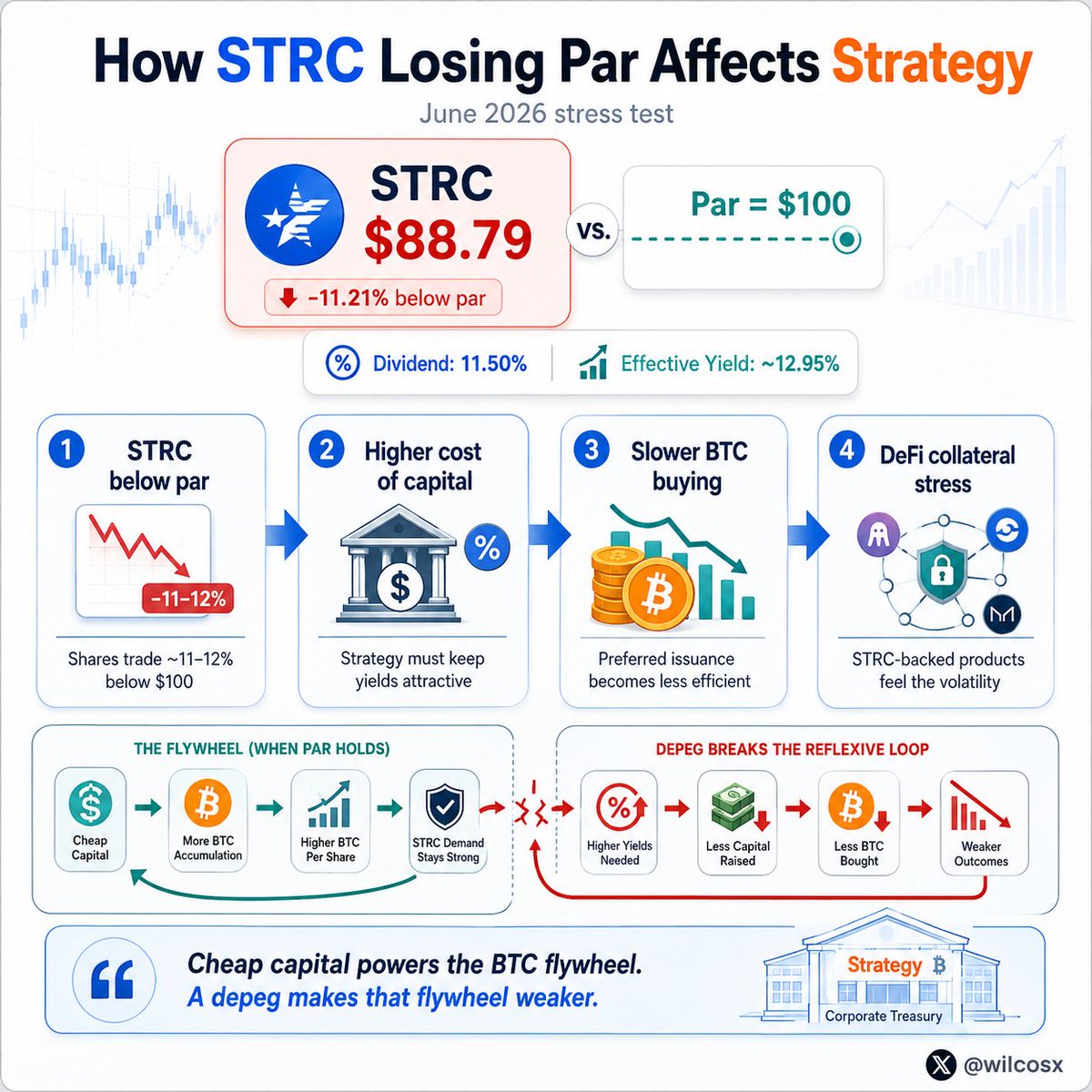
$STRC losing its $100 par is not just a “preferred stock dipped” story.
It directly hits @Strategy Bitcoin machine.
The old loop was simple:
→ Issue STRC near $100.
→ Pay a high dividend.
→ Use the cash to buy BTC.
→ BTC upside supports the whole structure.
→ Repeat.
But when STRC trades around $88–89, the loop becomes much harder.
At an 11.5% dividend on $100 par, the effective yield for buyers is now close to 13%.
@Saturn_btc sUSDat and similar: Also saw depegs (e.g., ~3.7% drops reported in some coverage).
That means the market is demanding a much higher return to hold Strategy credit.
The impact:
1/ Strategy’s cost of capital goes up.
To bring STRC back near par, they may need to keep dividends high or raise them again.
That makes future funding more expensive.
2/ New issuance becomes unattractive
Selling STRC below par means raising less cash while still paying dividends on the full $100 stated value.
That weakens the “issue preferred → buy BTC” engine.
3/ BTC buying can slow
If STRC is no longer a clean funding rail, Strategy has fewer easy ways to keep accumulating BTC without using common stock, debt, cash reserves, or even small BTC sales.
4/ DeFi collateral stress spreads
Products using STRC as collateral start feeling the drawdown too.
That turns a Nasdaq preferred stock problem into an on-chain liquidity problem.
5/ Market confidence gets tested
The big question is no longer just “how much BTC does Strategy own?”
It becomes:
Can Strategy keep funding BTC buys when its own credit instrument is trading like distressed high yield?
I don’t think this is a full Strategy collapse story yet.
But STRC losing par shows the weak point in the model: The Bitcoin treasury flywheel works beautifully when capital is cheap.
It gets much more fragile when the market starts demanding 13%+ to fund it.
The “L1s are dead” take is aging badly.
BTC, ETH, SOL, BNB, TRX and HYPE are all showing the same thing in different ways:
The comeback is not broad.
It is selective.
1/ $Bitcoin is becoming the reserve layer
$BTC is no longer only traded as a risk asset.
It now sits closer to digital reserve collateral.
ETF flows, treasury accumulation, institutional balance sheets and macro uncertainty keep reinforcing the same idea:
Bitcoin does not need high TPS to win.
It wins by being the most trusted settlement and store of value asset in crypto.
That makes BTC the cleanest L1 barbell against both fiat debasement and crypto cycle volatility.
2/ @ethereum is still the settlement layer
$ETH has been under pressure because execution moved to L2s.
@base , @arbitrum and other rollups captured a lot of user activity, while Ethereum mainnet looked slower, more expensive and less exciting.
But that is also the point.
Ethereum is slowly becoming the neutral settlement layer for DeFi, RWAs, stablecoins and institutional assets.
The market may hate slow ETH price action, but builders still treat Ethereum as the safest place for high value financial infrastructure.
The question is no longer whether Ethereum can compete with faster chains on UX.
The real question is whether ETH can capture enough value from being the settlement layer of a rollup economy.
3/ Solana is becoming the consumer chain
$SOL has the clearest comeback case among smart contract L1s.
The chain has strong activity across DEXs, memecoins, DePIN, payments and consumer apps.
More importantly, Solana is no longer only selling speed as a narrative.
It is moving toward real time finance.
Alpenglow targets much faster finality.
Firedancer improves validator client diversity and performance.
Stablecoin and payment use cases are becoming more serious.
If Ethereum is the institutional settlement layer, Solana is trying to become the high performance execution layer for consumer finance.
4/ BNB Chain and Tron still own retail flows
Not every L1 comeback needs to be based on developer prestige.
@BNBCHAIN and @trondao continue to prove that distribution matters.
BNB Chain has @binance and @cz_binance related retail flow, low fees and strong user familiarity.
Tron has one of the strongest stablecoin payment positions in crypto, especially around USDT movement.
These chains are not always the loudest on CT, but they keep activity because users already know why they are there.
4/ Specialized L1s are opening a new lane
@HyperliquidX is the most obvious example.
It is not trying to be a general purpose chain first.
It starts with a killer use case: decentralized perps.
That matters because the next L1 winners may not look like “Ethereum killers.”
They may look like vertically integrated financial systems with one dominant product, strong liquidity and a clear reason to exist.
This is also why chains like Sui, Avalanche, Near, TON and others still matter.
The market will not reward every L1 equally.
It will reward the ones with a real wedge.
---
The L1 comeback is not a return to the 2021 “every chain pumps” era.
It is a quality rotation.
> BTC wins trust.
> ETH wins settlement.
> SOL wins performance.
> BNB and Tron win distribution.
> HYPE wins specialization.
The chains that survive this cycle will not be the ones with the best slogan.
They will be the ones with real users, real liquidity, real fees and a clear role in the multichain economy.
Next week has $261M+ in token unlocks.
No single unlock dominates, but the pressure is spread across June 22 to 28.
Main ones I’m watching:
> $H: $62M on June 24.
> $GRAM: $58.2M on June 23.
> $WLD: $24.1M daily.
> $CC: $22.4M daily.
> $GUA: $19.7M on June 27.
> $SAHARA: $13.8M on June 26.
> $MEGA: $13.7M on June 23.
> $TRUMP: $11.5M daily.
> $XPL: $8.5M on June 25.
> $NEWT: $7.39M on June 24.
Watch out for those token lock! Which tokens are u holding?
Been avoiding leverage lately. Not because I don't have a view on the market, just because narratives have been changing way too fast and getting chopped isn't fun.
That's why I actually like what @yesorno_com_ is doing.Just answer YES or NO on the topics everyone's already debating every day.
It's almost like a low-stress way to check whether your reads on sentiment are right. And since it's free, there's no pressure to force trades just to "be active".
What's nice is that rewards are distributed daily:
- 300 USDT prize pool every day
- 50 winners each round
- Top prize: 28 USDT
So you don't need to be the smartest guy on CT to have a chance.Sometimes preserving capital is alpha. And sometimes the market is more about reading narratives than predicting candles.
Worth trying if you're into prediction games 👇
https://t.co/Yv4aR44hyo
Just joined the @42space World Cup Go For Goals campaign ⚽️
The campaign has a total reward pool of 50,000 USDT, split into two tracks:
> Individual Prize Pool: $20,000 (ranked by personal Tickets)
> Team Prize Pool: $30,000 (ranked by team total Tickets)
You earn Tickets through trading World Cup markets, referrals, and completing eligible campaign tasks.
These Tickets determine how much of the prize pool you can win, and you can compete in both individual and team rankings at the same time.
What’s interesting is that 42 doesn’t really have a standard points system right now, so Tickets feel like something unique to the ecosystem.
I’m not sure how they’ll evolve, but they seem like they could become an important way to show activity, loyalty, early participation on 42 over time.
Right now, I have 5 Tickets:
I’ve started with positions in the World Cup Winner market, spreading across three teams:
> Japan: Still my dark horse. They looked quite organized in their opening match.
> Netherlands: Played well in their first game. The squad depth and structure look solid.
> Portugal: This one is a bit disappointing so far. With the amount of star power they have, the tactics in the first match felt quite flat and lacked urgency.
Besides the winner market, I’ve also started looking at the Golden Boot market. Currently, I’m leaning toward Vinicius and Mbappé.
> Mbappé is the most obvious name he’s in great form and France should go deep in the tournament, which usually helps the top scorers.
> Vinicius offers better odds right now. Even though he only has 1 goal so far, his movement and decision making in the final third look very sharp. I think he has a real chance to finish as one of the top scorers.
> I’m less convinced about Haaland because Norway may not go far enough. For Messi and Kane, age and fitness could become a factor if their teams go deep into the knockout rounds.
For now, my focus is simple: keep trading, accumulate Tickets, complete achievement tasks, and track the leaderboard.
I’ve also joined a team called The World for this campaign. If the team ranks first, the whole team can share in the $30,000 Team Prize Pool.
If you’re keen to join the campaign and Team World, you can use my link to get your first Ticket and kickstart your campaign journey: https://t.co/6tzj2bhXJN
How to earn points and rewards
The campaign uses a Soccer Score (SS) system for the leaderboard.
Currently, there are three main ways to earn points:
> Clicking through to a prediction market from a signal: +1 SS (maximum 2 SS per signal)
> Prepaying for the signal subscription at only USD0.1: +200 SS. This USD0.1 can be redeemed as USD5 once Cournot's signal subscription feature goes live.
> Inviting others to join: +5 SS (once the invited user completes the click through step)
The total prize pool for the campaign is 5,000 USDT, distributed based on Soccer Score rankings.
The higher your rank, the larger your share of the rewards.
I find Cournot quite useful for those who are trading prediction markets during the World Cup and want additional context from AI before making decisions. The integration between signals and direct trading on 42 Space also makes the experience smoother.
If you’re also participating or want to try it out, you can use the link below:
Join Cournot World Cup Signals using my link: https://t.co/taRTkqiDFB
Give them a follow @CournotProtocol
Price manipulation aster-2:native from $0.66 to $0.80, then back to $0.60 ?
Classic crypto.
But this one feels more interesting because the market is not only trading Aster.
It is trading the CZ shadow.
The pump had a clean reason.
@Aster_DEX announced aggressive tokenomics:
- 99% of daily fees used for aster-2:native buybacks.
- Equal amount burned from reserves.
- veASTER stakers receive the buyback tokens.
- Long term supply target from 8B to 3B.
But the dump was just as obvious.
The market already priced the news before the mechanism could prove anything.
Buybacks happen gradually, but the candle moved instantly. That gap created the exit.
→ Early buyers got liquidity.
→ Late buyers chased the headline.
→ Market makers got their volume.
→ Then price returned to reality.
Now here is where the CZ theory comes in.
I’m not saying CZ manipulated aster-2:native.
But in crypto, sometimes a powerful name is enough to manipulate attention.
Aster has the Binance adjacent narrative.
CZ has mentioned it before.
The market knows Hyperliquid is the main enemy. So every bullish Aster announcement gets treated like:
“Is CZ trying to build the Hyperliquid killer?”
That alone creates FOMO.
---
A compare for aster-2:native adn @HyperliquidX :
Hyperliquid feels product-led.
Aster feels narrative-led.
Hyperliquid built trust through usage, volume, UI, liquidity, and community obsession.
Aster is trying to close the gap with tokenomics, buybacks, burns, and the CZ premium.
That can work short term.
But it also makes the chart more fragile.
Because when a token pumps mainly on narrative, it needs constant new attention to hold the level.
Once the CZ premium fades, traders stop asking “how high can this go?” and start asking “where is the real demand?”
That is why aster-2:native could pump to $0.80 and still dump to $0.60 and hyperliquid:native still pumping hard.
The tokenomics may be bullish long term.
Hyperliquid still has the product moat.
Aster has the storyline.
And in this market, storyline pumps short.
But product decides what survives after the candle is gone.