I think @spacexai should launch an autonomous wet lab in space and collect a tremendous amount of data from microgravity and build exceptional foundational biology models with @grok. Plus an AWS for Microgravity-type service allowing researchers to perform autonomous wet lab experiments in space and get that data back on Earth will significantly advance research. @elonmusk
Economies of scale triumph over everything. The Narayana Health Model is fascinating and their cost structure is also cheaper. The only healthcare chain that has the potential to become India’s Kaiser Permanente and change the landscape of Indian Healthcare. We need Narayana Health to spin out this model across the country. The private equity-backed healthcare systems are bankrupting the average Indian Middle class.
Heart surgeries performed by Narayana Health > UK’s top 10 hospitals combined.
@RajanAnandan: "That is what we call India scale."
"And India is the only country where healthcare costs per capita is coming down."
While scrolling through my bookmarks I stumbled upon this video. The world of frontier microgravity research is just getting started. Autonomous wetlabs, paired with cheaper spaceflight, can advance biological research in microgravity like never before. Previously we would have needed a trained astronaut flying to the ISS staying there for months, doing research, and sending results back to Earth. That all can change with autonomy. A @serendipityind X tigerfeathers deep-dive would be amazing @RahulSanghi1@AaryamanVir 😀🫣
Koreans and Taiwanese have an edge in semiconductors, with SK Hynix, Samsung, and TSMC, while we are just getting started. Also, their stock market caps are extremely concentrated in 1-2 companies. Every boom cycle is followed by a bust. Whenever that happens, we are going to witness another Asian Financial crisis like 97.
Today we're standing up XBOX LABS (https://t.co/dJSufI1vni). Here is the note that I sent to the team:
Team,
The first video games emerged some 75 years ago. In the time since, there have been booms and busts, but every year there are more great games to play, more devices to play them, and best of all, more people than ever playing. That growth helped make XBOX what it is today, and we've helped shape the industry in return, from bringing hard drives to consoles and online gaming through Xbox Live to Game Pass and cloud gaming, alongside franchises that have brought millions of people together.
In recent weeks, we've seen games rapidly decompiled and rebuilt to run on hardware they were never originally designed to support. Windows PC builds have been translated to run on Apple Silicon or ported to run inside a browser through WebAssembly and WebGPU, the latter now approaching 90% global browser support. Perhaps more surprisingly, we've seen many of the biggest games in the world have been remixed into the source code of another.
These experiments challenge long-held assumptions about our industry: the tether between software and hardware, the boundary between creation and play, and how people discover and experience games. While it is hard to predict the future of gaming, it is easy to see the possibilities in making great games easier to access, giving old games new life and allowing more players to become creators and co-creators. These are unmistakably good outcomes for players, even when (and sometimes because) they challenge our existing business models.
To explore these possibilities, I’ve asked Scott to stand-up XBOX LABS, a small group of game makers, engineers and scientists whose job is to turn emerging ideas into things our players and developers can experience. We'll build in the open, learn from what people do, and measure success by whether more people are playing and creating.
I think XBOX has an important role to play here. Coding became the first major workload for agents because they can write, run, and test software. Games share many of those same properties, and people spend more than 72 billion hours a year playing XBOX games, roughly five times the estimated time spent writing code worldwide. We've spent 25 years learning how to make great games, and I want our game makers to help shape what these new technologies make possible. As we learn, we’ll share the tools we build with developers across the industry, just as we always have.
Our priorities aren't changing. We remain committed to the 4Cs, to making great games, to our hardware and to being responsible stewards of IP and the communities built around it. LABS gives us a way to explore new technology that is game design led without abandoning the work already underway.
Asha
@chiraggoyal28 If you add our employees, warehouse workers, and all their families, Eternal directly supports the livelihoods of well over 1% Indians 💁♂️.. getting this to 5% by 2030 would be damn cool.
The Singaporean leadership is so articulate, smart, and highly educated. I saw PM @LawrenceWongST's interview with @FT some months ago, and that is by far the best political interview I've seen of any global leader. We have so much to learn from this great nation and its leaders. Lee Kuan Yew is still revered as one of the greatest politicians of all time.
@Shetty_nhl 6 AM is not peak traffic time.
The peak traffic starts at 8-9 AM and keeps peaking full day.
In mid August, I had to catch a flight at 2 AM. I left my place in HSR at 8:30 PM and reached the airport at 12:30 AM.
We built an 8000 sqft. high-throughput wet-lab in 30 days, to solve molecular discovery - starting with pesticides.
Most teams in drug-discovery don’t receive target-organism verification until clinical trials. Pesticides allow us to rapidly validate our model in the target organism directly. With the help of our high-throughput lab, we were able to generate compounds that killed a $13 billion pest, the Fall Armyworm.
We believe that the bitter lesson is coming for biology.
Spot on. Over the past few months, I've met people, first, who are super optimists; for them, opportunities that never existed are available today.
Other, who are somehow super pessimistic, and they too themselves don't know the reason why. I've never been able to understand the pessimists’ argument.
I said this long ago, a reusable rocket, should be a national priority. Once we have that, building constellations for climate and communications, will be faster and easier. Perfect time for a public-private partnership.
Let startups and companies handle launches and democratize space payload transport, while @isro focuses on deep research and aims for Gaganyaan and a moon base. @neerajKh_
The day we have a reusable (partial) rocket booster, the entire space tech ecosystem, including ISRO should focus purely on research and development building a moon base, a space station, and a tremendous number of constellations for climate, data centers, communications, and much more. Our subcontinent is geographically blessed to take at least 100 liftoffs a month. Every southern state should have at least one international space station to launch simultaneously. An entire spectrum of the space economy is about to be unlocked over the next decade and we should not lose the opportunity. It should be a national mission to get a reusable rocket booster, and everything else will follow.
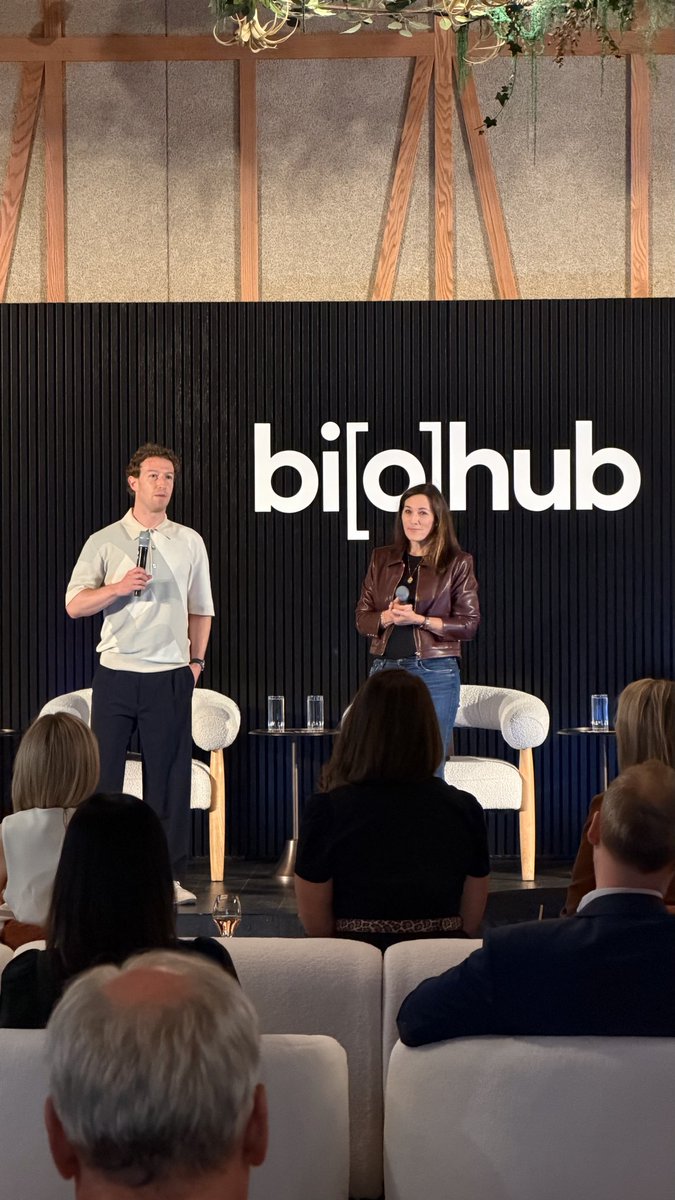
BREAKING: The U.S. government, Google, Meta & Zuckerberg-backed @biohub are launching a $1.8B push to build the data layer for AI biology.
The goal is to create the largest open, AI-ready biological dataset ever assembled, giving models the data needed to better predict how biology works & ultimately help treat disease.
The coalition is massive:
› Biohub committed $500M
› DOE is investing $500M+ across measurement, modeling & compute
› NIH is bringing $500M+ of federally funded datasets & repositories
› Meta, Google DeepMind & @IsomorphicLabs are jointly investing another $300M
This is effectively an infrastructure buildout for AI biology.
Instead of just building bigger models, they’re attacking one of the biggest bottlenecks in biology AI today, generating standardized, high-quality biological data at massive scale & making it openly available to researchers.
$1.8B committed to turning biology into something AI can increasingly model, predict & engineer.
Ramanujan wasn’t skipping proofs. He was hiding his chain of thought to prevent distillation.
Hardy: “Show your work.”
Ramanujan: “Sorry, reasoning tokens aren’t exposed via the API.”
@heykavsthere This area is always crowded; every night around 11:45 PM, when I return from the office, our cab can barely get through the traffic. It makes you feel like it's still 7 PM while crossing the HSR High Street.
your brain will never believe you are capable of doing hard and great things until you repeatedly do hard things and survive the hard outcomes. this is how you train your brain and how neuroplasticity works.