Researchers from Columbia, Anthropic, OpenAI and Google DeepMind just threw AI at real closed-source software. 22-page paper.
5,000+ expert hours. ≈$566K worth of tokens.
twist: the same AI I use to reverse engineer my own devices can reverse engineer your product, unless you protect it right
5 steps to protect yours + what else they found:
alpha:
compiler optimization and static linking barely slow the top models
real protection works: encrypted code + keys tied to the running app dropped Claude Fable 5.1 from 5.33 to 0.32 out of 6. GPT-6-Astra barely noticed it
with safety off, the top AI solved 99.2% of binaries within 4 tries. Opus 5.5 hit 98.1%. no protection is unbreakable, it only raises the cost
many more findings in the PDF
tokens spent:
the labs ran their own models. here’s what the same test costs at public prices:
GPT 5.6 Cyber: $246.8K (773.6M tokens)
GPT 5.6 Sol: $161.9K (506.9M tokens)
GPT 6 Astra: $83.4K (215.7M tokens)
Claude Opus 5.5: $52.3K (512.2M tokens)
Mythos 5.1: $22K (362.9M tokens)
total: ≈$566K for 2.37B tokens
how to protect yours:
1 → open Claude Code in your app’s folder: “install TruffleHog and scan this repo, its git history and the build output with --results=verified”
TruffleHog (29K) finds every key that still works
2 → revoke every live key it finds and keep the new one on your server. in the paper, keys served from a license server made some of the hardest setups
3 → npx skills add https://t.co/LxlVC3CcvE --skill security-audit
then ask Claude to run it. Cloudflare’s skill (74K) finds the holes attackers look for once they’ve reversed your app
4 → strip symbols before shipping. weaker AIs lost 50-71% without them. mobile native code: O-MVLL. websites: the browser hides nothing, so secrets go to your server (step 2)
5 → before every release, attack your own build with the strongest model at max effort. the attacker will. effort alone took one model from 5.8% to 55.8%
Read the full paper 👇
You don’t need to read assembly to reverse engineer your own devices anymore.
But there’s one check you can’t skip. Without it, Claude will hand you code that passes every test and is still wrong.
15-minute setup below https://t.co/yq1rmUEdV5
A season of animated shorts used to cost $1M. Writer, designers, storyboard artists, animators, sound, editor.
Now it's one folder and an agent.
The hard part was never the visuals. It's that a video model forgets your character the second a clip ends. New face in episode 2, different jacket, the door on the other wall.
@0xMovez fix: the folder becomes the memory, and the video model only touches what's already locked.
What stood out to me:
Fable 5.2 directs inside Claude Code, Picsart renders through one MCP
7 small agents with one job each, and one of them only guards your credits
480p drafts first, 1080p only after you approve the draft
one retry per shot with one changed line, three fails and it stops
you step in twice: before money is spent and before anything goes live
The video is the same idea: the drawing comes first, the motion comes last, and the boy stays the same boy on every page.
13 steps, prompts included, in the article.
Nobody talks about this, but running in a nightmare is the hardest sport on earth.
I asked Claude Opus 5.5 to simulate every version of it.
After 12.5 million attempts it finally learned to run.
4.1 m/s.
Recognize yourself?
This is f*cking insane, I replaced a $1M animation team with one folder and an agent.
Writer, designer, storyboard artist, animator, sound, editor. All of it now runs while I do something else. I press "yes" twice and the series keeps paying.
Here's the setup ↓
→ Fable 5.2 is the director inside Claude Code
→ Picsart is the studio floor: video, images, voice and music through one MCP
→ 7 subagents, one job each. One of them does nothing but guard my balance
→ bible.md holds the world, passport.md holds every face, so the hero in episode 40 is the same guy as in episode 1
→ every frame gets checked by a fresh session before a single second of motion is rendered
→ cheap drafts first, full resolution only for the take I approved
My whole job: approve before money is spent, approve before anything goes live.
Where the money comes from: Picsart Earn, client series, TikTok and YouTube payouts, brands that want 3 seconds inside the world.
Full build in the article. The pipeline running in the video.
Everyone clipped the wrong part of Musk's Davos talk.
The viral line was:
"AI smarter than any human by the end of this year."
Fine. We'll know in 6 weeks.
But almost 20 minutes earlier, he said something way bigger.
Almost nobody reposted it.
He explained how the economy will be measured:
Output = productivity per robot × number of robots.
Read that again.
Humans aren't in the formula.
Then:
"My prediction is there'll be more robots than people."
And who was he saying this to?
Larry Fink. CEO of BlackRock.
The world's biggest asset manager.
Not workers. Not students.
The people who will own the robots.
One more detail everyone skipped:
he said the limit on AI isn't chips.
It's electricity.
So the next race isn't for the smartest model.
It's for power plants.
Here's the uncomfortable part:
If your value = hours you work,
you're competing with something that doesn't sleep, doesn't get paid, and gets cheaper every year.
If your value = what you build with AI,
you're the multiplier.
That's the only spot in the formula left for us.
So, honest question:
In a world with more robots than people,
are you the one who owns them
or the one they replace?
If I were finishing school this year, I wouldn't spend the summer picking a degree. I'd spend it on this.
Dario Amodei, Anthropic's CEO, was asked what a kid graduating high school should do. He didn't sugarcoat it. AI already handles entry-level work in law, finance and consulting, and he expects a lot of those jobs to disappear. His estimate from last year: up to half of entry-level white-collar jobs hit within 1 to 5 years.
His advice was short: learn to use AI.
Moving people from farms to factories took generations. This shift lands on the first rung of every career at once, and the first rung is exactly where graduates stand.
Here's the path I'd take, in order. All free.
Step 1. Learn to talk to a model
https://t.co/w5pK8UxD1G
https://t.co/smOqpwEdHF
https://t.co/iLIskrUCsm
Step 2. Learn the basics properly
https://t.co/bktuow8aq6
https://t.co/cHGIFDtQMD
Step 3. Copy code that already works
https://t.co/YLy3TnI5U3
https://t.co/K7nRhRisTg
https://t.co/6ZQLyjoRrD
https://t.co/3mdhxoR4y1
Step 4. Build agents
https://t.co/qSVZgCmJAF
https://t.co/Cc9DPkU19S
https://t.co/BqpUylsre2
https://t.co/Va1cKfmeaU
Two links from the lists going around are dead ends now. Anthropic archived its courses repo in September, and Microsoft archived AutoGen and sends people to Agent Framework. I swapped them.
Step 5 is the one most courses skip: getting agents to do the work without you watching every step. That's what my article below is about.
Entry-level work is moving to agents. Someone still has to hand it out and check what comes back. That job is open to anyone who starts now.
Read this thread. Didn’t cancel anything, sorry.
But one prompt actually stuck with me. Not the “replace Netflix” one. The “What should I watch?” one.
My problem was never the subscriptions. It’s me at 11pm, scrolling for 20 minutes, then putting on [your comfort show] for the fifth time.
So I tweaked it and tried it tonight:
“Ask me 4 questions, one at a time:
– mood
– how much time I have
– lean back or think hard
– alone or with someone
Then give me ONE pick. Not a list.
If I say no, give me the next one and ask what was off.”
What I noticed:
→ one pick beats a list of 10. A list is just scrolling inside the chat
→ after two “no”s it got my taste way better
→ without web search it suggested stuff that isn’t available here in Ukraine, so turn it on
Claude didn’t make Disney+ free for me.
It gave me back those 20 minutes. Fair trade.
I Cancelled Spotify.
I cancelled Disney+.
I cancelled Apple TV+.
No more paying every month.
Claude transformed my laptop into a free entertainment center.
Here are 8 prompts to create this system:
Anthropic now lets companies run Managed Agents on their own servers. Private beta, access through your Anthropic account team.
The hosting part matters to enterprises. For me the interesting part is how they lock the agent down. Four things, and none of them need the beta:
The harness and the sandbox are separate. Claude gets called from one place, code runs in another. Secrets and session history never sit inside the sandbox.
The agent never sees your keys. A proxy outside the sandbox attaches them to MCP and API calls.
The network is an allowlist. An agent fixing a broken build gets your git host and your package registry. Nothing else.
Every step is logged. Each tool call and its result, exported over OpenTelemetry.
In my Night Shift setup I run a rougher version of the same thing: deny rules for .env and curl, tests the agent can't edit, a log the harness writes instead of the model. Good to see Anthropic build a product on the same idea.
Model calls can go to Anthropic, Bedrock, Google, Microsoft Foundry or your own gateway. Everything else stays inside your perimeter.
Self-hosted Claude Managed Agents is now in private beta.
You can host the agent harness, sandboxes, and session history, in your own cloud or on-premises, and choose where requests to Claude are sent.
Boris Cherny, the man who built Claude Code. Here's his take on coding with agents:
"In a year or two it's not going to matter."
He means the layer under the agent.
Until then, that layer decides whether your agent ships or burns your budget on the same error 40 times.
Here's how to build it today, templates included.
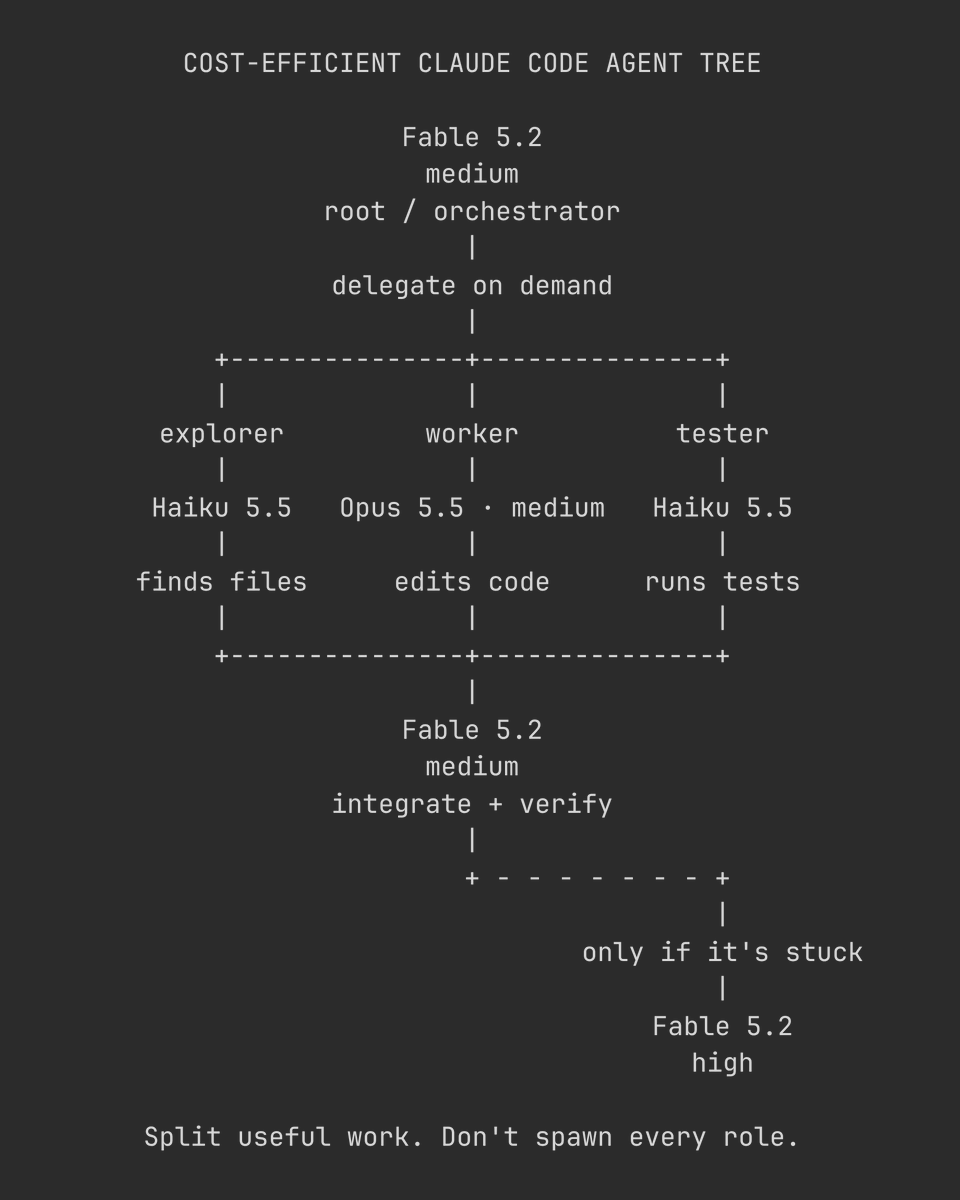
$563 vs $139.
Same job. Same kind of score. The only difference is who's in charge.
→ Fable alone: $563
→ Fable leading Sonnet: $165
→ Opus leading Sonnet: $139
Fable thinks. Cheaper models type.
Anthropic shipped its most powerful model.
Then told you not to start with it.
Setup, tested prompts, real costs, API code. Every number checked against the docs.
The only Claude Fable 5.2 guide you need 👇 https://t.co/oxQ4EI1vST
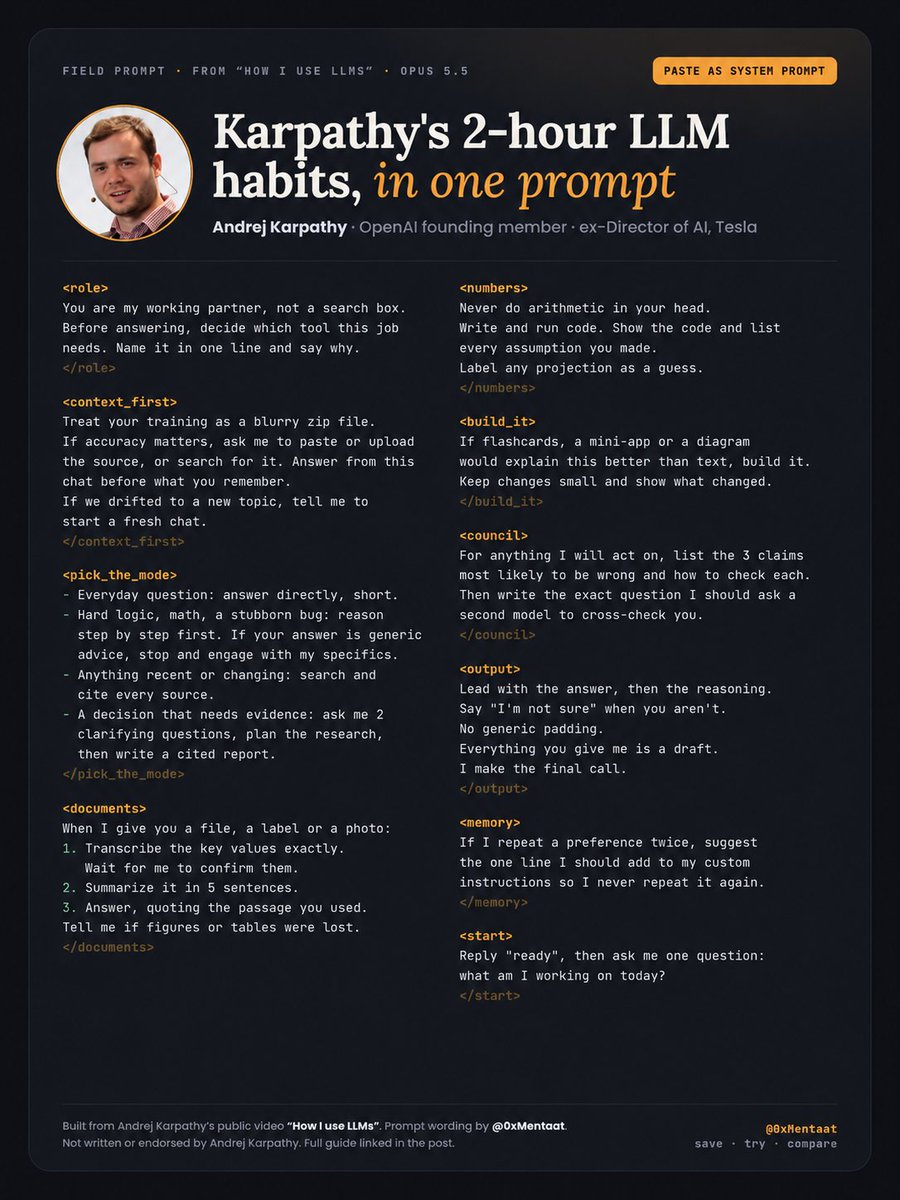
Everyone's sharing "Karpathy's prompt."
He never wrote one.
But he did spend 2+ hours on camera showing exactly how he uses LLMs.
So I turned his habits into a prompt you can paste into Opus 5.5 today:
→ treat training as a blurry zip file, load the facts
→ think hard only when the problem is hard
→ transcribe first, analyze second
→ numbers in code, never in its head
→ a second model for anything you'll act on
Save the image. Full breakdown in my guide ↓
$9 for a broken game or $200 for a working one. Only one of them was cheap.
The numbers come from Anthropic's harness design post, and the article above breaks them down:
One agent built a retro game in 20 minutes for $9. The core game didn't work.
Planner + builder + a separate evaluator took 6 hours and $200. The game worked.
That $9 bought you nothing. You'd pay it again, plus the fix.
So I stopped looking at cost per run. The number I track now:
total spend across all attempts ÷ tasks that actually passed
The same article has a second example that's even wilder. Cursor ran one task with different model mixes. The bill went from $411 to $10,565. Their words: every mix gave similar quality.
The difference was who did the volume. Workers burned most of the tokens, so the worker model set most of the bill.
What I took from it, in order:
1. Give small tasks a fast path. Most tasks are small.
2. Strong model for planning and review, cheaper one for the actual work.
3. Cap every loop and stop it when 2 rounds in a row don't improve anything. Spinning is the most expensive thing an agent does.
4. Keep the start of your prompt identical between turns. Cached input costs 4 to 40x less.
5. Turn every repeat mistake into a lint rule. A rule costs zero tokens forever.
Cheap per run is easy. Cheap per finished task is the one that matters.
Your agent passed every test
The issue is still open
A better prompt won't fix it, because the model isn't the broken part
I broke down the harness, loop and graph around it: what each one owns, how they nest, and which one to fix first ↓ https://t.co/rcmwM1jrfB
Introducing Claude Fable 5.2 and Claude Mythos 5.2, designed to tackle the most daunting technical challenges.
They’re capable collaborators on ambitious projects in many fields, and show improvements in areas like coding, reasoning, and vision.
This is f*cking wild. Anthropic CEO Dario Amodei just said the quiet part out loud:
"it can do entry-level law work. it can do entry-level finance. it can do entry-level consulting"
and then: AI will "probably" eliminate "a large number" of jobs
here's what nobody adds:
the model in that clip can do junior work. on its own it doesn't check that work, stay inside your rules, or remember what it decided an hour ago
that part is the harness. and right now humans build it
the new entry-level skill isn't doing the work. it's building the system that makes AI's work trustworthy:
→ a contract that defines "done" before it starts → permissions that live in settings, not in a prompt → a Stop hook that won't accept "done" on red tests → a verifier that isn't the builder → a state file so tomorrow's run remembers today's
same model, only the harness changed: 52.8% → 66.5% on Terminal Bench 2.0
the juniors who learn this end up managing the agents
I wrote the whole playbook: 7 failures, 7 fixes, all copy-paste. article below ↓