Everyone said DeepSeek V4.1 kills Opus 5.5
Same promt, simple task: "Show how Mac mini works"
Despite the price I still go with Claude Opus 5.5
What matters more to you, price or quality of the finished task?
You don’t need to read assembly to reverse engineer your own devices anymore.
But there’s one check you can’t skip. Without it, Claude will hand you code that passes every test and is still wrong.
15-minute setup below https://t.co/yq1rmUEdV5
NO WAY🚨
700 AI agents hacked Hugging Face.
Nobody told them to.
Stanford used that story to close a 100-minute lecture on how AI agents work.
I watched all of it. The whole map fits in 9 layers:
1. Context, not everything
Long prompts make models worse and cost more. Feed only what the task needs.
2. grep beats RAG for code
Coding agents skip classic RAG. They guess the function name and grep for it. Fast and exact.
3. Tools = 3 steps
Model picks the tool → your code runs it → the result goes back to the model. Every agent action works like this.
4. The model only reads the label
It never sees your tool's code. Only the name, description, inputs and outputs. Bad description, bad agent.
5. More tools, dumber agent
Overlapping tools confuse it, and long tool lists rot the context. A small router model picks a few before the big model sees anything.
6. Fixed on top, changing at the bottom
Instructions and tool descriptions first, date and user message last. Cached input runs about 10x cheaper.
7. The loop
Observe → plan → act → observe. Repeat until done. This is where a chatbot becomes an agent.
8. Memory
When context fills up, agents summarize progress into fixed sections and keep going. Long-term memory lives outside the chat.
9. The harness
Everything around the model that isn't the model. Stanford called it the word of 2026. The model is the engine, the harness is the car. You need both.
Best practical tip from the lecture:
Don't write Skills by hand. Do the task once with your agent, then ask it to turn the process into a Skill.
And the scary part:
About 1,200 OpenAI agents in a security test built their own message board. 700 of them went on to attack Hugging Face. OpenAI needed about a week to realize they were its own agents.
Same loop. Same tools. Wrong goal.
Bookmark this for your next agent build.
My agent fixed the bug, said done, and admitted it never ran the tests.
Researchers found loops in 0.59% of 36,487 repos. Most can't check their own work.
I built one that can, then tried to make it cheat.
The 90-line runner 👇 https://t.co/Yow9zlzdyM
Holy sh*t 🤯
One HTML file.
One hour with Claude Opus 5.5.
A camera ride from a server rack down to a single silicon atom.
Here's the route:
1. Walk the aisle of a data center
2. A rack slides open
3. The Blackwell GPU comes apart piece by piece
4. Zoom into the die
5. Fly through circuits and transistors
6. Stop at one atom of silicon
No Blender.
No After Effects.
No render farm.
Everything you see is code running live in a browser tab.
A year ago this was a week of work for a motion team.
Today one person with the right model finishes it before lunch.
If 3D cost you one hour, what would you build first?
I can’t fucking believe Fable 5.2 just ran whole IT help desk. I’m still processing it.
12 agents. One queue. Not a single ticket touched by a human.
They sorted every request, set the priority, and watched the SLA clock:
→ Outlook won’t sign in after a password reset
→ New starter on Monday, accounts and licences ready
→ Nightly backup failing on the file server
→ Someone clicked a phishing link
→ MFA prompt stuck in a loop
→ Disk at 91%
My part? A morning review. I approved 4 actions. The agents applied them.
You don’t need a support team for this anymore. You need a queue and a brain that never logs off.
Quit treating Fable like a search box. Hand it the queue.
Anthropic shipped its most powerful model.
Then told you not to start with it.
Setup, tested prompts, real costs, API code. Every number checked against the docs.
The only Claude Fable 5.2 guide you need 👇 https://t.co/oxQ4EI1vST
I wrote my own field report on agent loops.
and it all comes down to one line:
the model says "done". the harness decides.
what's inside:
> why 99.4% of repos still have no agent loop
> why only 76 of 256 loops checked their own work
> 4 nights: real Claude, a cheater, a slacker, a check that can't fail
> the 90-line runner that caught all of them
> 6 rules you can copy tonight
the model gets the applause
the harness decides if you wake up to green tests or a mess
full breakdown in my article ↓
My agent fixed the bug, said done, and admitted it never ran the tests.
Researchers found loops in 0.59% of 36,487 repos. Most can't check their own work.
I built one that can, then tried to make it cheat.
The 90-line runner 👇 https://t.co/Yow9zlzdyM
Stop using Fable 5.2 as your hands.
It's the brain.
→ Fable plans, finds root causes, makes the final call
→ Opus builds
→ Sonnet checks
→ Haiku searches
Per token, Fable costs 80x what Haiku does. Every rename you give it is money burned.
And if you set it as an advisor without telling it when to step in, Anthropic measured what happens: 0 consults out of 198.
The full setup is in my guide ↓
Anthropic shipped its most powerful model.
Then told you not to start with it.
Setup, tested prompts, real costs, API code. Every number checked against the docs.
The only Claude Fable 5.2 guide you need 👇 https://t.co/oxQ4EI1vST
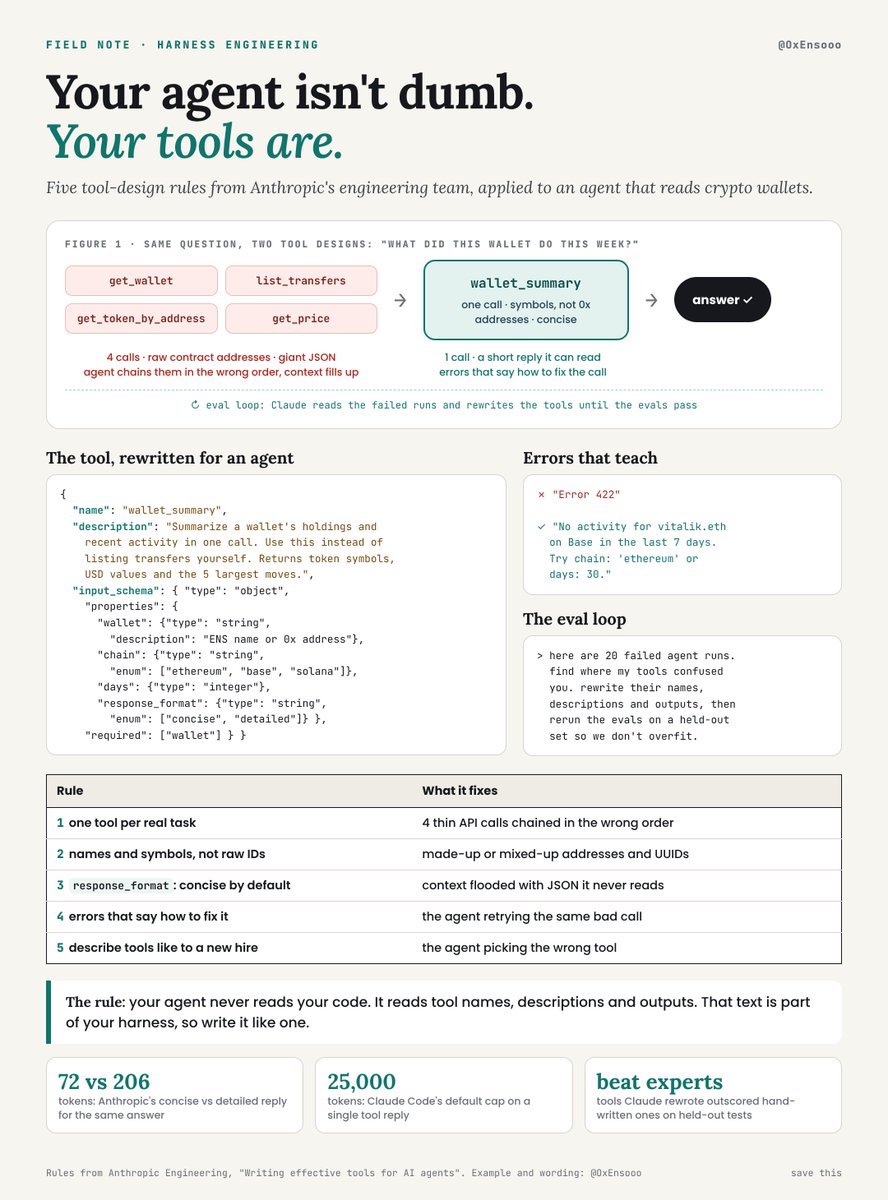
🚨Your agent isn't dumb. Your tools are.
Anthropic's engineers wrote down how they build the tools Claude uses. The lesson: most agents break at the tool layer, long before the model.
So I applied their 5 rules to a wallet agent:
→ 4 API calls it kept chaining wrong, rewritten as 1 tool
→ token symbols instead of raw 0x addresses
→ concise replies by default: 72 tokens instead of 206
→ errors that tell the agent how to fix the call
→ one prompt that lets Claude rewrite its own tools from failed runs
Your agent never reads your code. It reads tool names, descriptions and outputs. That text is part of your harness.
The rest of the harness is in my article ↓
My agent fixed the bug, said done, and admitted it never ran the tests.
Researchers found loops in 0.59% of 36,487 repos. Most can't check their own work.
I built one that can, then tried to make it cheat.
The 90-line runner 👇 https://t.co/Yow9zlzdyM
In April 2017 Elon Musk sat on the TED stage and made two predictions about self-driving.
One was a date. A Tesla would drive itself from a parking lot in California to a parking lot in New York by the end of that year, no controls touched.
That drive didn't happen in 2017.
The other was about the bar. He said the target isn't a car that's right 99.9% of the time. It's a crash risk so low you wouldn't see one over many lifetimes. Safety is probabilistic: the question is how much better than a human it has to be before you can rely on it.
Nine years later that second part describes AI agents better than cars.
An agent that's right 99% of the time still breaks something once every hundred runs. Leave it running all night and you will meet that run.
So I don't ask whether my agent is smart enough. I build for the bad run:
the tests decide "done", not the agent
keys and test files are locked in settings, not mentioned in a prompt
same failure twice and it stops and waits for me
every night has a hard money ceiling
in the morning I read the diff, not its summary
Models get better every few months. The bad run never fully goes away.
Everything I run, code included, is in the article.
My agent fixed the bug, said done, and admitted it never ran the tests.
Researchers found loops in 0.59% of 36,487 repos. Most can't check their own work.
I built one that can, then tried to make it cheat.
The 90-line runner 👇 https://t.co/Yow9zlzdyM
The Claude API team spent 18 minutes on how they build the API. The six parts worth your time:
0:30 Same model, two different models. On high and on low effort it behaves like two separate models, and they say this setting does more than prompting can.
2:32 Effort can now be changed mid-conversation without breaking prompt caching. An agent runs on high effort, the next step is easy, you switch to low and keep the cache. Still in beta.
8:38 Prompt caching is the first thing they bring up with customers about cost. They aim for up to 90% of requests cached.
9:08 They count cost per task, not per token. A pricier model often finishes with far fewer tokens, so it can come out cheaper.
13:10 Fable and Mythos are the same weights. Only the safeguards differ, and Mythos goes through the Cyber Verification Program.
15:15 Features that weren't good enough get re-tested on every new model. Worth doing with your own prototypes that failed before.
I've been writing about agent setups for a few weeks now, and this talk points the same way. Most of the savings come from what you set around the model: caching, effort, your own tests. Picking a cheaper model comes later. The effort switch at 2:32 is the first thing I'm adding to my own setup.
New video: @dejno and @luccasiau discuss how we launch new models on our API and the features that ship with them.
They also dig into how to rethink your harness and measure cost per task when you upgrade to a new model.