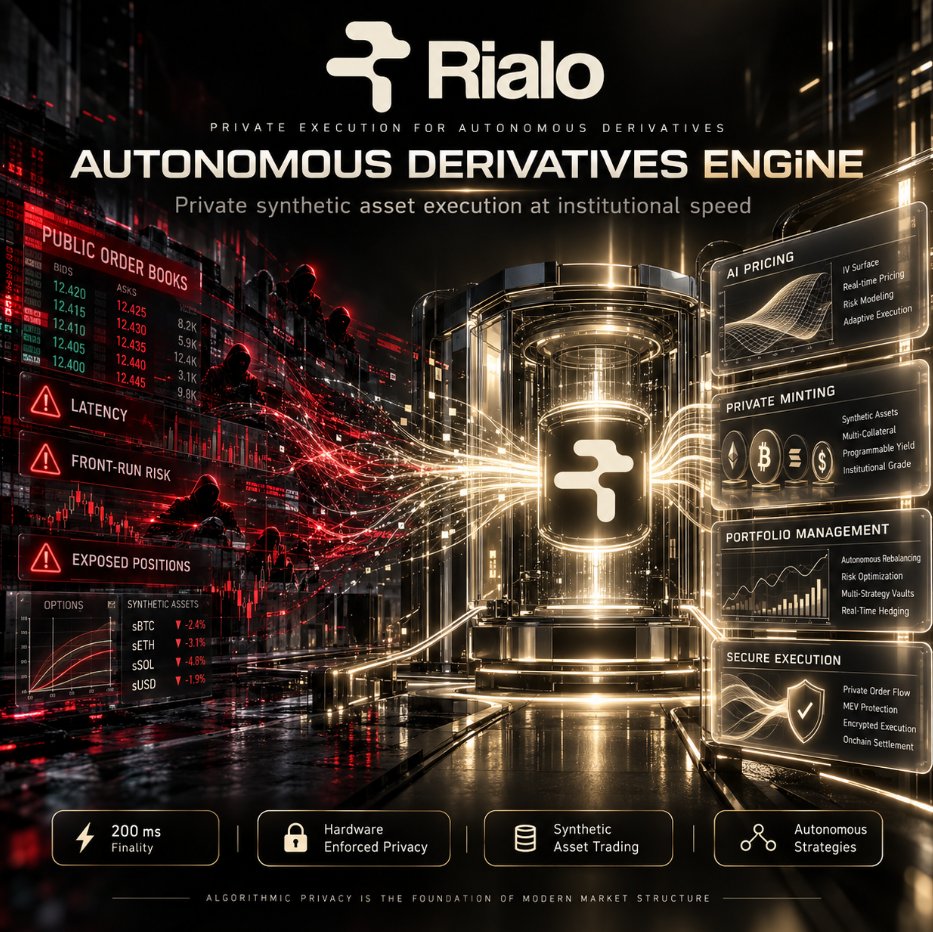
Traditional derivatives markets are built on legacy infrastructure that cannot support algorithmic execution at scale.
When decentralized platforms attempt to host synthetic assets they suffer from latency and public order books. This structural vulnerability allows predatory actors to front run complex financial instruments before execution. Institutional traders cannot deploy advanced derivative strategies on networks that expose their positions.
@RialoHQ builds the definitive settlement engine for autonomous derivatives.
By utilizing hardware enforced privacy the protocol enables artificial intelligence agents to price mint and trade synthetic assets completely shielded from public view. Supported by 200 millisecond finality these autonomous systems manage complex derivative portfolios with absolute mathematical precision.
The execution of complex financial instruments is now instantaneous. True market efficiency requires algorithmic privacy at the protocol level.
The industry is pouring billions into custom hardware and ASICs to accelerate execution and ZK proving.
But a hyper-optimized node is still bound by the physical limits of the network it connects to. You can process transactions in a microsecond on custom silicon, but if you have to broadcast that state through a rigid, sequential gossip protocol, your entire multi-million dollar hardware setup is bottlenecked by the propagation layer.
@get_optimum upgrades the network to match the hardware.
By replacing legacy data paths with RLNC, mump2p ensures that the global network operates at a speed worthy of modern execution engines.
Stop building supercomputers and plugging them into dial-up networks.
Silicon accelerates the node. RLNC accelerates the network.
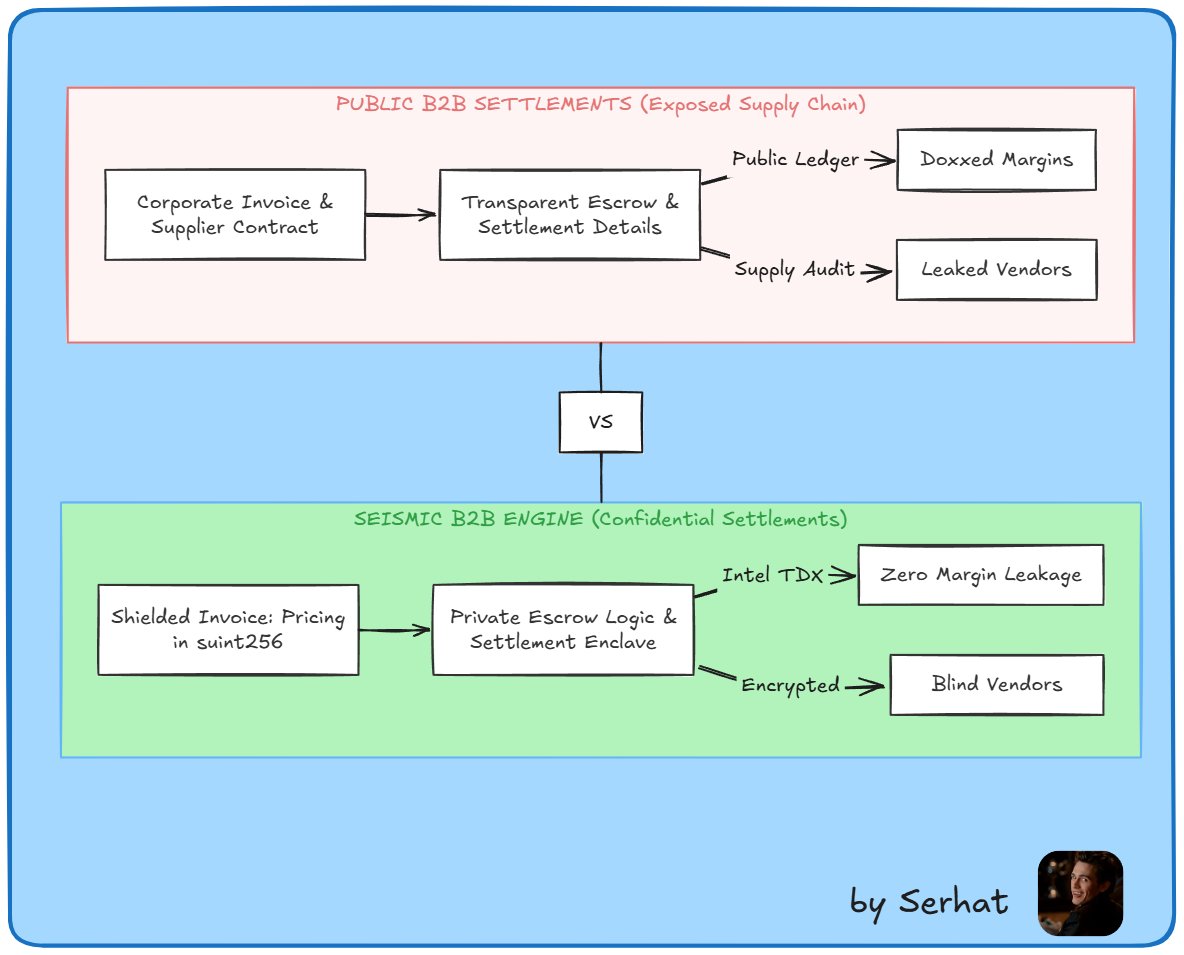
global commerce will never settle on a public blockchain if trade secrets are visible to competitors.
on transparent ledgers:
- invoice amounts reveal proprietary product margins and discount structures
- supplier wallet addresses expose critical supply chain vendors and logistics partners
- transaction timing signals raw material purchases and production cycles to rival firms
B2B commerce cannot run on an open broadcast network.
enter @SeismicSys: programmable confidentiality for global B2B payments and trade finance.
here is how Seismic powers confidential enterprise settlement:
1. shielded contractual state
invoice totals, payment terms, and vendor identities are stored as `suint256` and `saddress`. contract details remain completely blind on the public state trie.
2. hardware-enforced private escrow
settlement logic executes inside Intel TDX enclaves. milestone verifications, dispute resolutions, and programmatic payouts resolve natively in protected memory without exposing capital flows.
3. verifiable compliance on demand
enterprises can generate cryptographic audit proofs for tax authorities and financial regulators—proving settlement occurred without disclosing supplier pricing to competitors.
protect your supply chain. protect your margins.
standard Solidity. enterprise-grade settlement.
bring global trade onchain. build on @SeismicSys.
Static security audits are entirely insufficient for the speed of modern decentralized finance.
When institutional capital relies on periodic human code reviews it remains permanently exposed to dynamic attack vectors. Standard public networks cannot detect and neutralize threats before malicious transactions settle. This reactive security model is a catastrophic flaw for global wealth management leaving billions vulnerable to instant exploitation.
@RialoHQ introduces active algorithmic defense mechanisms for the autonomous era.
By combining 200 millisecond finality with hardware enforced privacy the protocol enables artificial intelligence agents to continuously audit smart contracts and monitor network traffic in real time. These autonomous security entities can detect anomalies and block malicious executions instantly without exposing vulnerability data to the public mempool.
The era of static defense is over. Institutional security now requires autonomous threat neutralization at machine speed.
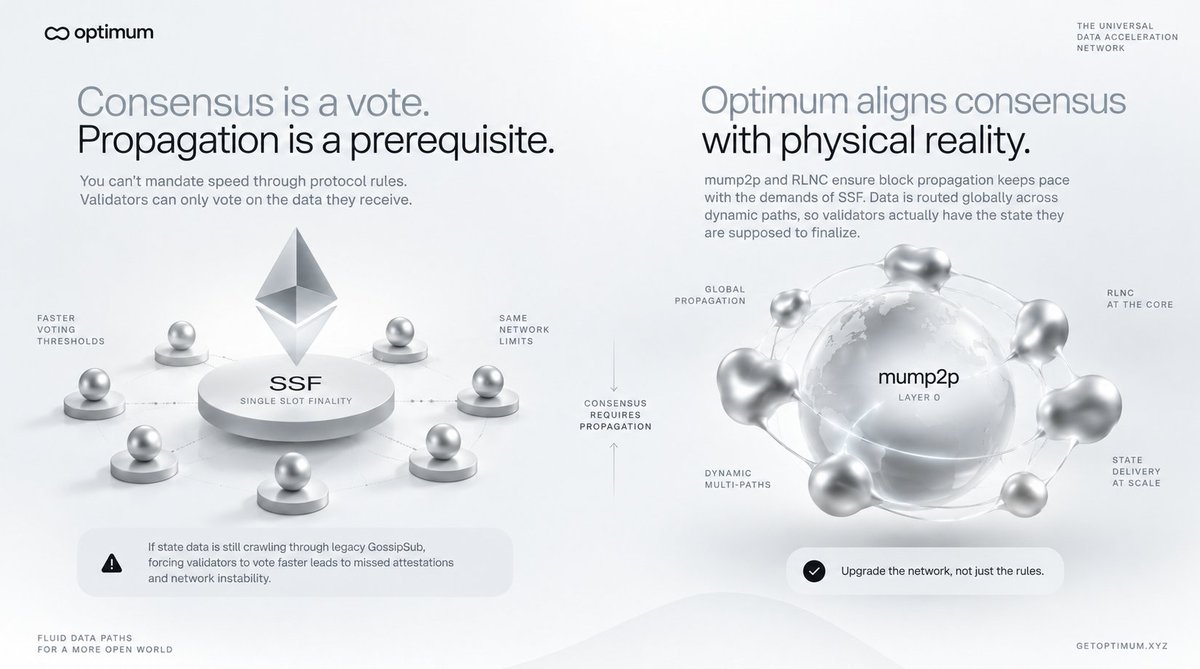
The Ethereum roadmap is heavily focused on Single Slot Finality (SSF).
But upgrading a consensus mechanism does not upgrade the physical network beneath it. Finality is simply a voting threshold. If the underlying state data is still crawling through a legacy GossipSub network, forcing validators to vote faster will only result in missed attestations and network instability. You cannot mandate speed through protocol rules.
@get_optimum aligns consensus ambitions with physical reality.
By operating mump2p at Layer 0, RLNC ensures that block propagation keeps pace with the demands of SSF. Data is routed globally across dynamic paths, guaranteeing that validators actually have the state they are supposed to finalize.
Stop forcing consensus rules onto broken physical layers.
Consensus is a vote. Propagation is a prerequisite.
The expansion of artificial intelligence is severely bottlenecked by centralized computational infrastructure.
When autonomous agents attempt to scale their operations they are forced to rely on monopolized cloud providers. Decentralized physical infrastructure networks offer an alternative but standard blockchains cannot process the high frequency microtransactions required for instant compute settlement. This forces developers to choose between centralization and network lag.
@RialoHQ engineers the exact settlement layer required for decentralized physical infrastructure.
By combining hardware enforced privacy with 200 millisecond finality the protocol allows autonomous agents to dynamically negotiate and purchase computational power in real time. Proprietary AI models can now operate across decentralized networks without exposing their core architecture to public ledgers.
The monopoly on physical infrastructure is broken. The autonomous economy now scales entirely on a decentralized computational grid.
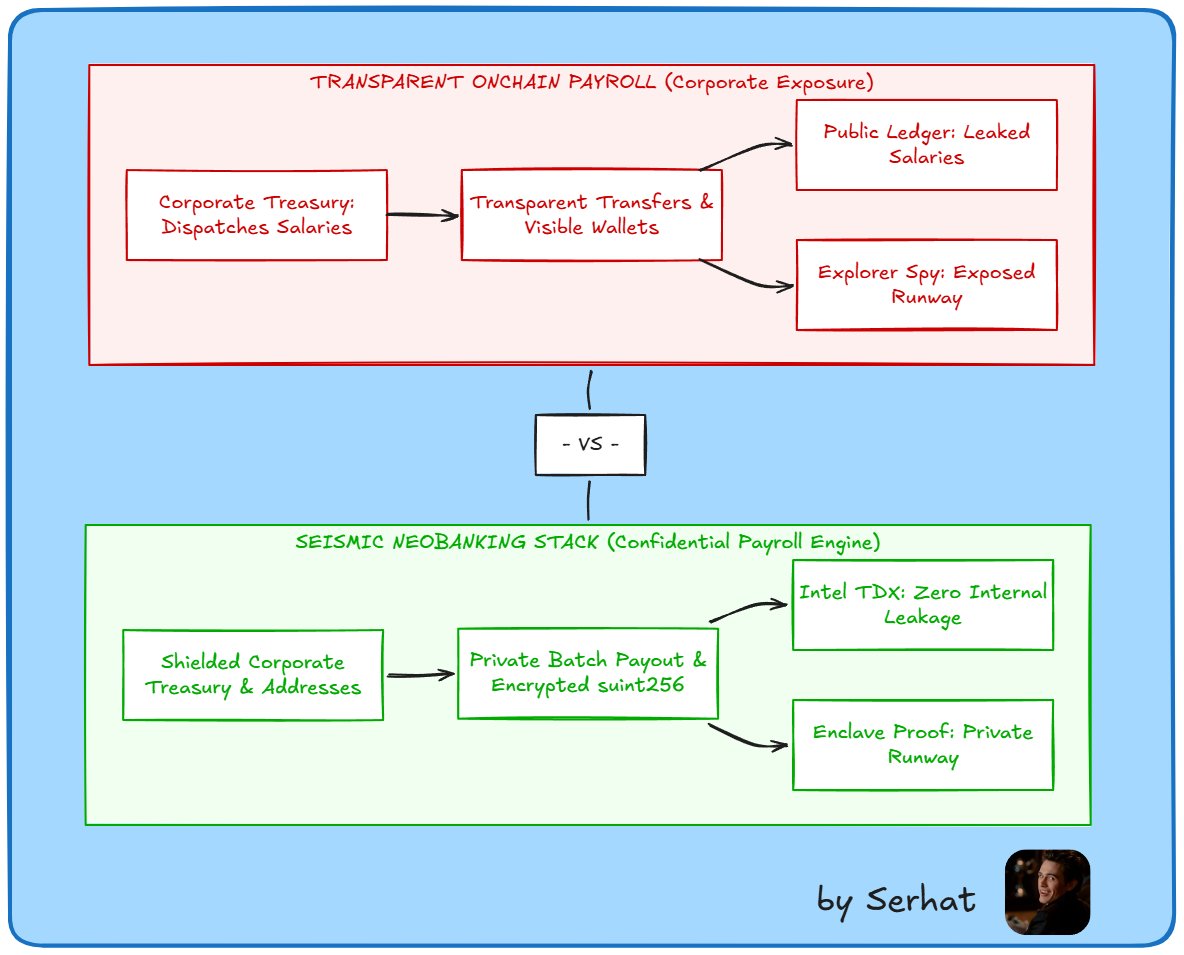
no real-world enterprise will run payroll or treasury on a public ledger.
on transparent blockchains:
• employee salaries, bonuses, and contractor rates sit exposed on public explorers
• competitors track enterprise runway, supplier payments, and vendor contracts in real time
• internal wage transparency becomes forced and irreversible the second tokens move
web3 neobanking cannot scale without financial confidentiality.
enter @SeismicSys: enterprise-grade privacy for modern onchain finance.
here is how Seismic powers confidential corporate finance:
1. shielded balance sheets
treasuries manage operating capital and payout pools using `suint256`. total reserves, payment schedules, and runway metrics remain strictly encrypted.
2. confidential batch disbursements
payout contracts execute multi-recipient disbursements natively in Solidity. individual payment amounts and employee wallet links are processed securely within Intel TDX enclaves.
3. selective auditability
compliance doesn't require total public exposure. protocols can generate verifiable attestations for tax authorities and auditors without doxxing corporate secrets to competitors.
real business runs on confidentiality.
standard Solidity. enterprise-grade neobanking.
build the next-gen onchain bank. build on @SeismicSys.
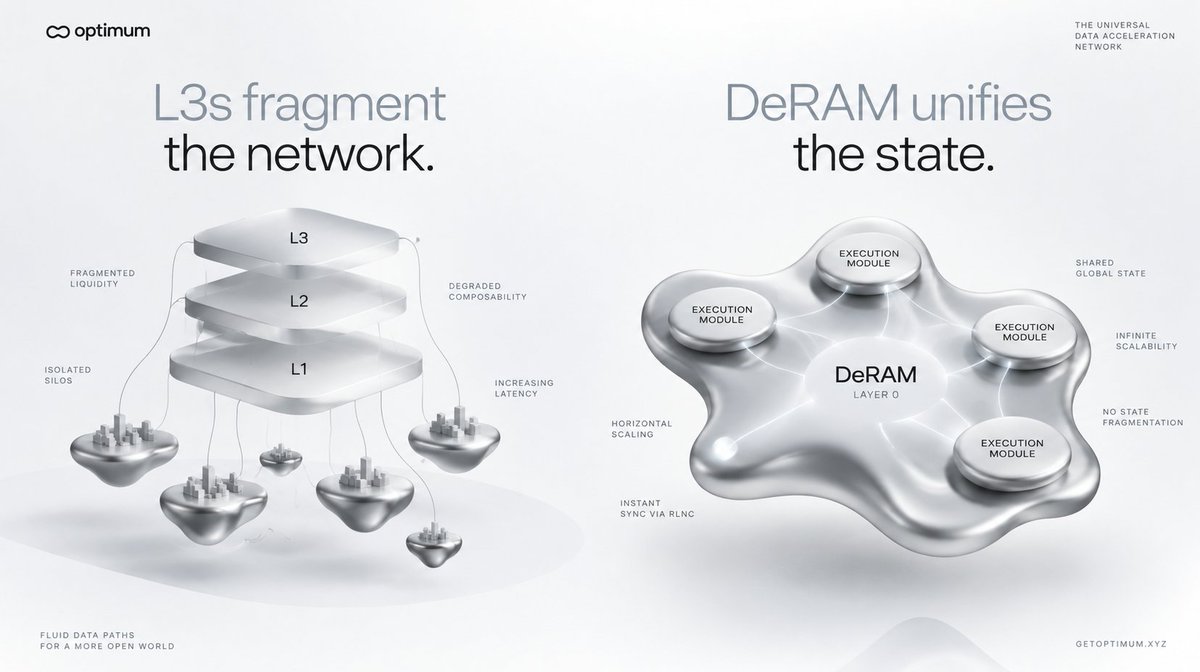
The ecosystem's solution to Layer 2 congestion is to build Layer 3s.
This is an architectural surrender. Stacking rollups on top of rollups exponentially degrades composability and fragments liquidity into increasingly isolated silos. You are trying to solve execution bottlenecks by permanently fracturing the global state.
@get_optimum’s DeRAM makes the concept of L3s structurally obsolete.
By providing an infinite, shared Layer 0 memory, you can scale execution horizontally without ever fragmenting the state. All execution modules compute independently but read and write to the exact same fluid base layer.
Stop building vertical silos to hide your latency.
L3s fragment the network. DeRAM unifies the state.
Capital fragmentation is the most significant inefficiency in modern decentralized finance.
When autonomous systems attempt to deploy strategies across multiple networks they encounter severe latency and bridging vulnerabilities. Standard interoperability protocols require complex wrapped assets and slow finality times. This fragmented architecture prevents artificial intelligence from accessing global liquidity seamlessly.
@RialoHQ engineers a unified execution environment for omnichain capital.
By leveraging universal execution compatibility the network allows AI agents to orchestrate transactions across disparate blockchains from a single secure center. Supported by 200 millisecond finality autonomous entities can arbitrage and settle cross chain liquidity instantly without bridging delays.
The era of isolated networks is concluding. True institutional finance demands a completely borderless algorithmic settlement layer.
The industry is currently obsessed with "Parallel Execution" and high-performance VMs.
But processing transactions in parallel is only half the equation. If your network executes thousands of transactions simultaneously but still forces the resulting state data through a sequential, bottlenecked gossip network, you haven't solved scaling. You've simply moved the traffic jam from the CPU to the propagation layer.
@get_optimum shifts the focus from parallel compute to parallel propagation.
By utilizing DeRAM and mump2p at Layer 0, state updates aren't just processed efficiently; they are routed globally across multiple dynamic paths via RLNC.
Stop optimizing the processor while ignoring the bandwidth.
Parallel execution requires fluid propagation.
@ekinoks_26 A verified-work snapshot is much harder to game than a price snapshot, but the final-hour verification queue introduces its own kind of timing risk.