This video looks like a rotating wheel. But watch just one single sphere. It never rotates. Every ball only moves in a perfectly straight line back and forth.
This is simple harmonic motion where linear position follows:
x = R cos(ωt)
By perfectly offsetting the timing of each straight path, the collective motion creates the illusion of rotation.
Networks of specialized agents working together? Sign me up.
One plans. One executes. One verifies. One adapts.
Aligned, they move faster, think deeper, and handle complexity with ease.
Multi-agent systems = coordinated intelligence at scale.
At the turn of the 18th century, mathematics was exploding with new ideas.
Calculus had just been invented.
Guillaume de l’Hôpital was a wealthy French nobleman passionate about math, but not exactly a genius.
He hired one of the brightest young mathematicians of the time, Johann Bernoulli, as a personal tutor. Bernoulli was so talented that L’Hôpital made him an incredible offer: a yearly salary of 300 francs in exchange for every new discovery he made.
Yes, L’Hôpital bought theorems. Whenever Bernoulli found something new, he sent it to his employer.
In 1696, L’Hôpital published the first calculus textbook, Analyse des Infiniment Petits.
It introduced the famous L’Hôpital’s Rule, how to handle indeterminate limits like 0/0.
But here’s the twist: the rule, and much of the book, were actually written by Bernoulli. After L’Hôpital’s death, Bernoulli revealed the truth and showed the letters proving the arrangement.
Still, L’Hôpital’s name stayed attached to the rule—a reminder that sometimes in science, money buys fame.
Today, every calculus student learns L’Hôpital’s Rule, even if the real author was Johann Bernoulli.
Bayes’ theorem is probably the single most important thing any rational person can learn.
So many of our debates and disagreements that we shout about are because we don’t understand Bayes’ theorem or how human rationality often works.
Bayes’ theorem is named after the 18th-century Thomas Bayes, and essentially it’s a formula that asks: when you are presented with all of the evidence for something, how much should you believe it?
Bayes’ theorem teaches us that our beliefs are not fixed; they are probabilities. Our beliefs change as we weigh new evidence against our assumptions, or our priors. In other words, we all carry certain ideas about how the world works, and new evidence can challenge them.
For example, somebody might believe that smoking is safe, that stress causes mouth ulcers, or that human activity is unrelated to climate change. These are their priors, their starting points. They can be formed by our culture, our biases, or even incomplete information.
Now imagine a new study comes along that challenges one of your priors. A single study might not carry enough weight to overturn your existing beliefs. But as studies accumulate, eventually the scales may tip. At some point, your prior will become less and less plausible.
Bayes’ theorem argues that being rational is not about black and white. It’s not even about true or false. It’s about what is most reasonable based on the best available evidence. But for this to work, we need to be presented with as much high-quality data as possible. Without evidence—without belief-forming data—we are left only with our priors and biases. And those aren’t all that rational.
Docker vs Kubernetes what’s the real difference? 🧵👇
Docker = Packaging & running apps
Docker lets you package your app + dependencies into a container.
That means:
• Same app
• Same behavior
• Runs anywhere
Laptop, server, cloud — no “it works on my machine” drama.
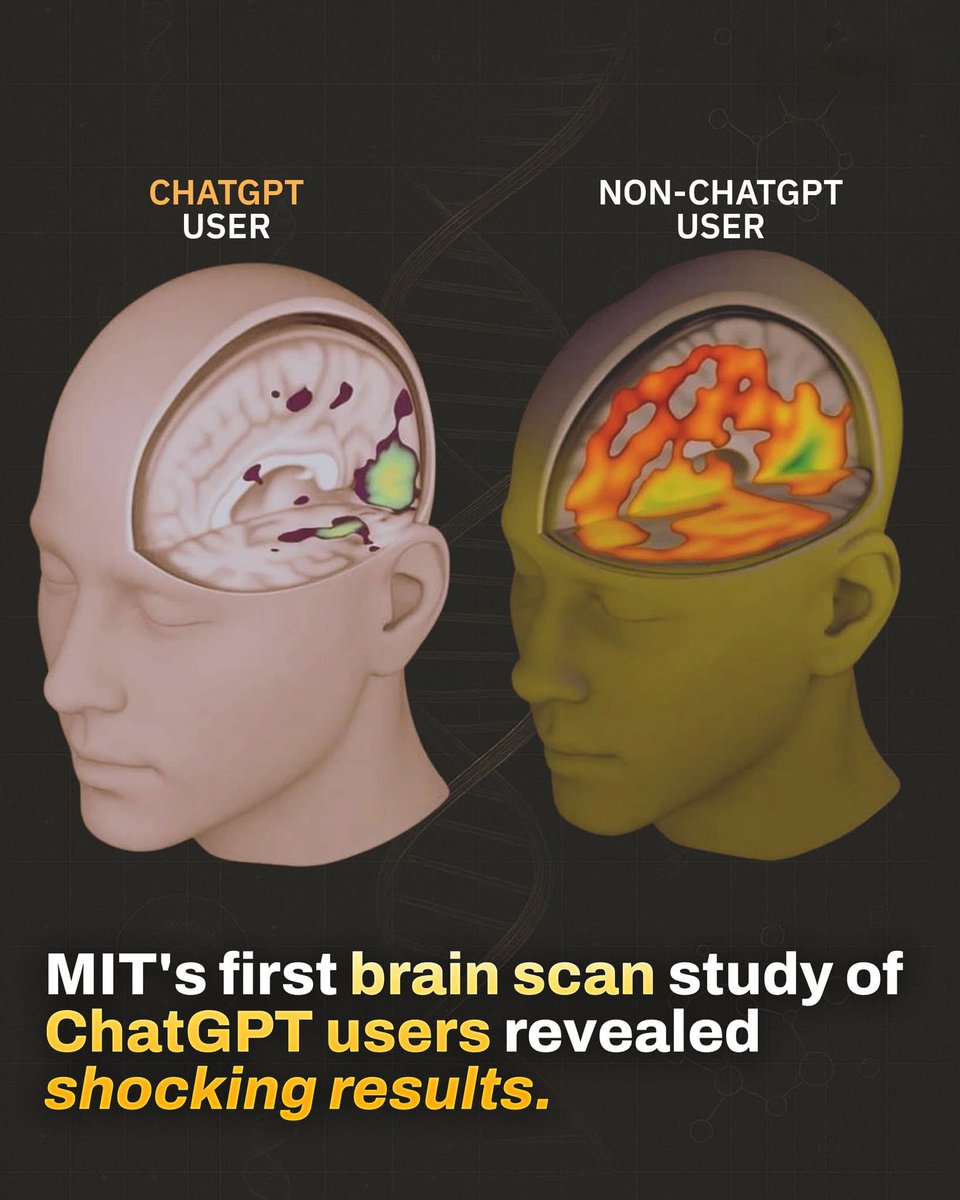
🧠 MIT recently completed the first brain-scan study on ChatGPT users—and the results are deeply revealing.
Rather than boosting brain function, prolonged AI use may be dulling it.
Over four months of cognitive data suggest we might be measuring productivity all wrong ⤵️
In MIT’s study, participants had their brains scanned while using ChatGPT.
→ 83.3% of users couldn’t recall a single sentence they’d written just minutes earlier.
→ In contrast, those writing without AI had no trouble remembering.
Brain connectivity dropped sharply—from 79 to 42 points.
→ That’s a 47% drop in neural engagement.
→ The lowest cognitive performance among all user groups.
Even after stopping ChatGPT use in later sessions, these users showed continued under-engagement.
→ Their performance remained lower than those who never used AI.
→ This suggests more than dependency—it’s cognitive weakening.
Beyond the scans, educators flagged the writing itself.
→ Essays were technically solid, but often called “robotic,” “soulless,” and “lacking depth.”
Here’s the paradox:
→ ChatGPT makes you 60% faster at completing tasks…
→ But it reduces the mental effort required for learning by 32%.
The top-performing group?
→ Those who began without AI and added it later.
→ They retained the best memory, brain activity, and overall scores.
Using ChatGPT can feel empowering—but it may quietly offload your thinking.
→ You gain speed, but lose engagement.
→ You get answers, but stop learning how to think.
The takeaway isn’t to avoid AI—but to use it intentionally.
→ Use it to assist, not replace your mind.
→ Build cognitive strength—not dependency.
MIT’s early study on AI and the brain lays out the stakes. The way we use these tools matters more than ever.
Software engineering isn’t becoming obsolete.
Manual coding is becoming less central.
The shift is toward knowing what to build, why it matters, directing systems to do it safely at scale, validating outcomes, and owning the consequences.
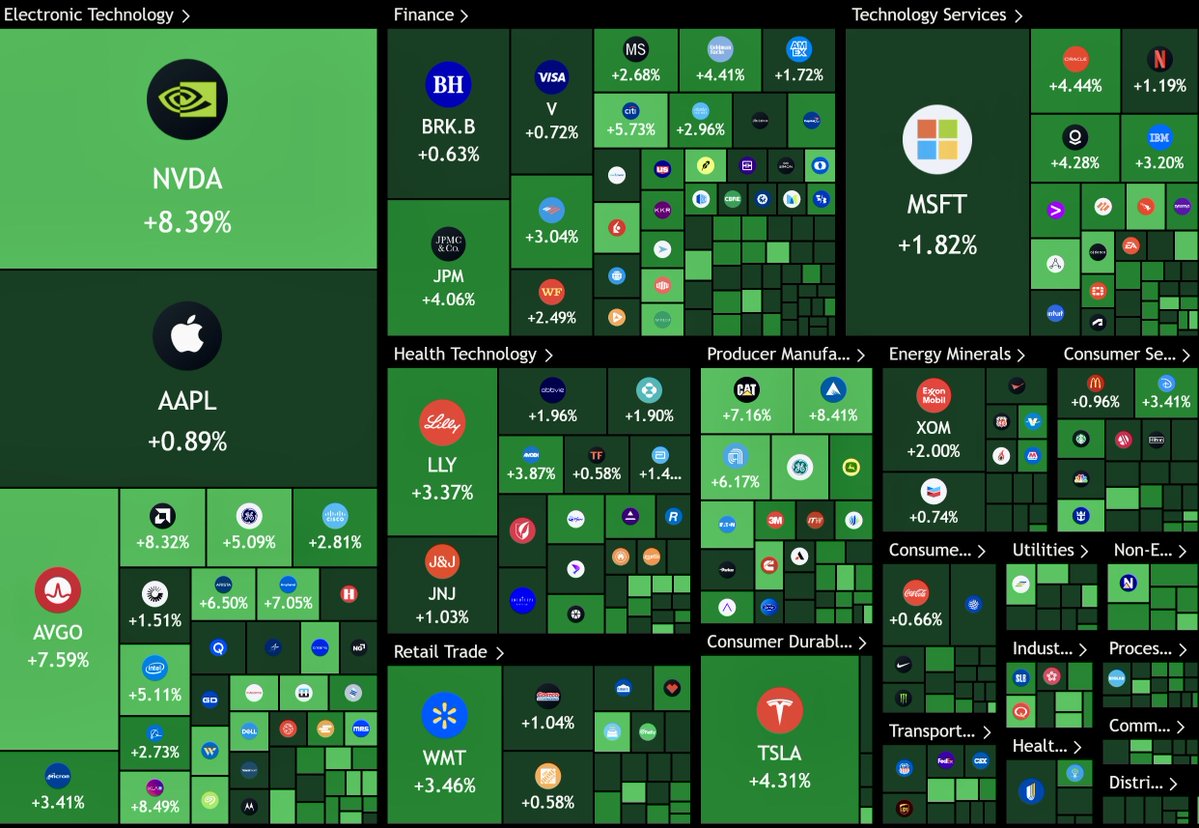
This looks less like a collapse and more like the market shaking out excess bets.
Once the noise clears, the only thing that matters is whether real buyers are still there.
The latest gold puke triggered historic long liquidation, with gold futures open interest collapsing at a pace unseen in two years.
https://t.co/bKmHSSk8kY
@opinion@technology@DaveLeeBBG Wall Street is reacting to capex, not capability.
Scale demands massive upfront spend, and markets get nervous before efficiency shows up.
The real question isn’t how much compute you buy, but how flexibly it’s provisioned and owned.
This is why we're building Dockhive. To operate on a decentralized network, offering enhanced security, transparency, and resistance to censorship.
Basically, your data is distributed across multiple nodes, ensuring better uptime and data sovereignty.
https://t.co/WqmrpiCPyk