1/ We just launched Elata SDK, allowing anyone to build an app for contactless bio-feedback.
For the first time, you can build apps for the web that deliver real-time insights for highly personalized biometrics.
ML runs locally to ensure data privacy without compromising performance.
Let’s get into what this entails 👇
very soon, launching one of these apps will literally be as easy as 1, 2, 3.
the model that ingests raw data will also never be centralized. everything will run locally, and device compatibility will be vast
Thinking of participating in a token sale?
The sale valuation is what matters most.
We analyzed 63 token sales and grouped them by valuation at the time of raise. Only the lowest valuation buckets (<$50M) showed positive returns. Above that, outcomes turn consistently negative, with some cohorts down as much as ~60%.
In token sales, the only edge is not overpaying.
1/ What is Elata?
Elata is a launchpad for brain interfacing apps.
We’ve combined easy browser tools with private, on-device processing and cryptoeconomics to help anyone ship one.
It’s orchestrated so builders get paid fairly and users can actually own a piece of the value they create.
Unfortunately, my team got cut in the layoffs. A disappointing outcome to an otherwise fantastic experience. I’m very grateful to have been a Messari Research Analyst.
What I can confidently say is that quality thought-leadership is presently the most undervalued resource in crypto. The mediocrity of AI-driven writing and reasoning has convinced many that it is a suitable replacement for a research analyst.
I promise you - it isn’t.
Frontier technologies today (crypto, AI, robotics, quantum) are hyper-ideological and incredibly contentious. We’re entering a new era that demands human judgement and debate. LLMs will tell you what’s consensus.
Ask any LLM today if an intelligent person should pivot from crypto to AI; they all say yes.
We need thought-leaders willing to play 4D chess in public and get a couple moves wrong before they win the match. Humanity is incredibly undervalued in the 21st century.
Lastly, the talent density at Messari was unlike anything I’ve ever seen. Any crypto companies hiring should reach out to myself, Diran, or any of the Messari folks directly to get in contact if you’re looking to hire.
.@USDai_Official is launching its $CHIP TGE soon.
i just published a 30-page valuation report that is free for all to access:
https://t.co/kgR6ZLCO2s
let's break down the key points:
1) what is https://t.co/dnwHcmkify?
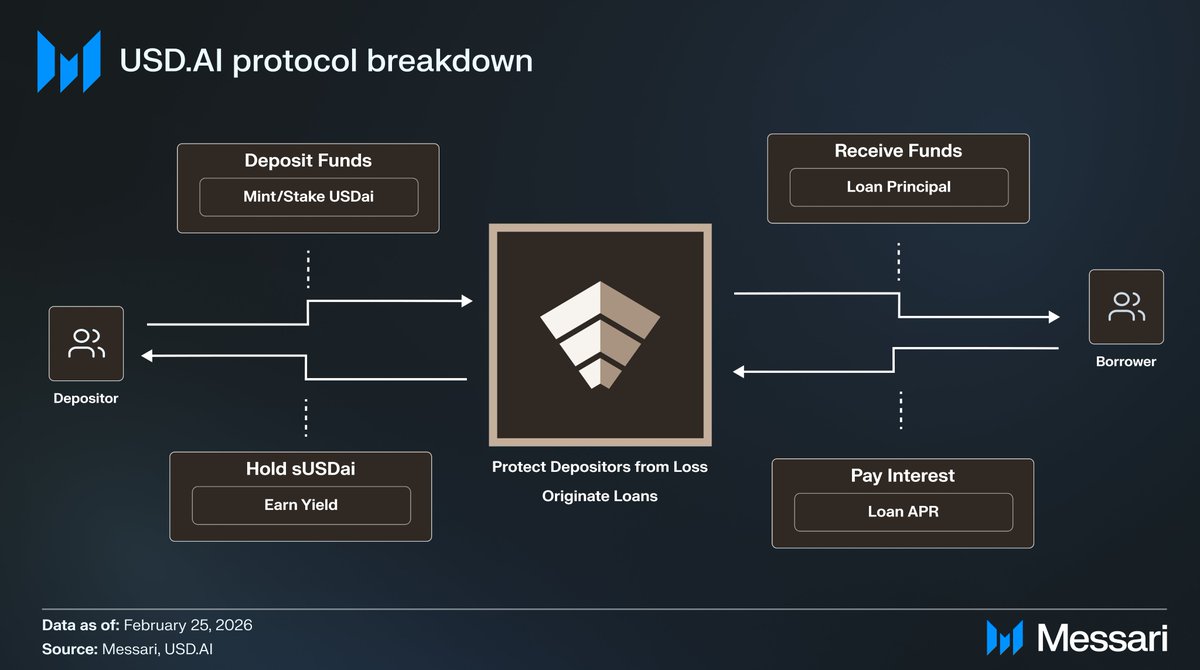
https://t.co/dnwHcmkify is an onchain credit protocol financing real-world AI infrastructure.
the protocol originates stablecoin-denominated loans backed by GPU hardware and related compute assets, bridging onchain capital with offchain infrastructure deployment.
https://t.co/dnwHcmkify issues two core tokens:
> $USDai – a dollar-denominated token used for minting, funding, and redemptions
> $sUSDai – a yield-bearing vault share representing exposure to deployed AI infrastructure loans
2) how does https://t.co/dnwHcmkify work?
https://t.co/dnwHcmkify sits between borrowers seeking upfront capital to deploy AI compute infrastructure and capital providers seeking dollar-denominated yield.
the protocol structures collateral, underwrites risk, coordinates funding, and manages liquidity and redemption mechanics within an onchain framework.
CALIBER provides the legal and technical backbone for representing GPU hardware as enforceable onchain collateral.
Queue Extractable Value (QEV) is the queue-based redemption mechanism used to manage liquidity against amortizing, illiquid collateral.
3) what does https://t.co/dnwHcmkify’s adoption look like?
https://t.co/dnwHcmkify currently has:
> $475M TVL
> 6.65% $sUSDai APY
> $8M in active loans
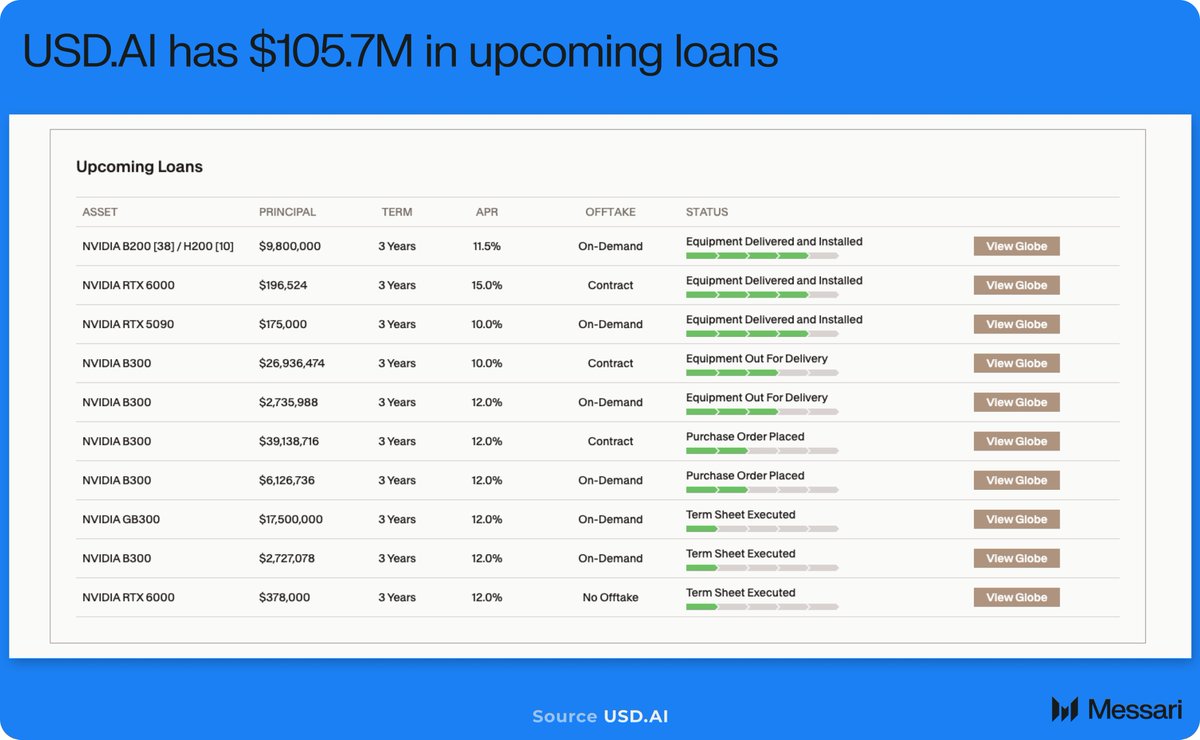
> $105M in near-term pipeline
> $1.5B+ expected loan volume over the next year
execution, not demand, is the binding constraint.
4) what is $CHIP?
$CHIP is https://t.co/dnwHcmkify’s governance and risk-policy token.
it governs:
> collateral standards
> underwriting parameters
> fee surfaces and routing
> interest rate controls
> treasury and capital policy
CHIP’s utility can be grouped into three domains:
1. governance and protocol control
2. revenue governance and capital allocation
3. staking module and insurance backstop
importantly, there is no mechanically enforced claim on protocol cash flows. Value accrual is governance-contingent.
5) how exactly did I value $CHIP?
i did not assume $CHIP automatically gets protocol cash flows, as there is currently no hard-coded revenue share.
so instead of forcing a DCF, I built the valuation from protocol mechanics up.
i model $CHIP using two complementary lenses:
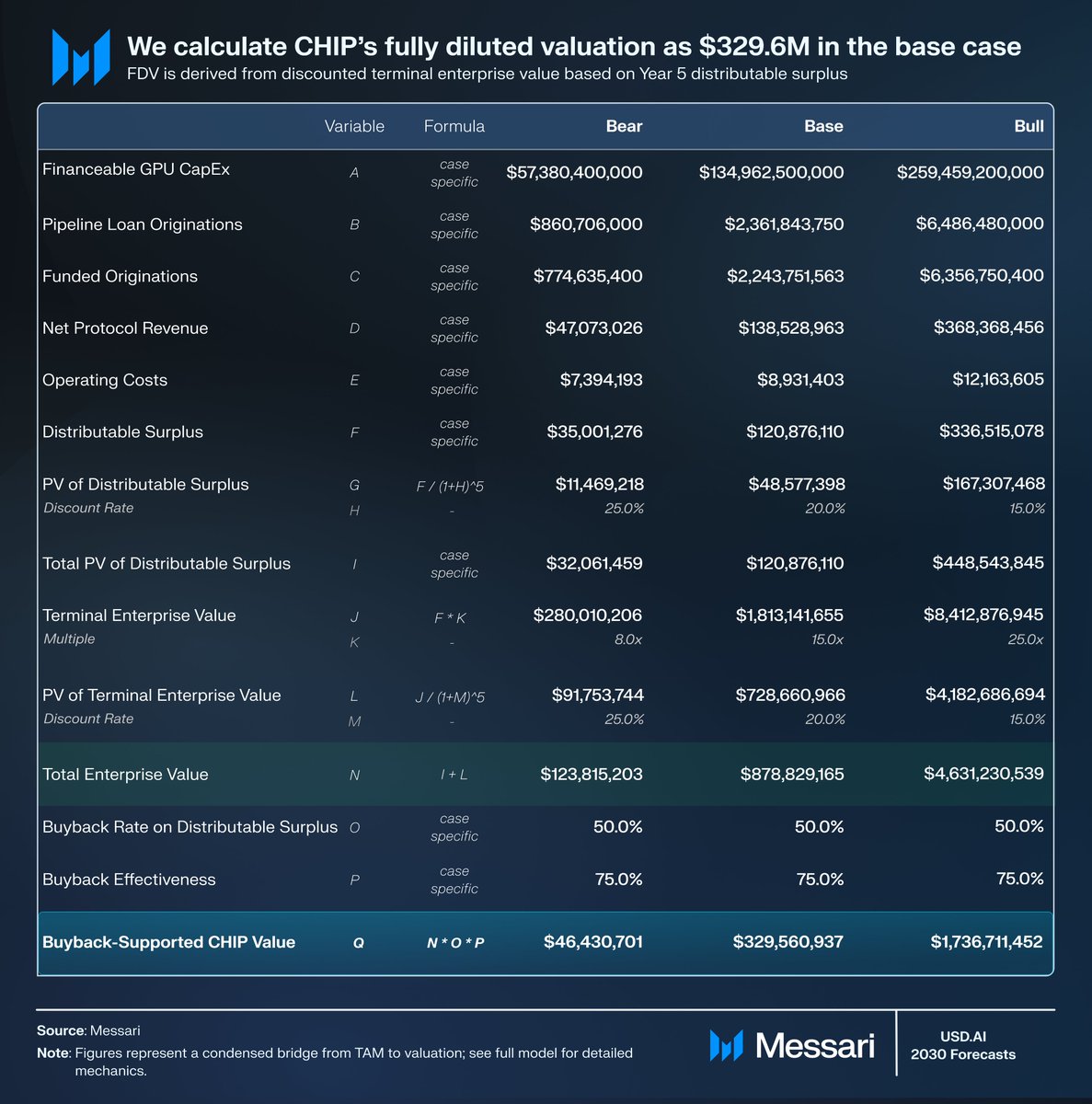
>> Buyback-supported value
i project distributable surplus (Years 1–5), discount it to present value, and add a terminal enterprise value based on Year 5 surplus: PV of distributable surplus + PV of terminal EV = total EV.
Then I apply governance-contingent assumptions: buyback rate & buyback effectiveness.
This produces a buyback-supported FDV range of:
> Bear: $46.4M
> Base: $329.6M
> Bull: $1.74B
This pathway only works if governance actually routes surplus to tokenholders.
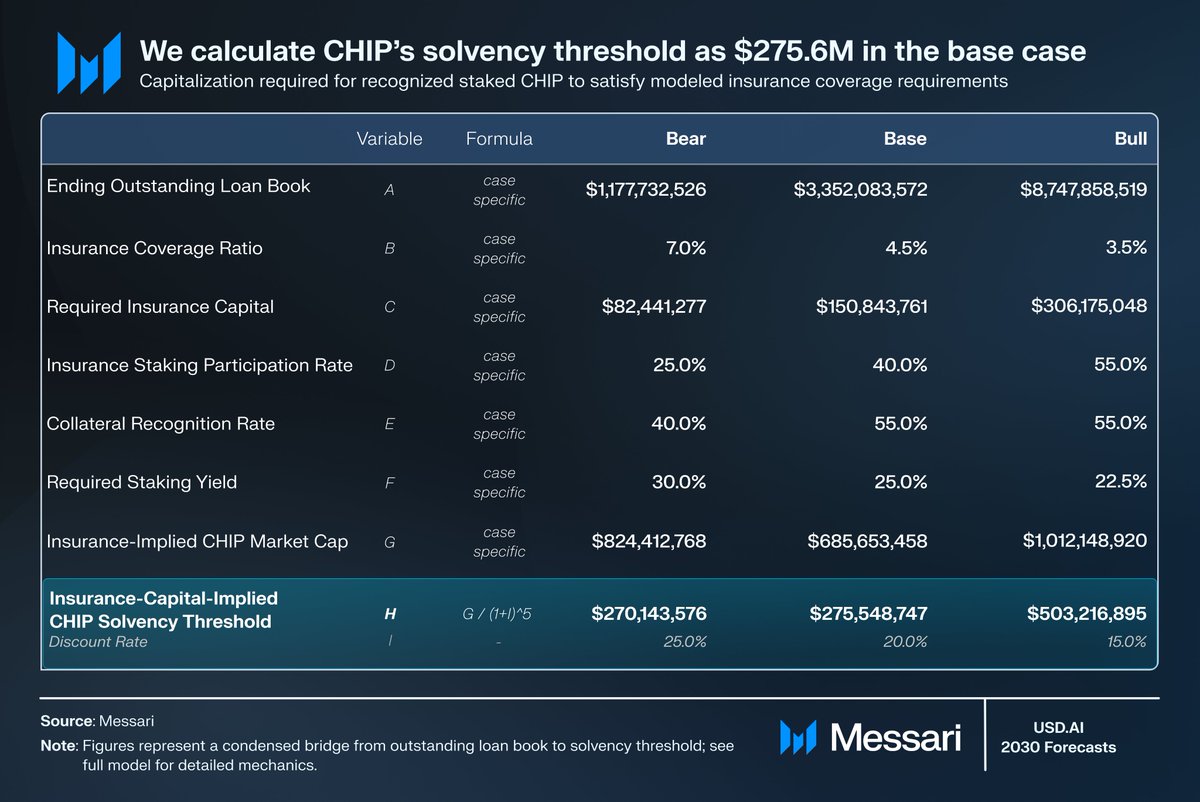
>> Insurance-capital-implied solvency threshold
$CHIP may function as recognized backstop capital in the insurance module. Under this lens, valuation is driven by:
> outstanding funded exposure
> coverage requirement
> required backstop capital
> staking participation & recognition rate
> required staking yield
the outputs are the FDVs at which staked $CHIP would be sufficient to meet modeled coverage requirements. They are not price targets, but capital adequacy thresholds:
> Bear: $270.1M
> Base: $275.6M
> Bull: $503.2M
together, these two lenses bracket the investment question:
> can https://t.co/dnwHcmkify convert pipeline into funded originations at scale?
> can it maintain capital efficiency?
> will governance establish credible, repeatable value routing?
6) disclaimer: i do not hold $CHIP at time of writing. this is not investment advice.
Tempo's Dan Romero explains why the future of AI agents will be "stablecoin-native."
John: "Why wouldn't I just give OpenClaw my credit card?"
@DWR: "The credit card itself is kind of a private key, having that get prompt-injected out, maybe not the best thing in the world."
“If you have agent swarms, the idea of spinning up a new credit card for each individual sub-agent doesn’t make sense. With wallets, you can spin up as many as you want and manage the balances for each agent.”
“An API call to any of these frontier labs right now is pay-per-call. You’re eventually going to get to a point where, for every single API call, you can just pay some amount of stablecoins in the background and keep moving.”