Now that ZKEVMs are at alpha stage (production-quality performance, remaining work is safety) and PeerDAS is live on mainnet, it's time to talk more about what this combination means for Ethereum.
These are not minor improvements; they are shifting Ethereum into being a fundamentally new and more powerful kind of decentralized network.
To see why, let's look at the two major types of p2p network so far:
BitTorrent (2000): huge total bandwidth, highly decentralized, no consensus
Bitcoin (2009): highly decentralized, consensus, but low bandwidth - because it’s not “distributed” in the sense of work being split up, it’s *replicated*
Now, Ethereum with PeerDAS (2025) and ZK-EVMs (expect small portions of the network using it in 2026), we get: decentralized, consensus and high bandwidth
The trilemma has been solved - not on paper, but with live running code, of which one half (data availability sampling) is *on mainnet today*, and the other half (ZK-EVMs) is *production-quality on performance today* - safety is what remains.
This was a 10-year journey (see the first commit of my original post on DAS here: https://t.co/Fa0jKFgObW , and ZK-EVM attempts started in ~2020), but it's finally here.
Over the next ~4 years, expect to see the full extent of this vision roll out:
* In 2026, large non-ZKEVM-dependent gas limit increases due to BALs and ePBS, and we'll see the first opportunities to run a ZKEVM node
* In 2026-28, gas repricings, changes to state structure, exec payload going into blobs, and other adjustments to make higher gas limits safe
* In 2027-30, large further gas limit increases, as ZKEVM becomes the primary way to validate blocks on the network
A third piece of this is distributed block building.
A long-term ideal holy grail is to get to a future where the full block is *never* constituted in one single place. This will not be necessary for a long time, but IMO it is worth striving for us at least have the capability to do that.
Even before that point, we want the meaningful authority in block building to be as distributed as possible. This can be done either in-protocol (eg. maybe we figure out how to expand FOCIL to make it a primary channel for txs), or out-of-protocol with distributed builder marketplaces. This reduces risk of centralized interference with real-time transaction inclusion, AND it creates a better environment for geographical fairness.
Onward.
1/ Now live: the Ethereum for Institutions site
Ethereum is the neutral, secure base layer where the world's financial value is coming onchain
Today, we’re launching a new site for the builders, leaders, and institutions advancing this global movement
ETH is going to $10k—by year end
> We are still in a crypto renaissance
> ETH is still an institutional store of value alongside BTC
> ETH is generating 3% to 7% yield with restaking
> The Ethereum economy (L1, L2s, apps) still functioned seamlessly
Crypto is…
Desperate gamblers chasing their first bag.
Investors funding the buildout of the global casino.
Bankers hypnotizing the masses to collect their vig.
…all meaningless and ephemeral without the cypherpunks, who defend the dream of encrypted and unstoppable cash.
🚨Yesterday’s markets put every chain to the test. Here’s how Ethereum performed compared to others under heavy load
Ethereum processed over 2,835 TPS with less than 1% failure rate ⚡️
solana processed less than 1,800 true TPS, 99% TX failure rate leading to MASS LIQUIDATION🤮
I just sent some ETH from one address to another on Arbitrum by force-including my transaction on Ethereum L1, without touching Arbitrum's sequencer at all
Always knew this was possible, but actually doing it made me realise how powerful truly permissionless Ethereum L2s are
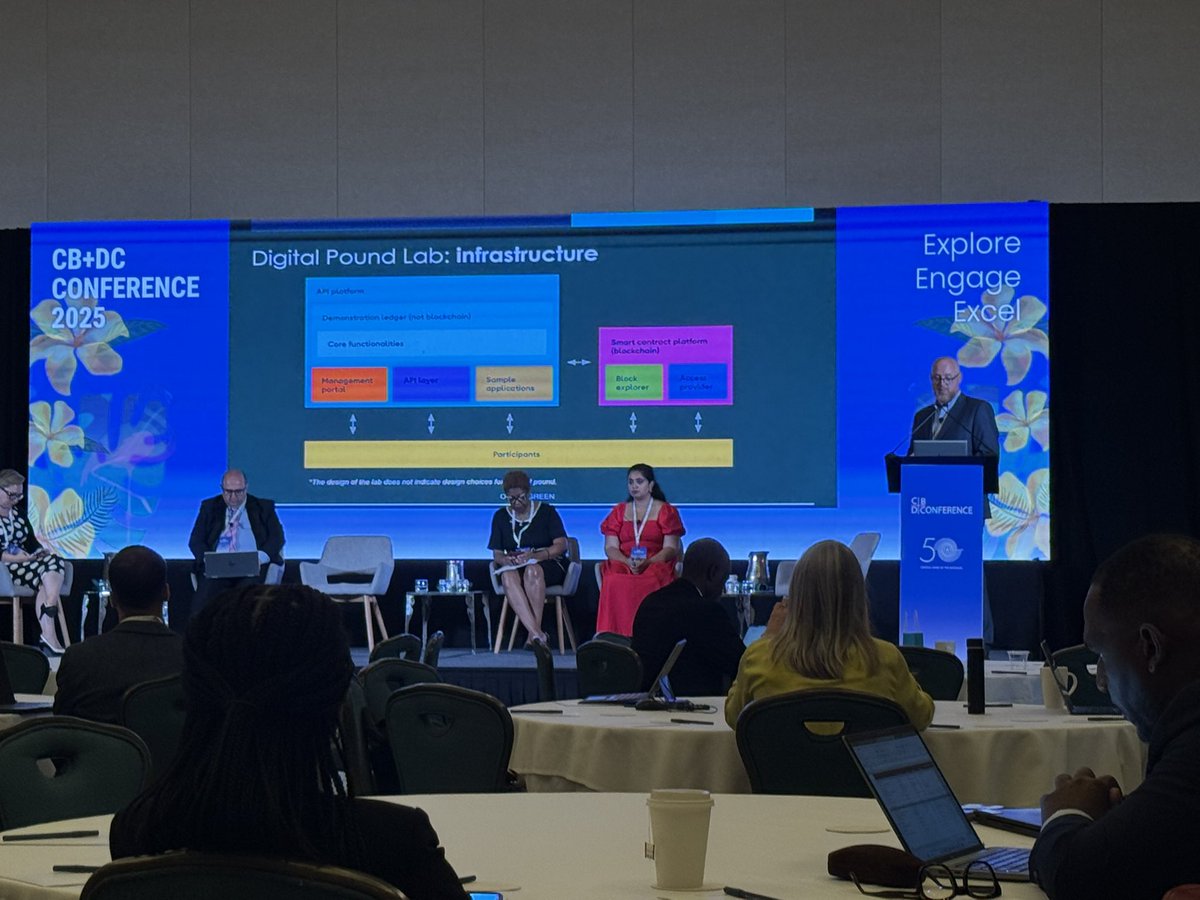
At a CBDC conference in the Bahamas
Spoke to a top German bank saying 50% working capital cost cuts are possible with 20-30% savings on all debt / treasury operations - but private blockchains. Like $50-100m of annual savings per large client. Very material
It increasingly seems like CBDCs in Europe are inevitable due to “monetary sovereignty” considerations. The Bank Of England is currently in a pilot and their chain will have a smart contract platform bolted on (you’re tired of corporate L1s anon? Wait til every country having one). Mainnet decision for BoE in 2026
I pointed out to the German banker that the working capital debt instruments could be tokenized and traded by non KYCed degenerates who were forced by Trump to keep their money in stables. He started laughing and then realized I was right
Canton network and other American players already making inroads there
But this creates a really interesting set up. Everyone saw how Pendle looping got usde $6b of TVL in a month. One thing we know about speculators is that they love carry trades
Even if usde only has 7% yields the defi primitives enable leveraged bets that make interesting returns for typical retail
There will be a situation where every corporate liability is on chain (with a yield) - and has public blockchain representations even if the core assets are on private blockchains
So the “real world asset” thesis is initially a corporate treasury optimization function, that gets turbo charged by CBDCs. One *could* view this as competitive for a lot of existing L1s and you’d be right at a surface level
If the BOE has a smart contract platform on its CBDC then why would a UK corporate use another platform
But this analysis misses the Pendle thing.
Let’s say you start looping Siemens corporate liabilities. That’s great until you realize one is denominated in euros and the other is usd. So it won’t work as well. So contracts will be created on the back end to automatically swap yields into UsD equivalents
Your eyes are rolling back at this point but basically what I’m saying is
1) the German corporations are coming on chain to save money. They can’t help it - they’re Germans and have to optimize everything
2) the Europeans and UK are coming on chain via CBDCs for political sovereignty bc they hate Trump. This is also why they’re arming themselves
3) these assets and chains will be interoperable with existing smart contract platforms
4) the resulting yield trades will have massive fx risk when juxtaposed with massive US dollar stable supply
5) people will solve this and you’ll have a system where you can literally leverage trade any fixed income spread in the world from your web browser
6) the Korean and Japanese retail trading markets are huge crypto volume drivers and already *very familiar* with fx carry trades.
ALL FUTURE ASSETS WILL BE LOOPED ON CHAIN
Nobody is talking about it which is why I’m writing about it a bit
The very simple conclusion of all the above is that
1) Ethereum is going to go deflationary bc the stablecoin ramp will be accompanied by European RWA surge
2) the RWA assets probably end up represented and traded on blockchains so all the exchanges make more money
3) this all results in huge fx trading volume increases (probably why Ripple acquired hidden road)
4) the most incremental asset is probably fixed income spreads - which is why Canton network and fixed income clearing on chain is succeeding (has Goldman Sachs already). MASSIVE CARRY TRADES
5) average Uk/ EU citizens who are already alarmed by censored internet will freak out about CBDCs and get crypto pilled. The CBDCs ironically serve as on ramps
So the entire CBDC/RWA configuration is massively bullish. Galaxy stock should work. ETH/ SOL on the RWA ramp. We need to see ripple actually articulate how this links to hidden road for xrp to pump. Bullish all exchanges and super bullish all defi protocols. Then BTC for all the blackpilled euros
did you know
that the enterprise team at the @ethereumfndn has done 120 calls this month alone, with banks, F500s, and even governments.
@davwals@_ashmorgan_@ismiMatthew & @motypes are leading the charge, follow them!
Amazing to see so many major L2s now at stage 1.
The next goal we should shoot for is, in my view, fast (<1h) withdrawal times, enabled by validity (aka ZK) proof systems.
I consider this even more important than stage 2.
Fast withdrawal times are important because waiting a week to withdraw is simply far too long for people, and even for intent-based bridging (eg. ERC-7683), the cost of capital becomes too high if the liquidity provider has to wait a week. This creates large incentives to instead use solutions with unacceptable trust assumptions (eg. multisigs/MPC) that undermine the whole point of having L2s instead of fully independent L1s.
If we can reduce native withdrawal times to under 1h short term, and 12s medium term, then we can further cement the Ethereum L1 as the default place to issue assets, and the economic center of the Ethereum ecosystem.
To do this, we need to move away from optimistic proof systems, which inherently require waiting multiple days to withdraw.
Historically, ZK proof tech has been immature and expensive, which made optimistic proofs the smart and safe choice. But recently, this is changing rapidly. https://t.co/MRqAcqiGre is an excellent place to track the progress of ZK-EVM proofs, which have been improving rapidly. Formal verification on ZK proofs is also advancing.
Earlier this year, I proposed a 2-of-3 ZK + OP + TEE proof system strategy that threads the needle between security, speed and maturity:
https://t.co/Z5N81HiiNi
* 2 of 3 systems (ZK, OP) are trustless, so no single actor (incl TEE manufacturer or side channel attacker) can break the proof system by violating a trust assumption
* 2 of 3 systems (ZK, TEE) are instant, so you get fast withdrawals in the normal case
* 2 of 3 systems (TEE, OP) have been in production in various contexts for years
This is one approach; perhaps people will opt to instead do ZK + ZK + OP tiebreak, or ZK + ZK + security council tiebreak. I have no strong opinions here, I care about the underlying goal, which is to be fast (in the normal case) and secure.
With such proof systems, the only remaining bottleneck to fast settlement becomes the gas cost of submitting proofs onchain. This is why short term I say once per hour: if you try to submit a 500k+ gas ZK proof (or a 5m gas STARK) much more often, it adds a high additional cost.
In the longer term, we can solve this with aggregation: N proofs from N rollups (plus txs from privacy-protocol users) can be replaced by a single proof that proves the validity of the N proofs. This becomes economical to submit once per slot, enabling the endgame: near-instant native cross-L2 asset movement through the L1.
Let's work together to make this happen.