**Official Toccata Release — Mainnet Hardfork Activation Included** (Links in reply)
We’re excited to announce the official Kaspa release containing the **Toccata Hardfork** activation logic.
Toccata is scheduled to activate on mainnet at DAA score `474,165,565`, expected around **June 30, 2026, 16:15 UTC**.
This is a consensus-changing upgrade. All node operators, miners, pools, exchanges, indexers, wallets, and infrastructure providers must upgrade before activation to remain compatible with the network.
Toccata introduces a major expansion of Kaspa L1 capabilities, including:
• **Native L1 covenant support** through transaction introspection, allowing for more expressive contracts, including stateful contracts
• **Covenant IDs**, providing stable covenant lineage across UTXO transitions, so covenant instances can preserve continuity as their state moves from one UTXO to the next
• **ZK proof verification on L1** via `OpZkPrecompile`, enabling to trustlessly offload computation off-chain.
• **Partitioned sequencing commitments**, improving support for based ZK applications by making lane-local proving scale with relevant activity rather than global throughput
Please upgrade as soon as possible and verify your nodes are running the new release well before the activation DAA score.
Thank you to everyone who contributed to designing, implementing, reviewing, and testing Toccata.
4/ I designed it to be model/provider agnostic and free/local-friendly.
You can adapt the transport: Codex, Claude, local models, CLI workers, whatever.
The protocol matters more than the exact model setup.
#OpenSource#Codex#Claude
1/ Built a small artifact-based protocol for multi-model coding collaboration.
It lets two coding agents plan and review together without relying on hidden chat memory.
Repo:
https://t.co/5eI1gjYET7
#AI#CodingAgents#DevTools
3/ The main idea: use files as the coordination layer.
Plans, critiques, implementation summaries, validation output, and final reviews are written under .context/multimodel/.
That makes the process inspectable, resumable, and less dependent on whatever one agent remembers
2/ The workflow is split into three skills:
colab-plan: two models plan independently, critique each other, then converge on one implementation plan
colab-implement: model implements the plan
colab-review: both models review, cross-check findings, then produce one joint review
Within eight weeks of open mainnet, a working DeFi ecosystem with $4.5M in liquidity deployed on Igra:
- ZealousSwap: Uniswap v.2 AMM https://t.co/v67gLBkZS2
- Kaskad: collateralization and leverage for KAS https://t.co/PxW4KMHshf
- Nuntius: TEE-based Composite Order Book oracle https://t.co/0SeesZ0pHI
- KaspaCom: KRC-20 and L1-native DeFi, positioned for covenants post-Toccata https://t.co/44fHWCAklO
- INS: Igra Name Service, identity primitive https://t.co/9vyhTHb6K4
- Hyperlane: cross-chain warp routes https://t.co/jqefspU94P
- Attesting protocol: 14 independent attesters with 33M IGRA staked https://t.co/gGXZ3N2Hus
- KAT Bridge: KRC-20 to ERC-20, iKAS entries and exits https://t.co/6XTjBTGLgJ.
We optimize so builders ship faster by working directly with core and ecosystem teams.
Come build with us.
https://t.co/2Ob6cVGeQs | https://t.co/qDgoreSOQC
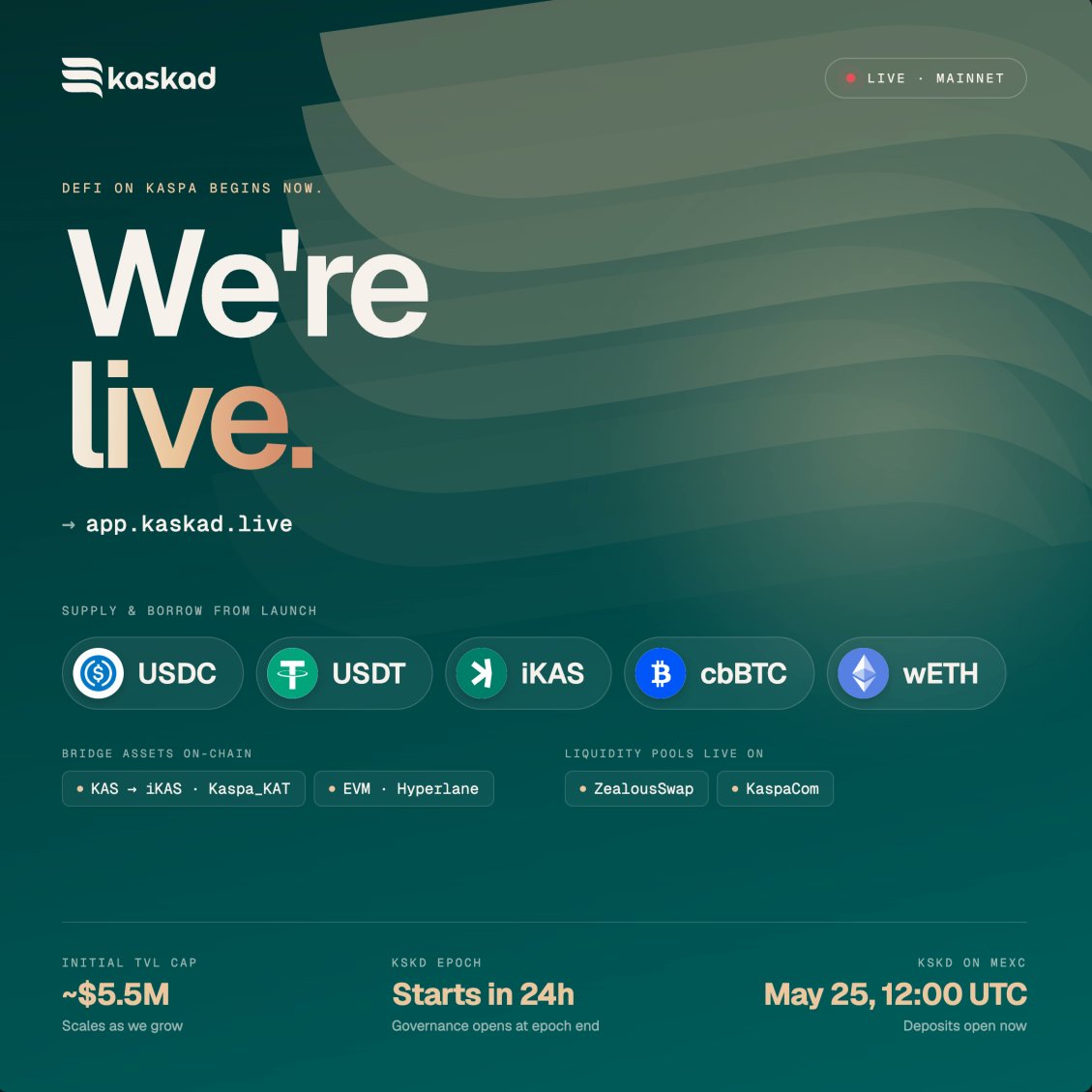
Kaskad is now LIVE on https://t.co/1lOpEQ8dyU !
You can now put your KAS to work via @Igra_Labs!
What's available from launch: Supply and borrow USDC, USDT, iKAS, cbBTC, and wETH — more assets will be added in the upcoming weeks.
💎To early KSKD investors: your TGE allocation is ready to claim in the vesting module.
Access is restricted to whitelisted and verified participants only.
KSKD deposits are now open on @MEXC and the KSKD listing will start on May 25, 12:00 UTC. Getting assets on-chain:
Bridge routes:
→ KAS → iKAS via @Kaspa_KAT bridge https://t.co/oT4kTkSyC7
→ EVM assets via @hyperlane bridge → Liquidity pools live on @ZealousSwap and @KaspaCom
We've intentionally set an initial max TVL cap of ~$5.5M; it lets us validate all systems under real conditions smoothly and safely before scaling. Caps increase as the platform grows.
KSKD epoch starts in 24h. Governance window will open at the end of the first epoch.
Let the DeFi on Kaspa begin 🔥🔥🔥!
Fast, secure, and simple: swap Kaspa (KAS) in Ledger Wallet!
No need to move your assets to an exchange. Approve your swap directly on your Ledger signer and keep your private keys offline 🔐
Head over to Ledger Wallet now to swap KAS.
$IGRA ON @DeBankDeFi 🏦
One of THE BEST DeFi portfolio trackers out there. They let communities vote to add new chains.
@Igra_Labs Mainnet is up for voting. 35 Votes already, link in first reply.
$KAS Fam, it takes 30 seconds:
Connect wallet
→ Vote
→ Done ✅
@Igra_Labs delivers the based rollup evm compatible layer, @AppKaskad services instant liquidity and yield services, @hyperlane unlocks the gates of stables from all EVM chains, and @Tangem let's you store and spend your stables however you want, securely.
All of this sequenced on Kaspa L1 🤝
Today is a monumentous day for quantum computing and cryptography. Two breakthrough papers just landed (links in next tweet). Both papers improve Shor's algorithm, infamous for cracking RSA and elliptic curve cryptography. The two results compound, optimising separate layers of the quantum stack. The results are shocking. I expect a narrative shift and a further R&D boost toward post-quantum cryptography.
The first paper is by Google Quantum AI. They tackle the (logical) Shor algorithm, tailoring it to crack Bitcoin and Ethereum signatures. The algorithm runs on ~1K logical qubits for the 256-bit elliptic curve secp256k1. Due to the low circuit depth, a fast superconducting computer would recover private keys in minutes. I'm grateful to have joined as a late paper co-author, in large part for the chance to interact with experts and the alpha gleaned from internal discussions.
The second paper is by a stealthy startup called Oratomic, with ex-Google and prominent Caltech faculty. Their starting point is Google's improvements to the logical quantum circuit. They then apply improvements at the physical layer, with tricks specific to neutral atom quantum computers. The result estimates that 26,000 atomic qubits are sufficient to break 256-bit elliptic curve signatures. This would be roughly a 40x improvement in physical qubit count over previous state-of-the-art. On the flip side, a single Shor run would take ~10 days due to the relatively slow speed of neutral atoms.
Below are my key takeaways. As a disclaimer, I am not a quantum expert. Time is needed for the results to be properly vetted. Based on my interactions with the team, I have faith the Google Quantum AI results are conservative. The Oratomic paper is much harder for me to assess, especially because of the use of more exotic qLDPC codes. I will take it with a grain of salt until the dust settles.
→ q-day: My confidence in q-day by 2032 has shot up significantly. IMO there's at least a 10% chance that by 2032 a quantum computer recovers a secp256k1 ECDSA private key from an exposed public key. While a cryptographically-relevant quantum computer (CRQC) before 2030 still feels unlikely, now is undoubtedly the time to start preparing.
→ censorship: The Google paper uses a zero-knowledge (ZK) proof to demonstrate the algorithm's existence without leaking actual optimisations. From now on, assume state-of-the-art algorithms will be censored. There may be self-censorship for moral or commercial reasons, or because of government pressure. A blackout in academic publications would be a tell-tale sign.
→ cracking time: A superconducting quantum computer, the type Google is building, could crack keys in minutes. This is because the optimised quantum circuit is just 100M Toffoli gates, which is surprisingly shallow. (Toffoli gates are hard because they require production of so-called "magic states".) Toffoli gates would consume ~10 microseconds on a superconducting platform, totalling ~1,000 sec of Shor runtime.
→ latency optimisations: Two latency optimisations bring key cracking time to single-digit minutes. The first parallelises computation across quantum devices. The second involves feeding the pubkey to the quantum computer mid-flight, after a generic setup phase.
→ fast- and slow-clock: At first approximation there are two families of quantum computers. The fast-clock flavour, which includes superconducting and photonic architectures, runs at roughly 100 kHz. The slow-clock flavour, which includes trapped ion and neutral atom architectures, runs roughly 1,000x slower (~100 Hz, or ~1 week to crack a single key).
→ qubit count: The size-optimised variant of the algorithm runs on 1,200 logical qubits. On a superconducting computer with surface code error correction that's roughly 500K physical qubits, a 400:1 physical-to-logical ratio. The surface code is conservative, assuming only four-way nearest-neighbour grid connectivity. It was demonstrated last year by Google on a real quantum computer.
→ future gains: Low-hanging fruit is still being picked, with at least one of the Google optimisations resulting from a surprisingly simple observation. Interestingly, AI was not (yet!) tasked to find optimisations. This was also the first time authors such as Craig Gidney attacked elliptic curves (as opposed to RSA). Shor logical qubit count could plausibly go under 1K soonish.
→ error correction: The physical-to-logical ratio for superconducting computers could go under 100:1. For superconducting computers that would be mean ~100K physical qubits for a CRQC, two orders of magnitude away from state of the art. Neutral atoms quantum computers are amenable to error correcting codes other than the surface code. While much slower to run, they can bring down the physical to logical qubit ratio closer to 10:1.
→ Bitcoin PoW: Commercially-viable Bitcoin PoW via Grover's algorithm is not happening any time soon. We're talking decades, possibly centuries away. This observation should help focus the discussion on ECDSA and Schnorr. (Side note: as unofficial Bitcoin security researcher, I still believe Bitcoin PoW is cooked due to the dwindling security budget.)
→ team quality: The folks at Google Quantum AI are the real deal. Craig Gidney (@CraigGidney) is arguably the world's top quantum circuit optimisooor. Just last year he squeezed 10x out of Shor for RSA, bringing the physical qubit count down from 10M to 1M. Special thanks to the Google team for patiently answering all my newb questions with detailed, fact-based answers. I was expecting some hype, but found none.
🚨 CRITICAL: Active supply chain attack on axios -- one of npm's most depended-on packages.
The latest [email protected] now pulls in [email protected], a package that did not exist before today. This is a live compromise.
This is textbook supply chain installer malware. axios has 100M+ weekly downloads. Every npm install pulling the latest version is potentially compromised right now.
Socket AI analysis confirms this is malware. plain-crypto-js is an obfuscated dropper/loader that:
• Deobfuscates embedded payloads and operational strings at runtime
• Dynamically loads fs, os, and execSync to evade static analysis
• Executes decoded shell commands
• Stages and copies payload files into OS temp and Windows ProgramData directories
• Deletes and renames artifacts post-execution to destroy forensic evidence
If you use axios, pin your version immediately and audit your lockfiles. Do not upgrade.
Our @woods_wandererr is at @EthCC next week — feel free to connect! He can geek out on anything from IgReth and DAG reorg handling, public nodes orchestration to ATAN and what it actually takes to build an EVM rollup on proof-of-work.
$IGRA is security and governance token of Igra Network, decentralized EVM layer on Kaspa BlockDAG.
4.5M KAS volume and more than 1,300 bids in three days. No VCs, no market making, all community-based. Open to everyone.
Three more days.
FAQ: https://t.co/AkgaoKZfbr
Telegram: https://t.co/JBObsp4KNs
ZAP: https://t.co/6gtBg4YRav
⚠️ Warning: A fake IGRA token has appeared on Kasfun using our branding. The only official IGRA token is on Igra Mainnet: https://t.co/5C0dM9btsk . Do not engage with anything else. If it's not on Igra Mainnet at this address, it's not $IGRA.
🙌 You can now participate in the $IGRA Public Auction directly from your Zelcore wallet!
Bridge your $KAS to iKAS and join a fully onchain, permissionless token auction on @Igra_Labs, where the market sets the price.
Here’s a simple guide to get started:
👉https://t.co/zWW3Iq085e
Safe{Wallet} is now live on Igra Mainnet: https://t.co/Pglev8ekWo.
DAOs, teams, and protocols building on Igra can now manage treasuries and multisig operations natively on-chain.
Safe is the industry-standard multisig smart contract wallet where no single key controls funds, threshold logic is enforced on-chain, not in the UI. It currently secures over $60B across EVM chains.
We've deployed the canonical bytecode identical Safe 1.5.0 contracts on Igra Mainnet: https://t.co/qYiGkHjtzn
The UI is self-hosted by Igra Association at https://t.co/Pglev8ekWo with no fees collected, no modifications to Safe's core contracts.
Try it out, set up your multisig, ask questions. For moving significant liquidity: we'll signal when bridge security upgrades are complete post-ZAP.